



10 Sep PR Amendment Bill 2026: Gram Panchayats to Deposit Funds in Banks, Post Offices
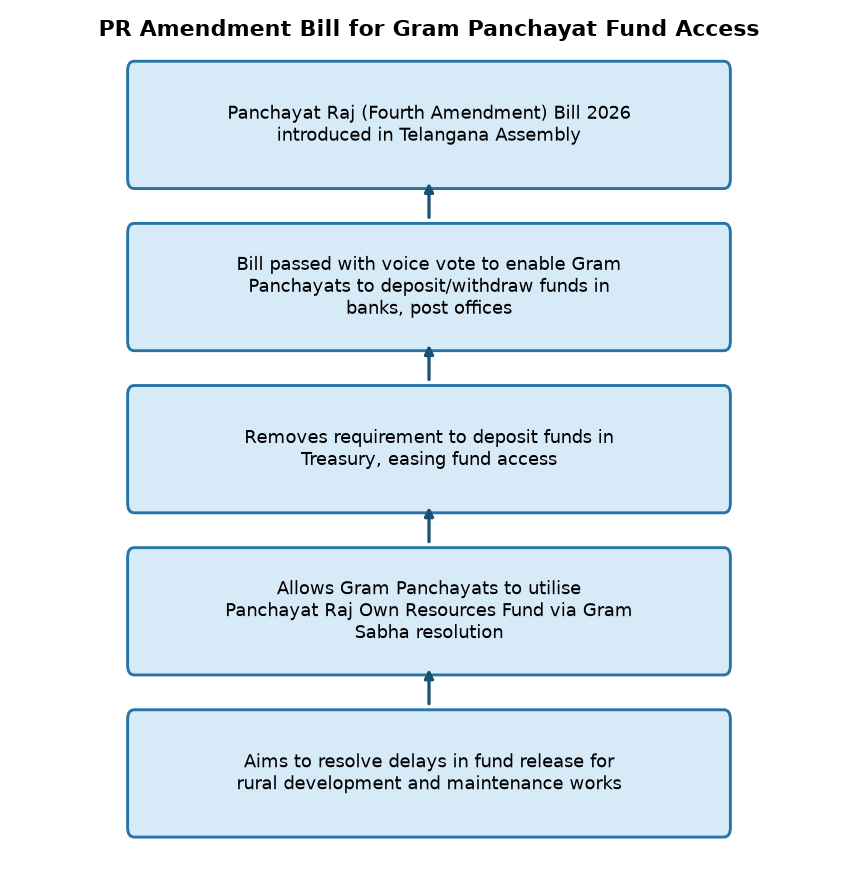
✎ The Panchayat Raj (Fourth Amendment) Bill, 2026, enables Gram Panchayats in Telangana to deposit and withdraw funds directly from banks and post offices, reducing bureaucratic delays and enhancing financial autonomy.
Subject Relevance — Where This Topic Fits
- GS Paper II — Constitutional and Statutory Bodies (Panchayati Raj Institutions) | GS Paper III — Decentralized Planning and Local Governance
- Prelims: Panchayati Raj Amendment Bill, Gram Panchayat financial autonomy, Treasury Direct Benefit Transfer (DBT), State Finance Commissions, Local Body Funds, Cooperative Banks, Nationalised Banks
- Essay: The Role of Local Governance in Sustainable Development, Financial Inclusion and Local Democracy
Quick Revision: The Panchayat Raj (Fourth Amendment) Bill, 2026, enables Gram Panchayats in Telangana to deposit and withdraw funds directly from banks and post offices, reducing bureaucratic delays and enhancing financial autonomy.
Why is this in the news?
The Legislative Assembly of Telangana passed the Panchayat Raj (Fourth Amendment) Bill, 2026, enabling Gram Panchayats to deposit and withdraw funds directly from nationalised banks, cooperative banks, and post offices. This amendment addresses operational challenges faced by Panchayati Raj Institutions (PRIs) in accessing allocated funds due to cumbersome withdrawal processes from the Treasury system. The move is significant as it aligns with the broader objective of enhancing financial autonomy and operational efficiency of local self-governance institutions.
Background
- The Panchayati Raj system in India, established under the 73rd Constitutional Amendment Act, 1992, mandates decentralized governance through Gram Panchayats, Mandal Parishads, and Zilla Parishads.
- Gram Panchayats are entrusted with the responsibility of local governance, including the execution of development schemes and maintenance of public infrastructure.
- Historically, Gram Panchayats in Telangana deposited funds in the Treasury, which posed challenges in timely withdrawal for operational needs, leading to delays in executing even basic maintenance works.
- The amendment follows a long-standing demand from local bodies to simplify financial transactions and improve liquidity for grassroots governance.
- The issue of delayed fund disbursement has been highlighted in the context of Central and State Government grants, including the release of matching grants under various schemes.
- The amendment also seeks to address the non-release of per capita grants, stamp duty shares, and seigniorage charges to local bodies, which are critical for their financial sustenance.
What is the Panchayat Raj (Fourth Amendment) Bill, 2026?
- The Bill amends the Telangana Panchayat Raj Act, 1994, to allow Gram Panchayats to deposit and withdraw funds directly from nationalised banks, cooperative banks, and post offices, instead of relying solely on the Treasury system.
- This amendment aims to streamline financial transactions for Gram Panchayats, reducing bureaucratic delays and improving operational efficiency in fund utilization.
- The Bill empowers Gram Panchayats to avail the Panchayat Raj Own Resources Fund (PRORF) through Gram Sabha resolutions, enhancing their financial autonomy.
- The amendment addresses the practical difficulties faced by Gram Panchayats in withdrawing funds for routine maintenance works, such as repairing streetlights or rural infrastructure.
- The move is expected to improve the disbursement of Central and State Government grants, including matching grants, which are critical for local development.
- The Bill also seeks to resolve issues related to the non-release of per capita grants, stamp duty shares, and seigniorage charges, which are essential for the financial health of local bodies.
- By enabling direct access to banking facilities, the amendment aligns with the broader goal of financial inclusion and decentralization in governance.
- The amendment reflects a shift towards modernizing the financial management of local self-governance institutions, ensuring timely and efficient fund utilization.
Key Features
| Feature | Significance |
|---|---|
| Authorization for bank/post office deposits | Enables Gram Panchayats to deposit and withdraw funds in nationalised banks, cooperative banks, and post offices, addressing operational inefficiencies in fund management. |
| Panchayat Raj Own Resources Fund | Introduces a dedicated fund mechanism that can be accessed by Gram Panchayats through Gram Sabha resolutions, enhancing financial autonomy at the local level. |
| Streamlined fund withdrawal process | Eliminates the cumbersome process of withdrawing funds from the Treasury, thereby accelerating the execution of small-scale maintenance works such as street-light repairs. |
| Integration with Central/State allocations | Facilitates the seamless flow of centrally and state-sanctioned funds (e.g., ₹14,100 crore in 2025-26) to Gram Panchayats, ensuring timely disbursement for local development. |
| Gram Sabha resolution requirement | Mandates prior approval from the Gram Sabha for accessing the Panchayat Raj Own Resources Fund, ensuring democratic accountability in fund utilisation. |
Why it Matters
Institutional Strengthening
- Enhances the functional autonomy of Gram Panchayats by reducing bureaucratic delays in fund management, thereby improving their capacity to execute local governance functions.
- Promotes financial decentralisation by enabling local bodies to manage funds independently, aligning with the 73rd Constitutional Amendment Act’s objectives.
- Strengthens the fiscal federalism framework by ensuring that local bodies can utilise allocated funds without undue centralised restrictions.
Operational Efficiency
- Reduces transactional friction in fund disbursement and utilisation, particularly for routine maintenance works, thereby improving service delivery at the grassroots level.
- Facilitates quicker release of development funds, such as those allocated under central schemes, to Gram Panchayats, ensuring timely implementation of local infrastructure projects.
- Simplifies administrative processes for local bodies, allowing them to focus on core developmental activities rather than procedural compliance.
Financial Inclusion
- Encourages the use of formal banking channels (banks, post offices) by Gram Panchayats, thereby promoting transparency and accountability in financial transactions.
- Expands access to financial services for rural local bodies, aligning with broader initiatives to strengthen the rural financial ecosystem.
Democratic Accountability
- Mandates Gram Sabha approval for accessing the Panchayat Raj Own Resources Fund, ensuring that fund utilisation is subject to local democratic oversight.
- Reinforces the principle of subsidiarity by empowering Gram Panchayats to make financial decisions closer to the citizenry.
Challenges
1. Delayed Disbursement of Matching Grants
- The delay in releasing state-matching grants for centrally sanctioned funds (e.g., ₹1,000 crore in 2026-27) hampers the operational readiness of Gram Panchayats.
- Such delays disproportionately affect small maintenance works, undermining the efficacy of local governance institutions.
UPSC Link: GS-II: Local Governance
2. Operational Bottlenecks in Treasury Systems
- The existing Treasury-based fund management system imposes procedural delays, particularly in withdrawing funds for routine maintenance activities.
- These bottlenecks discourage Gram Panchayats from initiating timely developmental works, exacerbating rural infrastructure deficits.
UPSC Link: GS-II: Decentralisation
3. Underutilisation of Financial Resources
- Non-release of per capita grants (₹8 per capita), stamp duty shares, and seigniorage charges to local bodies deprives them of critical financial resources.
- This underutilisation restricts the ability of Gram Panchayats to address local developmental needs effectively.
UPSC Link: GS-II: Fiscal Federalism
4. Infrastructure Gaps in Rural Areas
- Inadequate rural road connectivity (e.g., farm-to-market roads) limits the mobility of agricultural produce and inputs, constraining local economic activities.
- Gram Panchayats often lack the financial autonomy to address such infrastructure gaps without timely and adequate fund disbursement.
UPSC Link: GS-III: Rural Development
5. Capacity Constraints in Local Bodies
- Limited technical and administrative capacity in Gram Panchayats may hinder their ability to utilise the new fund management mechanisms effectively.
- Training and institutional support are required to ensure seamless adoption of the amended provisions.
UPSC Link: GS-II: Local Governance
Challenges — UPSC Perspective
| Issue | Concern |
|---|---|
| Delayed Matching Grants | State funds tied to central allocations are not released promptly, delaying local development works. |
| Treasury Withdrawal Delays | Cumbersome Treasury procedures impede timely fund access for Gram Panchayats. |
| Underutilised Financial Entitlements | Per capita grants, stamp duty shares, and seigniorage charges remain un-released, limiting local resources. |
| Rural Infrastructure Deficits | Poor farm-to-market roads and rural connectivity restrict economic mobility and development. |
| Capacity Gaps in Local Bodies | Limited administrative and technical expertise in Gram Panchayats may hinder effective fund utilisation. |
Government Initiatives — Must-Memorise for Prelims
- Panchayat Raj Own Resources Fund (introduced via the amendment)
Way Forward
- Constitute a State-level Task Force to monitor the timely disbursement of matching grants and central allocations to Gram Panchayats.
- Develop a standardised digital platform for Gram Panchayats to track fund releases, withdrawals, and utilisation in real time.
- Organise capacity-building programmes for elected representatives and officials of Gram Panchayats on fund management and financial reporting.
- Accelerate the implementation of rural road connectivity schemes (e.g., PM Gram Sadak Yojana) to complement the new fund management provisions.
- Establish a grievance redressal mechanism at the district level to address delays or discrepancies in fund disbursement.
- Ensure Gram Sabha meetings are conducted regularly to approve fund utilisation plans under the Panchayat Raj Own Resources Fund.
- Conduct periodic audits of Gram Panchayat finances to ensure transparency and accountability in fund utilisation.
UPSC Value Addition
Keywords for Mains Answer-Writing
Panchayati Raj Institutions (PRIs) · 73rd Constitutional Amendment Act, 1992 · Gram Panchayats (GPs) · Panchayat Raj Amendment Bill · Local Fund Audit (LFA) · Treasury System · Cooperative Banks · Post Office Savings Bank · Panchayat Raj Own Resources Fund · Fiscal Decentralisation · Local Governance · Constitutional Provisions for Local Governance · Concurrent List (7th Schedule) · State Finance Commission (SFC) · Gram Sabha · Maintenance of Rural Assets · Rythu Vedika · VB G-RAM G Fund · Seigniorage Charges · Stamp Duty Share · Per Capita Grant · Matching Grants · Fiscal Federalism · Institutional Autonomy of PRIs · Gram Panchayat Fund Management · Panchayat Raj System in Telangana
Constitutional & Policy Linkages
- Article 243G: Powers, authority, and responsibilities of Panchayats (73rd Constitutional Amendment Act, 1992).
Concept Flow
Central/State Governments allocate funds to Gram Panchayats for local development. → Funds are traditionally deposited in the Treasury, leading to withdrawal delays and operational inefficiencies. → Gram Panchayats face challenges in executing small maintenance works due to delayed fund access. → The PR Amendment Bill 2026 enables Gram Panchayats to deposit/draw funds in banks/post offices, reducing bureaucratic delays. → The Panchayat Raj Own Resources Fund is introduced, requiring Gram Sabha approval for utilisation. → Financial autonomy and democratic accountability are enhanced at the local governance level. → Operational efficiency improves, enabling timely execution of rural infrastructure and maintenance works.
Prelims Practice Questions
Q1. Consider the following statements regarding the 73rd Constitutional Amendment Act, 1992:
1. It mandates the establishment of a three-tier Panchayati Raj system in India.
2. It provides for the reservation of seats for women in Panchayats up to one-third of the total seats.
3. It empowers the State Legislature to devolve powers and responsibilities to Panchayats through legislation.
4. It establishes a separate fund for Panchayats at the district level only.
How many of the above statements are correct?
- Only one
- Only two
- Only three
- All four
Answer: Only three — Statements 1, 2, and 3 are correct as per the 73rd Amendment Act. Statement 4 is incorrect because the Act does not specify the level of Panchayats for fund establishment; funds are to be managed at the Gram Panchayat, Intermediate, and District levels as per state legislation.
Q2. Assertion (A): The Treasury System for depositing funds of Gram Panchayats was introduced to ensure transparency and accountability in fund management.
Reason (R): The Treasury System centralises fund management, reducing the autonomy of local bodies in financial decision-making.
Options:
A. Both A and R are true, and R is the correct explanation of A.
B. Both A and R are true, but R is not the correct explanation of A.
C. A is true, but R is false.
D. A is false, but R is true.
Answer: ? — Assertion (A) is true as the Treasury System was introduced to enhance transparency. However, Reason (R) is false because the Treasury System, while centralising funds, often reduces the autonomy of local bodies, making it a governance challenge rather than a solution for accountability.
Q3. Match the following pairs related to Panchayati Raj institutions in India:
Column I (Institution) | Column II (Function)
———————————————–|————————————————–
A. Gram Sabha | 1. Preparation of plans for economic development
B. Gram Panchayat | 2. Supervision of Gram Panchayat functioning
C. Intermediate Panchayat | 3. Direct participation of villagers in governance
D. District Panchayat | 4. Implementation of schemes at the block level
Options:
A-3, B-4, C-1, D-2
A-3, B-1, C-4, D-2
A-4, B-3, C-2, D-1
A-2, B-4, C-1, D-3
Answer: ? — The correct match is: A-3 (Gram Sabha: Direct participation of villagers in governance), B-4 (Gram Panchayat: Implementation of schemes at the village level), C-1 (Intermediate Panchayat: Preparation of plans for economic development at the block level), D-2 (District Panchayat: Supervision of Gram Panchayat functioning at the district level).
Mains Practice Question
✍ The Panchayati Raj Amendment Bill passed by the Telangana Legislative Assembly seeks to address the fiscal autonomy of Gram Panchayats by allowing them to deposit and withdraw funds in nationalised banks, cooperative banks, and post offices, rather than the Treasury System. Critically analyse the significance of this amendment in the context of fiscal federalism and local governance in India. Also, examine the challenges that Gram Panchayats continue to face in financial management despite such legislative measures. (15 Marks)
Approach: MODEL-ANSWER SKELETON:
1. **Introduction (2 Marks)**
– Briefly define Panchayati Raj Institutions (PRIs) and their constitutional mandate under the 73rd Amendment Act, 1992.
– Mention the role of Gram Panchayats (GPs) as the lowest tier of local self-government.
– State the objective of the Telangana Panchayat Raj (Fourth Amendment) Bill, 2026: enabling GPs to deposit/withdraw funds in banks/post offices to enhance fiscal autonomy.
2. **Significance of the Amendment (5 Marks)**
– **Fiscal Federalism**: Explain how the amendment aligns with the principles of fiscal federalism by devolving financial powers closer to the grassroots, reducing dependence on state treasuries.
– **Autonomy of PRIs**: Discuss how the amendment empowers GPs to manage funds independently, aligning with the constitutional vision of decentralised governance (Art. 243G, 11th Schedule).
– **Efficiency in Fund Utilisation**: Highlight the potential reduction in delays and bureaucratic hurdles in fund disbursement, enabling timely execution of local development projects.
– **Financial Inclusion**: Mention the role of post offices and cooperative banks in rural areas, ensuring accessibility to financial services for GPs.
– **Panchayat Raj Own Resources Fund**: Explain how the amendment enables GPs to utilise funds raised through Gram Sabha resolutions, fostering community participation in financial governance.
3. **Challenges in Financial Management of PRIs (5 Marks)**
– **Institutional Capacity**: Discuss the lack of financial expertise among elected representatives and officials in GPs, leading to mismanagement or underutilisation of funds.
– **Dependence on State/Union Grants**: Highlight the continued reliance on centrally sponsored schemes (CSS) and state grants, which may not always align with local priorities.
– **Audit and Accountability**: Mention the challenges in auditing funds managed by GPs, including delays in Local Fund Audit (LFA) and lack of transparency in fund utilisation.
– **Political Interference**: Discuss how local politics may influence the allocation and utilisation of funds, undermining the autonomy of GPs.
– **Infrastructure Gaps**: Point out the lack of digital infrastructure in rural areas, which may hinder efficient fund management even after the amendment.
4. **Way Forward (3 Marks)**
– **Capacity Building**: Suggest training programmes for elected representatives and officials in financial management and auditing.
– **Strengthening State Finance Commissions (SFC)**: Emphasise the role of SFCs in ensuring equitable distribution of funds and addressing fiscal imbalances.
– **Digital Governance**: Recommend the adoption of e-governance tools (e.g., Panchayat Enterprise Suite) for real-time tracking of funds and transparency.
– **Community Participation**: Stress the need for active involvement of Gram Sabhas in financial planning and monitoring to ensure accountability.
**Balanced View**: Acknowledge that while the amendment is a step toward fiscal decentralisation, its success depends on addressing systemic challenges in PRIs’ institutional capacity, transparency, and political economy.
Source: The Hindu
Generated by AanyaAi for educational purpose.
Related guides on our sites
- Current affairs for upsc 2026
- Best PSIR optional coaching for upsc
- Best PSIR optional teacher for upsc
- Best teacher of PSIR optional for upsc

- मानव-वन्यजीव संघर्ष में केरल मानवाधिकार आयोग की चेतावनी प्रणाली पर जोर, जानिए पूर्ण निर्देश - September 16, 2026
- Kerala HR Panel Urges Early Warning Systems for Human-Wildlife Conflict Mitigation - September 16, 2026
- एनजीटी का आदेश: पुणे-पिंपरी में साइलेंस जोन में लाउडस्पीकर पर पूर्ण प्रतिबंध लागू करें सरकार - September 16, 2026

No Comments