


13 Sep El Niño and Kerala’s Power Crisis: Beyond Rainfall Deficit Analysis
✎ El Niño is a climate phenomenon that can disrupt the Southwest Monsoon, but its impact on Keralam’s power sector is mediated by institutional preparedness, grid resilience, and long-term energy planning.
Subject Relevance — Where This Topic Fits
- GS Paper III — Environment, Ecology, Bio-diversity and Climate Change | GS Paper III — Infrastructure: Energy
- Prelims: El Niño-Southern Oscillation (ENSO), Southwest Monsoon, Hydroelectric Power Generation, Peak Power Demand Management, Rainfall Deficit, Grid Stability, Energy Storage Systems, Renewable Energy Integration
- Essay: Climate Change and Sustainable Development: The Case of Energy Security in India, Institutional Preparedness vs. Environmental Variability: Lessons from Keralam’s Power Sector
Quick Revision: El Niño is a climate phenomenon that can disrupt the Southwest Monsoon, but its impact on Keralam’s power sector is mediated by institutional preparedness, grid resilience, and long-term energy planning.
Why is this in the news?
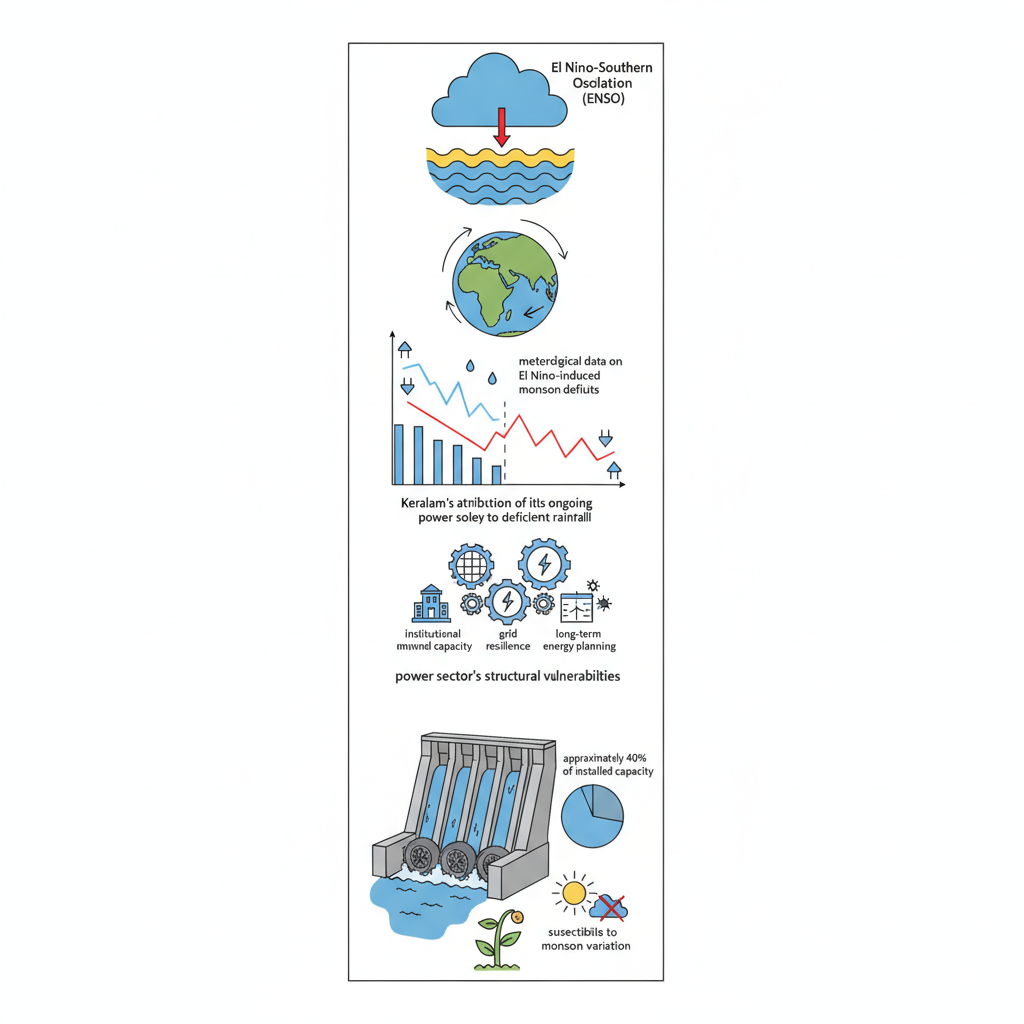
The article highlights the divergence between meteorological data on El Niño-induced monsoon deficits in Keralam and the State’s attribution of its ongoing power crisis solely to deficient rainfall. It underscores the need for a nuanced examination of the power sector’s structural vulnerabilities, including institutional capacity, grid resilience, and long-term energy planning, beyond episodic climatic anomalies.
Background
- El Niño-Southern Oscillation (ENSO) is a periodic climatic phenomenon characterised by abnormal warming of the central and eastern equatorial Pacific Ocean, disrupting global weather patterns, including the Indian Southwest Monsoon.
- Keralam’s power sector is heavily reliant on hydroelectric generation, which constitutes approximately 40% of its installed capacity, making it particularly susceptible to monsoon variability.
- Historical data from the India Meteorological Department (IMD) indicates that only a subset of El Niño years (1965, 1972, 1987, 2002, 2015, 2023, 2026) resulted in deficient monsoon rainfall in Keralam, with 2023 recording the highest deficit of 34%.
- Despite severe monsoon deficits in past El Niño years (e.g., 2015, 2023), Keralam did not impose power restrictions, suggesting that factors beyond rainfall deficits may have contributed to the current crisis.
- The State’s power demand has been rising due to urbanisation, industrialisation, and agricultural pump-set usage, exacerbating the strain on the grid during peak hours.
- Institutional mechanisms such as the State Load Dispatch Centre (SLDC) and the Kerala State Electricity Board (KSEB) play a critical role in managing power distribution, but their efficacy is contingent on robust planning and adaptive governance.
Understanding the Relationship Between El Niño, Monsoon Variability, and Power Sector Resilience in Keralam
- El Niño is a climate phenomenon linked to the Southern Oscillation, where warm sea surface temperatures in the Pacific Ocean weaken trade winds, reducing moisture transport to the Indian subcontinent and leading to deficient monsoon rainfall.
- The Southwest Monsoon is the primary source of freshwater for Keralam, replenishing reservoirs critical for hydroelectric power generation; its variability directly impacts energy security.
- Hydroelectric power, a cornerstone of Keralam’s energy mix, is highly sensitive to monsoon performance, as reservoir levels determine generation capacity during peak demand periods.
- While El Niño increases the probability of monsoon deficits, historical data shows that not all El Niño years result in deficient rainfall in Keralam, indicating the influence of other climatic factors such as the Indian Ocean Dipole (IOD) and local atmospheric conditions.
- The State’s power sector faces structural challenges, including aging infrastructure, limited inter-state power exchange capacity, and inadequate energy storage solutions to mitigate supply-demand mismatches.
- Peak power demand in Keralam often exceeds supply during evening hours (6 p.m. to 12 a.m.), necessitating load-shedding measures; this vulnerability is exacerbated by insufficient peaking power plants and grid instability.
- Institutional preparedness, including real-time monitoring by the State Load Dispatch Centre (SLDC) and proactive reservoir management by the Kerala State Electricity Board (KSEB), is essential to mitigate climate-induced power shortages.
- Renewable energy integration, particularly solar and wind, can diversify the energy mix and reduce dependence on hydroelectricity, but requires supportive policies, grid modernisation, and energy storage infrastructure.
Key Features
| Feature | Significance |
|---|---|
| El Niño Phenomenon | A climate pattern marked by abnormal warming of central and eastern equatorial Pacific Ocean, weakening trade winds and reducing monsoon rainfall over the Indian subcontinent. |
| Monsoon Rainfall Deficit in Keralam | A deviation from normal rainfall during the southwest monsoon season, quantified as a percentage shortfall compared to long-term averages. |
| Power Sector Management | The planning, distribution, and regulatory mechanisms governing electricity supply, demand, and grid stability in a state. |
| Peak-Hour Power Restrictions | Temporary curtailment of electricity supply during high-demand periods to prevent grid overload and ensure system stability. |
| Heatwave Conditions | Prolonged periods of abnormally high temperatures, exacerbating electricity demand for cooling and stressing power infrastructure. |
Why it Matters
Economic
- Power restrictions disrupt industrial productivity, leading to potential revenue losses and reduced economic growth in Keralam.
- Increased reliance on costly short-term power purchases to bridge deficits, straining state finances.
- Tourism and agriculture sectors face operational challenges due to unreliable electricity supply, impacting livelihoods.
- Foreign investment sentiment may be adversely affected by perceived energy insecurity in the state.
Strategic
- Energy security is a critical component of state resilience, influencing disaster preparedness and crisis management capabilities.
- Inter-state power trade dynamics are affected, as Keralam may need to import electricity from neighboring states, altering regional energy balances.
- Grid stability and load management become national concerns, given Keralam’s role in India’s southern power grid.
Environmental
- Over-reliance on thermal power plants during deficits may increase carbon emissions, undermining climate goals.
- Hydropower generation shortfalls could lead to compensatory use of fossil fuels, exacerbating air quality concerns.
- Deficient rainfall impacts water availability for hydroelectric projects, highlighting the vulnerability of renewable energy sources.
Institutional
- The crisis tests the efficacy of Keralam State Electricity Board’s (KSEB) contingency planning and resource allocation.
- Regulatory oversight by institutions like the Central Electricity Regulatory Commission (CERC) and State Electricity Regulatory Commissions (SERCs) is scrutinized.
- Coordination between meteorological agencies (IMD), power utilities, and disaster management authorities is evaluated.
Challenges
1. Meteorological Uncertainty and Monsoon Variability
- El Niño events do not guarantee deficient rainfall in Keralam, as historical data shows mixed outcomes.
- IMD forecasts, while improving, still carry inherent uncertainties, complicating long-term power planning.
- Climate change is altering traditional monsoon patterns, making historical data less reliable for future projections.
UPSC Link: GS Paper 3: Climate Change
2. Power Sector Governance and Infrastructure Gaps
- Inadequate investment in grid modernization and renewable energy integration limits adaptive capacity during deficits.
- Aging thermal power plants and delayed commissioning of new projects exacerbate supply-side vulnerabilities.
- Lack of robust energy storage solutions (e.g., pumped hydro, batteries) reduces resilience to intermittent supply shocks.
UPSC Link: GS Paper 3: Infrastructure
3. Demand-Supply Mismatch and Peak Load Management
- Rapid urbanization and economic growth have outpaced incremental power capacity additions.
- Inefficient energy pricing and subsidy structures distort consumption patterns, exacerbating peak demand pressures.
- Limited public awareness and participation in energy conservation measures undermine demand-side management efforts.
UPSC Link: GS Paper 3: Energy
4. Inter-State Power Trade and Regulatory Bottlenecks
- Overdependence on neighboring states for power imports during deficits creates geopolitical and economic risks.
- Cross-state transmission constraints and tariff disparities hinder seamless power flow.
- Delays in regulatory approvals for new power purchase agreements (PPAs) and open access transactions prolong crises.
UPSC Link: GS Paper 2: Federalism
5. Climate-Resilient Power Planning
- Insufficient integration of climate risk assessments into long-term power sector strategies.
- Lack of diversified energy portfolios (e.g., solar, wind, hydro) increases vulnerability to single-point failures.
- Delayed implementation of climate adaptation measures in infrastructure design and operation.
UPSC Link: GS Paper 3: Disaster Management
Challenges — UPSC Perspective
| Issue | Concern |
|---|---|
| Rainfall Deficit | Insufficient monsoon rainfall reduces hydropower generation, a key component of Keralam’s energy mix. |
| Thermal Power Dependence | Over-reliance on coal-based plants during deficits increases costs and emissions. |
| Grid Stability | Frequent power restrictions risk grid instability and potential blackouts. |
| Regulatory Delays | Slow approvals for power trade and new projects prolong supply-side constraints. |
| Public Awareness | Low consumer participation in energy conservation exacerbates demand pressures. |
| Climate Change | Altering monsoon patterns and increasing extreme weather events complicate future planning. |
Way Forward
- Conduct a comprehensive audit of Keralam’s power sector to identify structural vulnerabilities and inefficiencies.
- Accelerate the integration of renewable energy sources (solar, wind) with robust storage solutions to diversify the energy mix.
- Enhance demand-side management through dynamic pricing, energy audits, and public awareness campaigns.
- Strengthen inter-state power trade agreements and cross-border transmission infrastructure to improve grid resilience.
- Invest in grid modernization, including smart grid technologies, to improve real-time monitoring and load balancing.
- Develop climate-resilient power infrastructure plans, incorporating long-term climate projections and risk assessments.
- Establish a dedicated state-level energy crisis management cell to coordinate responses during deficits and extreme weather events.
- Promote public-private partnerships for decentralized energy solutions, such as rooftop solar and microgrids.
UPSC Value Addition
Keywords for Mains Answer-Writing
Kerala power crisis · El Niño impact on monsoon · Energy security in India · Sustainable energy transition · Grid management challenges · Renewable energy integration · Climate change and power sector · Peak-hour power restrictions · IMD rainfall data analysis · Energy policy governance gaps · Hydroelectric power dependency · Grid resilience · Monsoon variability · Power sector reforms · Climate-resilient infrastructure · Energy transition pathways
Concept Flow
El Niño event → Weakened trade winds → Reduced monsoon rainfall over Indian subcontinent → Lower hydropower generation in Keralam → Rainfall deficit → Reduced water availability for hydroelectric projects → Increased reliance on thermal power plants → Thermal power dependence → Higher costs and emissions → Strain on state finances and environmental compliance → Peak demand pressures → Grid instability risks → Imposition of power restrictions → Power restrictions → Disruptions in industrial, agricultural, and domestic sectors → Economic and social impacts → Climate change → Altered monsoon patterns → Increased frequency of extreme weather events → Heightened vulnerability of power infrastructure → Governance gaps → Inadequate contingency planning → Prolonged crisis → Need for structural reforms in the power sector
Prelims Practice Questions
Q1. Consider the following statements regarding El Niño and its impact on the Indian monsoon:
1. El Niño is characterised by the abnormal warming of sea surface temperatures in the central and eastern equatorial Pacific Ocean.
2. El Niño invariably leads to deficient monsoon rainfall across the entire Indian subcontinent.
3. The India Meteorological Department (IMD) has forecast moderate to heavy rainfall in Kerala during the second half of September 2026.
How many of the above statements are correct?
- Only one
- Only two
- All
- None
Answer: All — Statements 1 and 3 are correct. Statement 2 is incorrect because El Niño does not invariably lead to deficient monsoon rainfall across the entire subcontinent; historical data shows normal to above-normal rainfall in some El Niño years.
Q2. Assertion (A): The current power crisis in Kerala is solely attributed to deficient monsoon rainfall caused by El Niño.
Reason (R): Historical rainfall data from past El Niño years in Kerala shows that power restrictions were not imposed despite similar or worse rainfall deficits.
Options:
A. Both A and R are true, and R is the correct explanation of A.
B. Both A and R are true, but R is not the correct explanation of A.
C. A is true, but R is false.
D. A is false, but R is true.
Answer: ? — Assertion (A) is false because the power crisis in Kerala cannot be solely attributed to El Niño-induced rainfall deficits, as historical data shows no power restrictions were imposed during comparable deficits. Reason (R) is true and highlights the governance gap in attributing the crisis solely to climate factors.
Mains Practice Question
✍ Critically analyse the governance gaps in Kerala’s power sector that have exacerbated the recent power crisis, despite the occurrence of El Niño and associated monsoon deficits. Substantiate your arguments with reference to historical rainfall data, institutional responses, and the structural challenges in energy management. (15 Marks)
Approach: MODEL-ANSWER SKELETON:
1. **Introduction (2 Marks)**: Briefly define the Kerala power crisis and its attribution to El Niño, citing IMD data on rainfall deficits in 2023 and 2026. Highlight the paradox of no power restrictions during comparable deficits in past years.
2. **Historical Context and Data (3 Marks)**:
– Present IMD data on El Niño years (1951–2026) and their impact on Kerala’s monsoon rainfall (e.g., 1965, 1972, 1987, 2002, 2015, 2023, 2026).
– Compare rainfall deficits in 2023 (34%) and 2026 (~26%) with the absence of power restrictions in 2023 and 2015–2016.
3. **Structural Challenges in Power Sector (5 Marks)**:
– **Dependency on Hydroelectric Power**: Kerala’s power sector relies heavily on hydroelectric generation, which is vulnerable to monsoon variability. Cite the share of hydroelectric power in Kerala’s energy mix (e.g., ~30–40%).
– **Grid Management and Infrastructure**: Discuss the lack of diversification in energy sources, inadequate grid resilience, and delayed integration of renewable energy (solar/wind) despite high potential.
– **Policy and Institutional Gaps**: Highlight the absence of long-term climate-resilient energy planning, including storage solutions for renewable energy and demand-side management strategies.
– **Peak-hour Restrictions**: Explain the administrative response (6:15 p.m. to 12:45 a.m. restrictions) as a short-term measure masking deeper structural issues.
4. **Comparative Analysis (3 Marks)**:
– Contrast Kerala’s response with states like Tamil Nadu or Karnataka, which have better diversified energy portfolios and managed similar monsoon deficits without severe power restrictions.
– Reference the National Electricity Policy (2022) and the Electricity Act, 2003, which mandate diversification and grid resilience but lack enforceable timelines.
5. **Way Forward (2 Marks)**:
– **Short-term**: Strengthen demand-side management, incentivize rooftop solar adoption, and improve hydroelectric reservoir management.
– **Long-term**: Accelerate renewable energy integration, invest in pumped hydro storage, and adopt climate-resilient infrastructure policies.
Balance: Emphasize the need for a multi-dimensional approach combining institutional reforms, technological upgrades, and policy enforcement, while avoiding attribution to any political entity.
Source: The Hindu
Generated by AanyaAi for educational purpose.
Related guides on our sites
- Current affairs for upsc 2026
- How to prepare for GS paper 1 for UPSC CSE mains exam
- Best UPSC coaching for IFOS exam
- Best geography optional coaching

- UPSC Civil Services (Main) Examination 2026 — Tamil Literature Paper I: Question Paper | Plutus IAS - September 15, 2026
- उत्तराखंड सीएम धामी ने चारधाम यात्रा की ऑनलाइन समीक्षा बैठक की, जानिए तैयारी - September 15, 2026
- UPSC Alert: CM Dhami Reviews Char Dham Yatra 2026 Security & Logistics - September 15, 2026

No Comments