



30 Oct RBI Auctions State Government Securities: ₹29,900 Crore Bonds on Nov 3
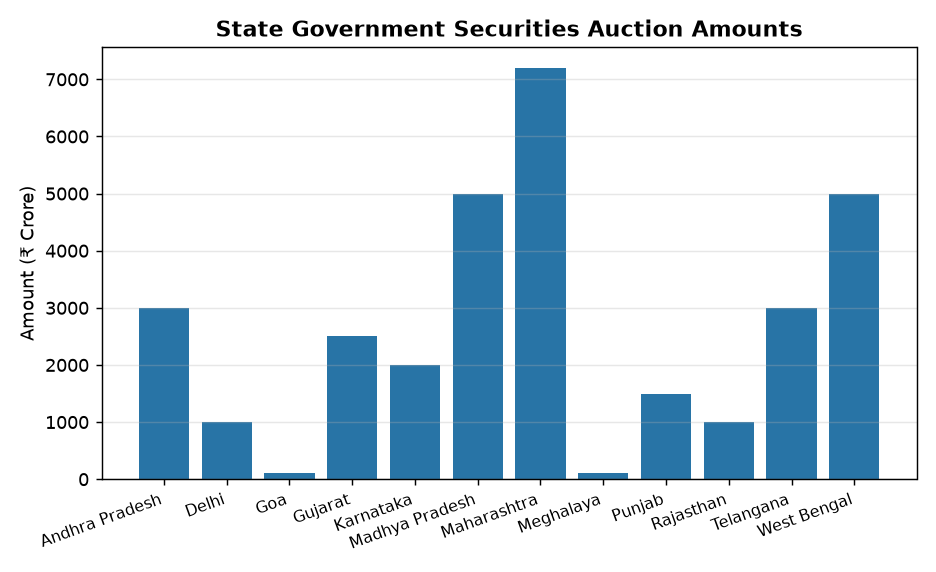
✎ State Government Securities (SGS) are market-based instruments issued by state governments for resource mobilisation, with the RBI conducting auctions to ensure transparency, efficiency, and alignment with fiscal federalism…
Subject Relevance — Where This Topic Fits
- GS Paper II — Functions and Responsibilities of the Union and the States | GS Paper III — Indian Economy and Issues Relating to Planning, Mobilisation of Resources, Growth, Development and Employment
- Prelims: State Development Loans (SDLs), Fiscal Deficit, Public Debt Management, Reserve Bank of India (RBI), E-Kuber System, Non-competitive Bidding Facility, Retail Direct Portal
- Essay: Fiscal Federalism and Cooperative Governance in India, Resource Mobilisation and Sustainable Development: Balancing State Autonomy and Fiscal Discipline
Quick Revision: State Government Securities (SGS) are market-based instruments issued by state governments for resource mobilisation, with the RBI conducting auctions to ensure transparency, efficiency, and alignment with fiscal federalism principles.
Why is this in the news?
The Reserve Bank of India (RBI) has announced an auction of State Government Securities (SGS) on November 3, 2026, for an aggregate face value of ₹29,900 crore. This auction, conducted via the RBI’s Core Banking Solution (E-Kuber) system, involves multiple states re-issuing existing securities with varying tenors and coupon rates. The event is significant for understanding the institutional framework governing sub-national borrowing, the role of the RBI in debt management, and the modalities of market-based resource mobilisation by state governments within India’s fiscal federal structure.
Background
- State governments in India rely on borrowings to finance developmental expenditure, given their constitutional mandate under the Seventh Schedule (State List) to undertake public welfare activities.
- The issuance of State Government Securities (SGS) is governed by the provisions of the State Financial Corporations Act, 1951, and the RBI’s regulatory framework for public debt management.
- The RBI acts as the debt manager for state governments, conducting auctions on their behalf through the E-Kuber platform, which ensures transparency and efficiency in the borrowing process.
- State Development Loans (SDLs) are the primary instruments through which state governments raise funds from the market, with the RBI determining the timing, tenor, and quantum of issuances based on macroeconomic conditions and fiscal needs.
- The auction mechanism includes both competitive and non-competitive bidding, with the latter facilitating participation by retail investors through the Retail Direct Portal, thereby democratising access to government securities.
- The RBI’s role in managing state borrowings is critical for maintaining fiscal discipline, preventing crowding-out effects in the capital market, and ensuring alignment with the Fiscal Responsibility and Budget Management (FRBM) Act framework.
What are State Government Securities (SGS)?
- State Government Securities (SGS) are debt instruments issued by state governments to raise funds for developmental and welfare expenditures, including infrastructure, education, and healthcare.
- SGS are typically issued in the form of State Development Loans (SDLs), which are long-term securities with maturities ranging from 5 to 30 years, tailored to the fiscal requirements of the issuing state.
- The issuance of SGS is conducted through auctions managed by the RBI, ensuring a transparent and competitive process that determines the yield or price of the securities based on market demand.
- SGS are eligible for inclusion in the Statutory Liquidity Ratio (SLR) requirements of banks, making them attractive investment options for financial institutions and institutional investors.
- The coupon rates on SGS reflect the creditworthiness of the state government, macroeconomic conditions, and the prevailing yield curve in the government securities market.
- Investors in SGS include commercial banks, insurance companies, mutual funds, provident funds, and retail investors, with the latter participating through the RBI’s Retail Direct Portal.
- The RBI’s Core Banking Solution (E-Kuber) system facilitates the electronic submission of bids, ensuring real-time processing and settlement of transactions in SGS auctions.
- The auction process includes a non-competitive bidding facility, allowing small investors to participate without the need for sophisticated financial analysis, thereby promoting financial inclusion.
Key Features
| Feature | Significance |
|---|---|
| Auction Mechanism | Facilitates transparent price discovery for state government securities (SGS) through competitive and non-competitive bidding, ensuring market-driven interest rates. |
| Non-Competitive Bidding Facility | Enables retail investors (individuals) to participate without competitive bidding pressure, capped at 1% of notified amount per stock to democratise access. |
| Retail Direct Portal Integration | Provides individual investors a digital platform (https://rbiretaildirect.org.in) to submit non-competitive bids, enhancing financial inclusion in government securities. |
| Greenshoe Option | Allows issuance of additional securities (up to 50% of notified amount) if demand exceeds expectations, providing flexibility to state governments in raising funds. |
| Electronic Submission via E-Kuber | Ensures real-time, secure, and efficient bid submission through RBI’s Core Banking Solution, reducing operational delays and errors. |
| Yield/Price Expression | Bids must specify yield (for coupon securities) or price (for zero-coupon securities) up to two decimal points, ensuring precision in valuation. |
Why it Matters
Macroeconomic Implications
- State governments rely on SGS auctions to finance fiscal deficits, infrastructure projects, and social welfare schemes, thereby influencing aggregate demand and economic growth.
- The aggregate issuance of ₹29,900 crore reflects the scale of state-level borrowing, which, when aggregated nationally, impacts the overall public debt trajectory and fiscal sustainability.
- Yield curves derived from these auctions serve as benchmarks for pricing corporate bonds, influencing corporate borrowing costs and investment decisions.
- Higher yields on state securities may signal rising risk perceptions among investors, potentially crowding out private investment or increasing the cost of capital for states.
Financial Market Development
- Regular auctions enhance liquidity in the secondary market for state securities, attracting institutional investors (banks, insurance companies, mutual funds) and deepening the bond market.
- The inclusion of retail investors via the Retail Direct Portal fosters a culture of long-term savings in government securities, reducing reliance on bank deposits.
- Competitive bidding ensures efficient allocation of capital, rewarding states with stronger fiscal credibility through lower borrowing costs.
- The Greenshoe option allows states to capitalise on favourable market conditions, optimising debt management strategies.
Fiscal Federalism
- State governments issue SGS under Article 293(1) of the Constitution, which permits borrowing subject to central government limits, balancing fiscal autonomy with macroeconomic stability.
- Auctions operationalise the cooperative federalism framework by enabling states to access capital markets directly, reducing dependence on central transfers or high-cost loans.
- The diversity in tenors (e.g., 6-year to 26-year) reflects state-specific fiscal needs, from short-term liquidity to long-term infrastructure financing.
- Yield differentials across states highlight regional disparities in creditworthiness, fiscal discipline, and economic performance.
Investor Participation and Risk Management
- Competitive bidding allows institutional investors (e.g., pension funds, sovereign wealth funds) to align portfolios with risk-return preferences, while non-competitive bidding lowers barriers for retail participants.
- Yield spreads between state securities and central government securities (G-secs) provide insights into state-specific risks, including revenue volatility, debt sustainability, and political stability.
- The auction’s electronic format minimises settlement risks and operational inefficiencies, enhancing investor confidence in state securities.
Challenges
1. Market Volatility and Yield Spikes
- Sudden shifts in macroeconomic conditions (e.g., inflation, interest rate hikes) can lead to volatile yields, increasing borrowing costs for states and complicating debt management.
- Geopolitical risks or global financial crises may trigger capital outflows, reducing demand for state securities and forcing higher coupon rates.
- Liquidity crunches in secondary markets can deter institutional investors, limiting the depth of the market for state securities.
UPSC Link: GS-III: Fiscal Policy & Public Finance
2. Fiscal Discipline and Debt Sustainability
- States with high debt-to-GSDP ratios face higher borrowing costs, creating a vicious cycle of rising interest payments and reduced fiscal space for development spending.
- Over-reliance on market borrowings may lead to pro-cyclical fiscal policies, where states cut essential expenditures during economic downturns to service debt.
- Off-budget liabilities (e.g., guarantees, public-private partnerships) can distort fiscal metrics, masking true debt levels and increasing contingent risks for investors.
UPSC Link: GS-III: Public Debt Management
3. Regulatory and Operational Risks
- Technical glitches in the E-Kuber system or Retail Direct Portal could disrupt bid submissions, leading to delays or misallocation of securities.
- Inadequate disclosures by states regarding fiscal health or project viability may erode investor trust, increasing risk premiums.
- Fraudulent bids or collusion among bidders could distort price discovery, undermining the auction’s integrity.
UPSC Link: GS-III: Financial Sector Reforms
4. Retail Investor Participation Gaps
- Limited financial literacy among retail investors may deter participation, despite the non-competitive bidding facility.
- The cap of 1% per stock per bid for non-competitive bidders may restrict meaningful allocations for high-net-worth individuals.
- Tax inefficiencies (e.g., capital gains tax on securities) can reduce the attractiveness of state securities compared to other instruments.
UPSC Link: GS-III: Financial Inclusion
5. Inter-State Disparities
- States with weaker credit ratings (e.g., smaller or fiscally stressed states) may face higher borrowing costs, exacerbating regional economic imbalances.
- Divergent fiscal policies (e.g., tax regimes, expenditure priorities) can lead to uneven demand for state securities, distorting market dynamics.
- Central government oversight (e.g., Article 293(3) limits) may constrain states’ borrowing autonomy, creating tensions between federalism and fiscal prudence.
UPSC Link: GS-II: Cooperative Federalism
Challenges — UPSC Perspective
| Issue | Concern |
|---|---|
| Yield Volatility | Unpredictable interest rate movements may increase borrowing costs for states, straining fiscal budgets. |
| Debt Sustainability | High debt levels could trigger credit rating downgrades, limiting future market access for states. |
| Liquidity Constraints | Thin secondary markets may deter institutional investors, reducing demand for state securities. |
| Retail Investor Apathy | Low awareness or participation among retail investors limits the inclusivity of the auction mechanism. |
| Operational Risks | Technical failures in auction platforms could disrupt bid submissions or settlement processes. |
| Fiscal Transparency Gaps | Inadequate disclosures by states may erode investor confidence and inflate risk premiums. |
Way Forward
- Enhance fiscal transparency by mandating states to publish detailed debt sustainability reports and project-wise expenditure data before auctions.
- Expand retail investor education through RBI’s Financial Literacy Centres and partnerships with SEBI-registered investment advisors.
- Introduce dynamic pricing mechanisms (e.g., Dutch auctions) to mitigate yield volatility and improve price discovery.
- Strengthen the secondary market for state securities by incentivising market-makers (e.g., primary dealers) to provide liquidity.
- Develop a unified state debt management framework to harmonise borrowing practices and reduce inter-state disparities in credit ratings.
- Leverage technology (e.g., blockchain) to streamline settlement processes and reduce operational risks in auction execution.
- Encourage states to diversify their funding sources by exploring green bonds or social impact bonds for sustainable development projects.
- Establish a centralised credit rating agency for state governments to standardise risk assessments and reduce information asymmetry.
UPSC Value Addition
Keywords for Mains Answer-Writing
State Government Securities · State Development Loans · Public Debt Office · Non-competitive Bidding Facility · Auction Mechanism · Fiscal Federalism · Market Borrowing by States · Reserve Bank of India Core Banking Solution (E-Kuber) · Yield Curve · Debt Management · Retail Direct Portal · Fiscal Consolidation · Gross State Domestic Product · Debt-to-GDP Ratio · Auction Process for Government Securities · Competitive and Non-competitive Bidding
Constitutional & Policy Linkages
- {‘link’: ‘Article 293(1): State borrowing powers’, ‘note’: ‘Permits state governments to borrow subject to central limits.’}
- {‘link’: ‘Article 293(3): Central government oversight’, ‘note’: ‘Empowers the Centre to impose borrowing limits on states.’}
- {‘link’: ‘Seventh Schedule: State List (Entry 43)’, ‘note’: ‘Reserves state borrowing within the federal structure.’}
Concept Flow
State governments assess fiscal deficits and project financing needs → → RBI conducts SGS auctions on behalf of states via E-Kuber system → → Investors (institutional/retail) submit competitive/non-competitive bids → → Auction results determine yield/price based on demand-supply dynamics → → Successful bidders receive securities, while states raise required capital → → Secondary market trading of SGS establishes yield curves for broader financial markets → → Yield spreads reflect state-specific risks, influencing future borrowing costs.
Prelims Practice Questions
Q1. Consider the following statements regarding the auction of State Government Securities (SGS) in India:
1. The auction of SGS is conducted exclusively through the Reserve Bank of India Core Banking Solution (E-Kuber) system.
2. Non-competitive bids for SGS can be submitted only by retail investors through the Retail Direct portal.
3. The auction process includes both competitive and non-competitive bidding mechanisms.
How many of the above statements are correct?
- Only one
- Only two
- All
- None
Answer: All — Statement 1 is correct as the auction is conducted on the E-Kuber system. Statement 2 is incorrect because non-competitive bids can also be submitted through the E-Kuber system. Statement 3 is correct as both competitive and non-competitive bidding mechanisms are part of the auction process.
Q2. Assertion (A): The Reserve Bank of India (RBI) conducts auctions for State Government Securities to facilitate fiscal federalism in India.
Reason (R): The auction process allows states to borrow funds directly from the market, reducing their dependence on the central government.
- Both A and R are true, and R is the correct explanation of A.
- Both A and R are true, but R is not the correct explanation of A.
- A is true, but R is false.
- A is false, but R is true.
Answer: Both A and R are true, but R is not the correct explanation of A. — The assertion is true as RBI conducts auctions for SGS to enable states to borrow funds, promoting fiscal federalism. The reason correctly explains the assertion by stating that the auction process reduces state dependence on the central government.
Q3. Match the following columns related to the auction of State Government Securities:
Column I (State/UT) | Column II (Tenor of Securities)
1. Andhra Pradesh | A. 10 years
2. Delhi | B. 15 years
3. Rajasthan | C. 20 years
4. Telangana | D. 26 years
Select the correct match:
- 1-A, 2-B, 3-C, 4-D
- 1-B, 2-A, 3-D, 4-C
- 1-A, 2-B, 3-D, 4-C
- 1-D, 2-C, 3-B, 4-A
Answer: 1-A, 2-B, 3-C, 4-D — Andhra Pradesh offers securities with a tenor of 2035 (9 years) and 2056 (30 years), but the closest match is 10 years for Andhra Pradesh. Delhi offers a 15-year tenor. Rajasthan offers 11 and 21 years, with 21 years being the closest match. Telangana offers 20 and 26 years, with 26 years being the closest match.
Mains Practice Question
✍ The auction of State Government Securities (SGS) serves as a critical instrument for fiscal federalism in India. Critically examine the role of the Reserve Bank of India (RBI) in conducting these auctions, with particular reference to the auction mechanism, the non-competitive bidding facility, and the implications for fiscal consolidation at the state level. (15 Marks)
Approach: 1. **Introduction**: Define State Government Securities (SGS) and their significance in India’s fiscal federalism. Mention that SGS are issued by state governments to finance developmental expenditures and bridge fiscal deficits.
2. **RBI’s Role in Conducting Auctions**:
– Explain the RBI’s constitutional and statutory mandate under the Reserve Bank of India Act, 1934, and the Government Securities Act, 2006.
– Discuss the RBI’s role as the debt manager for the central and state governments, including the conduct of auctions through the E-Kuber system.
– Highlight the RBI’s responsibility in ensuring transparency, efficiency, and market stability in the auction process.
3. **Auction Mechanism**:
– Describe the dual mechanism of competitive and non-competitive bidding.
– Explain the yield curve and how it reflects market expectations of interest rates and inflation.
– Discuss the significance of the ‘greenshoe option’ in providing flexibility to state governments in raising additional funds.
4. **Non-competitive Bidding Facility**:
– Outline the Scheme for Non-competitive Bidding Facility, including its objectives, eligibility criteria, and the cap on individual bids (1% of the notified amount per stock).
– Explain the Retail Direct Portal as a platform for retail investors to participate in the auction process.
– Discuss the benefits of this facility for small investors and its role in democratizing access to government securities.
5. **Implications for Fiscal Consolidation**:
– Analyze how the auction mechanism promotes fiscal discipline by subjecting state governments to market discipline.
– Discuss the role of SGS in enabling states to finance developmental projects without resorting to excessive borrowing from the central government.
– Critically examine the challenges, such as the debt-to-GDP ratio constraints and the risk of crowding out private investment.
6. **Conclusion**: Summarize the RBI’s pivotal role in ensuring the smooth functioning of the SGS auction process and its contribution to fiscal federalism. Highlight the need for balanced fiscal policies to maintain macroeconomic stability.
Source: RBI
Generated by AanyaAi for educational purpose.
Related guides on our sites
- Best economics optional coaching for upsc
- Best economics optional teacher for upsc
- How to prepare for GS paper 1 for UPSC CSE mains exam
- Best UPSC coaching for IFOS exam

- RBI Auctions State Government Securities: ₹29,900 Crore Bonds on Nov 3 - October 30, 2026
- कर्नाटक उच्च न्यायालय ने विकलांग व्यक्ति को आवंटित करने के आदेश को किया निरस्त - October 30, 2026
- Kerala launches ₹1,000-crore housing scheme for SC, ST families - October 30, 2026

No Comments