


30 Oct Kerala launches ₹1,000-crore housing scheme for SC, ST families
✎ Kerala’s ₹1,000-crore housing scheme for SC and ST families enhances financial assistance, streamlines implementation through dedicated departments, and prioritises particularly vulnerable groups, reflecting a governance response…
Subject Relevance — Where This Topic Fits
- GS Paper II — Welfare Schemes for Vulnerable Sections of the Population and their Performance | GS Paper III — Role of Government in Poverty Alleviation and Housing Policies
- Prelims: Scheduled Castes and Scheduled Tribes (Prevention of Atrocities) Act, 1989, Pradhan Mantri Awas Yojana (PMAY), LIFE Mission (Kerala), Social Justice and Empowerment, Direct Benefit Transfer (DBT), Particularly Vulnerable Tribal Groups (PVTGs), Annual Family Income Ceiling for Welfare Schemes
- Essay: Inclusive development: Balancing growth with social equity in India, The role of state governments in addressing historical injustices through targeted welfare schemes
Quick Revision: Kerala’s ₹1,000-crore housing scheme for SC and ST families enhances financial assistance, streamlines implementation through dedicated departments, and prioritises particularly vulnerable groups, reflecting a governance response to historical exclusion and administrative inefficiencies in integrated housing programmes.
Why is this in the news?
The Government of Kerala has approved a ₹1,000-crore housing scheme specifically for Scheduled Caste (SC) and Scheduled Tribe (ST) families, marking a significant policy shift from the erstwhile LIFE Mission framework. The scheme aims to provide housing to 32,000 families—25,000 SC and 7,000 ST—while enhancing financial assistance and streamlining implementation through dedicated departments. This initiative underscores the state’s commitment to addressing historical exclusion and accelerating social justice through targeted welfare measures.
Background
- Kerala has historically implemented housing schemes under the LIFE Mission, launched during the Left Democratic Front (LDF) government, which integrated funds for all sections into a unified programme.
- The LIFE Mission faced challenges in fund utilisation for SC and ST beneficiaries, with ₹120 crore (2024-25) and ₹105 crore (2025-26) remaining unspent and returned to the Finance Department, indicating administrative and procedural bottlenecks.
- The new scheme represents a return to a segregated housing programme, reflecting a policy recalibration to ensure higher disbursement efficiency and targeted outreach for marginalised communities.
- The scheme aligns with constitutional provisions under Articles 15(4) and 46, which mandate the state to promote educational and economic interests of Scheduled Castes and Scheduled Tribes, and Directive Principles of State Policy (Article 38) on minimising inequalities.
- Kerala’s ST population, particularly in remote and tribal areas, faces unique challenges such as land alienation, displacement, and inadequate infrastructure, necessitating specialised housing interventions.
- The scheme’s financial outlay of ₹1,000 crore is part of Kerala’s broader strategy to address housing deficits among vulnerable groups, complementing national schemes like PMAY.
What is Kerala’s Special Housing Scheme for SC and ST Families?
- A targeted housing initiative launched by the Government of Kerala to provide pucca houses to 25,000 Scheduled Caste (SC) and 7,000 Scheduled Tribe (ST) families during the financial year 2026-27.
- The scheme replaces the erstwhile LIFE Mission’s integrated housing approach, opting instead for a segregated programme administered directly by the Departments of Welfare of Scheduled Castes, Scheduled Tribes, and Backward Classes.
- Financial assistance has been enhanced: ₹6 lakh for SC families (up from ₹4 lakh), ₹6 lakh for ST families (up from ₹4 lakh), and ₹8 lakh for ST families in remote locations (up from ₹6 lakh).
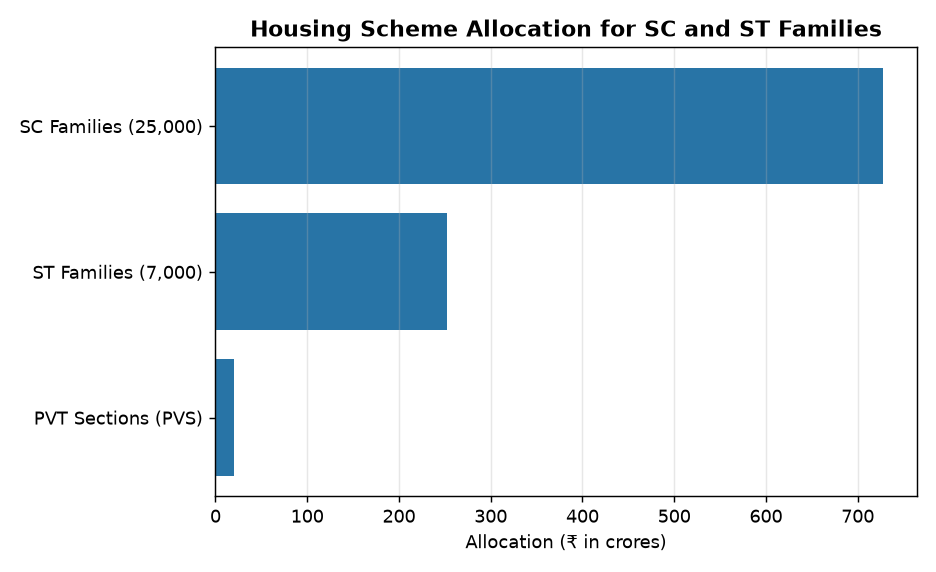
- The scheme allocates ₹727.68 crore for SC housing, ₹252.52 crore for ST housing, and an additional ₹20 crore for particularly vulnerable sections, ensuring focused resource allocation.
- Applications will be accepted from November 1 to 16, 2026, through offline (SC offices) and online (departmental portal) channels, with a streamlined scrutiny process culminating in beneficiary lists by December 3.
- Disbursement of funds will occur in four installments, with the first two installments (December 2026 and February 2027) linked to initial construction milestones, and the remaining two tied to progress verification.
- The annual family income ceiling is set at ₹3 lakh for SC applicants and ₹1 lakh for ST applicants, with priority given to households headed by widows, those with members suffering from serious illnesses, and other particularly vulnerable groups.
- The scheme’s implementation timeline includes a state-level inauguration on December 6, 2026, and a structured monitoring framework to ensure timely completion and transparency in fund utilisation.
Key Features
| Feature | Significance |
|---|---|
| Financial Allocation | A total outlay of ₹1,000 crore, with ₹727.68 crore for SC families and ₹252.52 crore for ST families, ensuring targeted resource deployment for marginalised sections. |
| Enhanced Assistance | Increased housing assistance from ₹4 lakh to ₹6 lakh for SC and ST families, and from ₹6 lakh to ₹8 lakh for ST families in remote locations, addressing inflation and construction cost escalations. |
| Income Ceiling | Annual family income ceilings set at ₹3 lakh for SC applicants and ₹1 lakh for ST applicants, ensuring the scheme benefits those with the greatest need. |
| Priority Groups | Priority given to households headed by widows, those with members suffering from serious illnesses, and other particularly vulnerable groups, ensuring inclusive targeting. |
| Implementation Mechanism | Direct implementation through the respective departments rather than the LIFE Mission, aiming to address past implementation gaps and unspent funds. |
Why it Matters
Social Inclusion
- Addresses historical deprivation among SC and ST communities by providing secure housing, a critical step toward reducing socio-economic disparities.
- Enhances dignity and quality of life for 32,000 families, particularly in rural and remote areas where housing deficits are acute.
- Aligns with constitutional directives under Articles 46 and 38(2) to promote the educational and economic interests of weaker sections.
Economic Impact
- Stimulates local economies through increased construction activity, generating employment in labour-intensive sectors such as masonry, carpentry, and allied trades.
- Potential multiplier effect on ancillary industries like cement, steel, and transportation, contributing to regional GDP growth.
- Reduces long-term expenditure on welfare measures by addressing housing insecurity, a precursor to other developmental challenges.
Governance Reforms
- Demonstrates a shift toward direct implementation models to improve efficiency, addressing past issues of unspent funds and administrative bottlenecks.
- Introduces a streamlined application and disbursement process with clear timelines, enhancing transparency and accountability.
- Showcases adaptive governance in response to ground-level feedback from implementing departments.
Policy Precedent
- Sets a benchmark for state-level welfare schemes targeting marginalised communities, potentially influencing similar initiatives in other states.
- Highlights the role of targeted financial assistance in achieving Sustainable Development Goal 11 (Sustainable Cities and Communities).
- Underscores the importance of periodic review and revision of welfare schemes to align with evolving socio-economic conditions.
Challenges
1. Implementation Bottlenecks
- Risk of delays in disbursement due to the four-installment structure, which may strain beneficiary finances if construction progress is slow.
- Potential administrative hurdles in rural and remote areas where access to documentation and digital platforms may be limited.
- Need for robust monitoring to prevent diversion of funds or misallocation, given the scale of financial outlay.
UPSC Link: GS2: Centre-State relations; GS3: Resource mobilisation
2. Targeting Precision
- Ensuring that the income ceiling effectively captures the most vulnerable households without excluding deserving cases due to bureaucratic rigidities.
- Balancing the needs of remote ST communities with logistical challenges in construction and service delivery.
- Avoiding duplication with existing schemes like the Pradhan Mantri Awas Yojana (PMAY), which may already cover some beneficiaries.
UPSC Link: GS1: Social empowerment; GS2: Welfare schemes
3. Sustainability of Housing
- Ensuring the durability and habitability of constructed houses, particularly in flood-prone or seismically active regions of Keralam.
- Addressing post-construction maintenance and provision of basic amenities such as water, sanitation, and electricity.
- Preventing the creation of isolated or ghettoised settlements that could exacerbate social exclusion.
UPSC Link: GS2: Urban and rural planning; GS3: Disaster management
4. Fiscal Sustainability
- Long-term viability of the scheme given the state’s fiscal constraints, especially if similar schemes are introduced for other communities.
- Risk of fiscal imbalance if the scheme’s outlay is not matched by corresponding revenue generation or cost-saving measures elsewhere.
- Need for periodic evaluation to assess cost-effectiveness and adjust allocations based on outcomes.
UPSC Link: GS3: Fiscal policy; GS2: Centre-State financial relations
5. Land and Resource Constraints
- Potential scarcity of land in densely populated or ecologically sensitive areas, necessitating innovative solutions like vertical housing or community land trusts.
- Legal and procedural delays in land acquisition, particularly for ST communities in forest-dwelling areas under the Forest Rights Act, 2006.
- Ensuring equitable access to land titles and preventing elite capture of resources.
UPSC Link: GS2: Land reforms; GS3: Natural resource management
Challenges — UPSC Perspective
| Issue | Concern |
|---|---|
| Disbursement Delays | Four-installment structure may lead to financial strain for beneficiaries if construction progress is slow or stalled. |
| Administrative Capacity | Limited reach of digital platforms in rural areas may hinder application and monitoring processes. |
| Income Ceiling Rigidity | Risk of excluding deserving households due to rigid income thresholds or bureaucratic interpretations. |
| Land Scarcity | Dense population and ecological constraints in Keralam may limit availability of suitable construction sites. |
| Post-Construction Maintenance | Ensuring long-term habitability and access to basic amenities remains a challenge. |
| Fiscal Strain | Sustained funding for the scheme may pose challenges given competing state priorities and revenue constraints. |
Government Initiatives — Must-Memorise for Prelims
- LIFE Mission (Kerala’s earlier housing initiative, now superseded by this scheme)
- Pradhan Mantri Awas Yojana (PMAY) – Gramin (potential overlap in beneficiary targeting)
Way Forward
- Establish a real-time monitoring dashboard to track disbursement progress and construction milestones, ensuring transparency and accountability.
- Conduct pre-construction surveys to identify land availability and ecological constraints, particularly in remote ST-dominated areas.
- Strengthen grievance redressal mechanisms to address beneficiary concerns promptly and prevent fund misutilisation.
- Integrate the scheme with existing welfare programmes (e.g., MGNREGA) to create livelihood linkages and enhance income security.
- Undertake periodic third-party audits to assess the scheme’s cost-effectiveness and recommend mid-course corrections.
- Develop a post-construction support framework, including maintenance grants and community engagement, to ensure sustainability.
- Collaborate with academic institutions and NGOs to conduct impact assessments and generate evidence for future policy refinements.
- Explore innovative financing models, such as public-private partnerships or social impact bonds, to supplement state funds.
UPSC Value Addition
Keywords for Mains Answer-Writing
Scheduled Castes and Scheduled Tribes Sub-Plan · Special Component Plan for Scheduled Castes · Housing for marginalised groups · Constitutional provisions for socio-economic upliftment (Articles 46, 38) · Kerala State Scheduled Castes Development Corporation · LIFE Mission (Kerala) · Direct Benefit Transfer (DBT) · Vulnerable sections of society · Targeted welfare delivery mechanisms · Intersectionality in welfare policies · Convergence of Centrally Sponsored Schemes (CSS) · State-level implementation of central welfare schemes · Economic empowerment through asset creation · Poverty alleviation and housing justice · Inclusive growth and constitutional morality
Constitutional & Policy Linkages
- Article 46: Promotion of educational and economic interests of weaker sections.
- Article 38(2): Minimising inequalities in income and status.
Concept Flow
Identification of housing deficit among SC/ST communities through socio-economic surveys. → Policy formulation: Recognising the need for targeted housing schemes to address historical deprivation. → Scheme design: Setting income ceilings, financial assistance norms, and implementation timelines. → Administrative restructuring: Transitioning from LIFE Mission to direct departmental implementation. → Resource allocation: Approving ₹1,000 crore budget with enhanced assistance for remote areas. → Implementation: Launching the scheme, accepting applications, and disbursing funds in installments. → Monitoring and evaluation: Tracking construction progress, beneficiary satisfaction, and long-term impact.
Prelims Practice Questions
Q1. Consider the following statements regarding the Special Component Plan (SCP) for Scheduled Castes in India:
1. The SCP is a centrally sponsored scheme aimed at promoting the welfare of Scheduled Castes.
2. The SCP is mandated under Article 46 of the Constitution of India.
3. The SCP funds are utilised exclusively for educational purposes.
4. The SCP is implemented by the Ministry of Social Justice and Empowerment.
How many of the above statements are correct?
- Only one
- Only two
- Only three
- All
Answer: Only three — Statements 1, 2, and 4 are correct. The SCP is a centrally sponsored scheme under Article 46, implemented by the Ministry of Social Justice and Empowerment. Statement 3 is incorrect as SCP funds are utilised for multi-dimensional welfare, including housing, education, and economic empowerment.
Q2. Assertion (A): The LIFE Mission in Kerala was a flagship housing scheme implemented by the previous Left Democratic Front (LDF) government.
Reason (R): The LIFE Mission aimed to merge funds from various welfare schemes to ensure convergence and efficient delivery of benefits.
Options:
A. Both A and R are true, and R is the correct explanation of A.
B. Both A and R are true, but R is NOT the correct explanation of A.
C. A is true, but R is false.
D. A is false, but R is true.
Answer: ? — Assertion (A) is true as the LIFE Mission was indeed a flagship housing scheme in Kerala. Reason (R) is also true and correctly explains the assertion, as the mission sought to merge funds for convergence and efficiency.
Q3. Match the following welfare schemes with their respective implementing agencies in India:
Column I (Scheme) | Column II (Implementing Agency)
1. Pradhan Mantri Awas Yojana (PMAY) | A. Ministry of Tribal Affairs
2. Scheduled Tribes and Other Traditional Forest Dwellers (Recognition of Forest Rights) Act, 2006 | B. Ministry of Rural Development
3. Special Component Plan for Scheduled Castes | C. Ministry of Housing and Urban Affairs
4. Van Mitra Yojana | D. Ministry of Social Justice and Empowerment
Options:
A. 1-C, 2-A, 3-D, 4-B
B. 1-B, 2-A, 3-D, 4-C
C. 1-A, 2-C, 3-D, 4-B
D. 1-C, 2-D, 3-A, 4-B
Answer: ? — 1-C: PMAY is implemented by the Ministry of Housing and Urban Affairs. 2-A: The Forest Rights Act is implemented by the Ministry of Tribal Affairs. 3-D: The Special Component Plan for SCs is implemented by the Ministry of Social Justice and Empowerment. 4-B: Van Mitra Yojana is implemented by the Ministry of Rural Development.
Mains Practice Question
✍ The Government of Kerala’s recent housing scheme for Scheduled Castes (SC) and Scheduled Tribes (ST) families exemplifies a targeted welfare delivery mechanism. Critically examine the constitutional and policy foundations of such targeted welfare schemes for marginalised groups in India. Also, analyse the challenges in their effective implementation, with reference to contemporary examples. (15 Marks)
Approach: MODEL-ANSWER SKELETON:
1. Constitutional Foundations:
– Article 46: Directive Principle to promote educational and economic interests of SCs and STs.
– Article 38: Directive Principle of State policy to secure social and economic justice.
– Article 275(1): Grants-in-aid from the Union to states for welfare of SCs and STs.
– Constitutional morality and the principle of affirmative action (Indra Sawhney v. Union of India, 1992).
2. Policy Frameworks:
– Special Component Plan (SCP) for SCs: A non-lapsable central plan for socio-economic development.
– Tribal Sub-Plan (TSP): A strategy for rapid development of tribal areas.
– Scheduled Castes and Scheduled Tribes (Prevention of Atrocities) Act, 1989: Legal safeguards.
– Pradhan Mantri Awas Yojana (PMAY) and its sub-schemes for SCs/STs.
3. Targeted Welfare Delivery:
– Identification of beneficiaries: Income ceilings, priority to vulnerable groups (e.g., widows, persons with disabilities).
– Direct Benefit Transfer (DBT) and convergence of schemes to avoid duplication.
– Role of state-level corporations (e.g., Kerala State Scheduled Castes Development Corporation).
4. Challenges in Implementation:
– Bureaucratic delays and procedural bottlenecks in fund disbursal.
– Leakage and diversion of funds due to weak monitoring mechanisms.
– Inadequate convergence with other welfare schemes (e.g., MGNREGA, PM-KISAN).
– Socio-cultural barriers and land ownership issues in tribal areas.
– Lack of awareness and digital divide in remote regions.
5. Contemporary Examples:
– Kerala’s LIFE Mission: Challenges in convergence and fund utilisation.
– Odisha’s Mission Shakti: Empowerment of women through self-help groups.
– Jharkhand’s Birsa Munda Tribal Welfare Scheme: Issues in land allocation and displacement.
6. Way Forward:
– Strengthening monitoring and grievance redressal mechanisms.
– Enhancing inter-departmental coordination and convergence.
– Promoting community participation and local governance (Panchayati Raj Institutions).
– Leveraging technology for transparent and accountable delivery (e.g., GIS mapping, Aadhaar-based authentication).
Source: The Hindu
Generated by AanyaAi for educational purpose.
Related guides on our sites
- Current affairs for upsc 2026
- Best PSIR optional coaching for upsc
- Best sociology optional coaching for upsc
- Which is best sociology optional coaching for upsc

- RBI Auctions State Government Securities: ₹29,900 Crore Bonds on Nov 3 - October 30, 2026
- कर्नाटक उच्च न्यायालय ने विकलांग व्यक्ति को आवंटित करने के आदेश को किया निरस्त - October 30, 2026
- Kerala launches ₹1,000-crore housing scheme for SC, ST families - October 30, 2026

No Comments