


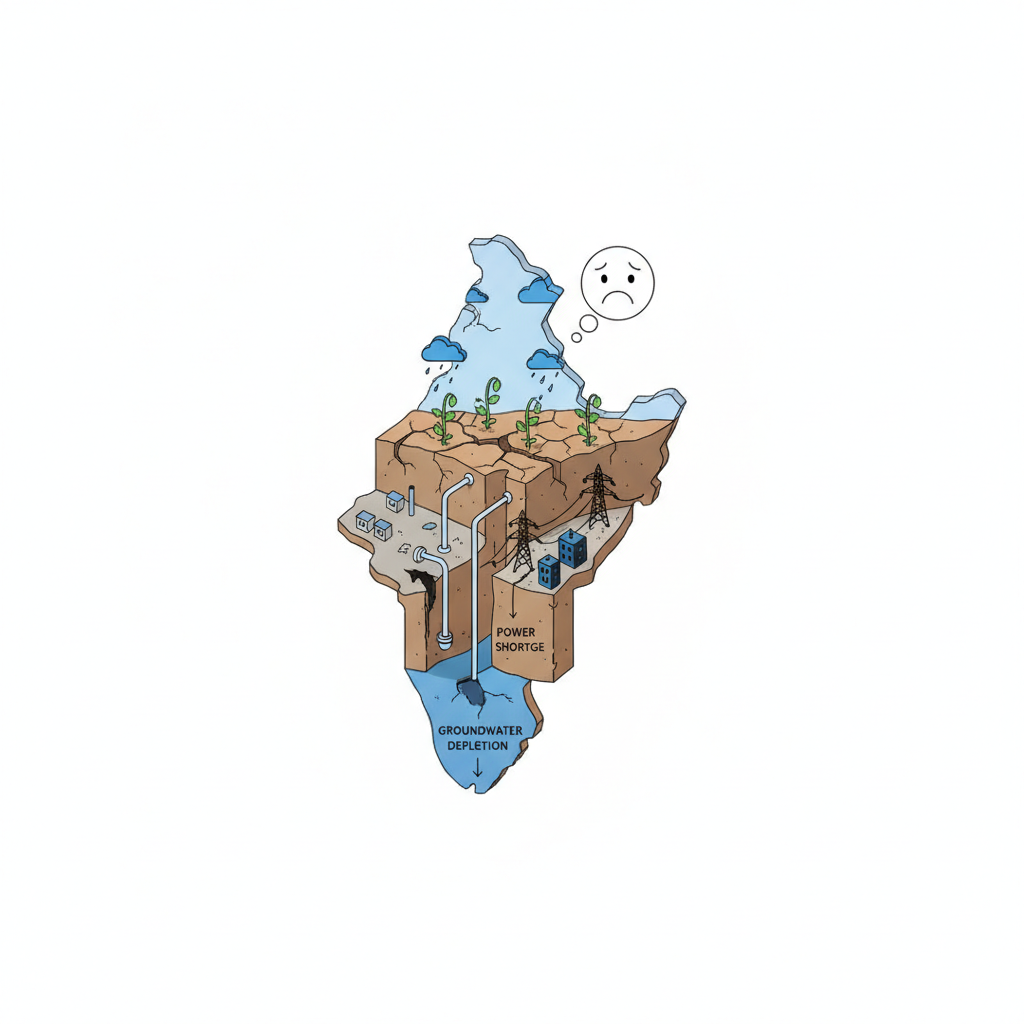
14 Sep Karnataka Faces Severe Water & Power Shortage Due to Weak Monsoon 2026
✎ Drought in Karnataka is being addressed through a multi-pronged approach involving real-time monitoring by KSNDMC, Central assistance under NDRF, groundwater regulation, and inter-state power procurement under the Electricity…
Subject Relevance — Where This Topic Fits
- GS Paper II — Functions and Responsibilities of the Union and the States | GS Paper III — Disaster Management | GS Paper III — Indian Economy and Issues Relating to Planning, Mobilisation of Resources, Growth, Development and Employment | GS Paper III — Infrastructure: Energy
- Prelims: Drought Management, Groundwater Depletion, Karnataka State Natural Disaster Monitoring Centre, Kasturirangan Report, Inter-State Water Disputes, Peak Power Demand, Central Water Commission (CWC), National Disaster Response Fund (NDRF)
- Essay: Climate Change and Governance: Balancing Development and Environmental Sustainability, Water Security in India: Challenges and Policy Interventions
Quick Revision: Drought in Karnataka is being addressed through a multi-pronged approach involving real-time monitoring by KSNDMC, Central assistance under NDRF, groundwater regulation, and inter-state power procurement under the Electricity Act, 2003.
Why is this in the news?
The Chief Minister of Karnataka has issued a warning regarding imminent water and power shortages in the state due to deficient monsoon rainfall, exacerbating existing drought conditions. This development underscores the critical governance challenges in managing natural disasters, ensuring water security, and maintaining energy supply during climatic adversities, particularly in a state with high agricultural dependency and urban demand.
Background
- Karnataka, a state with significant agricultural and industrial activity, is highly vulnerable to monsoon variability.
- Over 200 of Karnataka’s 239 taluks are facing drought conditions, with 101 already declared drought-hit under Central government guidelines.
- Groundwater depletion has compounded the crisis, reducing the state’s resilience to drought.
- The state’s peak power demand has surged to over 19,000 MW, necessitating costly power procurement from other states.
- A special session of the Karnataka Legislative Assembly has been convened to address drought mitigation and the implementation of the Kasturirangan report.
What is Drought Management in the Context of Karnataka’s Current Crisis?
- Drought is a prolonged period of abnormally low rainfall, leading to a shortage of water for agriculture, industry, and domestic use, as defined by the National Disaster Management Authority (NDMA).
- Drought management in India is governed by the National Disaster Management Act, 2005, and the National Policy on Disaster Management, 2009, which classify drought as a notified disaster under the National Disaster Response Fund (NDRF).
- The Karnataka State Natural Disaster Monitoring Centre (KSNDMC) plays a pivotal role in real-time drought assessment and early warning through meteorological and hydrological data analysis.
- The Central Water Commission (CWC) provides technical guidance and data on water resources, including river basin management and inter-state water disputes, which are critical during droughts.
- Groundwater governance in Karnataka is regulated under the Karnataka Ground Water (Regulation for Protection of Sources of Drinking Water) Act, 1999, and the Atal Bhujal Yojana, a Central scheme aimed at sustainable groundwater management.
- Power shortages during droughts are exacerbated by reduced hydropower generation, as Karnataka relies on hydroelectric projects like the Krishna and Cauvery basin dams for a significant portion of its energy mix.
- Inter-state power procurement during shortages is facilitated by the Electricity Act, 2003, and the Central Electricity Regulatory Commission (CERC), which regulates tariffs and cross-border power transactions.
Key Features
| Feature | Significance |
|---|---|
| Declared drought-hit taluks (101+) | Triggers drought relief measures under the National Disaster Management Guidelines, enabling access to central funds and administrative support for affected regions. |
| Peak power demand surge (>19,000 MW) | Exceeds state’s in-house generation capacity, necessitating costly procurement from other states, increasing fiscal burden and exposing grid vulnerabilities. |
| Groundwater depletion | Undermines long-term agricultural productivity and rural water security, exacerbating drought impacts beyond immediate rainfall deficits. |
| Monsoon rainfall deficit (81% in September) | Indicates cumulative seasonal shortfall (June–August: 42%, 29%, 23%), disrupting kharif sowing, hydropower generation, and soil moisture retention. |
| Special Assembly session (Sep 21–23) | Provides legislative platform to discuss drought mitigation, interstate water disputes (e.g., Cauvery), and implementation of ecological reports (Kasturirangan). |
Why it Matters
Economic
- Agricultural output decline reduces rural incomes, impacting GDP growth and food inflation due to supply chain disruptions.
- Power procurement at Rs 11–12/unit inflates state’s subsidy burden and may necessitate tariff revisions, affecting industrial competitiveness.
- Drought relief expenditure (e.g., Rs 4,708 crore demand) strains fiscal resources, potentially crowding out other developmental priorities.
Environmental
- Depleting groundwater levels reflect unsustainable extraction rates, threatening aquifer recharge and long-term water security.
- Weak monsoon and delayed rainfall patterns align with climate change projections, increasing the frequency of extreme weather events in peninsular India.
Institutional
- State’s ability to manage concurrent crises (drought + power shortage) tests the efficacy of Karnataka State Disaster Management Authority (KSDMA) and State Load Dispatch Centre (SLDC).
- Interstate power trading (via ISTS) becomes critical during deficits, highlighting the role of Central Electricity Regulatory Commission (CERC) in facilitating cross-border transactions.
Social
- Rural livelihoods dependent on agriculture face acute distress, necessitating targeted welfare measures (e.g., MGNREGS, PM-KISAN) to prevent migration and indebtedness.
- Urban-rural water conflicts may intensify as municipalities and industries compete for limited resources, requiring equitable distribution mechanisms.
Challenges
1. AGRICULTURAL PRODUCTIVITY LOSS
- Kharif crop failure reduces farm output, threatening food security and farmer incomes, particularly in rainfed districts.
- Delayed monsoon disrupts sowing cycles, forcing farmers to switch to less water-intensive crops or incur higher input costs.
- Groundwater depletion limits irrigation access, exacerbating vulnerability to meteorological droughts.
UPSC Link: GS3: Major crops, irrigation systems, drought management
2. POWER SECTOR VULNERABILITIES
- Peak demand exceeding 19,000 MW exposes Karnataka’s dependence on external power purchases, increasing costs and grid instability.
- Hydropower generation declines due to low reservoir levels, reducing renewable energy share in the state’s energy mix.
- Night-time consumption surge (e.g., increased irrigation pumping) strains distribution networks, risking load shedding.
UPSC Link: GS3: Energy infrastructure, grid management, renewable energy
3. WATER RESOURCE MANAGEMENT
- Cumulative monsoon deficit (81% in September) reflects poor rainfall distribution, necessitating long-term watershed management and rainwater harvesting.
- Interstate water disputes (e.g., Cauvery) complicate drought mitigation, as downstream states may demand reduced releases, triggering legal and political friction.
- Urban water scarcity in Bengaluru and other cities may escalate due to over-extraction and delayed monsoon recharge.
UPSC Link: GS2: Interstate river water disputes, water conservation
4. FISCAL AND ADMINISTRATIVE BURDENS
- Drought relief expenditure (e.g., Rs 4,708 crore demand) diverts funds from developmental projects, affecting capital expenditure.
- Subsidised power procurement increases state’s revenue deficit, potentially leading to fiscal imbalances.
- Delayed declaration of drought-hit taluks may hinder timely relief distribution, exacerbating rural distress.
UPSC Link: GS3: Fiscal federalism, disaster relief, public expenditure
5. CLIMATE CHANGE ADAPTATION
- Increasing frequency of weak monsoons and erratic rainfall patterns necessitates climate-resilient agriculture and water storage infrastructure.
- State’s preparedness for extreme weather events remains inadequate, as evidenced by cumulative rainfall deficits across monsoon months.
- Long-term strategies (e.g., Kasturirangan report implementation) require multi-stakeholder coordination and ecological sensitivity.
UPSC Link: GS3: Climate change, sustainable agriculture, disaster risk reduction
Challenges — UPSC Perspective
| Issue | Concern |
|---|---|
| Kharif crop failure | Threatens food security, farmer incomes, and rural employment, particularly in rainfed districts. |
| Groundwater depletion | Undermines irrigation capacity, increases pumping costs, and reduces long-term water availability. |
| Power demand surge | Exceeds state’s generation capacity, necessitates costly imports, and risks grid instability. |
| Interstate water disputes | Complicates drought mitigation and may lead to reduced water releases from upstream states. |
| Fiscal strain | Increased drought relief and power procurement costs strain state finances, affecting developmental spending. |
| Urban water scarcity | Aggravates supply-demand mismatch in cities like Bengaluru, risking public unrest and industrial slowdown. |
Government Initiatives — Must-Memorise for Prelims
- National Disaster Management Guidelines (NDMG) – Drought
- Pradhan Mantri Krishi Sinchayee Yojana (PMKSY)
- Mahatma Gandhi National Rural Employment Guarantee Scheme (MGNREGS)
- Atal Mission for Rejuvenation and Urban Transformation (AMRUT) – Water Supply Component
Way Forward
- Constitute a multi-departmental task force to assess real-time water availability and prioritise critical uses (drinking, agriculture, industry).
- Accelerate implementation of rainwater harvesting and watershed management projects under PMKSY to enhance groundwater recharge.
- Diversify energy mix by scaling up solar and wind power to reduce dependence on hydropower and fossil fuel-based imports during deficits.
- Strengthen interstate coordination mechanisms (e.g., Cauvery Water Management Authority) to resolve water-sharing disputes through data-driven negotiations.
- Expand MGNREGS works to include drought-proofing activities (e.g., farm ponds, contour bunding) and provide immediate employment to affected rural households.
- Monitor groundwater levels using satellite-based tools (e.g., Central Ground Water Board’s Aquifer Mapping) to enforce sustainable extraction norms.
- Launch public awareness campaigns on water conservation, including incentives for farmers to adopt micro-irrigation (e.g., drip irrigation under PMKSY).
- Enhance urban water supply resilience by investing in decentralised wastewater treatment and recycling systems under AMRUT 2.0.
UPSC Value Addition
Keywords for Mains Answer-Writing
Drought management in India · Inter-State Water Disputes Act, 1956 · Constitutional provisions for water governance · Groundwater depletion and legal framework · Karnataka drought 2026 · Cauvery Water Disputes Tribunal · National Disaster Management Authority (NDMA) guidelines · Power procurement under Electricity Act, 2003 · Climate change and water scarcity · State-State water sharing mechanisms · Agricultural drought mitigation · Groundwater regulation in India · Constitutional provisions for inter-state water disputes · National Water Policy 2012 · State Disaster Response Fund (SDRF)
Constitutional & Policy Linkages
- Article 262 – Interstate Water Disputes (Cauvery Water Disputes Tribunal)
- Article 292 – Borrowing powers of the State Government (fiscal management during droughts)
- Seventh Schedule – State List (Entry 17: Water supply; Entry 18: Land; Entry 23: Social security)
Concept Flow
Weak monsoon → Cumulative rainfall deficit (June–September) → Reduced soil moisture and reservoir levels → Hydropower generation decline → Reduced hydropower → Increased reliance on fossil fuel-based power imports → Higher procurement costs and grid instability → Rainfall deficit → Groundwater over-extraction for irrigation → Depletion of aquifers and long-term water insecurity → Crop failure due to drought → Reduced farm incomes and rural distress → Increased demand for MGNREGS and welfare schemes → Interstate water disputes (e.g., Cauvery) → Political and legal friction → Delayed relief measures and resource allocation → Drought declaration → Triggers National Disaster Management Guidelines → Access to central funds and administrative support → State’s fiscal strain → Reduced capital expenditure → Compromised developmental projects and long-term resilience
Prelims Practice Questions
Q1. Consider the following statements regarding drought management in India:
1. The National Disaster Management Authority (NDMA) is the nodal agency for drought management under the Disaster Management Act, 2005.
2. The State Disaster Response Fund (SDRF) is exclusively used for drought relief measures.
3. The Inter-State Water Disputes Act, 1956 provides for the establishment of Tribunals to adjudicate water disputes between states.
How many of the above statements are correct?
- Only one
- Only two
- All three
- None
Answer: All three — Statements 1 and 3 are correct. Statement 2 is incorrect because SDRF is a general fund for all notified disasters, not exclusively for droughts. NDMA provides guidelines for drought management, and the Inter-State Water Disputes Act, 1956 empowers the Union Government to establish Tribunals for inter-state water disputes.
Q2. Assertion (A): The Constitution of India does not explicitly mention water as a subject under the Union List, State List, or Concurrent List.
Reason (R): Water is treated as a state subject under Entry 17 of the State List, but the Union Government can legislate on inter-state water disputes and regulate matters of national importance.
In the context of the above two statements, which of the following is correct?
- Both A and R are true, and R is the correct explanation of A
- Both A and R are true, but R is not the correct explanation of A
- A is true but R is false
- A is false but R is true
Answer: A is true but R is false — Assertion (A) is true: water is not explicitly listed in any of the three lists. Reason (R) is also true but does not correctly explain (A) because the absence of explicit mention does not imply lack of constitutional provisions; rather, water governance is derived from multiple entries and judicial interpretations.
Q3. Which of the following is NOT a function of the Cauvery Water Management Authority (CWMA) established under the Inter-State Water Disputes Act, 1956?
- To monitor and supervise the implementation of the Cauvery Water Disputes Tribunal’s final order
- To regulate the release of water from Karnataka to Tamil Nadu as per the Tribunal’s award
- To adjudicate disputes between Karnataka and Tamil Nadu on water sharing
- To ensure compliance with the Tribunal’s directions by the states involved
Answer: To adjudicate disputes between Karnataka and Tamil Nadu on water sharing — The Cauvery Water Management Authority (CWMA) does not adjudicate disputes; that function is performed by the Cauvery Water Disputes Tribunal under the Inter-State Water Disputes Act, 1956. The CWMA’s role is to implement and monitor the Tribunal’s final order.
Mains Practice Question
✍ The management of water resources during droughts in India is a complex interplay of constitutional provisions, statutory frameworks, and institutional mechanisms. Critically examine the efficacy of existing legal and institutional arrangements in addressing drought-induced water and power shortages, with particular reference to the situation in Karnataka in 2026. (15 Marks)
Approach: MODEL-ANSWER SKELETON:
1. Constitutional and Legal Framework:
– Entry 17 (State List) and Entry 56 (Union List) under the Seventh Schedule.
– Groundwater regulation: Environmental (Protection) Act, 1986, and state-level groundwater acts (e.g., Karnataka Ground Water (Regulation for Protection of Sources) Act, 2011).
– Inter-State Water Disputes Act, 1956 and Cauvery Water Disputes Tribunal (CWDT) final order (2018).
– National Water Policy 2012 and National Disaster Management Authority (NDMA) guidelines for drought management.
2. Institutional Mechanisms:
– Role of State Disaster Management Authorities (SDMA) and National Disaster Response Force (NDRF).
– Functioning of the Cauvery Water Management Authority (CWMA) in implementing Tribunal orders.
– Power procurement mechanisms under the Electricity Act, 2003 and role of the Central Electricity Regulatory Commission (CERC).
3. Challenges and Gaps:
– Fragmented governance: overlapping jurisdictions between Centre, states, and local bodies.
– Groundwater depletion: lack of effective regulation despite legal frameworks.
– Inter-state disputes: delays in implementation of Tribunal awards (e.g., Cauvery water sharing).
– Climate change: increasing frequency and intensity of droughts, outpacing institutional adaptation.
– Power shortages: reliance on market-based procurement at high costs (e.g., Rs 11-12/unit in Karnataka).
4. Comparative Perspective:
– Lessons from other states (e.g., Maharashtra’s drought management under the Maharashtra Drought Relief Manual).
– Role of judiciary in ensuring compliance with water-sharing orders (e.g., Supreme Court’s intervention in Cauvery disputes).
5. Way Forward:
– Strengthening inter-state coordination mechanisms (e.g., River Basin Organisations).
– Integrated water resources management (IWRM) with community participation.
– Augmenting groundwater recharge and rainwater harvesting.
– Enhancing power generation capacity and grid integration.
– Data-driven drought forecasting and early warning systems.
Source: The Indian Express
Karnataka PCS (KPSC) — State PCS Practice
Prelims: Which of the following measures has Karnataka Chief Minister Shivakumar proposed to address the anticipated water and power shortage due to weak monsoon conditions?
- A. Immediate ban on all agricultural water usage
- B. Implementation of staggered power cuts in urban areas
- C. Formation of a high-level committee to monitor water and power resources
- D. Privatization of the state’s electricity distribution
Answer: C. Formation of a high-level committee to monitor water and power resources — CM Shivakumar warned of water and power shortages and proposed forming a high-level committee to monitor and manage resources effectively.
Mains: Discuss the socio-economic implications of water and power shortages in Karnataka, with a focus on their impact on agriculture, urban livelihoods, and industrial productivity. Suggest policy measures to mitigate these challenges in the short and long term.
Generated by AanyaAi for educational purpose.
Related guides on our sites
- Best geography optional coaching
- Best geography optional coaching
- Best geography optional teacher
- Best geography optional teacher

- Karnataka Faces Severe Water & Power Shortage Due to Weak Monsoon 2026 - September 14, 2026
- झारखंड का 1.36 लाख करोड़ का बकाया खत्म! केंद्र बनाम राज्य अब सुप्रीम कोर्ट में - September 14, 2026
- Jharkhand’s ₹1.36 Lakh Crore Dues: Supreme Court Battle Over MMDRA Amendment - September 14, 2026

No Comments