


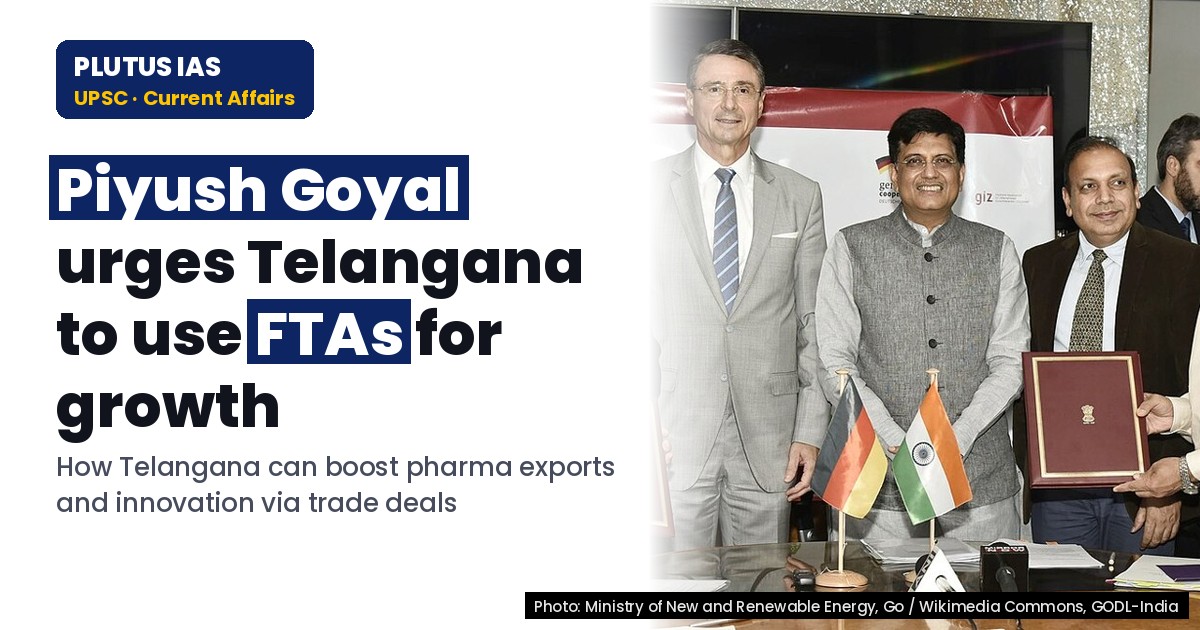
30 Oct Piyush Goyal urges Telangana to leverage FTAs for growth
✎ FTAs provide preferential market access, but their effective utilisation hinges on domestic industry competitiveness, compliance with Rules of Origin, and alignment with global quality standards.
Subject Relevance — Where This Topic Fits
- GS Paper II — International Relations (Bilateral, Regional and Global Groupings and Agreements involving India and/or affecting India’s interests) | GS Paper III — Economy (Foreign Trade, Investment Models, Export Promotion Schemes)
- Prelims: Free Trade Agreement (FTA), Regional Comprehensive Economic Partnership (RCEP), Global Value Chains (GVCs), Export Preparedness Index, GI Tag, Ease of Doing Business, Trade Facilitation Agreement, Economic Survey 2023-24, WTO, IMF World Economic Outlook
- Essay: India’s Role in Global Trade: Opportunities and Challenges in the 21st Century, Balancing National Development with Global Integration: A Case for Strategic FTAs
Quick Revision: FTAs provide preferential market access, but their effective utilisation hinges on domestic industry competitiveness, compliance with Rules of Origin, and alignment with global quality standards.
Why is this in the news?
The Union Minister of Commerce and Industry, Shri Piyush Goyal, highlighted the underutilisation of India’s Free Trade Agreements (FTAs) by Telangana during the pre-event of the Invest Telangana Global Summit. He emphasised that leveraging FTAs could accelerate Telangana’s economic growth, particularly in pharmaceutical innovation, global Geographical Indication (GI) exports, and ease of doing business. This underscores the broader national strategy to utilise FTAs as a catalyst for achieving the $1 trillion export target by 2030 and positioning India as a key player in global supply chains.
Background
- India has signed 13 FTAs with 38 developed countries, covering 76% of global GDP.
- Telangana, with its robust pharmaceutical and agro-based industries, stands to benefit significantly from FTAs that reduce tariff barriers and enhance market access for high-value exports.
- The state’s historical trade linkages, such as the Kakatiya dynasty’s maritime charter in 1244, reflect its long-standing engagement with global trade, necessitating modern policy alignment.
- India’s export target of $1 trillion by 2030 requires a 15% annual growth rate, which is contingent on leveraging FTAs to access high-demand markets in developed economies.
- Global trade growth is projected at 1.9% by the IMF for 2026, underscoring the need for India to diversify export destinations and reduce dependency on traditional markets.
- The Union Government’s ‘Viksit Bharat @2047’ vision aligns with state-level economic growth targets, such as Telangana’s ambition to achieve a $3 trillion economy by 2047.
What are Free Trade Agreements (FTAs) and their significance for India?
- FTAs are treaties between two or more countries to reduce or eliminate trade barriers, such as tariffs and quotas, facilitating smoother cross-border commerce.
- India’s FTAs are categorised into Comprehensive Economic Partnership Agreements (CEPAs), Comprehensive Economic Cooperation Agreements (CECAs), and Early Harvest Schemes (EHS), each tailored to specific economic objectives.
- FTAs enhance market access for Indian goods and services, particularly in sectors like pharmaceuticals, textiles, and engineering, where Telangana has comparative advantages.
- The utilisation of FTAs requires domestic industries to align with global standards, adopt advanced technologies, and enhance supply chain efficiencies to compete in international markets.
- India’s FTAs are designed to integrate with global value chains (GVCs), enabling domestic firms to participate in cross-border production networks and benefit from economies of scale.
- The ‘Rules of Origin’ clause in FTAs ensures that only goods originating from the partner countries benefit from preferential tariffs, preventing trade deflection and ensuring fair utilisation.
- FTAs also include provisions on intellectual property rights, dispute resolution mechanisms, and non-tariff barriers, which are critical for sectors like pharmaceuticals and agro-processing.
- The success of FTAs depends on proactive engagement by state governments, industry associations, and exporters to identify and exploit market opportunities in partner countries.
Key Features
| Feature | Significance |
|---|---|
| Free Trade Agreements (FTAs) | Provide preferential market access to Indian exporters in partner countries, covering 76% of global GDP through existing and prospective agreements. |
| Geographical Indications (GI) Exports | Enhance value addition and global recognition for regional products, particularly in pharmaceuticals and agro-based industries. |
| Ease of Doing Business | Reduces transaction costs and regulatory barriers, attracting foreign direct investment and fostering industrial growth. |
| Policy Stability | Ensures long-term predictability for investors, critical for sustained economic expansion and export competitiveness. |
| Supply Chain Resilience | Strengthens domestic manufacturing capabilities and reduces dependency on volatile global supply chains. |
Why it Matters
Economic Growth and Export Expansion
- India’s FTAs collectively cover 76% of global GDP, offering unprecedented market access for domestic industries, particularly in pharmaceuticals, technology, and agro-products.
- The target of achieving a $1 trillion merchandise export economy by 2030, with a projected 15% growth in the current year, underscores India’s ambition to integrate deeper into global value chains.
- Telangana’s ambition to become a $3 trillion economy by 2047 aligns with national export goals, leveraging its historical trade strengths and emerging sectors like pharmaceutical innovation.
- IMF projections indicate India will remain the fastest-growing major economy, reinforcing investor confidence in long-term growth prospects.
Strategic Trade Diplomacy
- India’s proactive FTA negotiations with developed and developing nations enhance its geoeconomic influence and reduce over-reliance on any single market.
- The integration of advanced economies (e.g., those with high-tech manufacturing capabilities) complements India’s supply chain requirements, particularly in electronics and pharmaceuticals.
- Historical trade precedents, such as the Kakatiya dynasty’s maritime charter (1244 CE), highlight Telangana’s long-standing role in fostering stable trade environments.
Structural Reforms and Institutional Strength
- Recent upgrades in India’s credit ratings by agencies like JCR reflect improved macroeconomic fundamentals and policy credibility.
- The completion of nine FTAs in the last four-and-a-half years demonstrates accelerated trade liberalization and institutional agility.
- Policy continuity and rule-of-law assurances reduce investment risks, attracting both domestic and foreign capital.
Challenges
1. Global Trade Uncertainty
- Geopolitical conflicts (e.g., West Asia, Ukraine) disrupt supply chains and increase transaction costs, particularly for energy and critical inputs.
- IMF’s projection of global trade growth at 1.9% for the current year underscores the need for India to diversify export markets and reduce exposure to volatile regions.
UPSC Link: GS III: Indian Economy and issues relating to planning, mobilization of resources
2. Domestic Supply Chain Bottlenecks
- Infrastructure gaps in logistics and transportation increase the cost of doing business, particularly for MSMEs in export-oriented sectors.
- Dependence on imported intermediates (e.g., APIs in pharmaceuticals) exposes industries to global price volatility.
UPSC Link: GS III: Infrastructure and Investment
3. Policy Consistency and Predictability
- Investors prioritize long-term policy stability; frequent regulatory changes or retrospective amendments erode confidence.
- The need for continuous stakeholder consultations to align state-level (e.g., Telangana) and national trade policies with global standards.
UPSC Link: GS II: Government policies and interventions
4. Competitive Export Markets
- Developed economies with advanced manufacturing capabilities pose stiff competition, requiring India to focus on high-value addition and innovation.
- Non-tariff barriers (e.g., technical standards, sanitary norms) in partner countries necessitate proactive compliance and certification mechanisms.
UPSC Link: GS III: Effects of liberalization on the economy
5. Regional Disparities in Trade Integration
- States like Telangana, with strong pharmaceutical and IT sectors, must align local industrial policies with national trade strategies to maximize FTA benefits.
- Bridging the urban-rural divide in export participation requires targeted interventions in logistics, skill development, and financial inclusion.
UPSC Link: GS II: Federalism and State Governments
Challenges — UPSC Perspective
| Issue | Concern |
|---|---|
| Geopolitical Instability | Disruptions in energy and supply chains due to conflicts in West Asia and Ukraine. |
| Logistics Infrastructure Gaps | High transportation costs and delays in export-oriented industries. |
| Regulatory Overlaps | Inconsistencies between state and central policies affecting investor confidence. |
| Non-Tariff Barriers | Technical and sanitary standards in partner countries limiting market access. |
| Skill Mismatch | Shortage of trained workforce in high-tech and pharmaceutical sectors. |
| Credit Accessibility | Limited financing options for MSMEs in export-driven states like Telangana. |
Way Forward
- Leverage Telangana’s pharmaceutical and IT strengths to align with FTA-enabled markets, particularly in high-tech devices and APIs.
- Strengthen state-level trade facilitation agencies to assist MSMEs in navigating FTA compliance and certification processes.
- Invest in multimodal logistics infrastructure (e.g., dedicated freight corridors, port connectivity) to reduce export costs.
- Promote industry-academia collaborations to address skill gaps in sectors critical to export growth (e.g., pharmaceutical innovation, AI-driven manufacturing).
- Establish a dedicated export promotion cell in Telangana to monitor FTA utilization, identify bottlenecks, and coordinate with central agencies.
- Enhance digital trade facilitation platforms to streamline documentation, customs clearance, and real-time market intelligence for exporters.
- Conduct periodic reviews of FTAs to assess their impact on domestic industries and negotiate adjustments for emerging sectors.
- Expand trade diplomacy outreach to diversify export markets beyond traditional partners, focusing on Africa, Latin America, and Southeast Asia.
UPSC Value Addition
Keywords for Mains Answer-Writing
Free Trade Agreements (FTAs) · Foreign Trade Policy · Export Promotion Schemes · Global Value Chains · Geographical Indications (GIs) · Ease of Doing Business · Trade Facilitation · India’s Trade Diplomacy · Regional Economic Integration · Trade and Investment Policies · Make in India · Atmanirbhar Bharat · Global Economic Order · Multilateral Trade Agreements · India’s Economic Growth Trajectory
Constitutional & Policy Linkages
- Article 286: Restrictions on imposition of tax on sale or purchase of goods in the course of inter-State trade or commerce (relevant for GST alignment with FTAs).
- Article 299: Contracts entered into by the Government of India (governs trade agreements and their legal enforceability).
Concept Flow
India’s proactive FTA negotiations → Expansion of preferential market access to 76% of global GDP → Enhanced export competitiveness for domestic industries. → Telangana’s pharmaceutical and IT sector strengths → Alignment with FTA-enabled markets (e.g., advanced economies) → Increased value addition and job creation. → Global geopolitical instability → Disruptions in supply chains and energy prices → Need for diversified export markets and resilient supply chains. → Policy stability and rule-of-law assurances → Improved credit ratings (e.g., JCR upgrade) → Higher investor confidence and FDI inflows. → Infrastructure gaps in logistics and transportation → High transaction costs for exporters → Urgent need for multimodal connectivity upgrades. → Non-tariff barriers in partner countries → Compliance challenges for MSMEs → Requirement for state-level trade facilitation support. → Skill mismatches in high-tech sectors → Limited export capacity in emerging industries → Focus on industry-academia collaborations.
Prelims Practice Questions
Q1. Consider the following statements regarding Free Trade Agreements (FTAs) and India’s trade policy:
1. India’s current FTAs cover approximately 76% of the global GDP in terms of primary market access.
2. The India-UAE Comprehensive Economic Partnership Agreement (CEPA) is one of the nine recently concluded FTAs mentioned in the press release.
3. The Kākatiya maritime charter (Mōṭupalli Abhaya Śāsana) issued in 1244 CE is cited as a historical precedent for trade facilitation in India.
How many of the above statements are correct?
- Only one
- Only two
- All three
- None
Answer: All three — Statement 1 is correct: The press release states that India’s FTAs cover 76% of global GDP. Statement 2 is incorrect: The press release does not specify the India-UAE CEPA as one of the nine recently concluded FTAs. Statement 3 is correct: The Kākatiya maritime charter is explicitly mentioned as a historical trade facilitation measure.
Q2. Assertion (A): India’s recent FTAs have primarily focused on developed countries to leverage advanced technologies and supply chains.
Reason (R): The FTAs provide access to markets with complementary capabilities such as high-tech devices, GPUs, and advanced manufacturing equipment.
In the context of the above Assertion and Reason, select the correct option:
- Both A and R are true, and R is the correct explanation of A
- Both A and R are true, but R is NOT the correct explanation of A
- A is true, but R is false
- A is false, but R is true
Answer: Both A and R are true, and R is the correct explanation of A — Assertion (A) is true: The press release highlights that India’s FTAs with developed countries provide access to advanced technologies. Reason (R) is also true and directly explains Assertion (A), as the FTAs are designed to complement India’s industrial needs with capabilities available in partner countries.
Q3. Match the following FTAs/concepts with their respective partner countries or regions:
Column I
A. Comprehensive Economic Partnership Agreement (CEPA)
B. Regional Comprehensive Economic Partnership (RCEP)
C. India’s FTA with the European Union (EU)
D. India-ASEAN Trade in Goods Agreement (TIGA)
Column II
1. Japan
2. ASEAN
3. United Arab Emirates
4. Not yet concluded
Select the correct match:
- A-3, B-1, C-4, D-2
- A-1, B-2, C-3, D-4
- A-2, B-3, C-1, D-4
- A-4, B-1, C-2, D-3
Answer: A-3, B-1, C-4, D-2 — A-3: India-UAE CEPA is a recently concluded FTA. B-1: India is not a member of RCEP but has engaged in negotiations. C-4: The India-EU FTA is under negotiation and not yet concluded. D-2: India-ASEAN TIGA is an existing agreement.
Mains Practice Question
✍ The utilisation of Free Trade Agreements (FTAs) by Indian states is pivotal for achieving the goal of a developed economy by 2047. In this context, critically examine the role of FTAs in enhancing India’s export competitiveness and industrial growth, with special reference to the pharmaceutical and agro-processing sectors. (15 Marks)
Approach: MODEL-ANSWER SKELETON:
1. **Introduction (2 Marks)**
– Define FTAs and their significance in contemporary trade policy.
– State India’s export target of $1 trillion and the role of FTAs in achieving this.
– Mention the press release’s reference to India’s FTAs covering 76% of global GDP.
2. **Mechanisms through which FTAs enhance export competitiveness (5 Marks)**
– **Tariff Reduction/Elimination**: Cite specific FTAs (e.g., India-UAE CEPA, India-ASEAN TIGA) reducing tariffs on pharmaceuticals and agro-processed goods.
– **Rules of Origin (RoO)**: Explain how RoO in FTAs prevent trade deflection and ensure benefits accrue to domestic industries.
– **Non-Tariff Barriers (NTBs)**: Discuss how FTAs address NTBs such as sanitary and phytosanitary (SPS) measures in agro-processing.
– **Market Access**: Highlight preferential access to developed markets (e.g., EU, Japan) for high-value pharmaceuticals and processed foods.
3. **Sector-Specific Analysis (5 Marks)**
– **Pharmaceuticals**:
– FTAs facilitate export of generic medicines (e.g., India’s strength in affordable generics).
– Reference to Geographical Indications (GIs) for traditional medicines (e.g., Ayurveda, Unani).
– Case: India’s export growth in pharmaceuticals post-FTA with ASEAN.
– **Agro-Processing**:
– FTAs reduce tariffs on processed foods (e.g., basmati rice, spices, dairy products).
– Compliance with international standards (e.g., Codex Alimentarius) under FTA frameworks.
– Example: India’s mango and banana exports to the EU under the India-EU FTA negotiations.
4. **Challenges and Constraints (2 Marks)**
– **Rules of Origin Compliance**: Burden on SMEs to meet complex RoO criteria.
– **Non-Tariff Measures**: Stringent SPS measures in developed markets (e.g., EU’s pesticide residue norms).
– **Supply Chain Disruptions**: Global geopolitical tensions (e.g., Red Sea crisis) impacting trade flows.
– **Domestic Industry Preparedness**: Need for upskilling and technology adoption to meet global standards.
5. **Conclusion (1 Mark)**
– FTAs are a critical tool for export-led growth but require complementary domestic policies (e.g., PLI schemes, infrastructure development).
– Emphasise the need for state-level initiatives (e.g., Telangana’s focus on pharma and agro-processing) to leverage FTAs effectively.
Source: PIB (Press Information Bureau)
Telangana PCS (TGPSC (TSPSC)) — State PCS Practice
Prelims: Which of the following initiatives was recently emphasized by Union Commerce and Industry Minister Piyush Goyal to maximize benefits for Telangana?
- A. Free Trade Agreements (FTAs)
- B. Special Economic Zones (SEZs)
- C. Startup India Scheme
- D. Make in India Campaign
Answer: A. Free Trade Agreements (FTAs) — Union Commerce and Industry Minister Piyush Goyal urged Telangana to leverage FTAs to boost exports and economic growth.
Mains: Discuss the significance of Free Trade Agreements (FTAs) for Telangana’s economy, with a focus on key sectors that can benefit from enhanced trade opportunities under FTAs.
Generated by AanyaAi for educational purpose.
Related guides on our sites
- Current affairs for upsc 2026
- How to prepare for GS paper 1 for UPSC CSE mains exam
- Best economics optional coaching for upsc
- Best economics optional teacher for upsc

- Piyush Goyal urges Telangana to leverage FTAs for growth - October 30, 2026
- वित्तीय सेवा विभाग ने विशेष अभियान 6 के तहत 7 लाख वर्ग फुट स्थान खाली किया, 4.12 करोड़ रुपये राजस्व अर्जित - October 30, 2026
- RBI Auctions State Government Securities: ₹29,900 Crore Bonds on Nov 3 - October 30, 2026

No Comments