


20 Sep Foundation urges Kasturirangan report implementation for Western Ghats protection
✎ The Kasturirangan Committee Report (2013) recommends the declaration of the Western Ghats as an Ecologically Sensitive Area (ESA) with graded regulations to balance conservation and development, including bans on mining and…
Subject Relevance — Where This Topic Fits
- GS Paper II — Functions and Responsibilities of the Union and the States, Issues and Challenges Pertaining to the Federal Structure, Devolution of Powers and Finances up to Local Levels and Challenges Therein | GS Paper III — Conservation, Environmental Pollution and Degradation, Environmental Impact Assessment
- Prelims: Western Ghats, Kasturirangan Committee Report, Ecologically Sensitive Zones (ESZs), Extended Producer Responsibility (EPR), Single-use plastics ban, Environmental Impact Assessment (EIA) 2006, Forest Rights Act 2006, Pumped Storage Hydroelectric Projects, River Linking Projects, Climate Emergency
- Essay: Balancing environmental conservation with developmental imperatives: The case of the Western Ghats, Climate change governance: From policy to implementation
Quick Revision: The Kasturirangan Committee Report (2013) recommends the declaration of the Western Ghats as an Ecologically Sensitive Area (ESA) with graded regulations to balance conservation and development, including bans on mining and red-category industries in high-sensitivity zones.
Why is this in the news?
The Akka Foundation Trust has initiated a statewide campaign (‘Chalo Bengaluru’) to demand the implementation of the Kasturirangan Committee Report for the protection of the Western Ghats. The campaign highlights the dual imperatives of environmental conservation and addressing livelihood concerns of local communities, including farmers and forest-dwelling populations, while also advocating for stricter enforcement of environmental regulations such as the ban on single-use plastics and the implementation of Extended Producer Responsibility (EPR) mechanisms. The demand for the withdrawal of 38 projects, including major infrastructure initiatives like the Sharavathi Pumped Storage Project and river-linking proposals, underscores the policy tensions between development and conservation in ecologically sensitive regions.
Background
- The Western Ghats, a UNESCO World Heritage Site, is one of the eight ‘hottest hotspots’ of biological diversity globally, supporting numerous endemic species and providing critical ecosystem services such as water regulation, carbon sequestration, and climate moderation.
- The Kasturirangan Committee, constituted in 2012 under the chairmanship of Dr. K. Kasturirangan, was tasked with reviewing the Gadgil Committee Report (2011) on the Western Ghats. The committee recommended the declaration of the Western Ghats as an Ecologically Sensitive Area (ESA) with graded regulations to balance conservation with developmental needs.
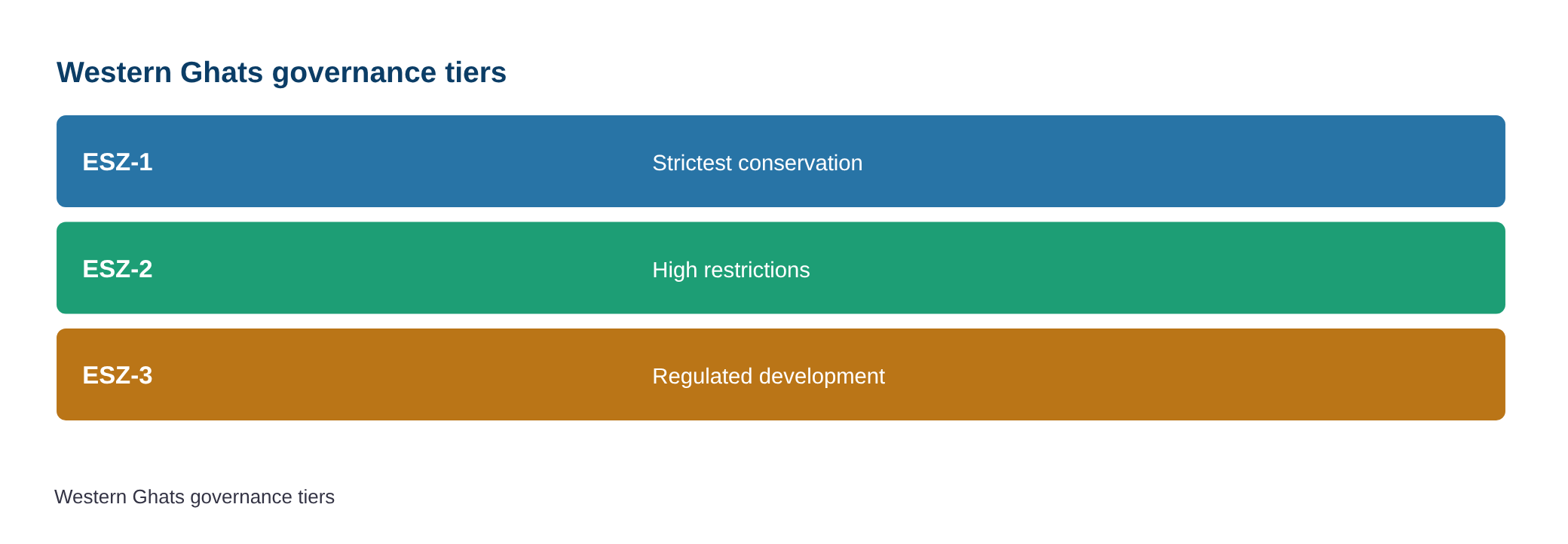
- The committee proposed a three-tier governance structure: Ecologically Sensitive Zones (ESZs) 1, 2, and 3, with varying degrees of restrictions on land use, mining, and industrial activities. ESZ-1 and ESZ-2 were proposed to have stringent regulations, while ESZ-3 allowed for regulated development.
- The Gadgil Committee Report (2011) had recommended a blanket ban on developmental activities in 64% of the Western Ghats, which faced significant opposition from state governments and local communities, leading to its diluted implementation.
- The Forest Rights Act (FRA) 2006 provides for the recognition of forest rights of forest-dwelling communities, including title deeds to cultivated lands. However, implementation challenges persist, particularly in regions where forest boundaries overlap with agricultural lands.
- The Environmental Impact Assessment (EIA) Notification 2006 mandates the assessment of projects for their environmental impact, including those in ecologically sensitive areas. However, enforcement mechanisms and compliance remain areas of concern.
What is the Kasturirangan Committee Report?
- The Kasturirangan Committee Report (2013) was submitted to the Ministry of Environment, Forest and Climate Change (MoEFCC) with recommendations for the conservation of the Western Ghats, a globally significant biodiversity hotspot.
- The report proposed the declaration of the Western Ghats as an Ecologically Sensitive Area (ESA) under the Environment (Protection) Act, 1986, to regulate developmental activities and ensure sustainable use of natural resources.
- Three Ecologically Sensitive Zones (ESZs) were recommended: ESZ-1 (highest restrictions), ESZ-2 (moderate restrictions), and ESZ-3 (regulated development). These zones were delineated based on ecological sensitivity, biodiversity, and human settlements.
- The report recommended a ban on mining, quarrying, and red-category industries in ESZ-1 and ESZ-2, while allowing regulated activities in ESZ-3 with prior environmental clearance.
- The report also proposed measures for afforestation, restoration of degraded lands, and promotion of eco-tourism to balance conservation with livelihoods of local communities.
- The committee emphasized the need for a participatory approach, involving state governments, local communities, and experts in the implementation of conservation measures.
- The report acknowledged the challenges posed by climate change and recommended measures such as afforestation, water conservation, and promotion of renewable energy to mitigate its impacts.
- The implementation of the report has been delayed due to opposition from state governments, industrial lobbies, and local communities, particularly in regions where developmental projects are proposed.
Key Features
| Feature | Significance |
|---|---|
| Kasturirangan Committee Report (2013) | A high-level committee constituted by the Ministry of Environment, Forest and Climate Change to recommend measures for the conservation of the ecologically sensitive Western Ghats region, balancing environmental protection with developmental needs. |
| Western Ghats (Ecological Hotspot) | A UNESCO World Heritage Site and one of the world’s eight ‘hottest hotspots’ of biological diversity, providing critical ecosystem services like water regulation, climate moderation, and biodiversity conservation. |
| Extended Producer Responsibility (EPR) | A policy framework under the Plastic Waste Management Rules, 2022, mandating producers, importers, and brand owners to manage the end-of-life disposal of plastic packaging waste. |
| Single-use Plastics Ban | A regulatory measure under the Plastic Waste Management Rules, 2022, aimed at reducing plastic pollution by prohibiting the manufacture, sale, and use of identified single-use plastic items. |
| Forest Rights Act, 2006 | A legislation that recognizes the rights of forest-dwelling communities, including those in the Western Ghats, to access and use forest resources for livelihood and cultural practices. |
Why it Matters
Ecological Significance
- The Western Ghats is a critical biodiversity hotspot, home to over 5,000 species of flowering plants, 139 mammal species, 508 bird species, and numerous endemic and endangered species, making its conservation vital for global biodiversity.
- The region plays a pivotal role in water conservation, acting as a catchment area for major rivers like the Godavari, Krishna, and Cauvery, which support agriculture and livelihoods across peninsular India.
- The Western Ghats contributes significantly to carbon sequestration, helping mitigate climate change by absorbing atmospheric CO2 and regulating local microclimates.
Economic Significance
- The Western Ghats supports agriculture, horticulture, and plantation-based livelihoods, including crops like arecanut, coffee, pepper, and cardamom, which are economically vital for the Malnad and other regions.
- The region is a hub for eco-tourism, wildlife tourism, and adventure tourism, generating substantial revenue and employment for local communities.
- Forest-based industries, including non-timber forest produce (NTFP) collection, contribute to the regional economy and provide livelihoods to tribal and forest-dependent communities.
Climate Change and Environmental Governance
- The Western Ghats is highly vulnerable to climate change impacts, including altered rainfall patterns, increased frequency of extreme weather events, and shifts in species distributions, necessitating adaptive governance frameworks.
- The region faces threats from deforestation, land-use change, and unsustainable development projects, which undermine its ecological integrity and resilience.
- Effective implementation of environmental laws and policies, such as the Kasturirangan Committee recommendations, is essential to balance developmental aspirations with ecological sustainability.
Challenges
1. Balancing Development and Conservation
- The Western Ghats faces a persistent challenge of reconciling developmental needs (e.g., infrastructure, agriculture, and industry) with the imperative of ecological conservation, often leading to conflicts between stakeholders.
- Projects such as the Sharavathi Pumped Storage Project, river-linking proposals, and railway projects have raised concerns over their potential to disrupt ecosystems, displace communities, and alter hydrological flows.
- The lack of a unified, participatory governance framework that integrates ecological, economic, and social dimensions of sustainability exacerbates these challenges.
UPSC Link: GS-III: Conservation, Environmental Pollution and Degradation
2. Implementation Gaps in Environmental Policies
- Despite the existence of robust environmental laws (e.g., Forest Conservation Act, 1980; Wildlife Protection Act, 1972; and the Kasturirangan Committee recommendations), their implementation remains inconsistent due to bureaucratic, political, and socio-economic constraints.
- The enforcement of the ban on single-use plastics and the Extended Producer Responsibility (EPR) system faces challenges such as lack of awareness, inadequate infrastructure for waste management, and resistance from industries and consumers.
- The absence of a dedicated institutional mechanism for monitoring and evaluating the implementation of environmental policies further hampers progress.
UPSC Link: GS-III: Environmental Impact Assessment
3. Land Tenure and Forest Rights
- A significant proportion of communities in the Western Ghats lack secure land titles due to historical and legal ambiguities in forest-related laws, which prevents them from accessing government schemes, credit facilities, and legal protections.
- The Forest Rights Act, 2006, while progressive, faces implementation challenges, including delays in recognition of rights, lack of awareness among forest-dwelling communities, and conflicts with conservation objectives.
- Uncertain land tenure exacerbates vulnerabilities to displacement, loss of livelihoods, and marginalization, particularly in the context of developmental projects.
UPSC Link: GS-II: Government Policies and Interventions
4. Climate Change Vulnerability
- The Western Ghats is highly susceptible to climate change impacts, including altered monsoon patterns, increased frequency of droughts and floods, and shifts in temperature regimes, which threaten agricultural productivity and ecosystem services.
- Climate-induced changes in crop diseases (e.g., arecanut, coffee, and pepper) and the spread of invasive species pose additional challenges to livelihoods and food security in the region.
- The lack of climate-resilient agricultural practices and adaptive governance frameworks further compounds these vulnerabilities.
UPSC Link: GS-III: Conservation, Environmental Pollution and Degradation
5. Public Participation and Awareness
- While civil society organizations and advocacy groups play a crucial role in raising awareness and advocating for environmental conservation, their efforts are often met with resistance from vested interests and political pressures.
- The absence of structured platforms for multi-stakeholder dialogue and participatory decision-making limits the effectiveness of conservation initiatives and exacerbates conflicts.
- Low awareness among local communities about their rights, entitlements, and environmental laws further hinders grassroots participation in conservation efforts.
UPSC Link: GS-II: Government Policies and Interventions
Challenges — UPSC Perspective
| Issue | Concern |
|---|---|
| Development vs Conservation | Conflicts between infrastructure projects and ecological integrity, leading to policy paralysis and stakeholder disputes. |
| Implementation Gaps | Inconsistent enforcement of environmental laws and policies due to bureaucratic, political, and socio-economic constraints. |
| Land Tenure Insecurity | Lack of secure land titles for forest-dwelling communities, limiting access to government schemes and credit facilities. |
| Climate Change Impacts | Altered monsoon patterns, crop diseases, and ecosystem disruptions threaten livelihoods and food security. |
| Plastic Pollution | Unregulated single-use plastics and inadequate waste management infrastructure exacerbate environmental degradation. |
| Public Participation | Limited awareness and structured platforms for multi-stakeholder dialogue hinder effective conservation efforts. |
Government Initiatives — Must-Memorise for Prelims
- Forest Rights Act, 2006
- National Mission for a Green India (GIM)
Way Forward
- Strengthen the implementation of the Kasturirangan Committee recommendations through a multi-stakeholder governance framework that integrates ecological, economic, and social dimensions.
- Establish a dedicated institutional mechanism for monitoring and evaluating the enforcement of environmental laws, including the ban on single-use plastics and the Extended Producer Responsibility (EPR) system.
- Accelerate the recognition and settlement of forest rights under the Forest Rights Act, 2006, to ensure secure land tenure for forest-dwelling communities and facilitate their participation in conservation efforts.
- Promote climate-resilient agricultural practices and adaptive governance frameworks to mitigate the impacts of climate change on livelihoods and ecosystem services in the Western Ghats.
- Enhance public participation and awareness through structured platforms for dialogue, capacity-building programs, and community-led conservation initiatives.
- Conduct comprehensive Environmental Impact Assessments (EIAs) for proposed projects in the Western Ghats, ensuring adherence to the precautionary principle and participatory decision-making.
- Invest in waste management infrastructure and awareness campaigns to enforce the ban on single-use plastics and promote sustainable alternatives like cloth bags.
- Foster collaboration between government agencies, civil society organizations, and local communities to develop integrated conservation and livelihood strategies for the Western Ghats.
UPSC Value Addition
Keywords for Mains Answer-Writing
Western Ghats Ecology Expert Panel (WGEEP) · Kasturirangan Committee Report · Environmental Protection Act · Forest Rights Act, 2006 · Climate Emergency Declaration · Single-use Plastics Ban · Extended Producer Responsibility (EPR) · Western Ghats Conservation · River-linking Projects · Agrarian Crisis and Forest Laws · Environmental Satyagraha · Biodiversity Hotspots · Sustainable Development Goals (SDGs) · Tribal and Forest-Dependent Communities
Constitutional & Policy Linkages
- Article 48A: Directive Principles of State Policy (Protection and improvement of environment and safeguarding of forests and wildlife)
- Article 51A(g): Fundamental Duties (To protect and improve the natural environment including forests and wildlife)
Concept Flow
Western Ghats identified as an ecological hotspot and UNESCO World Heritage Site → Kasturirangan Committee (2013) recommends conservation measures balancing development and environmental protection → Implementation gaps in environmental policies and land tenure issues lead to conflicts and vulnerabilities → Climate change exacerbates ecological and socio-economic challenges in the region → Advocacy groups demand implementation of Kasturirangan report and stricter enforcement of environmental laws → Government faces the dual challenge of addressing conservation needs and developmental aspirations → Multi-stakeholder governance and participatory frameworks emerge as critical solutions
Prelims Practice Questions
Q1. Consider the following statements regarding the Kasturirangan Committee Report on the Western Ghats:
1. It recommended a blanket ban on all developmental activities in the Western Ghats.
2. It proposed the establishment of a Western Ghats Ecology Authority.
3. It suggested the withdrawal of certain projects like the Sharavathi Pumped Storage Project.
4. It recommended the implementation of the Forest Rights Act, 2006, in letter and spirit.
How many of the above statements are correct?
- Only one
- Only two
- Only three
- All four
Answer: Only three — Statements 2 and 3 are correct. The Kasturirangan Committee recommended the establishment of a Western Ghats Ecology Authority and the withdrawal of certain projects, including the Sharavathi Pumped Storage Project. Statements 1 and 4 are incorrect as the report did not propose a blanket ban and did not specifically recommend the Forest Rights Act.
Q2. Assertion (A): The Western Ghats is designated as one of the world’s biodiversity hotspots.
Reason (R): The region is home to a significant number of endemic species and is ecologically fragile.
Options:
A. Both A and R are true, and R is the correct explanation of A.
B. Both A and R are true, but R is not the correct explanation of A.
C. A is true, but R is false.
D. A is false, but R is true.
Answer: ? — Both Assertion (A) and Reason (R) are true, and Reason (R) correctly explains Assertion (A). The Western Ghats is indeed a biodiversity hotspot due to its high level of endemism and ecological fragility.
Q3. Which of the following is NOT a primary objective of the Extended Producer Responsibility (EPR) system as envisaged under the Plastic Waste Management Rules, 2016?
A. To ensure the collection and recycling of plastic waste generated from products.
B. To mandate the use of biodegradable plastics in all packaging.
C. To hold manufacturers accountable for the end-of-life management of their products.
D. To promote the use of alternatives to single-use plastics.
- A
- B
- C
- D
Answer: B — Option B is not a primary objective of the EPR system. The EPR system focuses on the collection, recycling, and accountability of manufacturers for plastic waste, not mandating the use of biodegradable plastics.
Mains Practice Question
✍ The Kasturirangan Committee Report (2013) represents a critical intervention in the governance of the Western Ghats, a globally significant biodiversity hotspot. Critically examine the report’s key recommendations and their implications for environmental conservation, sustainable development, and the rights of forest-dependent communities. Also, analyse the challenges in implementing these recommendations in the context of developmental pressures and competing socio-economic interests. (15 Marks)
Approach: MODEL-ANSWER SKELETON:
1. **Introduction (2 Marks)**:
– Brief on the Western Ghats: biodiversity hotspot, ecological significance, and threats.
– Context of the Kasturirangan Committee (constituted under the Environment (Protection) Act, 1986) and its mandate.
– Mention the WGEEP (Gadgil Committee) report as a precursor and the need for a balanced approach.
2. **Key Recommendations of the Kasturirangan Committee (5 Marks)**:
– **Ecological Zoning**: Three-tier zoning (Ecologically Sensitive Zones ESZ 1, 2, 3) with varying degrees of restrictions.
– **Western Ghats Ecology Authority**: Proposal for a statutory authority to oversee implementation.
– **Project Withdrawals**: Identification of projects (e.g., Sharavathi Pumped Storage, river-linking projects) for withdrawal due to ecological impact.
– **Forest Rights Act, 2006**: Recommendations for harmonising conservation with forest rights, including land title issues.
– **Climate Change Mitigation**: Integration of climate resilience measures.
3. **Implications for Conservation and Sustainable Development (4 Marks)**:
– **Environmental Conservation**: Strengthening of legal frameworks, ecological monitoring, and biodiversity protection.
– **Sustainable Development**: Balancing conservation with livelihoods, agroforestry, and eco-tourism.
– **Legal and Institutional Framework**: Role of the proposed Western Ghats Ecology Authority and alignment with existing laws (e.g., Forest Rights Act, 2006; Environment Protection Act, 1986).
– **Global Commitments**: Alignment with SDGs (e.g., SDG 13 on climate action, SDG 15 on life on land).
4. **Challenges in Implementation (3 Marks)**:
– **Developmental Pressures**: Conflicts with infrastructure projects (e.g., river-linking, railways) and economic growth priorities.
– **Socio-Economic Interests**: Resistance from local communities, farmers, and industries dependent on the Western Ghats.
– **Legal and Administrative Hurdles**: Delays in notification of ESZs, lack of clarity in land titles, and enforcement challenges.
– **Political and Bureaucratic Will**: Need for sustained political commitment and inter-state coordination.
5. **Conclusion (1 Mark)**:
– Reiterate the need for a balanced, participatory, and evidence-based approach to governance in the Western Ghats.
– Highlight the role of civil society, judiciary, and local institutions in ensuring compliance and addressing grievances.
Source: The Hindu
Generated by AanyaAi for educational purpose.
Related guides on our sites
- Best economics services coaching
- Anthropology VS PSIR
- Best PSIR optional coaching
- Best PSIR optional coaching online

- कस्तूरीरंगन रिपोर्ट लागू करने की मांग: पश्चिमी घाट संरक्षण पर सरकार से अपील - September 20, 2026
- Foundation urges Kasturirangan report implementation for Western Ghats protection - September 20, 2026
- कैट की जम्मू बेंच: सेवा मामलों के निपटारे में देश में सर्वोच्च, जानें पूरा विवरण - September 20, 2026

No Comments