


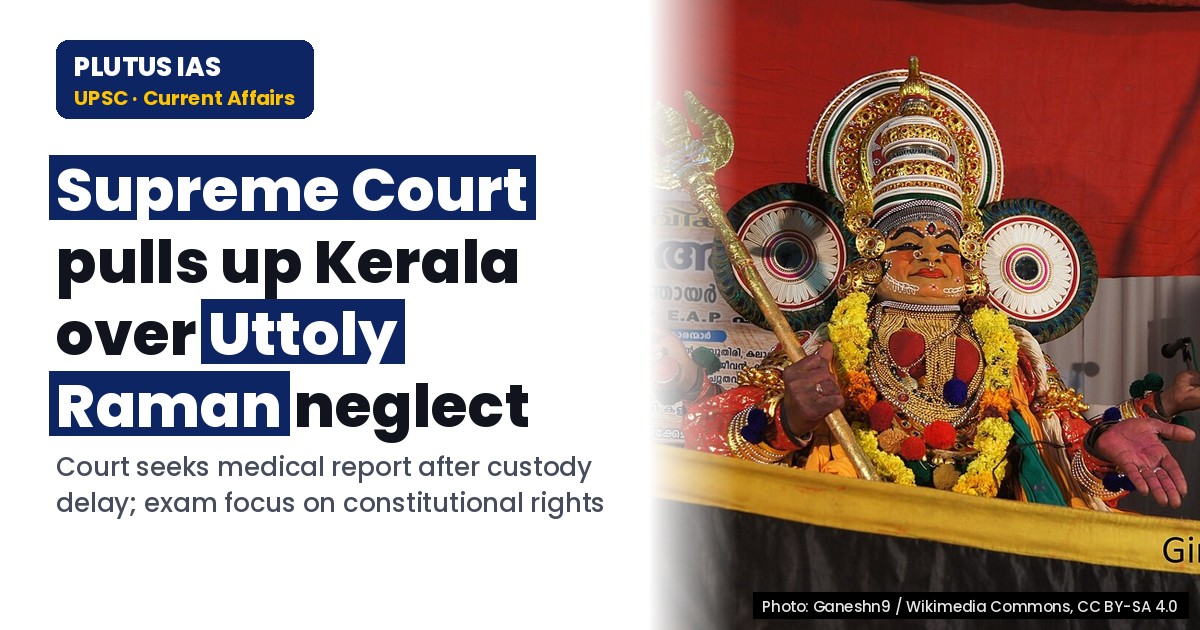
09 Oct Supreme Court Slams Kerala Over Welfare of Tallest Captive Elephant
✎ Captive elephants in India are protected under the Wildlife Protection Act 1972, the Prevention of Cruelty to Animals Act 1960, and the Captive Elephant Management Guidelines, which mandate regular health check-ups, humane…
Subject Relevance — Where This Topic Fits
- GS Paper II — Governance, Constitution, Polity, Social Justice and International Relations (Animal Welfare as part of Fundamental Duties and Directive Principles) | GS Paper III — Environment and Ecology (Conservation of Wildlife and Biodiversity)
- Prelims: Fundamental Duty (Article 51A(g)), Wildlife Protection Act 1972, Prevention of Cruelty to Animals Act 1960, Animal Welfare Board of India (AWBI), Section 42 of the Wildlife Protection Act, Captive Elephant Management Guidelines, Central Zoo Authority, Project Elephant, Judicial activism in environmental governance, Public Interest Litigation (PIL), Contempt of Court, Judicial review
- Essay: Ethical stewardship of non-human life forms: Balancing tradition, commerce, and welfare, The role of judiciary in ensuring constitutional morality in governance
Quick Revision: Captive elephants in India are protected under the Wildlife Protection Act 1972, the Prevention of Cruelty to Animals Act 1960, and the Captive Elephant Management Guidelines, which mandate regular health check-ups, humane treatment, and prohibition of commercial use.
Why is this in the news?
The Supreme Court of India, on October 9, 2026, reprimanded the Kerala government for its failure to comply with its June 2026 order concerning the welfare of Uttoly Raman, Kerala’s tallest captive elephant. The Court directed the State to submit a fresh medical examination report by October 12, 2026, and raised serious concerns over the delay in custody transfer and the absence of welfare measures. This case underscores the judiciary’s role in enforcing constitutional and statutory obligations toward animal welfare, particularly in resolving ownership disputes and ensuring humane treatment of captive elephants.
Background
- The ownership of Uttoly Raman, a captive elephant in Kerala, has been contested between the former caretaker, Krishnankutty, since its acquisition in 2018.
- The Supreme Court, in June 2026, had directed the Kerala government to take custody of Uttoly Raman to prevent its commercial exploitation and ensure its welfare, following a contempt petition filed against Krishnankutty for violating undertakings.
- The Kerala government’s affidavit to the Supreme Court failed to disclose the timeline of custody transfer or the measures taken for the elephant’s welfare, citing delays due to the State Assembly elections in Kerala.
- The Supreme Court had earlier observed that Krishnankutty’s treatment of the elephant amounted to commercial exploitation, and the Bench had held him in contempt for violating court orders.
- Captive elephants in India are governed by the Wildlife Protection Act 1972, the Prevention of Cruelty to Animals Act 1960, and the Captive Elephant Management Guidelines issued by the Ministry of Environment, Forest and Climate Change.
- The case highlights systemic challenges in enforcing animal welfare laws, particularly in resolving ownership disputes and ensuring compliance with judicial directives.
What are the legal and ethical frameworks governing captive elephants in India?
- The Wildlife Protection Act 1972: Classifies elephants as Schedule I species, granting them the highest legal protection. Section 42 prohibits the keeping of captive elephants without prior permission from the Chief Wildlife Warden.
- Prevention of Cruelty to Animals Act 1960: Criminalizes acts of cruelty, neglect, or torture toward animals. Section 11 defines offenses such as beating, overloading, or subjecting animals to unnecessary pain.
- Captive Elephant Management Guidelines: Issued by the Ministry of Environment, Forest and Climate Change, these guidelines mandate regular health check-ups, proper housing, and prohibition of commercial use.
- Fundamental Duties (Article 51A(g)): Imposes a constitutional obligation on citizens to have compassion for living creatures and to protect and improve the natural environment.
- Judicial Review and PIL: The Supreme Court has repeatedly intervened in cases of animal cruelty or neglect through Public Interest Litigations, emphasizing the right to life (Article 21) as extending to animals.
- Contempt of Court: Violation of court orders, such as those prohibiting commercial exploitation of animals, can lead to contempt proceedings under the Contempt of Courts Act 1971.
Key Features
| Feature | Significance |
|---|---|
| Custody transfer to State government | Ensures legal oversight of the elephant’s welfare and resolves the ownership dispute through judicial intervention. |
| Medical examination requirement | Mandates regular health assessments to monitor the physical condition of the captive elephant and prevent exploitation. |
| Contempt proceedings against caretaker | Upholds judicial orders by penalising violations of undertakings regarding the elephant’s use and care. |
| Judicial scrutiny of State compliance | Strengthens accountability of executive actions in wildlife protection cases. |
| Restriction on former caretaker | Prevents potential misuse or commercial exploitation of the elephant post-custody transfer. |
Why it Matters
Legal Governance
- Demonstrates the judiciary’s role in enforcing welfare standards for captive wildlife under Articles 21 and 51A(g) of the Constitution.
- Highlights the obligation of State governments to comply with judicial directives in wildlife protection cases.
- Reinforces the principle that judicial orders must be adhered to irrespective of administrative delays or electoral processes.
Wildlife Protection
- Emphasises the need for systematic medical care and monitoring of captive elephants to prevent cruelty and exploitation.
- Underscores the ethical imperative of ensuring the well-being of animals held in captivity, especially those with cultural or religious significance.
- Illustrates the intersection of legal, ethical, and ecological considerations in wildlife governance.
Administrative Accountability
- Exposes gaps in inter-institutional coordination between the judiciary, executive, and caretakers in wildlife protection cases.
- Shows the consequences of delays in compliance with judicial orders, particularly during electoral periods.
- Sets a precedent for stricter enforcement of wildlife protection laws and judicial directives.
Challenges
1. Judicial Enforcement Delays
- Administrative delays in compliance with judicial orders, such as during electoral periods, undermine the rule of law.
- Lack of timely updates to the court on compliance measures reflects systemic inefficiencies in governance.
- The incident highlights the need for robust mechanisms to ensure real-time monitoring and reporting of judicial directives.
UPSC Link: GS-II: Judiciary and Judicial Review
2. Custody and Ownership Disputes
- Prolonged legal disputes over ownership of captive wildlife complicate welfare and protection measures.
- Conflicting claims between institutions (e.g., religious mutts) and individuals create governance vacuums.
- The absence of clear legal frameworks for resolving such disputes exacerbates the problem.
UPSC Link: GS-III: Conservation, Environmental Pollution and Degradation
3. Commercial Exploitation of Wildlife
- Instances of commercial exploitation of captive elephants violate ethical and legal standards under the Wildlife Protection Act, 1972.
- Judicial interventions are necessary to curb such practices and ensure humane treatment.
- The case underscores the need for stricter regulatory oversight of wildlife in captivity.
UPSC Link: GS-III: Environmental Conservation
4. Health Monitoring of Captive Wildlife
- Inadequate or delayed medical examinations of captive elephants pose risks to their health and well-being.
- The lack of standardised protocols for health assessments in captivity hampers effective monitoring.
- Judicial directives to submit medical reports highlight the urgency of establishing systematic health monitoring systems.
UPSC Link: GS-III: Environmental Conservation
Challenges — UPSC Perspective
| Issue | Concern |
|---|---|
| Delay in compliance with judicial orders | Undermines the authority of the judiciary and delays welfare measures for the elephant. |
| Ownership disputes over captive wildlife | Complicates welfare and protection measures due to conflicting claims and legal ambiguities. |
| Commercial exploitation of elephants | Violates ethical and legal standards, leading to cruelty and exploitation. |
| Inadequate health monitoring systems | Risks the physical and psychological well-being of captive elephants. |
| Lack of inter-institutional coordination | Leads to gaps in enforcement and delays in compliance with judicial directives. |
Way Forward
- The State government must submit the latest medical examination report of Uttoly Raman by October 12, 2026, as directed by the Supreme Court.
- Establish a dedicated inter-departmental committee to oversee the welfare and health monitoring of captive elephants in Kerala.
- Implement standardised protocols for regular health check-ups, including veterinary assessments and documentation.
- Strengthen enforcement mechanisms to prevent commercial exploitation and ensure compliance with judicial orders.
- Resolve ownership disputes through transparent legal processes, prioritising the welfare of the animal over institutional or individual claims.
- Conduct periodic audits of captive wildlife facilities to ensure adherence to welfare standards and legal provisions.
- Enhance public awareness campaigns on the ethical treatment of captive wildlife and the legal consequences of exploitation.
UPSC Value Addition
Keywords for Mains Answer-Writing
Animal Welfare Board of India · Wild Life (Protection) Act, 1972 · Fundamental Duty under Article 51A(g) · Supreme Court directives on animal rights · Captive elephant welfare · Judicial activism in environmental governance · Constitutional provisions for animal protection · Kerala State Animal Welfare Board · Judicial review of executive inaction · Preventive and remedial measures under law
Constitutional & Policy Linkages
- Article 21: Right to Life and Personal Liberty (includes the right to a life of dignity for animals).
- Article 51A(g): Fundamental Duty to protect and improve the natural environment, including wildlife.
Concept Flow
Ownership dispute over captive elephant → Judicial intervention for custody transfer → State government assumes responsibility → Delay in compliance due to administrative reasons → Judicial scrutiny of compliance → Directives for medical examination → Concerns over commercial exploitation → Restrictions on former caretaker → Emphasis on welfare standards.
Prelims Practice Questions
Q1. Consider the following statements regarding the legal framework for animal welfare in India:
1. The Wild Life (Protection) Act, 1972, provides for the protection and welfare of wild animals, including captive elephants.
2. The Animal Welfare Board of India (AWBI) is a statutory body established under the Prevention of Cruelty to Animals Act, 1960.
3. The Fundamental Duty under Article 51A(g) of the Constitution of India enjoins upon citizens to have compassion for all living creatures.
4. The Supreme Court of India has no jurisdiction to issue directions for the welfare of individual animals.
How many of the above statements are correct?
- Only one
- Only two
- Only three
- All
Answer: Only three — Statements 1, 2, and 3 are correct. Statement 4 is incorrect as the Supreme Court has repeatedly issued directions for animal welfare under its writ jurisdiction. The Wild Life (Protection) Act, 1972, governs wild animals, including captive ones. The AWBI is established under the Prevention of Cruelty to Animals Act, 1960, and Article 51A(g) imposes a Fundamental Duty on citizens.
Q2. Assertion (A): The Supreme Court of India can suo motu take cognizance of issues pertaining to animal welfare.
Reason (R): Article 32 of the Constitution of India empowers the Supreme Court to issue writs for the enforcement of Fundamental Rights, including those related to animal welfare.
Options:
A. Both A and R are true, and R is the correct explanation of A.
B. Both A and R are true, but R is not the correct explanation of A.
C. A is true, but R is false.
D. A is false, but R is true.
Answer: ? — Both Assertion (A) and Reason (R) are true. The Supreme Court can suo motu take cognizance of animal welfare issues under Article 32, which empowers it to issue writs for the enforcement of Fundamental Rights. However, animal welfare is not a Fundamental Right but is protected through statutory and constitutional provisions. Thus, R is not the correct explanation of A.
Q3. Match the following legal provisions with their respective purposes:
Column I
1. Article 51A(g) of the Constitution of India
2. Wild Life (Protection) Act, 1972
3. Prevention of Cruelty to Animals Act, 1960
4. Section 429 of the Indian Penal Code, 1860
Column II
A. Provides for punishment for killing or maiming animals
B. Imposes a Fundamental Duty on citizens to show compassion for living creatures
C. Governs the protection and welfare of wild animals, including captive elephants
D. Establishes the Animal Welfare Board of India and penalizes cruelty to animals
Options:
1-B, 2-C, 3-D, 4-A
1-A, 2-B, 3-C, 4-D
1-D, 2-A, 3-B, 4-C
1-C, 2-D, 3-A, 4-B
Answer: ? — The correct match is: 1-B (Article 51A(g) imposes a Fundamental Duty on citizens), 2-C (Wild Life (Protection) Act, 1972 governs wild animals), 3-D (Prevention of Cruelty to Animals Act, 1960 establishes the AWBI and penalizes cruelty), and 4-A (Section 429 IPC provides punishment for killing or maiming animals).
Mains Practice Question
✍ The Supreme Court of India, in its recent directive concerning the welfare of a captive elephant in Kerala, has underscored the role of judicial institutions in ensuring compliance with statutory and constitutional obligations toward animal welfare. Critically examine the constitutional and statutory framework governing animal welfare in India, with particular reference to the role of the judiciary in enforcing these provisions. Also, analyse the challenges faced in the implementation of such directives at the ground level. (15 Marks)
Approach: MODEL-ANSWER SKELETON:
1. **Constitutional Framework** (3 Marks):
– Article 51A(g) of the Constitution of India: Fundamental Duty to show compassion for living creatures.
– Article 21 (Right to Life and Dignity): Extended to animals through judicial interpretation (e.g., *Animal Welfare Board of India v. A. Nagaraja & Ors.*, 2014).
– Article 48A (Directive Principle of State Policy): States to protect and improve the environment, including wildlife.
2. **Statutory Framework** (4 Marks):
– Wild Life (Protection) Act, 1972: Governs the protection and welfare of wild animals, including captive elephants (Schedule I species).
– Prevention of Cruelty to Animals Act, 1960: Establishes the Animal Welfare Board of India (AWBI) and penalizes cruelty (Sections 11-17).
– Indian Penal Code, 1860: Section 429 (punishment for killing or maiming animals) and Section 268 (public nuisance).
– State-specific laws: Kerala Captive Animals (Registration and Control) Rules, 2012.
3. **Judicial Role and Activism** (4 Marks):
– Judicial review under Article 32 and 226: Supreme Court and High Courts can issue directions for animal welfare (e.g., *A. Nagaraja case*, 2014; *Supreme Court’s directions in 2021 for elephant welfare*).
– Suo motu cognizance: Courts can take up issues of animal cruelty or welfare on their own (e.g., *Supreme Court’s recent directive in Kerala elephant case*).
– Balancing rights: Courts weigh animal welfare against cultural or religious practices (e.g., *Jain Deemed University v. Union of India*, 2020 on animal sacrifice).
4. **Challenges in Implementation** (3 Marks):
– Lack of awareness and sensitization among stakeholders (e.g., owners, caretakers, and local authorities).
– Inadequate resources and infrastructure for veterinary care and rehabilitation.
– Conflicts between statutory provisions and traditional practices (e.g., temple elephants).
– Delayed or selective compliance by state governments due to administrative bottlenecks or political considerations.
– Monitoring and enforcement gaps: AWBI and state boards often lack the capacity to conduct regular inspections or penalize violations.
5. **Way Forward** (1 Mark):
– Strengthening AWBI and state animal welfare boards with adequate funding and personnel.
– Sensitization programs for owners, caretakers, and local communities.
– Strict adherence to judicial directives and periodic reporting by states.
– Collaboration with NGOs and veterinary institutions for rehabilitation and care.
Source: The Hindu
Kerala PCS (Kerala PSC (KAS)) — State PCS Practice
Prelims: The Supreme Court recently sought a medical report of Kerala’s tallest captive elephant. Which of the following is the most likely reason for the Supreme Court’s intervention in this matter?
- A. To ensure compliance with the Wildlife Protection Act, 1972, regarding the welfare of captive elephants
- B. To investigate allegations of illegal trade in captive elephants in Kerala
- C. To assess the eligibility of the elephant for participation in religious processions
- D. To determine the ownership rights of the elephant between the State government and private parties
Answer: A. To ensure compliance with the Wildlife Protection Act, 1972, regarding the welfare of captive elephants — The Supreme Court intervened to ensure the welfare of the captive elephant, aligning with provisions of the Wildlife Protection Act, 1972, which mandates proper care and protection of wild animals.
Mains: Critically analyze the role of the judiciary in safeguarding the welfare of captive elephants in Kerala, citing the recent Supreme Court directive. Discuss the constitutional and legal provisions that empower such judicial interventions, and suggest measures to improve the management of captive elephants in the state.
Generated by AanyaAi for educational purpose.
Related guides on our sites
- Best economics services coaching
- Anthropology VS PSIR
- Best PSIR optional coaching
- Best PSIR optional coaching online


No Comments