


29 Oct Karnataka to evaluate impact of welfare schemes via Project K-Monitor
✎ Project K-Monitor represents Karnataka’s shift towards outcome-based governance, utilising systematic evaluation to enhance the efficacy of welfare schemes and ensure administrative accountability.
Subject Relevance — Where This Topic Fits
- GS Paper II — Governance, Constitution, Polity, Social Justice and International Relations | GS Paper III — Indian Economy: Issues Relating to Planning, Mobilisation of Resources, Growth, Development and Employment
- Prelims: Public Policy Evaluation, Beneficiary Targeting, Welfare Schemes, Particularly Vulnerable Tribal Groups (PVTGs), Adivasi Development Board, Direct Benefit Transfer (DBT), Outcome Monitoring, Public Service Delivery, Fiscal Federalism
- Essay: The Role of Evidence-Based Policy Making in Governance, Balancing Welfare Expansion with Fiscal Prudence and Administrative Efficiency
Quick Revision: Project K-Monitor represents Karnataka’s shift towards outcome-based governance, utilising systematic evaluation to enhance the efficacy of welfare schemes and ensure administrative accountability.
Why is this in the news?
The Karnataka Cabinet’s decision to launch ‘Project K-Monitor’—a statewide evaluation of government schemes, including guarantees and welfare programmes—reflects a growing emphasis on outcome-based governance and administrative accountability. This initiative, costing ₹14 crore, aims to assess the real-world impact of public policies, address implementation gaps, and enhance service delivery across sectors such as agriculture, healthcare, and education. The move is particularly significant in the context of rising fiscal pressures and debates over the efficacy of welfare schemes, making it a critical case study for UPSC aspirants examining governance reforms and policy evaluation mechanisms in India.
Background
- The Government of Karnataka has implemented several welfare schemes, including guarantees such as free electricity (Gruha Jyothi), monthly assistance to women heads of households (Gruha Lakshmi), food grains (Anna Bhagya), free travel for women in state buses (Shakti), and an unemployment allowance (Yuva Nidhi), to address socio-economic disparities and enhance public welfare.
- Criticisms have emerged regarding the targeting efficiency and impact assessment of these schemes, with concerns about leakage, duplication of benefits, and inadequate monitoring mechanisms.
- The concept of outcome-based governance has gained traction globally, with India’s NITI Aayog and state governments increasingly adopting performance monitoring frameworks to improve policy effectiveness.
- Karnataka’s Praja Seva Department, tasked with citizen service delivery, has been instrumental in streamlining administrative processes, and its role in Project K-Monitor underscores the institutionalisation of data-driven governance.
- The state’s decision to evaluate schemes aligns with constitutional provisions such as Directive Principles of State Policy (Articles 38, 39, and 41), which emphasise welfare and equitable growth.
- The initiative also reflects broader trends in India’s fiscal federalism, where states are leveraging their autonomy to innovate in public policy evaluation and service delivery.
What is Project K-Monitor?
- A statewide evaluation initiative launched by the Karnataka Government to assess the impact and implementation of public welfare schemes, including guarantees and direct benefit transfers.
- The project is named ‘K-Monitor’ to signify Karnataka’s commitment to systematic monitoring and evaluation of government programmes.
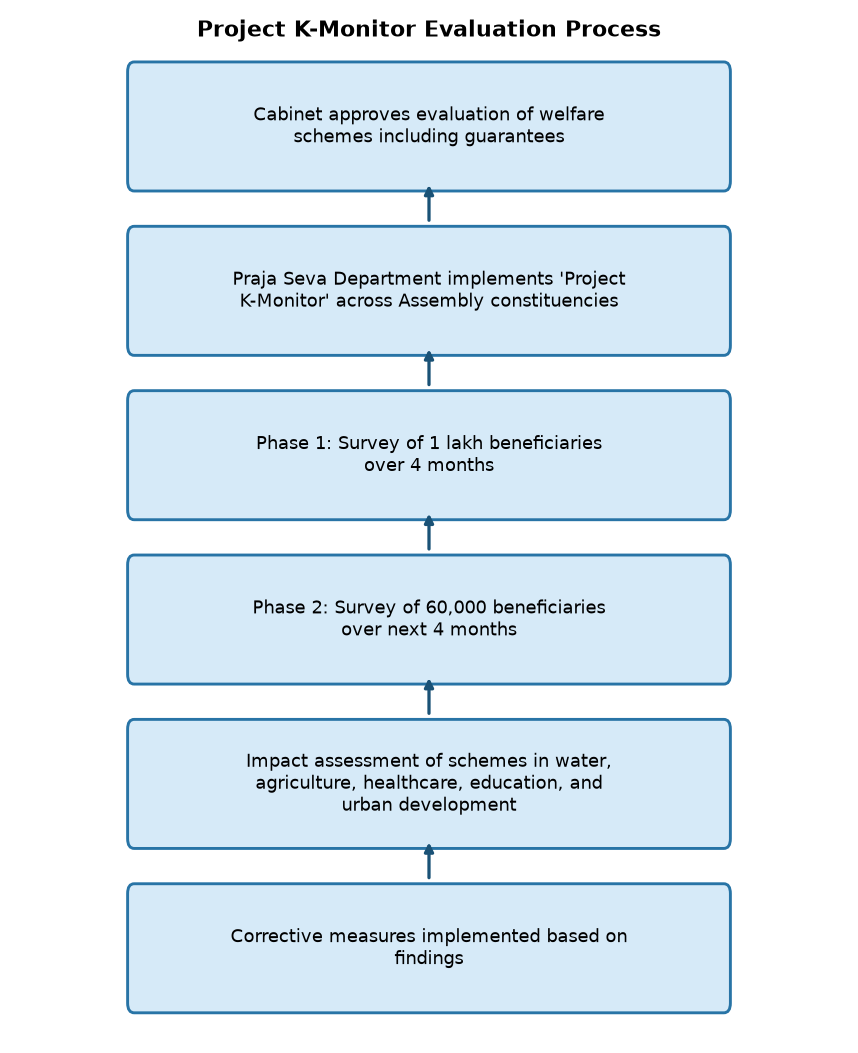
- It will be implemented in two phases over eight months, covering 1,60,000 beneficiaries across all Assembly constituencies to ensure comprehensive data collection and analysis.
- The evaluation will focus on key sectors such as water resources, agriculture, healthcare, education, and urban development to identify implementation gaps and administrative bottlenecks.
- The monitoring system will collect data on public service delivery, infrastructure development, employment opportunities, and other administrative outcomes to facilitate corrective action.
- The Praja Seva Department will lead the initiative, utilising ₹14 crore in funds to establish a robust data collection and analysis framework.
- The project aims to shift governance from mere implementation to measurable impact, ensuring that welfare schemes achieve their intended objectives.
- Findings from the evaluation will inform policy adjustments, improve targeting of beneficiaries, and enhance the efficiency of public service delivery.
Key Features
| Feature | Significance |
|---|---|
| Project K-Monitor | A state-wide evaluation initiative to assess the impact of welfare schemes, including guarantees, across all Assembly constituencies, ensuring evidence-based policy refinement. |
| Two-phase evaluation | Phase I covers 1 lakh beneficiaries; Phase II covers 60,000, enabling systematic data collection and comparative analysis over eight months. |
| Praja Seva Department oversight | Central nodal agency for monitoring, ensuring administrative coherence and accountability in scheme implementation and impact assessment. |
| ₹14 crore budget allocation | Funding for data collection, infrastructure, and analytical tools to establish a robust monitoring and evaluation mechanism. |
| Multi-sectoral coverage | Evaluation spans water resources, agriculture, healthcare, education, and urban development to assess cross-sectoral policy outcomes. |
Why it Matters
Governance and Public Policy
- Introduction of a structured framework for ex-post evaluation of welfare schemes, addressing concerns about expenditure efficiency and beneficiary targeting.
- Enhances transparency by quantifying scheme impact, enabling evidence-based adjustments to policy design and implementation strategies.
- Strengthens administrative accountability through systematic monitoring of departmental performance and identification of implementation gaps.
Social Welfare and Inclusion
- Demonstrates a commitment to inclusive development by evaluating schemes targeting marginalized and vulnerable groups, including tribal communities.
- Facilitates targeted interventions by identifying underperforming schemes and areas requiring corrective measures to maximize social impact.
Institutional Capacity Building
- Establishes a dedicated department (Praja Seva) for monitoring and evaluation, fostering institutional expertise in data-driven governance.
- Promotes the use of administrative data for policy refinement, reducing reliance on ad-hoc assessments and enhancing long-term planning.
Challenges
1. Data Quality and Reliability
- Risk of incomplete or inaccurate data collection due to survey fatigue among beneficiaries or administrative bottlenecks in field verification.
- Need for robust data validation mechanisms to ensure the credibility of evaluation findings and prevent misallocation of resources.
UPSC Link: GS2: Governance, Transparency
2. Targeting and Leakage in Welfare Schemes
- Potential for exclusion errors where deserving beneficiaries are overlooked, or inclusion errors where ineligible individuals receive benefits.
- Challenge of balancing universal coverage with targeted delivery, particularly in schemes with broad eligibility criteria.
UPSC Link: GS2: Welfare Schemes
3. Administrative Coordination and Interdepartmental Synergy
- Risk of siloed functioning among departments, leading to fragmented data collection and inconsistent evaluation methodologies.
- Need for standardized protocols to ensure comparability of findings across sectors and constituencies.
UPSC Link: GS2: Government Policies
4. Cost-Effectiveness vs. Scale of Evaluation
- Balancing the financial outlay (₹14 crore) with the scale of evaluation to ensure sustainability and scalability of the monitoring system.
- Risk of high administrative costs outweighing the benefits if the evaluation does not lead to tangible improvements in scheme delivery.
UPSC Link: GS3: Economic Development
Challenges — UPSC Perspective
| Issue | Concern |
|---|---|
| Data Collection Bottlenecks | Delays in field surveys or incomplete beneficiary responses may compromise the timeliness and accuracy of evaluation. |
| Political and Bureaucratic Resistance | Stakeholders may resist scrutiny due to perceived threats to autonomy or reputational risks, hindering objective assessment. |
| Lack of Standardized Metrics | Variations in evaluation criteria across departments may lead to inconsistent findings and hinder comparative analysis. |
| Sustainability of Monitoring System | Long-term viability of the Praja Seva Department’s role in ongoing evaluation without dedicated funding or institutional support. |
Government Initiatives — Must-Memorise for Prelims
- Karnataka Guarantee Schemes (e.g., Anna Bhagya, Gruha Jyothi, etc.)
- Karnataka Adivasi Development Board (proposed)
Way Forward
- Develop a standardized framework for data collection, ensuring uniformity in metrics across sectors and constituencies.
- Strengthen inter-departmental coordination through joint task forces to align evaluation methodologies and share best practices.
- Invest in training and capacity-building for field enumerators to enhance data quality and reduce survey fatigue among beneficiaries.
- Establish a grievance redressal mechanism for beneficiaries to report discrepancies in scheme delivery during the evaluation process.
- Pilot targeted corrective measures in identified underperforming constituencies to validate the efficacy of proposed reforms.
- Integrate evaluation findings into annual budgetary allocations to ensure resource allocation aligns with demonstrated impact.
- Explore the use of digital tools (e.g., GIS mapping, mobile applications) to streamline data collection and real-time monitoring.
- Conduct periodic reviews of the Praja Seva Department’s functioning to assess its effectiveness and recommend structural improvements.
UPSC Value Addition
Keywords for Mains Answer-Writing
Public policy evaluation · performance audit · welfare scheme impact assessment · beneficiary targeting · Praja Seva Department · Project K-Monitor · Particularly Vulnerable Tribal Groups (PVTGs) · Adivasi Development Board · governance monitoring mechanisms · infrastructure development in tribal regions · Karnataka governance initiatives · scheme implementation gaps · public service delivery assessment · constitutional governance · tribal welfare schemes
Concept Flow
Identification of concerns over welfare expenditure and targeting → Cabinet approval for Project K-Monitor → Establishment of Praja Seva Department → Two-phase beneficiary surveys → Data collection on scheme impact → Analysis of implementation gaps → Formulation of corrective policy measures → Integration of findings into future budgetary allocations.
Prelims Practice Questions
Q1. Consider the following statements regarding the evaluation of government schemes in Karnataka:
1. Project K-Monitor is a two-phase evaluation initiative covering all Assembly constituencies.
2. The first phase of Project K-Monitor will cover one lakh beneficiaries, while the second phase will cover 60,000 beneficiaries.
3. The monitoring system under Project K-Monitor will exclusively focus on financial audits of schemes.
How many of the above statements are correct?
- Only one
- Only two
- Only three
- None
Answer: Only two — Statements 1 and 2 are correct as per the report. Statement 3 is incorrect because the monitoring system is designed to assess public service delivery, infrastructure, employment opportunities, and administrative outcomes, not merely financial audits.
Q2. Assertion (A): The Praja Seva Department in Karnataka has been tasked with implementing Project K-Monitor to evaluate the impact of government schemes.
Reason (R): Project K-Monitor aims to establish a systematic mechanism to monitor the progress of government schemes and assess benefits reaching the public.
In the context of the above statements, which of the following is correct?
- Both A and R are true, and R is the correct explanation of A.
- Both A and R are true, but R is not the correct explanation of A.
- A is true, but R is false.
- A is false, but R is true.
Answer: Both A and R are true, and R is the correct explanation of A. — Both Assertion (A) and Reason (R) are true, and Reason (R) correctly explains Assertion (A). The Praja Seva Department is indeed responsible for implementing Project K-Monitor, which is designed to monitor scheme progress and assess public benefits.
Q3. Match the following Karnataka government initiatives with their respective allocations:
Column I (Initiative) | Column II (Allocation)
———————————————–|————————
A. Project K-Monitor | 1. ₹33.36 crore
B. Krantiveera Sangolli Rayanna Sainik School | 2. ₹228.95 crore
C. Karnataka Adivasi Development Board | 3. ₹14 crore
Select the correct match:
- A-3, B-2, C-1
- A-1, B-3, C-2
- A-2, B-1, C-3
- A-3, B-1, C-2
Answer: A-3, B-2, C-1 — Project K-Monitor has an allocation of ₹14 crore, the Krantiveera Sangolli Rayanna Sainik School has ₹228.95 crore, and the Karnataka Adivasi Development Board has ₹33.36 crore.
Mains Practice Question
✍ Critically examine the necessity and potential challenges of implementing a comprehensive performance audit mechanism like Project K-Monitor for evaluating the impact of welfare schemes in India. (15 Marks)
Approach: MODEL-ANSWER SKELETON:
1. **Necessity of Performance Audit Mechanisms**
– Define performance audit and its distinction from financial audit.
– Highlight issues in welfare schemes: leakages, exclusion errors, duplication, and lack of beneficiary feedback.
– Cite constitutional provisions (Art. 282, Art. 166) and administrative reforms (NITI Aayog’s Aspirational Districts Programme) supporting performance audits.
– Reference the rationale behind Karnataka’s Project K-Monitor: bridging implementation gaps and ensuring targeted delivery.
2. **Potential Challenges in Implementation**
– **Data Integrity and Transparency**: Challenges in collecting reliable beneficiary data and ensuring transparency in reporting.
– **Methodological Rigor**: Risk of subjective evaluations without standardized metrics; need for third-party audits (e.g., CAG, independent agencies).
– **Administrative and Political Constraints**: Bureaucratic resistance, lack of inter-departmental coordination, and potential politicization of audit findings.
– **Resource Allocation**: High cost (₹14 crore for Karnataka) and scalability issues for larger states.
3. **Comparative Perspective**
– Contrast with existing mechanisms: Social Audit (MGNREGA), Public Expenditure Tracking Surveys (PETS), and Outcome Budgeting.
– Discuss the role of technology (e.g., Aadhaar-enabled Direct Benefit Transfer, GIS mapping) in enhancing audit efficacy.
4. **Way Forward**
– Propose a multi-layered audit framework: combining real-time monitoring (Praja Seva Department), periodic third-party evaluations, and citizen participation (social audits).
– Emphasize the need for a national-level policy to standardize performance audits across states, drawing from Karnataka’s model.
5. **Conclusion**
– Acknowledge that while Project K-Monitor is a commendable step, its success hinges on addressing data challenges, ensuring autonomy in audits, and fostering inter-departmental synergy.
Source: The Hindu
Generated by AanyaAi for educational purpose.
Related guides on our sites
- Anthropology VS PSIR
- Best PSIR optional coaching
- Best PSIR optional coaching online
- Best PSIR optional teacher

- ISRO launches NVS-03 satellite to strengthen India’s NavIC GPS system - October 31, 2026
- हिमाचल की मुख्यमंत्री सहारा योजना: 10 हजार लाभार्थियों को मिलेगी आर्थिक मदद, डीसी करेंगे सत्यापन - October 31, 2026
- Kerala CM Urges Protection of Vembanad Lake’s Ecology for UPSC - October 31, 2026

No Comments