


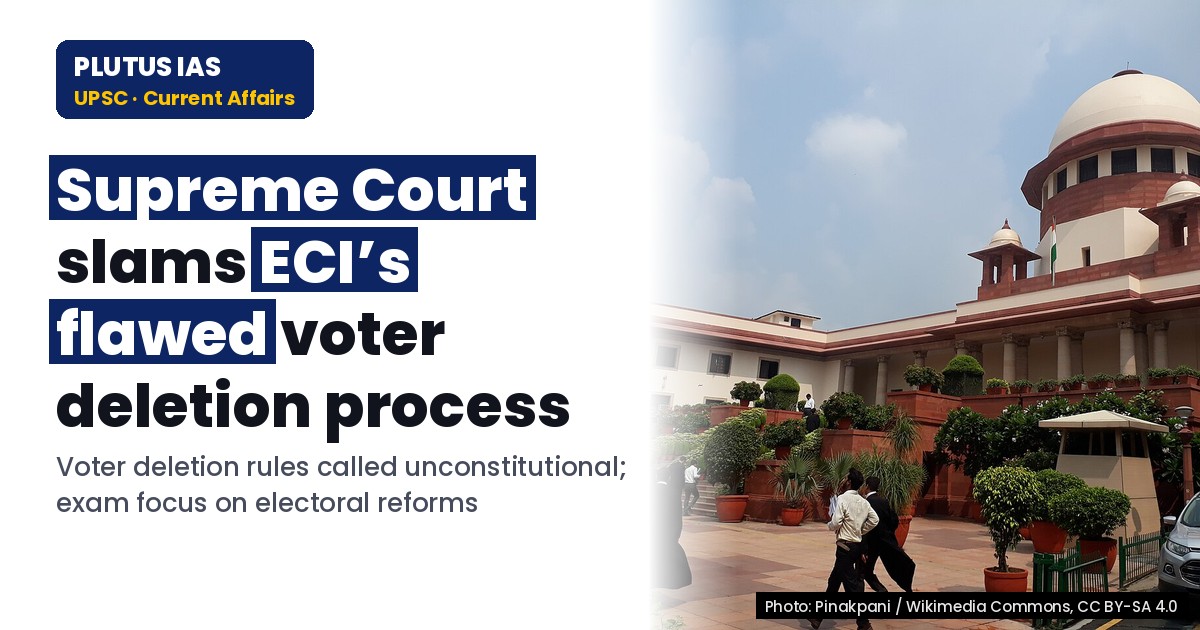
30 Oct Supreme Court Slams ECI’s Flawed SIR, Calls Deletion Process Unconstitutional
✎ The Special Intensive Revision (SIR) of electoral rolls, governed by the Representation of the People Acts (1950 and 1951) and overseen by the ECI under Article 324 of the Constitution, aims to ensure accuracy and inclusivity but…
Subject Relevance — Where This Topic Fits
- GS Paper II — Polity and Governance — Constitutional Framework, Statutory Bodies, Electoral Reforms | GS Paper III — Governance — Electoral Processes, Transparency in Public Institutions
- Prelims: Special Intensive Revision (SIR), Electoral Rolls, Form 6, Form 7, Form 8, ECI, Article 324, Section 21 of the Representation of the People Act, 1950, Section 22 of the Representation of the People Act, 1951, logical discrepancy checks, voter enumeration, disenfranchisement, Chief Electoral Officer (CEO), draft electoral rolls, final electoral rolls, adult population projection, minority representation
- Essay: Electoral Integrity and Democratic Accountability: The Role of Institutions in Safeguarding Universal Adult Franchise, Technology and Governance: Balancing Efficiency with Inclusivity in Electoral Processes
Quick Revision: The Special Intensive Revision (SIR) of electoral rolls, governed by the Representation of the People Acts (1950 and 1951) and overseen by the ECI under Article 324 of the Constitution, aims to ensure accuracy and inclusivity but has faced scrutiny for procedural flaws that risk disenfranchisement.
Why is this in the news?
The Supreme Court, in a recent hearing on the Delhi Special Intensive Revision (SIR) of electoral rolls, raised critical concerns regarding the procedural design of the SIR process. The Court questioned the Election Commission of India’s (ECI) methodology of striking off voters for non-response to enumeration forms, terming it a fundamental design flaw that shifts the burden of enrolment from the state to the elector. The Court also highlighted the disproportionate impact of ‘logical discrepancy’ checks, particularly on minority communities, and called for a reassessment of the SIR’s legal and constitutional validity.
Background
- The Representation of the People Act, 1950 (RPA, 1950) and the Representation of the People Act, 1951 (RPA, 1951) govern the preparation and revision of electoral rolls in India, with the Election Commission of India (ECI) as the statutory authority under Article 324 of the Constitution.
- The Special Intensive Revision (SIR) is a periodic revision of electoral rolls conducted by the ECI to ensure accuracy and inclusivity, particularly before general elections.
- The SIR process involves enumeration, display of draft rolls, receipt of claims and objections, and final publication of rolls. Voters are required to respond to enumeration forms or risk deletion from the rolls.
- Historically, the ECI’s mandate has been to widen the franchise, as seen in the 2002–03 intensive revision, where enumerators proactively enrolled shifted voters at their new residences.
- Recent data from Karnataka and Delhi indicates that a significant proportion of deletions under the SIR were attributed to ‘shifted’ or ‘absent’ voters, raising concerns about the accuracy and fairness of the process.
- The ECI’s use of algorithm-driven ‘logical discrepancy’ checks, such as discrepancies in family size or age gaps between voters and parents, has been criticised for disproportionately affecting minority communities, particularly in West Bengal and Delhi.
What is the Special Intensive Revision (SIR) of Electoral Rolls?
- Its primary objective is to ensure the accuracy, inclusivity, and completeness of electoral rolls by updating voter details, removing duplicates, and enrolling newly eligible electors.
- The SIR process involves multiple stages: enumeration (data collection), display of draft rolls, receipt of claims and objections (Forms 6, 7, and 8), and final publication of the electoral rolls.
- Enumeration forms are sent to registered voters to verify their details. Non-response to these forms may lead to deletion from the rolls, a provision that has been criticised for shifting the burden of enrolment from the state to the elector.
- The ECI’s mandate under Article 324 of the Constitution empowers it to supervise, direct, and control the preparation of electoral rolls, ensuring they reflect the true adult population.
- Historically, the ECI has used proactive measures to widen the franchise, such as the 2002–03 intensive revision, where enumerators enrolled shifted voters at their new residences, reducing disenfranchisement.
- The SIR process is distinct from routine revisions and is typically conducted in phases across states, with the final rolls required to align with the projected adult population.
- The ECI’s use of algorithm-driven ‘logical discrepancy’ checks, such as discrepancies in family size or age gaps, has raised concerns about arbitrary deletions and potential bias, particularly against minority communities.
Key Features
| Feature | Significance |
|---|---|
| Special Intensive Revision (SIR) of electoral rolls | A periodic process conducted by the Election Commission of India (ECI) to update and purify electoral rolls, ensuring accuracy and inclusivity in the voter base. |
| Enumeration forms and Form 6 | Enumeration forms are used to verify existing voters, while Form 6 is the application for new enrolment or correction of details, including address changes. |
| Logical discrepancy checks | Algorithm-driven verification processes used by the ECI to identify inconsistencies in voter data, such as family size or age gaps, which have been criticised for disproportionate disenfranchisement. |
| Draft deletions and claims phase | The SIR process involves drafting deletions of voters marked as ‘shifted’ or ‘absent,’ followed by a claims phase where affected voters can challenge deletions and new voters can enrol. |
| Supreme Court intervention | Judicial oversight of the ECI’s SIR process, highlighting design flaws and questioning the legality of certain practices, such as forcing voters to reapply for inclusion. |
Why it Matters
Electoral Integrity
- The SIR process is critical for maintaining the accuracy and credibility of electoral rolls, which underpin the fairness of elections in India.
- Erroneous deletions or exclusions can lead to disenfranchisement, undermining the democratic principle of universal adult suffrage.
- The Supreme Court’s scrutiny ensures that the ECI’s processes adhere to constitutional and legal standards, preventing arbitrary exclusions.
Democratic Principles
- The ECI’s mandate includes widening the franchise, which requires proactive measures to enrol eligible voters rather than penalising them for administrative lapses.
- Shifting the burden of enrolment from the state to the elector risks excluding marginalised groups, particularly those with limited access to administrative processes.
- The principle of inclusivity demands that voters who have previously participated in elections should not face forfeiture of their right to vote due to administrative negligence.
Administrative Efficiency
- The SIR process must balance efficiency with fairness, ensuring that deletions are accurate and that affected voters have meaningful opportunities to rectify errors.
- Algorithm-driven checks, while intended to improve accuracy, must be transparent and subject to judicial review to prevent misuse or disproportionate impact.
- The ECI’s reliance on enumeration forms and Form 6 requires streamlined processes to minimise bureaucratic hurdles for voters.
Challenges
1. Design Flaws in SIR Process
- The current SIR design places an undue burden on voters to prove their eligibility, particularly those who have shifted residences or failed to respond to enumeration forms.
- The process of treating moved voters as new applicants defeats the ECI’s historical mandate of proactively enrolling shifted voters at their new addresses.
- The reliance on ‘logical discrepancy’ checks, such as family size or age gaps, lacks statutory or regulatory basis and has led to disproportionate disenfranchisement.
UPSC Link: GS-II: Electoral Reforms and Challenges
2. Disproportionate Disenfranchisement
- Data indicates that certain groups, such as Muslims in Delhi, were disproportionately flagged and deleted during the SIR process, raising concerns about bias.
- The share of draft deletions marked as ‘shifted’ or ‘absent’ varied significantly across states, with Karnataka deleting 84 lakh electors but adding only 8.2 lakh net new voters.
- The final electoral rolls in some states fell short of the projected adult population, indicating systemic exclusions rather than isolated errors.
UPSC Link: GS-II: Minority Rights and Electoral Participation
3. Lack of Statutory Backing for Practices
- The ECI’s use of ‘logical discrepancy’ checks and other algorithm-driven processes lacks explicit statutory or regulatory authority, leaving them vulnerable to legal challenges.
- The Supreme Court has noted that practices like ‘logical discrepancy’ checks were permitted only as an interim arrangement in West Bengal and have not been finalised judicially.
- The absence of clear legal provisions for such checks creates ambiguity and undermines the legitimacy of the SIR process.
UPSC Link: GS-II: Constitutional and Statutory Framework for Elections
4. Judicial Scrutiny and Oversight
- While judicial intervention is essential to correct flaws, the Supreme Court must avoid issuing only managerial fixes (e.g., extended deadlines) and address systemic design issues.
- The Court’s observation that the Bihar judgment is not a binding precedent highlights the need for a uniform legal framework governing the SIR process.
- Questions over the ECI’s conduct during the SIR process and the appointment of its members require resolution to restore public trust in the electoral system.
UPSC Link: GS-II: Role of Judiciary in Electoral Reforms
5. Administrative and Logistical Hurdles
- The SIR process involves complex administrative steps, including enumeration, verification, and claims, which can be cumbersome for voters, particularly in rural or marginalised areas.
- The reconciliation of old and new entries, as mandated in the 2002-03 intensive revision, is not consistently implemented, leading to errors in the final rolls.
- The lack of a robust grievance redressal mechanism exacerbates the challenges faced by voters who are wrongly deleted or excluded.
UPSC Link: GS-II: Electoral Administration and Challenges
Challenges — UPSC Perspective
| Issue | Concern |
|---|---|
| Burden of Proof on Voters | Voters are required to reapply for inclusion if they fail to respond to enumeration forms, shifting the responsibility from the state to the elector. |
| Disproportionate Impact on Marginalised Groups | Algorithm-driven checks and deletion processes have disproportionately affected minority communities and other marginalised groups. |
| Lack of Statutory Backing for Practices | The ECI’s use of ‘logical discrepancy’ checks and other processes lacks explicit legal authority, making them vulnerable to legal challenges. |
| Systemic Errors in Final Rolls | Draft deletions and claims processes have resulted in final electoral rolls that fall short of the projected adult population, indicating systemic exclusions. |
| Judicial Oversight Limitations | While the Supreme Court has intervened, its focus on managerial fixes rather than systemic reforms risks perpetuating design flaws. |
Way Forward
- The ECI must revise the SIR process to shift the burden of proof from voters to the state, ensuring that voters are not penalised for administrative lapses.
- Algorithm-driven checks should be replaced with transparent, statutorily backed verification processes to prevent disproportionate disenfranchisement.
- The ECI should reinstate voters wrongly deleted during the SIR process and ensure that the final rolls reflect the true adult population, including newly eligible electors.
- A uniform legal framework governing the SIR process must be established, with clear provisions for voter verification, grievance redressal, and judicial oversight.
- The ECI should adopt a proactive approach to enrolling shifted voters, as mandated in the 2002-03 intensive revision, rather than treating them as new applicants.
- Judicial scrutiny of the SIR process should focus on systemic reforms rather than temporary fixes, ensuring long-term electoral integrity.
- The ECI must address concerns about the disproportionate impact on marginalised groups by conducting impact assessments and implementing safeguards.
- Parliament should consider enacting legislation to codify the SIR process, including the roles and responsibilities of the ECI, voters, and judicial authorities.
UPSC Value Addition
Keywords for Mains Answer-Writing
Special Intensive Revision (SIR) of electoral rolls · Electoral Disenfranchisement · Supreme Court of India · Election Commission of India (ECI) · Right to Vote · Electoral Reforms · Voter Enrolment Process · Logical Discrepancy Checks · Judicial Review of Electoral Rolls · Constitutional Safeguards for Voters · Delhi Electoral Rolls · Karnataka Electoral Rolls · Bihar Electoral Rolls · West Bengal Electoral Rolls · Minority Representation in Electoral Rolls
Constitutional & Policy Linkages
- [‘Article 325: Universal Adult Franchise and Electoral Rolls’]
- [‘Article 326: Elections to the House of the People and to the Legislative Assemblies of States’]
- [‘Article 327: Power of Parliament to make provision with respect to elections’]
Concept Flow
ECI conducts Special Intensive Revision (SIR) of electoral rolls to update and purify voter data. → Enumeration forms are sent to existing voters; non-response triggers deletion under ‘shifted’ or ‘absent’ categories. → Algorithm-driven ‘logical discrepancy’ checks flag inconsistencies, leading to further deletions. → Draft deletions are published; affected voters must reapply via Form 6 or challenge deletions during the claims phase. → Final rolls are prepared, but systemic errors and disproportionate disenfranchisement persist due to flawed design. → Supreme Court intervenes, questioning the legality of practices and highlighting the burden on voters. → Judicial scrutiny reveals design flaws, necessitating systemic reforms to restore electoral integrity and inclusivity.
Prelims Practice Questions
Q1. Consider the following statements regarding the Special Intensive Revision (SIR) of electoral rolls in India:
1. The SIR process allows the Election Commission of India (ECI) to strike off voters who do not respond to enumeration forms without providing an opportunity to re-enrol.
2. The ECI’s SIR process treats a mere change of address as grounds for deletion, requiring voters to re-register as new applicants.
3. The Supreme Court has upheld the legality of ‘logical discrepancy’ checks as a permanent feature of the SIR process.
4. The SIR process is designed to shift the burden of enrolment from the state to the elector.
How many of the above statements are correct?
- Only one
- Only two
- Only three
- All
Answer: All — Statements 1, 2, and 4 are correct as per the Supreme Court’s observations and the ECI’s SIR process. Statement 3 is incorrect because the Supreme Court has not upheld the legality of ‘logical discrepancy’ checks as a permanent feature; these checks were allowed only as an interim arrangement in West Bengal.
Q2. Assertion (A): The Supreme Court of India has observed that the Election Commission of India’s Special Intensive Revision (SIR) process, by requiring voters to re-register as new applicants upon relocation, undermines the historic mandate of widening the franchise.
Reason (R): The SIR process shifts the burden of enrolment from the state to the elector, treating a mere change of address as grounds for deletion.
Options:
A. Both A and R are true, and R is the correct explanation of A.
B. Both A and R are true, but R is not the correct explanation of A.
C. A is true, but R is false.
D. A is false, but R is true.
Answer: ? — Both Assertion (A) and Reason (R) are true, and Reason (R) correctly explains Assertion (A). The Supreme Court has highlighted that the SIR process shifts the burden of enrolment to the elector and treats a change of address as grounds for deletion, which undermines the ECI’s mandate of widening the franchise.
Q3. Match the following states/UTs with their respective issues during the Special Intensive Revision (SIR) of electoral rolls as reported in the Supreme Court hearing:
Column I (State/UT) | Column II (Issue)
1. Delhi | A. Disproportionate flagging of Muslim voters
2. Karnataka | B. 64.5 lakh shortfall in final electoral rolls
3. Bihar | C. 84 lakh electors deleted, marked as ‘shifted’ or ‘absent’
4. West Bengal | D. Massive disenfranchisement due to ‘logical discrepancy’ checks
Options:
A. 1-A, 2-C, 3-B, 4-D
B. 1-A, 2-B, 3-C, 4-D
C. 1-B, 2-C, 3-A, 4-D
D. 1-D, 2-B, 3-C, 4-A
Answer: ? — The correct matches are: 1-A (Delhi: Disproportionate flagging of Muslim voters), 2-B (Karnataka: 64.5 lakh shortfall in final electoral rolls), 3-C (Bihar: 84 lakh electors deleted, marked as ‘shifted’ or ‘absent’), and 4-D (West Bengal: Massive disenfranchisement due to ‘logical discrepancy’ checks).
Mains Practice Question
✍ The Supreme Court has highlighted systemic flaws in the Election Commission of India’s Special Intensive Revision (SIR) of electoral rolls, observing that the process disproportionately disenfranchises voters and shifts the burden of enrolment from the state to the elector. Critically examine the constitutional and institutional implications of these flaws. Also, suggest measures to ensure that the electoral rolls are inclusive, accurate, and reflective of the adult population. (15 Marks)
Approach: MODEL-ANSWER SKELETON:
1. **Constitutional and Legal Framework**:
– Article 326 of the Constitution guarantees the right to vote to every adult citizen.
– The Representation of the People Act, 1950, and the Conduct of Elections Rules, 1961, govern the electoral rolls.
– The ECI’s mandate under Article 324 to ensure free and fair elections.
2. **Flaws in the SIR Process Highlighted by the Supreme Court**:
– **Burden-Shifting**: The SIR process places the onus on voters to re-enrol, treating relocation as grounds for deletion, which contradicts the ECI’s historic mandate of widening the franchise (e.g., 2002-03 intensive revision).
– **Disproportionate Disenfranchisement**: Data from Karnataka (64.5 lakh shortfall) and West Bengal (massive disenfranchisement due to ‘logical discrepancy’ checks) illustrate systemic errors.
– **Algorithmic Bias**: ‘Logical discrepancy’ checks (e.g., family size, age gaps) lack statutory basis and disproportionately affect minorities (e.g., Muslims in Delhi).
– **Lack of Statutory Backing**: No statute or rule authorises ‘logical discrepancy’ checks as a permanent feature; these were allowed only as an interim arrangement in West Bengal.
3. **Institutional and Governance Implications**:
– **Erosion of Trust**: The SIR process undermines public confidence in the electoral process, particularly among marginalised communities.
– **Judicial Scrutiny**: The Supreme Court’s observations reflect growing judicial intervention in electoral governance, raising questions about the ECI’s autonomy and accountability.
– **Appointment of ECI Members**: The lack of a transparent, collegium-based appointment process for ECI members (as recommended by the Dinesh Goswami Committee, 1990) exacerbates concerns about institutional independence.
4. **Measures for Inclusive and Accurate Electoral Rolls**:
– **Statutory Clarity**: Enact specific provisions to regulate ‘logical discrepancy’ checks and ensure they are non-discriminatory and evidence-based.
– **Proactive Enumeration**: Restore the 2002-03 model where enumerators update rolls at new addresses and reconcile old entries.
– **Transparency and Grievance Redressal**: Mandate the display of draft rolls in local languages, extend deadlines for objections, and establish a robust grievance redressal mechanism.
– **Data-Driven Corrections**: Use Aadhaar-linked voter IDs and geo-tagging to minimise errors and ensure accurate deletions and inclusions.
– **Judicial Oversight**: Strengthen judicial review of electoral roll preparation to prevent arbitrary deletions.
5. **Balance of Views**:
– **ECI’s Perspective**: The ECI may argue that the SIR process is necessary to cleanse electoral rolls of dead, duplicate, and ineligible entries.
– **Judicial Perspective**: The Supreme Court’s observations reflect a growing trend of judicial activism in electoral matters, prioritising voter enfranchisement over administrative convenience.
– **Civil Society Perspective**: Activists and minority groups argue that the SIR process disproportionately disenfranchises marginalised communities, violating their constitutional rights.
6. **Conclusion**:
– The SIR process must be reformed to align with constitutional mandates, ensuring that the burden of enrolment remains with the state and not the elector.
– Transparency, statutory backing, and proactive enumeration are essential to restore trust and inclusivity in the electoral rolls.
Source: The Hindu
Generated by AanyaAi for educational purpose.
Related guides on our sites
- Anthropology VS PSIR
- Best PSIR optional coaching
- Best PSIR optional coaching online
- Best PSIR optional teacher

- ISRO launches NVS-03 satellite to strengthen India’s NavIC GPS system - October 31, 2026
- हिमाचल की मुख्यमंत्री सहारा योजना: 10 हजार लाभार्थियों को मिलेगी आर्थिक मदद, डीसी करेंगे सत्यापन - October 31, 2026
- Kerala CM Urges Protection of Vembanad Lake’s Ecology for UPSC - October 31, 2026

No Comments