


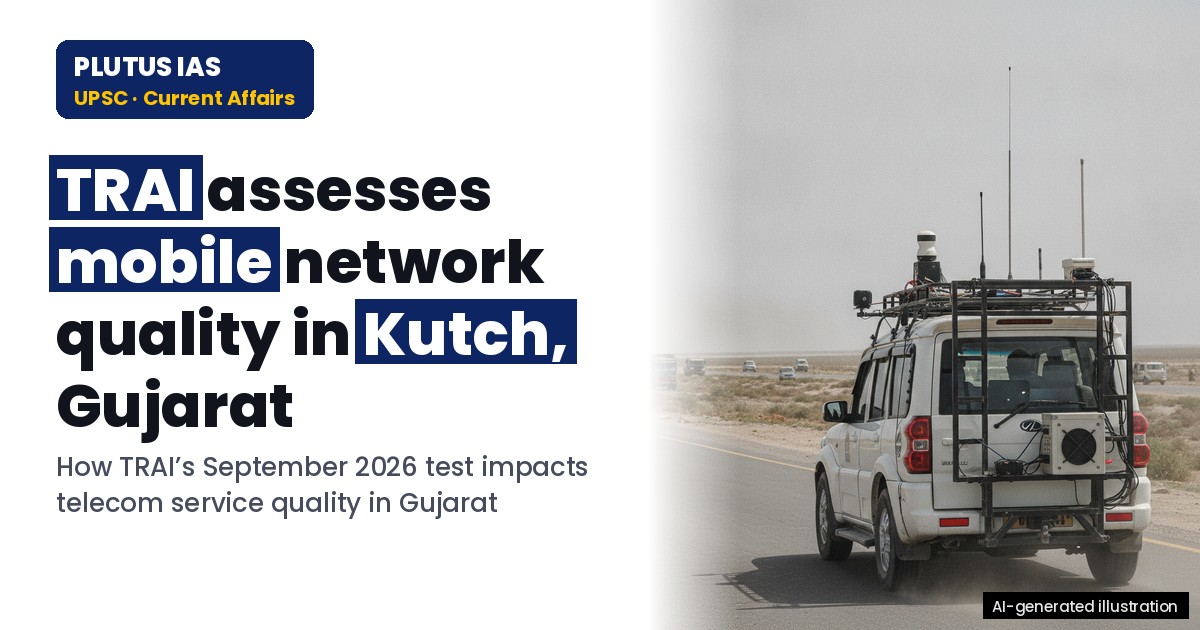
30 Oct ट्राई ने गुजरात के कच्छ क्षेत्र में मोबाइल नेटवर्क गुणवत्ता का आकलन किया
✎ Independent Drive Tests (IDTs) conducted by TRAI objectively assess real-world mobile network performance using parameters like coverage gaps, call drop rates, packet loss, and throughput to ensure regulatory accountability and…
Subject Relevance — Where This Topic Fits
- GS Paper II — Governance, Transparency and Accountability (Regulatory Institutions) | GS Paper III — Infrastructure: Energy, Ports, Roads, Airports, and Telecommunications
- Prelims: Telecom Regulatory Authority of India (TRAI), Quality of Service (QoS) parameters, Drive Tests (Independent Drive Tests – IDT), Call Drop Rate (CDR), Call Setup Success Rate (CSSR), Packet Loss Rate, Throughput (Download/Upload), Licensed Service Area (LSA), Telecom Service Providers (TSPs), 2G/3G/4G/5G networks
- Essay: The Role of Regulatory Bodies in Ensuring Public Service Accountability, Technological Sovereignty and Digital Infrastructure: Challenges and Opportunities for India
Quick Revision: Independent Drive Tests (IDTs) conducted by TRAI objectively assess real-world mobile network performance using parameters like coverage gaps, call drop rates, packet loss, and throughput to ensure regulatory accountability and consumer protection in telecom services.
Why is this in the news?
The Telecom Regulatory Authority of India (TRAI) conducted Independent Drive Tests (IDT) in September 2026 across the Kutch region of Gujarat, including Gandhidham, Bhuj, and the Bhuj-Bachau highway, to assess the real-time quality of mobile network services provided by Telecom Service Providers (TSPs). The findings, released on 29 October 2026, highlight critical Quality of Service (QoS) metrics such as coverage gaps, call drop rates, packet loss, and throughput, which are essential for evaluating telecom service reliability in geographically challenging terrains like Kutch.
Background
- The Telecom Regulatory Authority of India (TRAI) was established in 1997 under the Telecom Regulatory Authority of India Act, 1997, as an independent regulator to oversee the telecom sector in India.
- TRAI’s mandate includes ensuring fair competition, protecting consumer interests, and monitoring the Quality of Service (QoS) delivered by Telecom Service Providers (TSPs).
- The Kutch region in Gujarat is a geographically challenging area with sparse population density, extreme weather conditions, and significant infrastructure gaps, making telecom service provisioning particularly demanding.
- Independent Drive Tests (IDTs) are a regulatory tool employed by TRAI to objectively assess the actual performance of mobile networks in real-world conditions, distinct from self-reported data by TSPs.
- The assessment covered multiple network generations (2G, 3G, 4G, and 5G) and included key parameters such as coverage, call success rates, data throughput, and latency.
- TRAI’s findings are published to inform consumers, incentivize TSPs to improve service quality, and guide regulatory interventions where necessary.
What are Independent Drive Tests (IDTs) and Quality of Service (QoS) Parameters in Telecommunications?
- Independent Drive Tests (IDTs) are field-based assessments conducted by TRAI using advanced testing equipment and software to evaluate the real-world performance of mobile networks across various parameters such as coverage, call quality, and data speed.
- IDTs are designed to simulate actual user conditions by testing networks in diverse environments, including urban areas, highways, and public transport hubs, using multiple SIM cards from different TSPs.
- Key Quality of Service (QoS) parameters assessed during IDTs include: Coverage Gap (percentage of samples with signal strength below the prescribed threshold), Call Drop Rate (percentage of successfully established calls that drop before completion), Call Setup Success Rate (percentage of calls successfully initiated), Packet Loss Rate (percentage of data packets lost during transmission), and Throughput (data download/upload speeds).
- The tests cover all generations of mobile networks (2G, 3G, 4G, and 5G) to ensure comprehensive evaluation of network performance and future-readiness.
- IDTs use advanced handheld devices and real-time monitoring systems to record and analyze network performance metrics, ensuring objectivity and accuracy in the assessment.
- TRAI’s IDT reports are published periodically to provide transparency, hold TSPs accountable, and guide consumers in making informed choices about telecom services.
- The regulatory framework governing IDTs and QoS standards is outlined in TRAI’s regulations, such as the ‘Standards of Quality of Service of Basic Telephone Service (Wireline) and Cellular Mobile Telephone Service Regulations, 2009’, and subsequent amendments.
- IDTs are part of TRAI’s broader efforts to enhance telecom infrastructure, reduce digital divide, and ensure equitable access to reliable communication services across India, including remote and underserved regions.
Key Features
| Feature | Significance |
|---|---|
| Coverage Gap | Measures the proportion of route where signal strength falls below the minimum threshold for the technology (2G/3G/4G/5G), indicating areas of poor or absent mobile connectivity. |
| Call Drop Rate (CDR) | Quantifies the percentage of successfully established calls that terminate prematurely, reflecting network stability and handover efficiency. |
| Call Setup Success Rate (CSSR) | Assesses the reliability of call initiation by measuring the percentage of attempts that successfully connect within the stipulated time. |
| Call Silence Instances | Counts the number of calls experiencing silence periods exceeding three seconds, indicating disruptions in voice transmission quality. |
| Packet Loss Rate | Evaluates the efficiency of data transmission by measuring the percentage of data packets lost during downlink and uplink sessions. |
Why it Matters
Telecom Infrastructure and Digital Inclusion
- Quantitative assessment of mobile network performance in geographically challenging terrain (Kutch region and highway corridor) informs targeted infrastructure augmentation.
- Identifies service gaps that impede digital inclusion, particularly in remote and peri-urban areas of Gujarat.
- Enables evidence-based policy interventions to reduce the digital divide in regions critical for economic activity and disaster resilience.
Regulatory Oversight and Consumer Protection
- Independent measurement by TRAI ensures transparency and accountability of Telecom Service Providers (TSPs) in service delivery.
- Publication of performance metrics empowers consumers to make informed choices and incentivises TSPs to enhance service quality.
- Supports TRAI’s mandate under the Telecom Regulatory Authority of India Act, 1997, to protect consumer interests and promote fair competition.
Economic and Strategic Connectivity
- Reliable mobile connectivity is essential for trade, tourism, and emergency response in Kutch, a region bordering Pakistan and prone to natural disasters.
- Highway corridors like Bhuj-Bachau serve as critical logistics arteries; network resilience ensures uninterrupted communication for logistics and public transport.
- Improved telecom infrastructure can catalyse investment in sectors such as renewable energy and handicrafts, leveraging Kutch’s strategic location.
Challenges
1. Geographical and Topographical Constraints
- Kutch’s arid terrain, sparse population density, and undulating landscape pose challenges for uniform signal propagation and tower siting.
- Highway corridors traverse remote stretches where terrain and vegetation obstruct line-of-sight for microwave backhaul, exacerbating coverage gaps.
- Seasonal weather events (e.g., cyclones) may damage infrastructure, necessitating resilient design and rapid restoration protocols.
UPSC Link: GS III: Infrastructure – Telecommunications
2. Service Quality Disparities Among TSPs
- Variations in performance metrics (e.g., call drop rates, packet loss) across TSPs indicate uneven service quality, potentially disadvantaging consumers in shared coverage areas.
- Disparities may reflect differences in spectrum allocation, network architecture, or investment priorities, requiring regulatory scrutiny.
- Public disclosure of TSP-specific data enables comparative benchmarking and encourages market-driven improvements.
UPSC Link: GS II: Government Policies and Interventions
3. Data Integrity and Measurement Limitations
- Drive tests provide snapshots of performance at specific times; real-world conditions (e.g., peak traffic, congestion) may yield different results.
- Sampling limitations (e.g., route selection, time windows) may not capture micro-variations in network performance across the region.
- Dependence on proprietary testing equipment and methodologies necessitates standardisation to ensure comparability and reproducibility.
UPSC Link: GS III: Science and Technology – Telecommunications
4. Regulatory Enforcement and Compliance
- While TRAI publishes performance data, enforcement mechanisms to compel TSPs to address deficiencies remain a challenge.
- Penalties for non-compliance must balance deterrence with incentives for investment, particularly in low-revenue, high-cost regions.
- Coordination with state agencies and local authorities is essential to facilitate tower installations and right-of-way clearances.
UPSC Link: GS II: Statutory and Non-Statutory Bodies
Challenges — UPSC Perspective
| Issue | Concern |
|---|---|
| Sparse Population Density | Limited commercial viability for TSPs to deploy infrastructure in remote areas, leading to coverage gaps. |
| Terrain Obstructions | Undulating landscape and vegetation obstruct signal propagation, particularly for high-frequency bands (e.g., 5G). |
| Spectrum Allocation Gaps | Uneven distribution of spectrum among TSPs may contribute to disparities in service quality and coverage. |
| Regulatory Enforcement Gaps | Lack of stringent penalties or incentives for TSPs to improve service in underperforming regions. |
| Seasonal Disruptions | Natural disasters (e.g., cyclones) can damage infrastructure, disrupting connectivity during critical periods. |
Way Forward
- Enhance TRAI’s mandate to enforce service-level agreements (SLAs) with quantifiable penalties for non-compliance, particularly in underperforming regions.
- Promote public-private partnerships (PPPs) for shared infrastructure (e.g., tower sharing, fibre backhaul) to reduce costs and improve coverage in remote areas.
- Incentivise TSPs to deploy low-band spectrum (e.g., 700 MHz) in Kutch, which offers better penetration and coverage in challenging terrain.
- Strengthen disaster-resilient design standards for telecom infrastructure, including backup power systems and rapid restoration protocols.
- Expand drive-testing frequency and include diverse time slots (e.g., peak hours, nighttime) to capture real-world performance variations.
- Establish a grievance redressal mechanism for consumers to report service issues, with time-bound resolution targets enforced by TRAI.
- Integrate telecom infrastructure planning with state-led initiatives (e.g., Gujarat’s ‘Digital Gujarat’ mission) to align connectivity goals with developmental priorities.
UPSC Value Addition
Keywords for Mains Answer-Writing
Telecom Regulatory Authority of India (TRAI) · Quality of Service (QoS) in telecom · Independent Drive Test (IDT) · Call Drop Rate (CDR) · Call Setup Success Rate (CSSR) · Mobile Network Coverage · Telecom Service Providers (TSPs) · Gujarat Telecom Circle · 2G/3G/4G/5G Network Performance · Regulatory Oversight in Telecom Sector · Consumer Protection in Telecommunications · Telecom Infrastructure in Remote Regions · Performance Benchmarking of TSPs · Telecom Consumer Rights · Regulatory Mechanisms for QoS Monitoring
Constitutional & Policy Linkages
- Article 21: Right to Life and Personal Liberty (includes right to access essential services like telecom connectivity).
- Article 38: Directive Principles of State Policy (promotion of welfare and reduction of inequalities).
Concept Flow
Geographical and demographic constraints in Kutch → Limited commercial incentives for TSPs → Coverage gaps and service disparities → TRAI’s independent drive testing → Publication of performance metrics → Consumer awareness and regulatory scrutiny → Enforcement of service standards → Infrastructure augmentation and policy interventions → Improved connectivity and digital inclusion.
Prelims Practice Questions
Q1. Consider the following statements regarding the Independent Drive Test (IDT) conducted by the Telecom Regulatory Authority of India (TRAI):
1. IDT assesses the Quality of Service (QoS) parameters such as Call Drop Rate (CDR) and Call Setup Success Rate (CSSR).
2. IDT is conducted exclusively in urban areas to evaluate mobile network performance.
3. TRAI uses advanced test handsets and real-time monitoring software to analyse live data and voice sessions.
4. The primary objective of IDT is to penalise telecom service providers (TSPs) for poor network performance.
How many of the above statements are correct?
- Only one
- Only two
- Only three
- All four
Answer: Only three — Statements 1 and 3 are correct as IDT evaluates QoS parameters and uses advanced tools for real-time analysis. Statement 2 is incorrect because IDT covers diverse environments including highways and remote regions. Statement 4 is incorrect because the primary objective of IDT is to inform consumers and encourage TSPs to improve services, not to penalise them.
Q2. Assertion (A): The Telecom Regulatory Authority of India (TRAI) conducts Independent Drive Tests (IDT) to measure the Quality of Service (QoS) of mobile networks in real-world conditions.
Reason (R): TRAI aims to ensure that telecom service providers (TSPs) deliver consistent and reliable services to consumers across diverse geographical areas.
Options:
A. Both A and R are true, and R is the correct explanation of A.
B. Both A and R are true, but R is NOT the correct explanation of A.
C. A is true, but R is false.
D. A is false, but R is true.
Answer: ? — Assertion (A) is true as TRAI conducts IDT to assess QoS in real-world conditions. Reason (R) is also true and correctly explains the purpose of IDT, which is to ensure reliable services for consumers.
Q3. Match the following telecom Quality of Service (QoS) parameters with their respective definitions:
Column I (QoS Parameter) Column II (Definition)
A. Call Drop Rate (CDR) 1. Percentage of successfully established calls
B. Call Setup Success Rate (CSSR) 2. Number of calls dropped during a session
C. Packet Loss Rate 3. Percentage of data packets lost during transmission
D. Latency 4. Time delay between data transmission and reception
Options:
A. A-2, B-1, C-3, D-4
B. A-1, B-2, C-3, D-4
C. A-2, B-1, C-4, D-3
D. A-3, B-4, C-1, D-2
- A
- B
- C
- D
Answer: A — A. Call Drop Rate (CDR) refers to the number of calls dropped during a session. B. Call Setup Success Rate (CSSR) is the percentage of successfully established calls. C. Packet Loss Rate is the percentage of data packets lost during transmission. D. Latency is the time delay between data transmission and reception.
Mains Practice Question
✍ The Telecom Regulatory Authority of India (TRAI) conducts Independent Drive Tests (IDT) to evaluate the Quality of Service (QoS) of mobile networks in real-world conditions. Critically examine the significance of such regulatory oversight in ensuring consumer protection and promoting fair competition in the telecom sector. Also, analyse the challenges faced by TRAI in monitoring QoS in geographically challenging regions like Kutch in Gujarat. (15 Marks)
Approach: MODEL-ANSWER SKELETON:
1. **Introduction (2 Marks)**
– Define TRAI and its statutory mandate under the Telecom Regulatory Authority of India Act, 1997.
– Explain the concept of QoS in telecom and its importance for consumer welfare.
– Briefly introduce IDT as a tool for real-world QoS assessment.
2. **Significance of Regulatory Oversight (5 Marks)**
– **Consumer Protection**: How IDT empowers consumers by providing transparent data on network performance (e.g., call drop rates, data throughput).
– **Fair Competition**: Ensures a level playing field by holding all Telecom Service Providers (TSPs) accountable for QoS standards.
– **Regulatory Transparency**: Public dissemination of IDT results fosters trust and enables informed consumer choices.
– **Policy Formulation**: Data from IDT informs TRAI’s recommendations to the Department of Telecommunications (DoT) for policy interventions.
– **Legal Framework**: Reference to TRAI’s powers under Section 11 of the TRAI Act, 1997, to issue directions for QoS monitoring.
3. **Challenges in Monitoring QoS in Geographically Challenging Regions (5 Marks)**
– **Topographical Constraints**: Rugged terrain, sparse population, and extreme weather conditions in Kutch (e.g., salt marshes, deserts) hinder infrastructure deployment.
– **Infrastructure Gaps**: Limited tower density and backhaul connectivity in remote areas.
– **Cost Implications**: High capital expenditure (CAPEX) for network expansion in low-revenue regions.
– **Regulatory Enforcement**: Difficulty in ensuring compliance by TSPs due to logistical and operational constraints.
– **Data Collection Limitations**: IDT routes may not cover all critical areas, leading to incomplete assessments.
4. **Way Forward and Conclusion (3 Marks)**
– **Policy Interventions**: Recommendations such as incentivizing TSPs for rural network expansion (e.g., USOF subsidies under the National Digital Communications Policy, 2018).
– **Technological Solutions**: Adoption of advanced technologies like small cells, satellite backhaul, and 5G for improved coverage.
– **Stakeholder Collaboration**: Partnerships between TRAI, DoT, state governments, and TSPs to address infrastructure gaps.
– **Consumer Awareness**: Educating consumers on QoS parameters and their rights under the Telecom Consumers Protection (Ninth Amendment) Regulations, 2021.
**Balanced View**: Acknowledge TRAI’s efforts while highlighting systemic challenges (e.g., regulatory capacity, inter-state coordination) and the need for multi-stakeholder solutions.
Source: PIB (Press Information Bureau)
Gujarat PCS (GPSC) — State PCS Practice
Prelims: As per the recent TRAI assessment (September 2026) on mobile network quality in Gujarat, which of the following cities in Kutch region was included for evaluation along with Gandhidham?
- A. Bhuj
- B. Rajkot
- C. Jamnagar
- D. Surendranagar
Answer: A. Bhuj — The TRAI assessment in September 2026 evaluated mobile network quality in Gandhidham, Bhuj, and along the Bhuj-Bachau highway in Gujarat.
Mains: Discuss the significance of TRAI’s mobile network quality assessment in the Kutch region, particularly highlighting the challenges and policy measures required to improve telecom infrastructure in remote areas like Gandhidham, Bhuj, and the Bhuj-Bachau highway corridor.
Generated by AanyaAi for educational purpose.

- Kerala HC seeks state response on witness protection scheme delay - October 30, 2026
- केरल के कासरगोड में पारंपरिक सुरंगम पुनर्जीवित करने की पहल, जानिए कैसे होगा लाभ - October 30, 2026
- केरल में राज्य स्तरीय औद्योगिक उत्पादन सूचकांक के आधार वर्ष में संशोधन पर कार्यशाला - October 30, 2026

No Comments