


30 Oct Kerala HC seeks state response on witness protection scheme delay
✎ The Witness Protection Scheme (WPS), approved by the Supreme Court in 2019, is a constitutional mandate under Article 21 to ensure fair trials by protecting witnesses from intimidation; States must operationalise it through…
Subject Relevance — Where This Topic Fits
- GS Paper II — Polity and Governance — Judiciary and Legal Reforms | GS Paper III — Security and Disaster Management — Witness Protection and Victim Support
- Prelims: Witness Protection Scheme 2018, Supreme Court directives on witness protection, Article 21 (Right to Life and Personal Liberty), Kerala High Court PIL jurisdiction, Judicial activism in governance
- Essay: The Role of Judiciary in Ensuring Justice Delivery Systems, Balancing Security and Liberty: The Challenge of Witness Protection in India
Quick Revision: The Witness Protection Scheme (WPS), approved by the Supreme Court in 2019, is a constitutional mandate under Article 21 to ensure fair trials by protecting witnesses from intimidation; States must operationalise it through threat assessment, protection measures, and dedicated funds.
Why is this in the news?
The Kerala High Court has recently sought the State Government’s response to a Public Interest Litigation (PIL) highlighting the non-implementation of the Witness Protection Scheme (WPS) in Kerala, despite its approval by the Supreme Court in 2019. The PIL, filed by a retired Superintendent of Police, underscores systemic delays in operationalising the scheme, which is designed to safeguard witnesses in criminal cases from intimidation and threats, thereby ensuring fair trial and justice delivery.
Background
- The Witness Protection Scheme (WPS) was formulated by the Union Ministry of Home Affairs in 2018 and subsequently approved by the Supreme Court of India in 2019, making it a binding directive for all States and Union Territories.
- The scheme was introduced to address the pervasive issue of witness intimidation in criminal cases, which often leads to witnesses retracting statements or failing to testify, thereby undermining the justice delivery system.
- The Supreme Court, in *Mahender Chawla v. Union of India* (2019), mandated the implementation of the WPS across the country, emphasising its constitutional mandate under Article 21 (Right to Life and Personal Liberty) to ensure a fair trial.
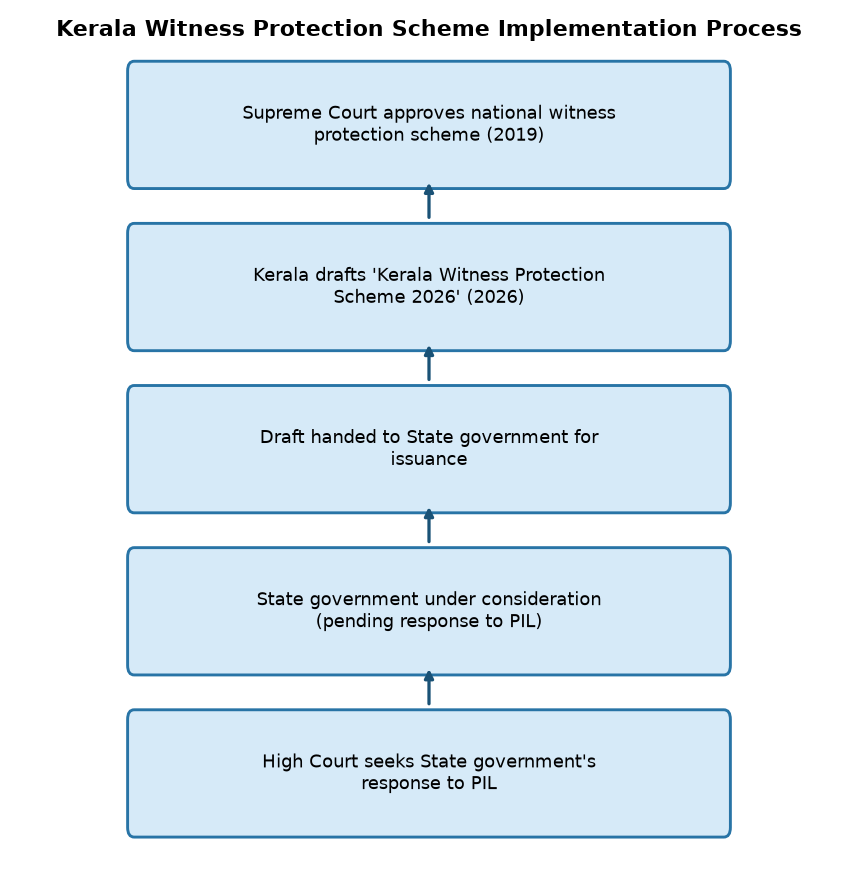
- Kerala, despite having a draft notification titled ‘Kerala Witness Protection Scheme 2026’, has yet to operationalise the scheme, as highlighted by the Kerala High Court in a recent PIL.
- The PIL cited specific cases, such as the Attapady Madhu murder, the criminal proceedings against former Bishop Franco Mulakkal, and the Nenmara double murder, where witness protection was either granted or required but not effectively implemented.
- The Kerala State Legal Services Authority (KeLSA) and the State Police Chief have acknowledged the draft notification but stated that the matter remains under consideration by the State Government.
What is the Witness Protection Scheme (WPS)?
- The WPS is a comprehensive framework designed to safeguard witnesses in criminal cases from threats, intimidation, or harm, ensuring their safety and enabling them to testify without fear.
- The scheme was formulated by the Union Ministry of Home Affairs in 2018 and approved by the Supreme Court in 2019, making it a legal obligation for all States and Union Territories to implement it.
- Key components of the WPS include threat assessment, protection measures (such as identity concealment, relocation, or police protection), constitution of competent authorities (e.g., State and District Witness Protection Committees), and the establishment of Witness Protection Cells.
- The scheme also mandates periodic review of protection measures and the creation of a Witness Protection Fund to finance the implementation of protective measures.
- The WPS applies to witnesses in cases involving serious offences, organised crime, terrorism, sexual offences, and other crimes where witness intimidation is likely.
- The scheme operates under the principle that the State has a duty to protect witnesses as part of its obligation to ensure a fair trial and uphold the rule of law.
- The Supreme Court, in *Mahender Chawla v. Union of India* (2019), directed the Union Government to frame a Witness Protection Scheme and directed all States to implement it within a stipulated timeframe.
- The scheme is grounded in constitutional provisions, particularly Article 21 (Right to Life and Personal Liberty), which includes the right to a fair trial and the right to live with dignity.
Key Features
| Feature | Significance |
|---|---|
| Threat assessment | Systematic evaluation of risks faced by witnesses to determine appropriate protection measures. |
| Protection measures | Implementation of physical, procedural, and technological safeguards for witnesses and their families. |
| Competent authorities | Designation of specialized bodies to administer and oversee witness protection protocols. |
| Witness protection cells | Dedicated units to coordinate protection efforts, maintain records, and liaise with law enforcement. |
| Periodic review | Mandatory reassessment of protection measures to adapt to evolving threats and case circumstances. |
| Witness protection fund | Financial mechanism to support the operational costs of protection schemes and victim compensation. |
Why it Matters
Judicial Administration
- Ensures the integrity of judicial processes by safeguarding witnesses from intimidation, coercion, or harm.
- Strengthens the rule of law by reducing witness reluctance to testify due to fear of retaliation.
- Aligns with constitutional guarantees of fair trial under Article 21 (Right to Life and Personal Liberty).
Rule of Law and Governance
- Facilitates the effective functioning of investigative and prosecutorial agencies by ensuring witness cooperation.
- Reduces instances of witness tampering and perjury, thereby enhancing the credibility of legal proceedings.
- Demonstrates the State’s commitment to upholding constitutional and statutory obligations in criminal justice.
Human Rights and Victim Protection
- Protects witnesses from secondary victimization by shielding them from threats, harassment, or social ostracization.
- Promotes gender justice by ensuring safety for vulnerable witnesses, such as women or marginalized groups.
- Supports the realization of Article 21’s protection against arbitrary state or private interference.
Institutional Capacity Building
- Encourages the establishment of specialized institutions (e.g., witness protection cells) to handle complex cases.
- Enhances inter-agency coordination between police, judiciary, and legal services authorities.
- Builds public trust in the criminal justice system by demonstrating proactive measures against witness intimidation.
Challenges
1. Institutional Delays and Bureaucratic Lags
- Prolonged delays in the formulation and notification of state-specific schemes despite Supreme Court directives.
- Lack of urgency in translating policy into actionable administrative orders or circulars.
- Fragmented responses from multiple agencies (Police, Home Department, Legal Services Authority) leading to procedural inertia.
UPSC Link: GS-II: Judiciary and Legal Reforms
2. Resource Constraints and Funding Gaps
- Inadequate allocation of financial resources for the operationalization of witness protection schemes.
- Dependence on ad-hoc or insufficient witness protection funds, limiting the scope of protection measures.
- Potential underutilization of existing funds due to lack of awareness or procedural bottlenecks.
UPSC Link: GS-III: Government Budgeting and Resource Allocation
3. Operational and Implementation Gaps
- Absence of standardized operating procedures (SOPs) for witness protection across all stages of legal proceedings.
- Lack of trained personnel or specialized units to assess threats and implement protection measures.
- Inadequate coordination between state agencies and central authorities, leading to gaps in implementation.
UPSC Link: GS-II: Centre-State Relations
4. Public Awareness and Stakeholder Engagement
- Limited awareness among witnesses, legal practitioners, and law enforcement about the availability and process of witness protection.
- Reluctance of witnesses to come forward due to lack of trust in the system or fear of exposure.
- Inadequate sensitization of judicial officers, police, and civil society on the importance of witness protection.
UPSC Link: GS-II: Role of Civil Society and NGOs
5. Legal and Procedural Ambiguities
- Unclear delineation of roles and responsibilities among competent authorities and witness protection cells.
- Potential conflicts between state-specific schemes and central guidelines or directives.
- Ambiguity in the definition of ‘witness’ or ‘threat,’ leading to inconsistent application of protection measures.
UPSC Link: GS-II: Legal Framework and Judicial Precedents
Challenges — UPSC Perspective
| Issue | Concern |
|---|---|
| Delay in notification | State government’s failure to finalize and issue the draft ‘Kerala Witness Protection Scheme 2026’. |
| Lack of SOPs | Absence of standardized operating procedures for witness attendance and protection. |
| Resource allocation | Insufficient funding for the witness protection fund and operational costs. |
| Inter-agency coordination | Poor synchronization between police, home department, and legal services authorities. |
| Public awareness | Limited knowledge among witnesses about the availability and process of protection. |
| Legal ambiguities | Unclear definitions or roles leading to inconsistent implementation of protection measures. |
Government Initiatives — Must-Memorise for Prelims
- Witness Protection Scheme, 2018 (as approved by the Supreme Court in 2019)
Way Forward
- The State government must expedite the finalization and notification of the ‘Kerala Witness Protection Scheme 2026’ in compliance with Supreme Court directives.
- Constitute dedicated witness protection cells with trained personnel to assess threats and implement protection measures.
- Develop standardized operating procedures (SOPs) for witness attendance, examination, and protection across all stages of legal proceedings.
- Allocate adequate financial resources to the witness protection fund and ensure transparent disbursement for operational needs.
- Conduct sensitization programs for judges, police officers, and civil society on the importance and process of witness protection.
- Establish a grievance redressal mechanism for witnesses to report lapses or seek urgent protection.
- Ensure periodic review of protection measures and adapt them based on evolving threats and case-specific requirements.
- Collaborate with civil society organizations to build public awareness and trust in the witness protection system.
UPSC Value Addition
Keywords for Mains Answer-Writing
Witness Protection Scheme · Kerala High Court · Public Interest Litigation · Supreme Court directives · Threat assessment · Witness protection fund · Competent authorities for witness protection · Criminal justice system reforms · Standard Operating Procedures · Right to Fair Trial · Judicial activism · State government implementation gaps · Witness security measures · Legal Services Authorities Act · Criminal Procedure Code provisions · Judicial review of executive inaction · Protection of witnesses in heinous crimes · Constitutional obligation of State · Judicial-Executive interface · Legal aid and witness protection
Constitutional & Policy Linkages
- Article 21: Right to Life and Personal Liberty (ensuring fair trial and protection from intimidation).
- Article 14: Right to Equality (ensuring non-discriminatory access to protection).
Concept Flow
Supreme Court directs implementation of Witness Protection Scheme (2019) → State government formulates draft scheme (2026) → PIL highlights delays in implementation → High Court seeks State response → State agencies cite procedural gaps → Need for urgent action identified.
Prelims Practice Questions
Q1. Consider the following statements regarding the Witness Protection Scheme in India:
1. The scheme was approved by the Supreme Court of India in 2019.
2. It mandates the constitution of competent authorities and witness protection cells in every State.
3. The scheme provides for a periodic review mechanism but does not include a witness protection fund.
4. Threat assessment is a key component of the scheme.
How many of the above statements are correct?
- Only one
- Only two
- Only three
- All four
Answer: Only three — Statements 1, 2, and 4 are correct. Statement 3 is incorrect as the scheme does include a witness protection fund.
Q2. Assertion (A): The Witness Protection Scheme in India is a statutory scheme mandated by the Parliament.
Reason (R): The scheme was formulated by the Supreme Court of India and directed to be implemented by all States.
Options:
A. Both A and R are true, and R is the correct explanation of A.
B. Both A and R are true, but R is not the correct explanation of A.
C. A is true, but R is false.
D. A is false, but R is true.
Answer: ? — Assertion (A) is false because the Witness Protection Scheme is not a statutory scheme enacted by Parliament; it is a scheme formulated by the Supreme Court and directed to be implemented by States. Reason (R) is true as the Supreme Court approved and directed the implementation of the scheme.
Q3. Match the following components of the Witness Protection Scheme with their respective descriptions:
Column I (Component)
A. Threat Assessment
B. Witness Protection Fund
C. Periodic Review
D. Competent Authorities
Column II (Description)
1. Mechanism to ensure continued safety and effectiveness of protection measures
2. Financial provision for implementing protection measures
3. Evaluation of the level of risk faced by witnesses
4. Bodies constituted to oversee implementation and administration
Options:
A. A-3, B-2, C-1, D-4
B. A-2, B-3, C-1, D-4
C. A-1, B-2, C-3, D-4
D. A-4, B-1, C-2, D-3
Answer: ? — Correct matching: A-3 (Threat Assessment involves evaluating risk), B-2 (Witness Protection Fund is a financial provision), C-1 (Periodic Review ensures continued effectiveness), D-4 (Competent Authorities are constituted bodies).
Mains Practice Question
✍ Critically examine the constitutional and judicial framework governing witness protection in India, with particular reference to the Supreme Court’s role in directing its implementation. Also, analyse the challenges faced by States in operationalising the scheme, using the Kerala High Court’s recent observations as a case in point. (15 Marks)
Approach: MODEL-ANSWER SKELETON:
1. **Constitutional and Judicial Framework** (5 points):
– Art. 21 (Right to Life and Personal Liberty) as the constitutional basis for witness protection.
– Art. 142 (Supreme Court’s power to pass any order necessary for doing complete justice) and the 2019 Supreme Court judgment in *Mukesh Singh v. State (NCT of Delhi)* directing States to implement the Witness Protection Scheme.
– Key provisions of the Scheme: threat assessment, protection measures, witness protection cells, periodic review, and witness protection fund.
– Role of the Supreme Court as a constitutional umpire ensuring the State’s obligation to protect witnesses.
– Judicial activism in ensuring the right to a fair trial (Art. 21) through witness protection.
2. **Challenges in Operationalisation** (5 points):
– **Institutional Delays**: Bureaucratic inertia, lack of political will, and inter-departmental coordination issues (e.g., Kerala High Court’s observation of the State ‘lagging’ in implementation).
– **Resource Constraints**: Inadequate funding for witness protection funds and infrastructure.
– **Legal and Procedural Gaps**: Absence of statutory backing (unlike the draft Witness Protection Bill, 2018) leading to non-compliance.
– **Cultural and Social Factors**: Witness intimidation, lack of trust in State mechanisms, and reluctance to come forward.
– **Case-Specific Issues**: High-profile cases (e.g., Attapady Madhu murder, Bishop Franco Mulakkal case) highlighting the urgency of implementation.
3. **Way Forward** (5 points):
– **Statutory Backing**: Enactment of the Witness Protection Bill, 2018, to provide legal enforceability.
– **State-Level Mechanisms**: Strengthening of State Witness Protection Authorities and cells with adequate staffing and resources.
– **Public Awareness**: Campaigns to build trust in witness protection mechanisms.
– **Judicial Oversight**: Continued monitoring by High Courts and the Supreme Court to ensure compliance.
– **Inter-State Coordination**: Sharing of best practices and resources among States to address resource constraints.
Balance of views: Acknowledge the Supreme Court’s proactive role while critiquing State inaction; highlight the need for a multi-dimensional approach combining legal, institutional, and social measures.
Source: The Hindu
Kerala PCS (Kerala PSC (KAS)) — State PCS Practice
Prelims: Which of the following statements is correct regarding the ‘Witness Protection Scheme’ as per the Kerala High Court’s recent directive to the State government in response to a PIL?
- The scheme is mandatory for all states under the Union Government’s Witness Protection Scheme, 2018.
- The Kerala High Court has directed the State government to file a detailed response on the implementation of the scheme within a specified timeline.
- The scheme is not applicable to cases under the Protection of Children from Sexual Offences (POCSO) Act.
- The Kerala government has already fully implemented the Witness Protection Scheme without any court intervention.
Answer: The Kerala High Court has directed the State government to file a detailed response on the implementation of the scheme within a specified timeline. — The Kerala High Court sought the State government’s response to a PIL regarding the implementation of the Witness Protection Scheme, directing a timeline for compliance.
Mains: Critically examine the significance of the Kerala High Court’s directive to the State government on the Witness Protection Scheme. Discuss the challenges in its implementation and suggest measures to ensure effective witness protection in Kerala.
Generated by AanyaAi for educational purpose.
Related guides on our sites
- Anthropology VS PSIR
- Best PSIR optional coaching
- Best PSIR optional coaching online
- Best PSIR optional teacher

- Kerala HC seeks state response on witness protection scheme delay - October 30, 2026
- केरल के कासरगोड में पारंपरिक सुरंगम पुनर्जीवित करने की पहल, जानिए कैसे होगा लाभ - October 30, 2026
- केरल में राज्य स्तरीय औद्योगिक उत्पादन सूचकांक के आधार वर्ष में संशोधन पर कार्यशाला - October 30, 2026

No Comments