


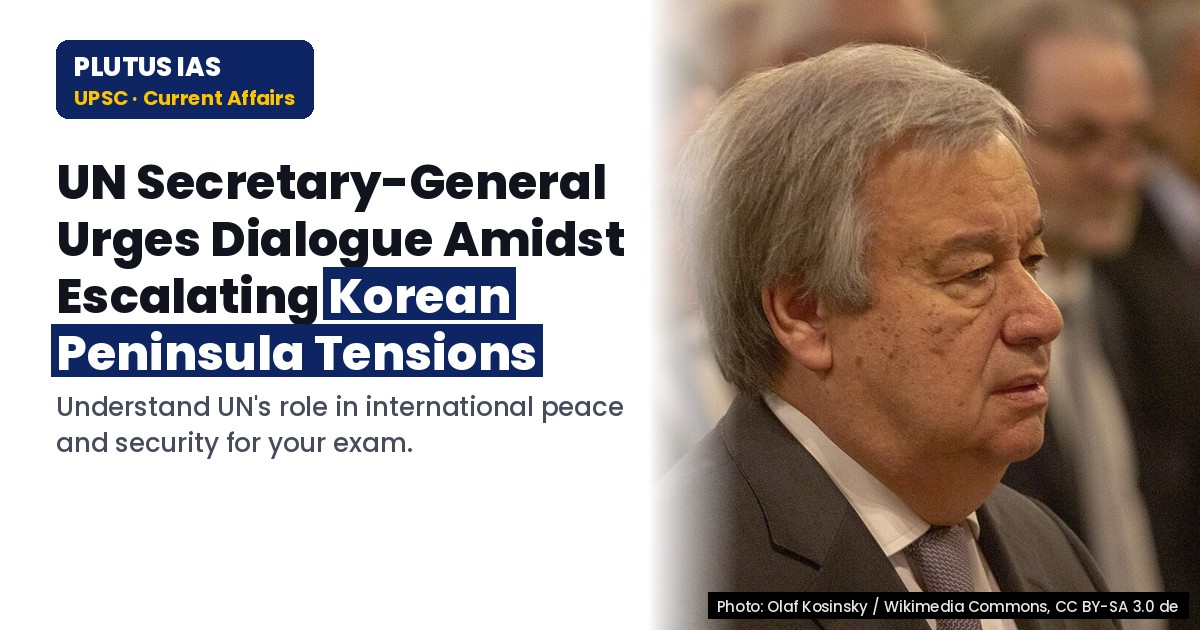
06 Nov Korea Tensions Mount: UN Urges Dialogue for Peace
✎ The UN is actively addressing escalating tensions on the Korean Peninsula through calls for dialogue, demanding accountability for the death of a staffer in Yemen, and advocating for inclusive global governance of Artificial…
Subject Relevance — Where This Topic Fits
- GS Paper II — International Relations | GS Paper II — Governance | GS Paper III — Science and Technology
- Prelims: Korean Peninsula, Demilitarized Zone (DMZ), Yemen conflict, Houthi authorities, Artificial Intelligence (AI) governance, UN Secretary-General
- Essay: The imperative of international cooperation in resolving geopolitical conflicts and humanitarian crises., Ethical considerations and global governance frameworks for emerging technologies like Artificial Intelligence.
Quick Revision: The UN is actively addressing escalating tensions on the Korean Peninsula through calls for dialogue, demanding accountability for the death of a staffer in Yemen, and advocating for inclusive global governance of Artificial Intelligence.
Why is this in the news?
The UN Secretary-General has expressed concern over escalating tensions on the Korean Peninsula, advocating for renewed dialogue between the Democratic People’s Republic of Korea (DPRK) and the Republic of Korea. Concurrently, the UN has demanded a prompt, independent investigation into the death of a UN staff member arbitrarily detained by Houthi authorities in Yemen, raising serious concerns about human rights and the safety of humanitarian personnel. Separately, the Secretary-General highlighted the critical need for inclusive governance in Artificial Intelligence to prevent its control by a limited number of corporations.
Background
- The Korean Peninsula has a history of division since the end of World War II, leading to the establishment of the DPRK (North Korea) and the Republic of Korea (South Korea).
- The Demilitarized Zone (DMZ) serves as a heavily fortified border separating the two Koreas, a legacy of the 1950-1953 Korean War, which ended in an armistice rather than a peace treaty.
- Yemen has been embroiled in a protracted civil conflict since 2014, involving various factions, including the Houthi movement, which controls significant territories, and the internationally recognized government.
- The conflict has resulted in a severe humanitarian crisis, characterized by widespread displacement, food insecurity, and a collapse of essential services, necessitating extensive international humanitarian assistance.
- The rapid advancements in Artificial Intelligence (AI) have prompted global discussions on its ethical implications, societal impact, and the need for robust governance frameworks to ensure equitable and responsible development and deployment.
- International organizations, including the United Nations, are actively engaged in promoting dialogue, mediating conflicts, providing humanitarian aid, and advocating for global standards in emerging technological domains.
Key Aspects of International Relations and Governance
- Diplomatic Engagement: The process of communication and negotiation between states or international actors to resolve disputes, build consensus, and foster cooperation, often involving multilateral platforms like the UN.
- Humanitarian Law: A body of international law that seeks to limit the effects of armed conflict by protecting persons who are not participating in hostilities and by restricting the means and methods of warfare. It includes principles such as humanity, distinction, proportionality, and precaution.
- Arbitrary Detention: The deprivation of a person’s liberty without any legal basis or due process, often violating international human rights standards, and is a matter of serious concern for international bodies.
- Artificial Intelligence (AI) Governance: The development and implementation of policies, regulations, and ethical guidelines to ensure that AI systems are developed and used responsibly, ethically, and for the benefit of all humanity, addressing issues such as bias, privacy, accountability, and control.
- UN’s Role in Peace and Security: The United Nations, through its various organs and agencies, plays a crucial role in maintaining international peace and security, preventing conflicts, providing humanitarian assistance, and promoting human rights globally.
- Demilitarized Zone (DMZ): A buffer zone established by treaties or agreements between military powers to avoid conflict, often characterized by a lack of military installations, personnel, or activities, as seen on the Korean Peninsula.
Key Features
| Feature | Significance |
|---|---|
| Korean Peninsula Tensions | Potential for regional instability and global geopolitical implications, necessitating diplomatic engagement. |
| UN Staffer’s Death in Yemen | Raises concerns regarding international humanitarian law, protection of humanitarian personnel, and accountability for human rights violations. |
| Displacement in Taiz, Yemen | Highlights the severe humanitarian crisis, including urgent needs for medical supplies, food, and shelter for internally displaced persons. |
| Artificial Intelligence Governance | Emphasises the need for inclusive development and regulation of AI to prevent monopolisation and ensure diverse societal representation. |
| Ibero-American Summit | Platform for multilateral cooperation among Spanish and Portuguese-speaking nations on shared challenges, including technological governance. |
Why it Matters
Geopolitical Significance
- The escalating tensions on the Korean Peninsula underscore the fragility of regional peace and the critical role of multilateral diplomacy in de-escalation.
- The situation in Yemen, particularly the death of a UN staff member and widespread displacement, highlights ongoing humanitarian crises and the imperative for adherence to international humanitarian law.
Humanitarian Significance
- The arbitrary detention and death of UN personnel in conflict zones like Yemen represent a grave breach of international norms and jeopardise humanitarian operations.
- The large-scale displacement in Taiz, Yemen, necessitates sustained international humanitarian assistance to address immediate needs such as food, shelter, and medical care.
Technological Governance Significance
- The call for inclusive AI development by the UN Secretary-General stresses the importance of ethical considerations and broad stakeholder participation in shaping future technological landscapes.
- Preventing the monopolisation of AI by a few entities is crucial for ensuring equitable access, diverse perspectives, and democratic control over information and belief systems.
Challenges
1. Escalation of Geopolitical Tensions
- The lack of communication channels between the Democratic People’s Republic of Korea (DPRK) and the Republic of Korea increases the risk of unintended incidents and miscalculations.
- Persistent military posturing and rhetoric can destabilise the region, potentially drawing in other international actors.
UPSC Link: International Relations, Security Challenges
2. Protection of Humanitarian Personnel
- Arbitrary detention and ill-treatment of UN and humanitarian staff by non-state actors impede critical aid delivery and violate international humanitarian law.
- Ensuring accountability for such incidents is challenging in conflict zones with fragmented authority and limited rule of law.
UPSC Link: International Humanitarian Law, Human Rights
3. Humanitarian Crisis Management
- Large-scale internal displacement strains existing resources and infrastructure, exacerbating vulnerabilities among affected populations.
- Delivering aid in conflict-affected areas is complicated by security risks, access restrictions, and the need for coordination among multiple humanitarian agencies.
UPSC Link: Disaster Management, Humanitarian Aid
4. Ethical and Equitable AI Development
- The concentration of AI development and control in a few corporations poses risks to democratic discourse, information integrity, and societal values.
- Ensuring AI systems reflect diverse voices and promote critical thinking requires significant international cooperation and regulatory frameworks.
UPSC Link: Science & Technology, Ethics in Governance
Challenges — UPSC Perspective
| Issue | Concern |
|---|---|
| Korean Peninsula Dialogue | Absence of military-to-military communication channels heightens risk of accidental conflict. |
| UN Staffer Accountability | Lack of independent investigation into death and conditions of detention raises serious human rights concerns. |
| Yemen Humanitarian Access | Ongoing conflict and arbitrary detentions impede delivery of essential aid to displaced populations. |
| AI Governance and Control | Potential for a few companies to disproportionately influence public perception and belief systems through AI. |
| Ibero-American Cooperation | Ensuring collective action on complex global issues like AI governance across diverse national contexts. |
Way Forward
- Promote sustained diplomatic engagement and re-establishment of communication channels between DPRK and Republic of Korea to foster de-escalation.
- Advocate for prompt, independent, and transparent investigations into all incidents involving harm to humanitarian personnel, ensuring accountability for perpetrators.
- Strengthen international humanitarian law frameworks and mechanisms for the protection of aid workers in conflict zones.
- Increase humanitarian aid and ensure unhindered access for relief organisations to address the urgent needs of internally displaced persons in Yemen.
- Develop inclusive and multi-stakeholder governance frameworks for Artificial Intelligence to prevent monopolisation and ensure ethical development.
- Integrate arts and humanities into education systems globally to cultivate critical thinking skills essential for navigating an AI-driven world.
- Foster international cooperation through platforms like the Ibero-American Summit to address shared challenges in technology governance and humanitarian crises.
UPSC Value Addition
Keywords for Mains Answer-Writing
Korean Peninsula geopolitics · Demilitarized Zone (DMZ) · Diplomatic engagement · Dialogue mechanisms · United Nations humanitarian operations · International humanitarian law · Arbitrary detention · Accountability for human rights violations · Displacement crises · Artificial Intelligence governance
Concept Flow
Geopolitical tension on Korean Peninsula → UN Secretary-General calls for renewed dialogue → Humanitarian crisis in Yemen, UN staffer death → UN demands investigation and accountability → Global discourse on AI governance → UN Secretary-General advocates for inclusive AI development → Ibero-American Summit discusses shared challenges
Prelims Practice Questions
Q1. Consider the following statements regarding the Korean Peninsula:
1. The Demilitarized Zone (DMZ) serves as a de facto border between the Democratic People’s Republic of Korea (DPRK) and the Republic of Korea.
2. The United Nations Secretary-General has consistently advocated for military-to-military communication channels between the two Koreas.
3. Diplomatic engagement is considered the sole pathway to achieving sustainable peace on the Korean Peninsula by the UN.
How many of the above statements are correct?
- Only one
- Only two
- Only three
- None
Answer: Only two — Statement 1 is correct. The DMZ is a buffer zone established to separate the DPRK and the Republic of Korea. Statement 2 is correct. The UN Secretary-General has encouraged the resumption of communication channels, including military-to-military, to prevent miscalculations. Statement 3 is incorrect. While diplomatic engagement and renewed dialogue are emphasized as the pathway, stating it as the ‘sole’ pathway might be an oversimplification, as other factors like economic cooperation and cultural exchange also play a role in long-term peacebuilding.
Q2. Which of the following international organisations is primarily responsible for delivering essential medical supplies and surgical kits to conflict-affected areas, as mentioned in the context of Yemen?
- United Nations Development Programme (UNDP)
- World Health Organization (WHO)
- International Committee of the Red Cross (ICRC)
- Médecins Sans Frontières (MSF)
Answer: International Committee of the Red Cross (ICRC) — The news explicitly states that the International Committee of the Red Cross (ICRC) delivered four trucks of essential medical supplies, including surgical kits, to hospitals in the encircled city of Taiz, Yemen. While other organisations may also provide medical aid, the ICRC is specifically mentioned in this context.
Mains Practice Question
✍ Examine the role of the United Nations in addressing humanitarian crises and promoting peace, with particular reference to the challenges posed by arbitrary detention of personnel and escalating regional tensions. (15 Marks)
Approach: The answer should address two main components:
1. **Role of the UN in Humanitarian Crises and Peace Promotion:**
* **Humanitarian Aid:** Discuss the mandate and operations of UN agencies (e.g., OCHA, WFP, UNHCR) in providing relief, shelter, food, and medical assistance, citing examples from Yemen (displacement, WFP’s emergency meals, shelter partners). Mention coordination efforts with other international bodies like ICRC.
* **Peacekeeping and Conflict Resolution:** Explain the UN’s role in mediation, diplomatic engagement, and encouraging dialogue, referencing the Secretary-General’s efforts on the Korean Peninsula (resumption of communication channels, military-to-military dialogue, diplomatic engagement as a pathway to peace).
* **International Law and Norms:** Highlight the UN’s role in upholding international humanitarian law and human rights, especially concerning the protection of civilians and humanitarian workers.
2. **Challenges Faced by the UN:**
* **Arbitrary Detention of Personnel:** Detail the specific concerns raised by the UN regarding the death and detention of its staff in Yemen (Mohammad el Shami’s case, lack of information, ill-treatment, call for independent investigation, accountability, release of arbitrarily detained personnel). Emphasize the implications for humanitarian operations and staff safety.
* **Escalating Regional Tensions:** Discuss the challenges in de-escalating tensions, particularly in regions like the Korean Peninsula (DMZ, potential for escalation, need for communication to avoid miscalculations). Address the limitations of diplomatic efforts when parties are unwilling to engage.
* **Sovereignty and Non-interference:** Briefly touch upon the complexities arising from state sovereignty and the principle of non-interference in internal affairs, which can hinder UN interventions in humanitarian and human rights issues.
* **Funding and Resources:** Acknowledge the perennial challenge of securing adequate funding and resources for extensive humanitarian and peacekeeping operations.
Source: news.un.org
Generated by AanyaAi for educational purpose.
Related guides on our sites
- Anthropology VS PSIR
- Best PSIR optional coaching
- Best PSIR optional coaching online
- Best PSIR optional teacher

- दिल्ली में प्रदूषण जुर्माना: 9 दिन में 11 करोड़, मुख्य उल्लंघन क्या? - November 11, 2026
- AQI Limitations & India’s Air Pollution Crisis Explained - November 11, 2026
- CII पार्टनरशिप समिट: भारत की वैश्विक आर्थिक भूमिका - November 11, 2026

No Comments