


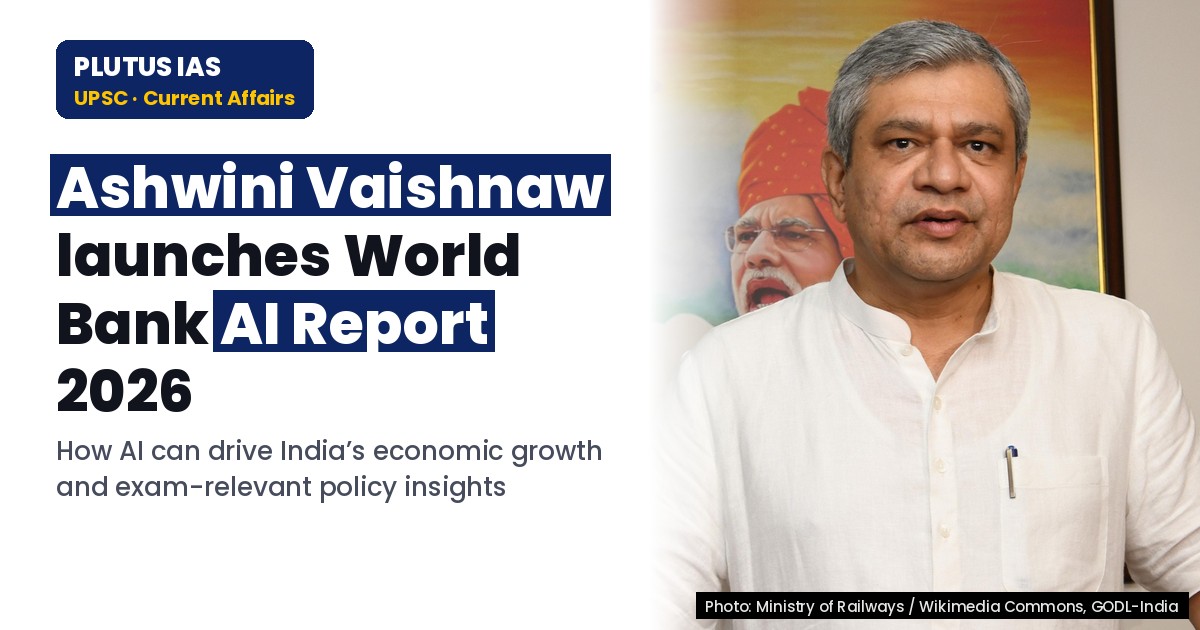
08 Oct AI & India’s Economic Growth: World Bank Report 2026 Unveiled by Union Minister
✎ AI adoption in developing economies must be anchored in robust digital infrastructure, ethical governance, and inclusive skilling to translate technological promise into equitable development outcomes.
Subject Relevance — Where This Topic Fits
- GS Paper II — International Organisations (World Bank Group) | GS Paper III — Science and Technology (AI), Information Technology and Digital Governance, Economic Development
- Prelims: Artificial Intelligence (AI), World Bank World Development Report (WDR), IndiaAI Mission, AI computing infrastructure, AI datasets, AI applications in agriculture, AI in healthcare, AI for public service delivery, National AI Portal, National Strategy for AI
- Essay: The Role of Technology in Bridging Development Gaps, Ethical Governance of Emerging Technologies: Balancing Innovation and Inclusion
Quick Revision: AI adoption in developing economies must be anchored in robust digital infrastructure, ethical governance, and inclusive skilling to translate technological promise into equitable development outcomes.
Why is this in the news?
The Union Minister for Electronics and Information Technology, Ashwini Vaishnaw, released the World Bank Group’s *World Development Report 2026: The Promise of Artificial Intelligence* in New Delhi on 8 October 2026. The event, co-hosted by the IndiaAI Mission under the Ministry of Electronics and Information Technology (MeitY) and the World Bank Group, underscored India’s strategic approach to leveraging AI for inclusive development through evidence-based scaling of AI solutions. The report provides a framework for developing economies to adopt, adapt, and advance AI for sustainable growth, while highlighting India’s ecosystem-building efforts under the IndiaAI Mission.
Background
- The World Bank Group’s *World Development Report* is an annual flagship publication that analyses critical development challenges and opportunities, offering policy frameworks for member states.
- Artificial Intelligence (AI) is increasingly recognised as a transformative force across sectors, including healthcare, agriculture, education, governance, and financial services, particularly in low- and middle-income countries.
- India’s *IndiaAI Mission*, launched under MeitY, is a multi-stakeholder initiative aimed at positioning India as a global leader in AI innovation and adoption, with a focus on inclusive and equitable growth.
- The World Bank’s report aligns with global initiatives such as the *UN Sustainable Development Goals (SDGs)* and the *Global Partnership on AI (GPAI)*, which emphasise responsible AI deployment for public good.
- India’s AI ecosystem has evolved through public-private partnerships, with initiatives like *AgriStack*, *AI for TB detection*, and *AI-enabled animal health platforms* demonstrating tangible socio-economic benefits.
What is the World Bank’s *World Development Report 2026: The Promise of Artificial Intelligence*?
- The report is a comprehensive analysis of AI’s potential to accelerate development in low- and middle-income countries by enhancing access to expertise, improving productivity, and improving service delivery.
- It provides a policy framework for countries to adopt AI responsibly, addressing challenges such as digital divide, data governance, infrastructure gaps, and skill deficits.
- The report highlights AI’s role in democratising access to critical services, such as telemedicine, precision agriculture, and personalised education, thereby reducing disparities in resource-constrained settings.
- It underscores the need for robust foundational elements, including reliable electricity, high-speed connectivity, computing infrastructure, quality datasets, and institutional capacity to harness AI effectively.
- The report advocates for a phased approach to AI adoption, starting with pilot projects and scaling up based on evidence, regulatory safeguards, and multi-stakeholder collaboration.
- It aligns with the World Bank’s broader mission to reduce poverty and promote shared prosperity through innovative solutions in the digital economy.
- The report serves as a global reference for policymakers, technologists, and development practitioners to design AI strategies that prioritise equity, transparency, and sustainability.
Key Features
| Feature | Significance |
|---|---|
| World Development Report 2026: AI’s Promise | Provides a framework for developing economies to adopt, adapt, and scale AI for inclusive growth, emphasizing evidence-based expansion over isolated pilots. |
| IndiaAI Mission | A government initiative under MeitY to build a comprehensive AI ecosystem across seven pillars, including computing capacity, indigenous model development, and application deployment. |
| AI-enabled Public Goods | Demonstrates AI applications in healthcare (e.g., TB detection), agriculture (e.g., yield optimization), and governance (e.g., citizen services) to bridge expertise gaps in rural and underserved regions. |
| State-Level AI Demonstrations | Showcases grassroots AI solutions from states and innovators, highlighting scalable models for replication across diverse socio-economic contexts. |
| Cross-Sectoral Collaboration | Fosters dialogue among policymakers, technologists, and development experts to align AI adoption with developmental priorities and institutional capacities. |
Why it Matters
Economic Growth and Productivity
- AI adoption can enhance productivity in agriculture, healthcare, and education by 20–40% through precision tools, as evidenced by pilot projects in Maharashtra and Gujarat.
- Reduces input costs (e.g., water, fertilizers) by 30% in agriculture, improving farmer incomes and resource efficiency.
- Enables access to specialized services (e.g., medical diagnostics, financial advisory) for underserved populations, reducing urban-rural disparities.
Strategic Autonomy and Innovation
- Promotes indigenous AI model development under IndiaAI Innovation Centre, reducing dependence on foreign proprietary technologies.
- Strengthens India’s position as a global AI hub by fostering a self-reliant ecosystem aligned with ‘Vocal for Local’ principles.
- Encourages public-private partnerships to accelerate R&D in AI, aligning with the National AI Strategy 2018.
Governance and Inclusion
- AI-driven governance tools (e.g., real-time data analytics for welfare schemes) can improve transparency and reduce leakages in public service delivery.
- Supports the Digital India mission by integrating AI with existing digital infrastructure (e.g., Aadhaar, GSTN, and GeM).
- Facilitates participatory development by involving states in AI solution design, ensuring contextual relevance.
Human Capital Development
- AI literacy programs under IndiaAI Mission aim to upskill 10 million Indians by 2027, addressing the global AI skills gap.
- Leverages AI in education (e.g., adaptive learning platforms) to personalize learning and improve outcomes in rural and tribal areas.
- Encourages STEM education reforms to build a pipeline of AI-ready professionals for future industries.
Challenges
1. Digital Divide and Infrastructure Gaps
- Rural and remote regions lack reliable electricity, internet connectivity, and computing infrastructure, limiting AI adoption.
- Only 47% of Indian villages have optical fiber connectivity (as of 2023), creating bottlenecks for data-intensive AI applications.
- High cost of high-performance computing (HPC) and cloud services restricts access for small enterprises and startups.
UPSC Link: GS3: Infrastructure (Digital)
2. Data Governance and Privacy
- Absence of a comprehensive data protection law (pending Digital Personal Data Protection Act implementation) creates legal uncertainty for AI deployments.
- Cross-border data flows for AI training raise sovereignty concerns, requiring robust data localization and governance frameworks.
- Lack of standardized data quality protocols hampers the reliability of AI models in critical sectors like healthcare and agriculture.
UPSC Link: GS2: Fundamental Rights (Privacy)
3. Ethical and Bias Concerns
- AI systems trained on biased datasets may perpetuate or amplify existing social inequalities (e.g., gender, caste, or regional biases in hiring or policing).
- Absence of ethical guidelines for AI deployment in sensitive sectors (e.g., criminal justice, healthcare) risks misuse and unintended consequences.
- Need for transparent AI governance frameworks to ensure accountability and public trust in automated decision-making.
UPSC Link: GS4: Ethics in Governance
4. Skill Shortages and Institutional Capacity
- India faces a deficit of 2.3 million AI professionals by 2027, with only 4% of engineering graduates possessing AI/ML skills.
- Limited institutional capacity in government agencies to design, implement, and monitor AI projects at scale.
- Lack of inter-ministerial coordination for AI integration, leading to siloed and fragmented approaches.
UPSC Link: GS3: Human Resource Development
5. Regulatory and Policy Ambiguity
- Overlapping jurisdictions between MeitY, TRAI, and sectoral regulators create regulatory fragmentation for AI applications.
- Absence of a national AI policy to align state-level initiatives with global best practices and ethical standards.
- Need for clear liability frameworks in case of AI-driven errors (e.g., autonomous vehicles, medical diagnostics).
UPSC Link: GS2: Government Policies
6. Sustainability and Energy Footprint
- AI training models (e.g., large language models) consume significant energy, contributing to carbon emissions and straining India’s renewable energy targets.
- Lack of green AI frameworks to optimize energy use in data centers and cloud computing infrastructure.
- Urgent need for policy incentives to promote energy-efficient AI hardware and algorithms.
UPSC Link: GS3: Environment and Sustainability
Challenges — UPSC Perspective
| Issue | Concern |
|---|---|
| Infrastructure Deficit | Inadequate electricity, internet, and computing resources in rural areas hinder AI scalability. |
| Data Governance Gaps | Lack of a unified data protection law and standardized data protocols undermines AI reliability. |
| Ethical Risks | Bias in AI models and absence of ethical guidelines risk reinforcing social inequalities. |
| Skill Shortages | Insufficient AI-ready workforce and institutional capacity limit implementation. |
| Regulatory Fragmentation | Overlapping mandates and absence of a national AI policy create policy ambiguity. |
| Environmental Impact | High energy consumption of AI models conflicts with India’s climate commitments. |
Government Initiatives — Must-Memorise for Prelims
- IndiaAI Mission (MeitY)
- Digital India Mission (supporting infrastructure)
Way Forward
- Establish a National AI Governance Framework to define ethical, legal, and technical standards for AI deployment across sectors.
- Accelerate rural digital infrastructure under BharatNet Phase-III to ensure last-mile connectivity for AI applications.
- Launch AI literacy programs in collaboration with AICTE and state universities to upskill 10 million professionals by 2027.
- Develop sector-specific AI sandboxes (e.g., healthcare, agriculture) to test and scale innovative solutions with regulatory oversight.
- Strengthen data governance by operationalizing the Digital Personal Data Protection Act and establishing a Data Protection Authority.
- Promote public-private partnerships to fund R&D in indigenous AI models and energy-efficient computing infrastructure.
- Incentivize green AI practices through subsidies for energy-efficient data centers and carbon-neutral AI training models.
- Create a National AI Advisory Council to coordinate between central ministries, states, and industry for cohesive policy implementation.
UPSC Value Addition
Keywords for Mains Answer-Writing
Artificial Intelligence (AI) governance · IndiaAI Mission · World Development Report 2026 · AI in developing economies · AI for public good · Digital public infrastructure · AI ethics and inclusivity · AI-driven agricultural innovation · AI in healthcare diagnostics · AI policy framework · AI adoption challenges · AI and sustainable development · AI ecosystem in India · AI regulatory architecture · AI for socio-economic transformation
Concept Flow
Development of AI technologies → Adoption in critical sectors (healthcare, agriculture, governance) → Evidence-based pilot projects → Scalability challenges (infrastructure, skills, ethics) → Policy interventions (governance frameworks, skill development) → Inclusive growth and strategic autonomy
Prelims Practice Questions
Q1. Consider the following statements regarding the IndiaAI Mission as outlined in the context of the World Development Report 2026:
1. The IndiaAI Mission is a seven-pillar initiative aimed at building a comprehensive AI ecosystem in India.
2. One of the pillars focuses on establishing indigenous foundational models through the IndiaAI Innovation Centre.
3. The IndiaAI Mission includes a platform named AIKosh for AI dataset management.
4. The Mission prioritizes the development of AI applications exclusively for urban areas to ensure rapid deployment.
How many of the above statements are correct?
- Only one
- Only two
- Only three
- All
Answer: Only three — Statements 1, 2, and 3 are correct as they align with the seven pillars of the IndiaAI Mission, including the IndiaAI Innovation Centre and AIKosh platform. Statement 4 is incorrect because the Mission emphasizes inclusive AI adoption across rural and urban areas.
Q2. Assertion (A): The World Development Report 2026 highlights that AI adoption in developing economies requires robust digital public infrastructure, including reliable electricity, connectivity, and quality data.
Reason (R): The report argues that AI’s potential to enhance productivity and service delivery in developing economies is contingent upon foundational enablers such as computing infrastructure and institutional capacity.
In the context of the above two statements, which one of the following is correct?
- Both A and R are true, and R is the correct explanation of A
- Both A and R are true, but R is not the correct explanation of A
- A is true, but R is false
- A is false, but R is true
Answer: Both A and R are true, and R is the correct explanation of A — Both the Assertion (A) and Reason (R) are true, and the Reason (R) correctly explains the Assertion (A) as the report explicitly links AI adoption to foundational enablers like infrastructure and institutional capacity.
Q3. Match the following initiatives under the IndiaAI Mission with their respective objectives:
Column I (Initiative) | Column II (Objective)
— | —
A. IndiaAI Computing Capacity | 1. Development of indigenous foundational AI models
B. IndiaAI Innovation Centre | 2. Provision of AI-enabled datasets for research and development
C. IndiaAI Dataset Platform (AIKosh) | 3. Enhancement of AI compute resources for large-scale deployment
D. IndiaAI Application Development Initiative | 4. Creation of AI-based solutions for public service delivery
Select the correct match:
- A-3, B-1, C-2, D-4
- A-1, B-3, C-4, D-2
- A-2, B-4, C-1, D-3
- A-4, B-2, C-3, D-1
Answer: A-3, B-1, C-2, D-4 — A-3: IndiaAI Computing Capacity focuses on enhancing AI compute resources. B-1: IndiaAI Innovation Centre aims to develop indigenous foundational AI models. C-2: AIKosh is a platform for AI-enabled datasets. D-4: IndiaAI Application Development Initiative targets AI-based solutions for public service delivery.
Mains Practice Question
✍ Critically examine the role of Artificial Intelligence (AI) in advancing inclusive development in India, with particular reference to the IndiaAI Mission and the World Development Report 2026. Substantiate your arguments with examples from sectors such as agriculture, healthcare, and governance. Also, discuss the challenges in ensuring equitable access to AI-driven benefits across diverse socio-economic groups. (15 Marks)
Approach: MODEL-ANSWER SKELETON:
1. **Introduction (2 marks)**
– Define AI and its significance for developing economies as highlighted in the World Development Report 2026.
– Briefly introduce the IndiaAI Mission and its seven-pillar framework.
2. **AI for Inclusive Development (5 marks)**
– **Agriculture**: Cite examples such as AI-driven soil health monitoring, crop yield prediction, and pest control (e.g., Gujarat’s AgriStack). Discuss how AI reduces labor costs and improves productivity (e.g., Baramati’s AI-enabled sugarcane yield increase by 40%).
– **Healthcare**: Highlight AI applications in diagnostics (e.g., TB detection rate improvement by 35%), telemedicine, and personalized treatment. Emphasize accessibility for rural populations.
– **Governance**: Discuss AI’s role in public service delivery, grievance redressal, and policy formulation (e.g., AI-driven chatbots, predictive analytics for resource allocation).
– **Skill Development**: Mention initiatives like AI skilling programs under IndiaAI to bridge the digital divide.
3. **Challenges to Equitable Access (5 marks)**
– **Digital Divide**: Highlight disparities in access to AI tools due to infrastructure gaps (electricity, internet), digital literacy, and affordability.
– **Data Privacy and Ethics**: Discuss concerns related to data sovereignty, consent, and algorithmic bias (e.g., caste or gender-based discrimination in AI models).
– **Institutional Capacity**: Address limitations in regulatory frameworks, inter-ministerial coordination, and institutional readiness to adopt AI.
– **Economic Barriers**: Highlight the cost of AI deployment and maintenance, particularly for small-scale farmers and rural enterprises.
4. **Way Forward (3 marks)**
– **Policy Measures**: Recommend strengthening the National AI Strategy, adopting a rights-based approach to AI governance, and enhancing public-private partnerships.
– **Infrastructure**: Emphasize the need for universal digital infrastructure, including reliable electricity, high-speed internet, and computing resources.
– **Capacity Building**: Stress the importance of AI literacy programs, upskilling initiatives, and community-level AI adoption.
– **Ethical Safeguards**: Advocate for transparent AI frameworks, accountability mechanisms, and inclusive design principles to mitigate bias and ensure fairness.
Source: PIB (Press Information Bureau)
Generated by AanyaAi for educational purpose.
Related guides on our sites
- Current affairs for upsc 2026
- Best PSIR optional coaching for upsc
- Best economics optional coaching for upsc
- Best PSIR optional teacher for upsc

- Shivraj Singh Chouhan launches ‘Khet Bachao Abhiyan’ to save farmland - October 23, 2026
- उत्तराखंड राज्यपाल की पीएम मोदी से महत्वपूर्ण बैठक: जानिए मुख्य बिंदु - October 23, 2026
- How India’s Rs 20,000 Cr CCUS Budget Can Drive Net-Zero Goals - October 23, 2026

No Comments