


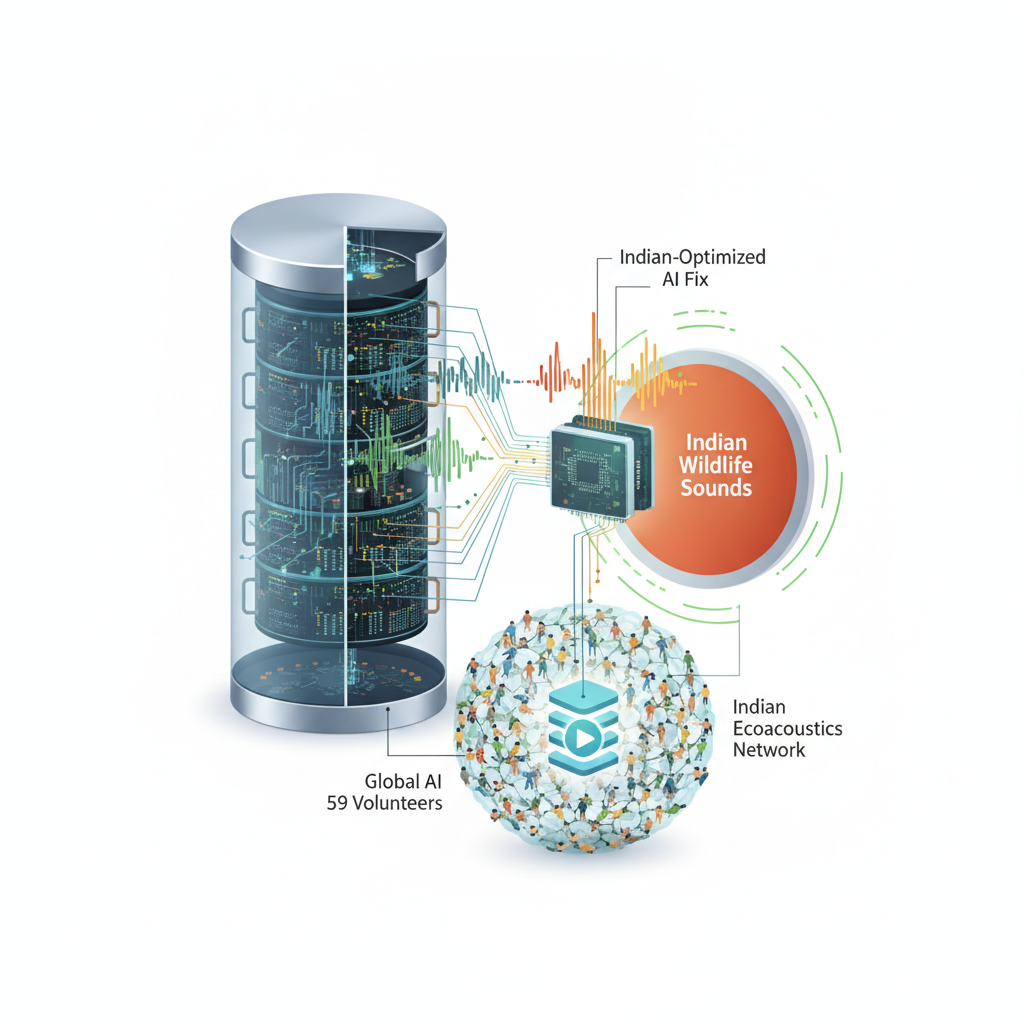
10 Aug AI Struggles with Indian Wildlife Sounds: How 59 Volunteers Fixed It for UPSC
AI modelsEcoacoustic datasetVolunteer networkWildlife sounds✎ Ecoacoustics combines environmental sound analysis with AI to enable non-invasive, scalable biodiversity monitoring, addressing the limitations of traditional visual surveys and global models trained on non-tropical datasets.
Subject Relevance — Where This Topic Fits
- GS Paper III — Environment, Ecology, Biodiversity and Climate Change
- Prelims: Ecoacoustics, Biodiversity monitoring, Deep learning in wildlife conservation, Spectrogram analysis, Citizen science in ecology, Western Ghats biodiversity, Tropical soundscapes, Non-invasive monitoring techniques
- Essay: The role of technology in environmental conservation, Citizen science and its impact on ecological research
Quick Revision: Ecoacoustics combines environmental sound analysis with AI to enable non-invasive, scalable biodiversity monitoring, addressing the limitations of traditional visual surveys and global models trained on non-tropical datasets.
Why is this in the news?
On 21 July 2026, the Indian Ecoacoustics Network (IEN) published India’s first open-access, crowdsourced ecoacoustic dataset comprising 5,815 minutes of recordings across 518 species from 25 states and union territories. This dataset addresses a critical gap in AI-driven wildlife monitoring, where models trained predominantly on Global North datasets perform poorly in tropical ecosystems like India’s. The initiative demonstrates the potential of citizen science and ecoacoustics to enhance biodiversity conservation through non-invasive, scalable monitoring tools.
Background
- Global deep learning models for wildlife sound recognition, such as BirdNET and Perch, are trained primarily on datasets from North America and Europe, leading to poor performance in tropical regions due to differences in soundscapes and species compositions.
- India, with its vast and diverse ecosystems ranging from the Western Ghats to the Sundarbans, requires locally relevant acoustic data for effective biodiversity monitoring.
- Traditional biodiversity surveys rely heavily on visual observations, which are often limited in dense forests and may miss cryptic or nocturnal species.
- Ecoacoustics, the study of environmental sounds, has emerged as a powerful tool for non-invasive monitoring, capturing species interactions, habitat health, and temporal changes in ecosystems.
- India’s existing ecoacoustic datasets were fragmented, with no unified, open-access repository for researchers and conservationists.
- The Indian Ecoacoustics Network (IEN) was established to address this gap by leveraging citizen science and crowdsourcing to build a comprehensive sound library.
What is Ecoacoustics and AI-driven Wildlife Monitoring?
- Ecoacoustics is the scientific study of environmental sounds, including those produced by animals, to assess biodiversity, ecosystem health, and species behavior without direct observation.
- Soundscapes in tropical ecosystems like India’s are uniquely complex, comprising bird calls, insect stridulations, amphibian vocalizations, and mammalian communications, often at frequencies beyond human hearing.
- Spectrograms are visual representations of sound waves, displaying frequency (pitch) on the y-axis and time on the x-axis, enabling researchers to identify species based on their unique acoustic signatures.
- AI models trained on ecoacoustic data can automatically detect and classify species, reducing the manual effort required in traditional surveys and enabling long-term, large-scale monitoring.
- Non-invasive monitoring techniques, such as automated sound recorders placed in habitats, minimize human disturbance and allow for continuous data collection over extended periods.
- The Indian dataset includes recordings from 25 states and union territories, covering diverse ecosystems such as the Western Ghats, East Deccan forests, and marine environments.
- Crowdsourcing and citizen science play a pivotal role in building such datasets, as they enable the collection of vast amounts of data across geographies and timeframes.
- Open-access datasets democratize research, allowing scientists, conservationists, and policymakers to access high-quality data for evidence-based decision-making.
Key Features
| Feature | Significance |
|---|---|
| Open-access crowdsourced dataset | First of its kind in India, enabling equitable access to ecoacoustic data for researchers and AI developers globally. |
| 518 species coverage across 25 states/UTs | Represents a substantial portion of India’s biodiversity, including underrepresented taxa like amphibians and insects. |
| Spectrogram-based annotation | Provides precise temporal and frequency data for species identification, enhancing AI model training accuracy. |
| Non-invasive recording methodology | Uses automated recorders placed in ecosystems, minimizing human disturbance to wildlife. |
| Multi-taxa inclusion (birds, insects, frogs, bats, etc.) | Bridges gaps in existing datasets dominated by bird calls, reflecting India’s rich biodiversity. |
Why it Matters
Scientific and Technological
- Addresses the data scarcity in tropical ecoacoustics, where AI models trained on Global North datasets underperform due to distinct soundscapes.
- Enables development of India-specific AI tools for biodiversity monitoring, reducing reliance on foreign datasets.
- Facilitates long-term acoustic monitoring, capturing temporal changes in ecosystems post-conservation interventions or disturbances.
Conservation and Ecology
- Provides a baseline for assessing biodiversity loss or recovery in key ecosystems like the Western Ghats and East Deccan Plateau.
- Supports non-invasive monitoring of elusive species (e.g., nocturnal animals, cryptic amphibians) that are difficult to track via traditional methods.
- Helps map species distributions and vocalization patterns, aiding habitat management and protected area planning.
Policy and Governance
- Strengthens India’s capacity for evidence-based environmental governance by integrating acoustic data into conservation policies.
- Promotes citizen science and collaborative research, aligning with global biodiversity monitoring frameworks like the Kunming-Montreal Global Biodiversity Framework.
Challenges
1. Data Bias in AI Training
- Global AI models for species recognition are predominantly trained on datasets from temperate regions, leading to poor performance in tropical ecosystems like India’s.
- Limited representation of Indian species in existing acoustic libraries hampers the development of accurate, localized AI tools.
UPSC Link: GS-III: Science & Tech, Biodiversity
2. Species Identification Accuracy
- Manual annotation of spectrograms is time-intensive and requires expert knowledge, posing scalability challenges for large datasets.
- Ambiguity in calls (e.g., overlapping frequencies) may lead to misidentification, affecting AI model reliability.
UPSC Link: GS-III: Environment, Ecology
3. Field Data Collection Constraints
- Logistical hurdles in accessing remote or dense ecosystems (e.g., Northeast India, Andaman Islands) limit comprehensive coverage.
- Environmental factors (noise pollution, seasonal variations) can degrade recording quality, complicating data standardization.
UPSC Link: GS-III: Disaster Management
4. Sustainability of Crowdsourcing
- Maintaining volunteer engagement and expertise over time is critical for expanding and updating the dataset.
- Ensuring data quality and consistency across diverse contributors requires robust validation protocols.
UPSC Link: GS-II: Governance, Citizen Participation
Challenges — UPSC Perspective
| Issue | Concern |
|---|---|
| AI Model Bias | Poor performance of global models in identifying Indian species due to lack of representative training data. |
| Annotation Bottleneck | Expert-driven spectrogram analysis is slow, limiting dataset expansion and real-time applications. |
| Ecological Variability | Diverse soundscapes across India’s biogeographic zones complicate standardization for AI training. |
| Resource Constraints | Limited funding and infrastructure for deploying recorders in remote or high-priority ecosystems. |
| Data Privacy and Ethics | Potential risks of misusing acoustic data (e.g., poaching, habitat disturbance) require ethical guidelines. |
Way Forward
- Expand the dataset by incorporating recordings from underrepresented regions (Northeast, Himalayas, deserts) and taxa (reptiles, marine species).
- Develop India-specific AI models (e.g.,
- Integrate acoustic monitoring into national biodiversity programs like the National Mission on Himalayan Studies and the National Biodiversity Authority’s projects.
- Establish a national ecoacoustic data repository under the Ministry of Environment, Forest and Climate Change for centralized access and analysis.
- Promote interdisciplinary collaborations between ecologists, data scientists, and indigenous communities for culturally relevant soundscapes.
- Invest in low-cost, automated recording devices and AI-powered annotation tools to reduce manual workload and improve scalability.
- Incorporate acoustic data into India’s State of Forest Reports and biodiversity action plans for evidence-based policy formulation.
UPSC Value Addition
Keywords for Mains Answer-Writing
Ecoacoustics · Biodiversity monitoring · Artificial Intelligence in ecology · Open-access data repositories · Species identification through sound · Deep learning models for wildlife · Crowdsourced ecological datasets · Non-invasive biodiversity assessment · Western Ghats biodiversity · Nature Research Scientific Data · Indian Ecoacoustics Network (IEN) · Spectrogram analysis in ecology
Concept Flow
Global AI models trained primarily on temperate-region datasets → Poor performance in India’s tropical ecosystems → Need for localized ecoacoustic data → Crowdsourced recording initiative → Dataset of 518 species across 25 states/UTs → Open-access publication → AI model improvement for Indian biodiversity monitoring → Enhanced conservation and policy outcomes.
Prelims Practice Questions
Q1. Consider the following statements about ecoacoustics and its applications:
1. Ecoacoustics involves the use of sound recordings to monitor biodiversity.
2. Deep learning models like BirdNET and Perch are trained exclusively on datasets from tropical ecosystems.
3. Spectrograms are visual representations of sound frequencies used in ecoacoustic analysis.
4. The Indian Ecoacoustics Network (IEN) has published India’s first open-access, crowdsourced ecoacoustic dataset.
How many of the above statements are correct?
- Only one
- Only two
- Only three
- All
Answer: All — Statements 1, 3, and 4 are correct. Statement 2 is incorrect because deep learning models are primarily trained on datasets from the Global North, which often perform poorly in tropical ecosystems like India.
Q2. Assertion (A): The Indian Ecoacoustics Network (IEN) dataset includes recordings from 518 species across 25 states and union territories.
Reason (R): Ecoacoustic datasets are essential for training AI models to accurately identify wildlife sounds in diverse ecosystems.
Options:
A. Both A and R are true, and R is the correct explanation of A.
B. Both A and R are true, but R is not the correct explanation of A.
C. A is true, but R is false.
D. A is false, but R is true.
Answer: ? — Both Assertion (A) and Reason (R) are true. The IEN dataset indeed includes 518 species across 25 states and union territories, and ecoacoustic datasets are critical for training AI models to improve species identification in diverse ecosystems.
Q3. Match the following terms with their correct descriptions:
Column I:
A. Ecoacoustics
B. Spectrogram
C. Deep learning models
D. Crowdsourced dataset
Column II:
1. A visual representation of sound frequencies used in ecological analysis.
2. A dataset built collaboratively by volunteers and made publicly available.
3. The study of environmental sounds to monitor biodiversity.
4. AI algorithms trained on large datasets to identify species from sound recordings.
Options:
A B C D
1 2 3 4
2 1 4 3
3 4 2 1
4 3 1 2
Answer: ? — A (Ecoacoustics) matches with 3 (The study of environmental sounds to monitor biodiversity). B (Spectrogram) matches with 1 (A visual representation of sound frequencies used in ecological analysis). C (Deep learning models) matches with 4 (AI algorithms trained on large datasets to identify species from sound recordings). D (Crowdsourced dataset) matches with 2 (A dataset built collaboratively by volunteers and made publicly available).
Mains Practice Question
✍ Ecoacoustic monitoring is emerging as a transformative tool for biodiversity assessment in India. Critically examine its advantages over traditional field surveys, and analyse the significance of open-access, crowdsourced datasets like the one published by the Indian Ecoacoustics Network (IEN) in enhancing AI-driven wildlife identification. (15 Marks)
Approach: MODEL-ANSWER SKELETON:
1. **Introduction (2 marks)**
– Define ecoacoustics and its relevance in biodiversity monitoring.
– Highlight the limitations of traditional field surveys (e.g., point counts, human bias, dense forest constraints).
2. **Advantages of Ecoacoustics (5 marks)**
– **Non-invasive and continuous monitoring**: Use of automated recorders capturing sound 24/7, including frequencies beyond human hearing range.
– **Comprehensive data capture**: Records multiple species simultaneously, including elusive or nocturnal ones (e.g., bats, frogs, insects).
– **Temporal and spatial scalability**: Enables long-term monitoring to detect seasonal changes, habitat degradation, or conservation impact.
– **Unique species signatures**: Examples like tigers’ chuffing or bird calls, which can be identified via spectrograms and AI.
– **Cost-effectiveness**: Reduces manpower and logistical costs compared to repeated field surveys.
3. **Role of AI in Ecoacoustics (4 marks)**
– **Deep learning models**: Explain BirdNET, Perch, and their reliance on large, labelled datasets for species identification.
– **Challenges in tropical ecosystems**: Poor performance of Global North-trained models due to unique soundscapes (e.g., dense forests, high biodiversity).
– **Need for India-specific datasets**: Emphasise how open-access datasets like IEN’s address this gap by providing regionally relevant training data.
4. **Significance of Open-Access Crowdsourced Datasets (3 marks)**
– **Democratising science**: Enables researchers, policymakers, and citizen scientists to access and utilise data without paywalls.
– **Collaborative potential**: Highlights the role of volunteers (e.g., ecologists, enthusiasts) in data collection and validation.
– **Policy and conservation applications**: Supports biodiversity action plans, protected area management, and climate change impact assessments.
5. **Conclusion (1 mark)**
– Summarise the transformative potential of ecoacoustics and AI in India’s biodiversity monitoring.
– Note the need for scaling up datasets and integrating them with national biodiversity programmes (e.g., National Mission on Biodiversity and Human Well-being).
Source: The Indian Express
Generated by AanyaAi for educational purpose.

- KWML’s Feasibility Reports for Water Metro in 18 Cities: UPSC & PCS Insights - October 3, 2026
- ओडिशा में वन्यजीव अनुसंधान अनुदान कार्यक्रम शुरू, सिमिलिपाल में 300 कैमरे और बढ़ेंगे - October 3, 2026
- India Summons Pakistan High Commission Official Over Violation - October 3, 2026

No Comments