


07 Aug Akal Takht Panel Rejects Talks on Anti-Sacrilege Bill Without Compliance Report
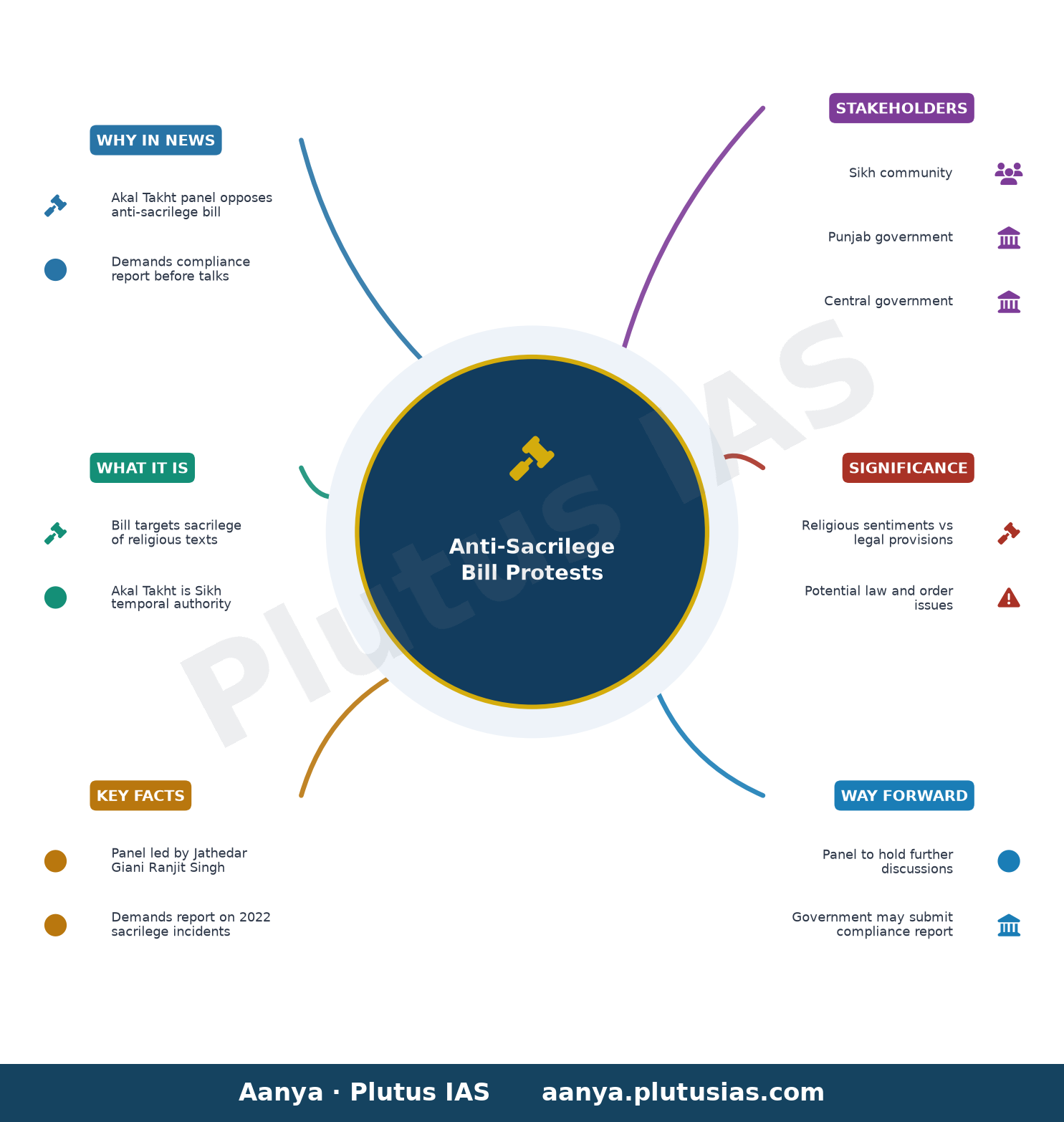
✎ Akal Takht panel insists on compliance report before engaging in talks on the anti-sacrilege bill.
Relevance for UPSC & State PCS: Economy/Governance
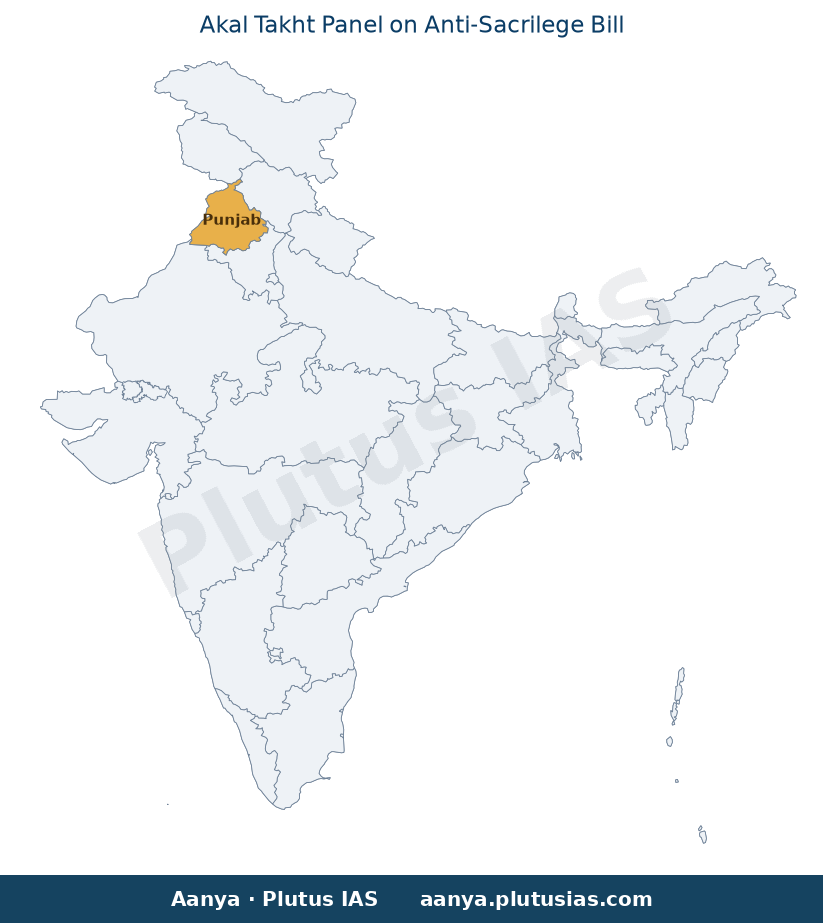
The Akal Takht’s high-powered committee overseeing the implementation of the 2018 anti-sacrilege laws has categorically stated that no further dialogue with the Punjab government will be entertained until the state submits a compliance report detailing action taken against those accused in sacrilege cases. The five-member panel, led by the Jathedar of Akal Takht, Giani Raghubir Singh, conveyed this stance after reviewing the status of pending cases, many of which have seen prolonged delays in judicial proceedings. This development underscores the deepening institutional friction between the Sikh religious leadership and the state administration over the enforcement of laws aimed at protecting religious sentiments, a matter that intersects with governance, law and order, and minority rights—key dimensions in the UPSC syllabus under polity and governance.
For UPSC aspirants, this episode highlights the complex interplay between statutory bodies and religious institutions in matters of public order and constitutional morality. The anti-sacrilege laws, originally enacted to address incidents of desecration of religious texts, have become a flashpoint for debates on secularism, federalism, and the limits of executive action. The Akal Takht’s insistence on compliance reflects a broader trend where non-state actors wield significant moral authority, compelling governments to align their actions with perceived societal expectations. Such dynamics are pertinent for questions on administrative accountability and the role of unelected institutions in shaping governance outcomes.
State PCS aspirants, particularly those preparing for Punjab or Haryana cadre, must understand the local socio-political context driving this standoff. The sacrilege issue has historically been a mobilizing factor for Sikh communities, and any mishandling risks exacerbating communal tensions. The demand for a compliance report is not merely procedural but a signal of the religious leadership’s intent to assert oversight over secular institutions. This scenario tests the ability of civil servants to navigate delicate socio-religious landscapes while upholding the rule of law—a critical skill evaluated in state civil service examinations focusing on district administration and crisis management.
From a governance perspective, the standoff also raises questions about the efficacy of laws that are perceived as partisan or selectively enforced. The UPSC often examines case studies where legislation, despite its noble intent, becomes a tool for political or religious posturing. The Akal Takht’s stance forces a reckoning with whether such laws serve their intended purpose or inadvertently deepen societal divisions. For aspirants, this case serves as a reminder that governance solutions must balance legal frameworks with ground realities, a lesson applicable across diverse administrative scenarios in India’s federal structure.
Source: ndtv.com
Practice Questions
Q1. What is the stance of the Akal Takht panel regarding any potential talks with the government on the anti-sacrilege bill?
- Talks can proceed without any conditions.
- Talks are conditional upon the government submitting a compliance report.
- Talks are indefinitely postponed.
- Talks will only occur if the bill is withdrawn.
Answer
Talks are conditional upon the government submitting a compliance report. — The Akal Takht panel has clearly stated that no talks will be held with the government unless a compliance report on the anti-sacrilege bill is submitted.
Q2. What is the primary concern of the Akal Takht panel regarding the anti-sacrilege bill?
- The bill does not address economic reforms.
- The bill lacks provisions for religious freedom.
- The bill requires a compliance report to ensure proper implementation.
- The bill is too lenient on offenders.
Answer
The bill requires a compliance report to ensure proper implementation. — The panel’s insistence on a compliance report suggests their primary concern is ensuring the bill adequately protects religious freedom and addresses sacrilege appropriately.
Generated by AanyaAi for educational purpose.

- KWML’s Feasibility Reports for Water Metro in 18 Cities: UPSC & PCS Insights - October 3, 2026
- ओडिशा में वन्यजीव अनुसंधान अनुदान कार्यक्रम शुरू, सिमिलिपाल में 300 कैमरे और बढ़ेंगे - October 3, 2026
- India Summons Pakistan High Commission Official Over Violation - October 3, 2026

No Comments