


05 Aug Al Nino Impact on 2026 Monsoon: IMD Forecast & State Preparedness
✎ El Niño weakens the Indian Southwest Monsoon by disrupting the Walker Circulation, historically reducing rainfall in 7 of 16 post-1950 events, with the strongest impact observed in September.
Subject Relevance — Where This Topic Fits
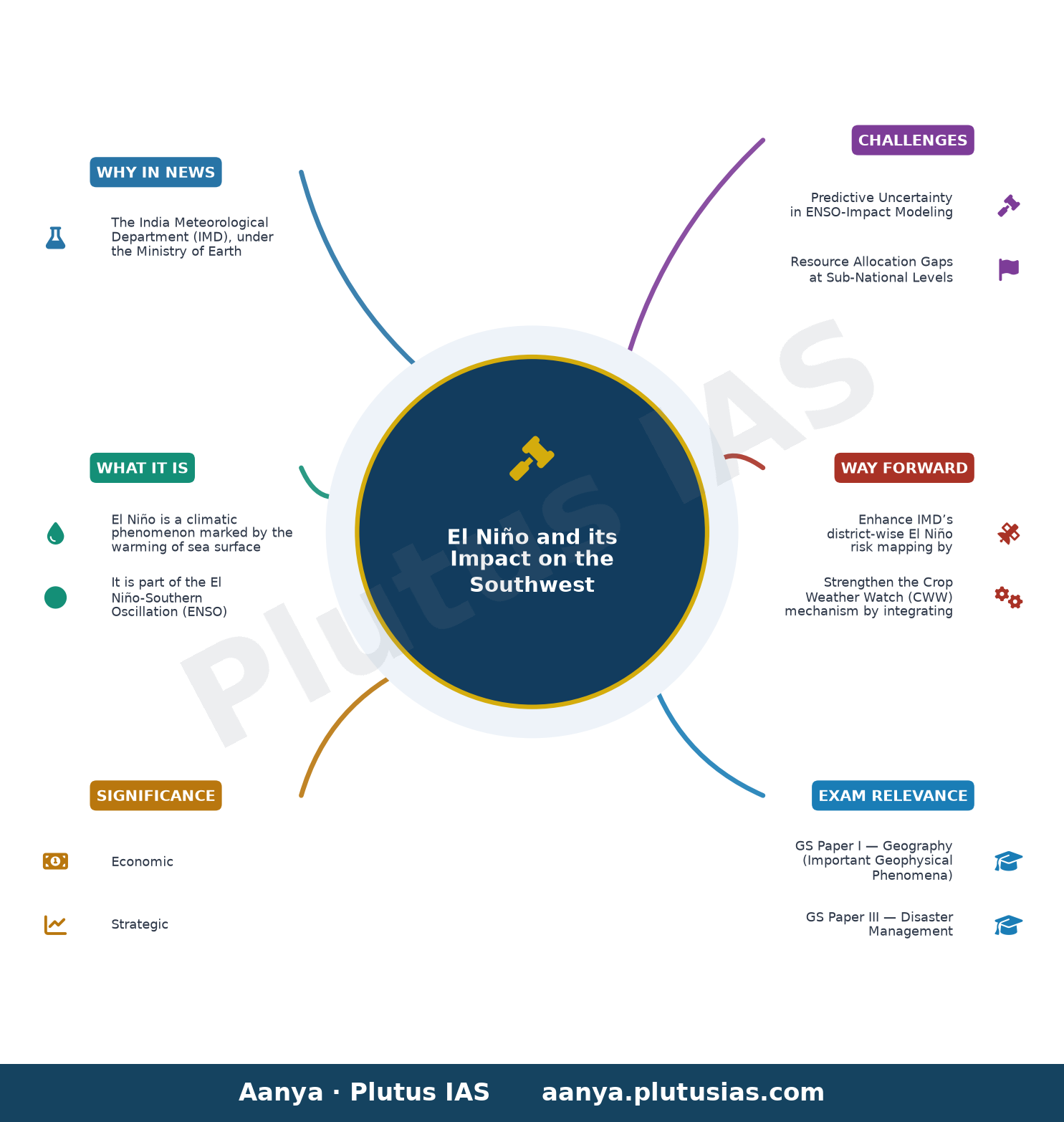
- GS Paper I — Geography (Important Geophysical Phenomena) | GS Paper III — Disaster Management | GS Paper III — Indian Economy and Agriculture
- Prelims: El Niño, ENSO, Indian Southwest Monsoon, Long Period Average (LPA), IMD, La Niña, Walker Circulation, drought-prone regions, crop-weather watch, heatwave, early warning systems
- Essay: Climate change and its cascading impacts on agriculture and food security, Preparedness and resilience in disaster management: Lessons from monsoon variability
Quick Revision: El Niño weakens the Indian Southwest Monsoon by disrupting the Walker Circulation, historically reducing rainfall in 7 of 16 post-1950 events, with the strongest impact observed in September.
Why is this in the news?
The India Meteorological Department (IMD), under the Ministry of Earth Sciences, has issued revised forecasts for the 2026 Southwest Monsoon, predicting below-normal rainfall at 90% of the Long Period Average (LPA) with a model error margin of ±4%. This forecast is influenced by the anticipated formation of El Niño conditions during the monsoon season, which historically weakens the Indian summer monsoon. The IMD’s assessment underscores the need for proactive preparedness among stakeholders, including central ministries, state governments, and agricultural departments, to mitigate potential adverse impacts on agriculture, water resources, and disaster management.
Background
- The Indian Southwest Monsoon is a critical climatic phenomenon, contributing approximately 75% of India’s annual rainfall and sustaining agricultural productivity across rainfed regions.
- El Niño, a phase of the El Niño-Southern Oscillation (ENSO) cycle, is characterised by anomalous warming of sea surface temperatures in the central and eastern equatorial Pacific Ocean, disrupting global weather patterns.
- Historically, 16 El Niño events have occurred since 1950, with 7 directly correlating to below-normal monsoon rainfall in India, particularly affecting the latter half of the monsoon season (e.g., September).
- The IMD issues seasonal and monthly forecasts for rainfall and temperature, utilising statistical and dynamical models to assess ENSO’s influence on monsoon variability.
- The Ministry of Earth Sciences, through the IMD and the Indian Institute of Tropical Meteorology (IITM), collaborates with agricultural and water management agencies to provide actionable insights for sector-specific preparedness.
- The 2026 monsoon forecast aligns with broader concerns about climate change exacerbating extreme weather events, including prolonged droughts and heatwaves.
What is El Niño and its relationship with the Indian Monsoon?
- El Niño is a climatic phenomenon marked by the warming of sea surface temperatures in the central and eastern equatorial Pacific Ocean, typically persisting for 9–12 months.
- It is part of the El Niño-Southern Oscillation (ENSO) cycle, which alternates between El Niño (warm phase), La Niña (cool phase), and neutral conditions.
- During El Niño, the Walker Circulation weakens, reducing the intensity of the Indian summer monsoon by disrupting the monsoon trough and moisture transport over the Indian subcontinent.
- The impact of El Niño on monsoon rainfall is not uniform; historical data shows that while 7 out of 16 El Niño events since 1950 led to below-normal rainfall, the relationship is probabilistic rather than deterministic.
- The intensity of El Niño events correlates with the severity of monsoon deficits: stronger El Niño events (e.g., 1997–98, 2015–16) are more likely to result in significant rainfall deficits.
- The relationship between El Niño and monsoon rainfall is strongest in the latter half of the monsoon season (August–September), often leading to prolonged dry spells in central and peninsular India.
- The IMD’s forecasting framework incorporates ENSO indices (e.g., Nino 3.4 region sea surface temperature anomalies) to refine monsoon predictions and issue early warnings.
- El Niño’s global teleconnections extend beyond monsoon variability, influencing phenomena such as tropical cyclones, heatwaves, and droughts in other regions.
Key Features
| Feature | Significance |
|---|---|
| El Niño-Southern Oscillation (ENSO) Phenomenon | A coupled ocean-atmosphere phenomenon originating in the tropical Pacific, influencing global weather patterns, including the Indian Summer Monsoon (ISM). |
| Indian Summer Monsoon (ISM) | Critical for India’s agriculture, water resources, and economy; its variability directly impacts food security and GDP growth. |
| Long Period Average (LPA) | The 50-year average rainfall benchmark used by IMD to classify monsoon performance as normal (96-104%), deficient (<90%), or excess (>104%). |
| IMD’s Seasonal and Monthly Forecasts | Provides advance information on rainfall distribution, enabling stakeholders to plan agricultural, water management, and disaster mitigation strategies. |
| District and Block-Level Rainfall Data | Enables granular planning at the grassroots level, supporting local governments and farmers in resource allocation and risk management. |
| Crop Weather Watch (CWW) Mechanism | A weekly bulletin by IMD under MoAFW, integrating rainfall data and forecasts to guide agricultural operations and mitigate climate risks. |
| Experimental Forecasts by IITM | Leverages climate models to provide probabilistic forecasts for agriculture and dam management, enhancing resilience against ENSO-related extremes. |
Why it Matters
Economic
- Agricultural output, which contributes ~18% to India’s GDP, is heavily dependent on monsoon rainfall; deficient monsoons can reduce farm incomes by 20-30% in vulnerable regions.
- Water scarcity due to weak monsoons impacts hydroelectric power generation, exacerbating energy deficits in rural areas.
- Food inflation risks rise during deficient monsoons, as seen historically during El Niño years (e.g., 2015, 2018).
Strategic
- Monsoon variability affects India’s food security strategy, necessitating buffer stock management and import planning for critical commodities like pulses and edible oils.
- Weak monsoons can strain water-sharing agreements with neighboring countries (e.g., Indus Waters Treaty), requiring diplomatic preparedness.
Environmental
- Prolonged dry spells increase forest fire risks and air pollution levels, particularly in central and northern India.
- Delayed or erratic monsoons disrupt ecosystems, affecting biodiversity and soil moisture retention.
Social
- Rural livelihoods, especially small and marginal farmers, are disproportionately affected by monsoon failures, leading to migration and indebtedness.
- Public health risks escalate due to heatwaves and waterborne diseases during prolonged dry periods.
Challenges
1. Predictive Uncertainty in ENSO-Impact Modeling
- ENSO’s influence on ISM is probabilistic; while El Niño generally weakens monsoons, its intensity and teleconnections vary, complicating precise forecasting.
- IMD’s ±4-5% error margin in seasonal forecasts necessitates adaptive strategies rather than rigid planning.
UPSC Link: GS3: Climate Change
2. Resource Allocation Gaps at Sub-National Levels
- State governments often lack district-wise risk assessments for El Niño-induced deficits, leading to inefficient resource deployment.
- Delayed dissemination of localized forecasts hampers on-ground preparedness in agriculture and water management.
UPSC Link: GS2: Federalism
3. Agricultural Vulnerability to Climate Extremes
- Smallholder farmers lack access to climate-resilient seeds, insurance mechanisms, and advisory services to mitigate El Niño impacts.
- Lack of integrated drought management plans at the block level increases recovery time post-deficient monsoons.
UPSC Link: GS3: Agriculture
4. Institutional Coordination Deficits
- While IMD, MoES, and MoAFW share data, real-time inter-ministerial coordination for crisis response remains suboptimal.
- Local governments often receive conflicting advisories, reducing the efficacy of mitigation measures.
UPSC Link: GS2: Governance
5. Economic Buffering Capacity
- India’s food subsidy bill rises during monsoon deficits, straining fiscal resources and limiting fiscal space for other developmental priorities.
- Weak monsoons reduce rural demand, impacting industrial growth and employment in sectors like FMCG and textiles.
UPSC Link: GS3: Indian Economy
Challenges — UPSC Perspective
| Issue | Concern |
|---|---|
| Inadequate District-Level Risk Mapping | States lack granular assessments of El Niño’s impact on specific districts, hindering targeted interventions. |
| Delayed Forecast Dissemination | Local governments and farmers receive forecasts too late to adjust sowing patterns or water conservation strategies. |
| Limited Access to Climate-Resilient Technology | Small farmers face barriers in adopting drought-resistant seeds, micro-irrigation, and precision agriculture tools. |
| Overlapping Jurisdictions in Disaster Management | Multiple agencies (IMD, NDMA, state departments) lead to duplication of efforts and diluted accountability. |
| Insufficient Insurance Penetration | Less than 20% of small farmers are covered under crop insurance schemes, leaving them financially exposed to monsoon failures. |
| Weak Inter-Ministerial Data Integration | Lack of a unified platform for sharing ENSO-related forecasts and advisories across central and state agencies. |
Way Forward
- Enhance IMD’s district-wise El Niño risk mapping by leveraging AI and satellite data for hyperlocal forecasts and advisories.
- Strengthen the Crop Weather Watch (CWW) mechanism by integrating real-time soil moisture data and farmer feedback loops.
- Expand the coverage of the Pradhan Mantri Fasal Bima Yojana (PMFBY) to include all small and marginal farmers, with simplified claim processes.
- Develop state-specific drought management plans with clear timelines for seed distribution, water rationing, and employment generation under MGNREGS.
- Promote climate-resilient agriculture through subsidies for drought-resistant seeds, micro-irrigation, and precision farming techniques in El Niño-prone regions.
- Establish a dedicated inter-ministerial task force (IMD, MoAFW, NDMA, state governments) for real-time coordination during ENSO-related crises.
- Launch public awareness campaigns on water conservation, crop diversification, and early warning systems in vulnerable districts.
- Invest in long-term climate modeling by IITM to improve the accuracy of probabilistic forecasts for ISM and ENSO impacts.
UPSC Value Addition
Keywords for Mains Answer-Writing
El Niño-Southern Oscillation (ENSO) · Indian Summer Monsoon (ISM) · Long Period Average (LPA) · India Meteorological Department (IMD) · Southwest Monsoon Forecasting · ENSO-Monsoon Teleconnection · Seasonal Rainfall Variability · Climate Preparedness and Mitigation · Drought Risk Assessment · Agricultural Planning and Water Management · Extreme Weather Events · Climate Change and Monsoon Patterns
Concept Flow
El Niño conditions develop in the tropical Pacific → Disruption in Walker Circulation weakens the Indian Summer Monsoon → IMD issues seasonal forecast with 90-92% of LPA (2026) → States and farmers receive district-level advisories → Agricultural output declines in rainfed regions → Food inflation rises, fiscal deficit widens → Rural distress and migration increase → Government implements drought relief measures under MGNREGS and PM-KISAN
Prelims Practice Questions
Q1. Consider the following statements regarding the El Niño-Southern Oscillation (ENSO) and its impact on the Indian Summer Monsoon (ISM):
1. El Niño events are generally associated with above-normal rainfall over India during the Southwest Monsoon season.
2. The strength of El Niño directly influences the extent of its impact on the ISM.
3. Historical data from 1950 to 2026 shows that all El Niño events have resulted in deficient monsoon rainfall over India.
4. There is a strong inverse relationship between El Niño and rainfall during the latter part of the monsoon season, particularly in September.
How many of the above statements are correct?
- Only one
- Only two
- Only three
- All
Answer: Only three — Statements 2 and 4 are correct. Statement 1 is incorrect because El Niño events are generally associated with below-normal rainfall over India. Statement 3 is incorrect because not all El Niño events have resulted in deficient monsoon rainfall; only 7 out of 16 events since 1950 have shown such an impact.
Q2. Which of the following best describes the role of the India Meteorological Department (IMD) in the context of the Southwest Monsoon forecasting and ENSO monitoring?
- IMD issues daily rainfall updates and monthly ENSO condition reports, and provides district-level rainfall information to stakeholders for preparedness.
- IMD solely relies on global climate models for monsoon forecasting without issuing any seasonal or monthly forecasts.
- IMD has no role in ENSO monitoring and only focuses on temperature predictions for India.
- IMD provides rainfall forecasts only for the first two weeks of the monsoon season and does not issue long-term seasonal outlooks.
Answer: IMD issues daily rainfall updates and monthly ENSO condition reports, and provides district-level rainfall information to stakeholders for preparedness. — The IMD issues daily and monthly updates on rainfall and ENSO conditions, and provides district-level rainfall information to central ministries, state governments, and other stakeholders for preparedness and planning.
Q3. Assertion (A): The India Meteorological Department (IMD) revised its long-range forecast for the 2026 Southwest Monsoon season from 92% of the Long Period Average (LPA) to 90% of LPA, indicating a higher likelihood of below-normal rainfall.
Reason (R): The revision was made due to the anticipated formation of El Niño conditions during the monsoon season, which typically weakens the Indian Summer Monsoon.
- Both A and R are true, and R is the correct explanation of A.
- Both A and R are true, but R is not the correct explanation of A.
- A is true, but R is false.
- A is false, but R is true.
Answer: Both A and R are true, and R is the correct explanation of A. — Both the assertion and reason are true. The IMD revised its forecast to 90% of LPA from 92% due to the expected El Niño conditions, which are known to weaken the Indian Summer Monsoon.
Mains Practice Question
✍ Critically examine the relationship between El Niño-Southern Oscillation (ENSO) and the Indian Summer Monsoon (ISM), with particular reference to the forecasting mechanisms employed by the India Meteorological Department (IMD) for seasonal rainfall prediction. Also, discuss the implications of below-normal monsoon forecasts for agricultural planning and water resource management in India. (15 Marks)
Approach: MODEL-ANSWER SKELETON:
1. **Introduction (2 Marks)**
– Define ENSO and its two phases: El Niño (warming of central and eastern tropical Pacific) and La Niña (cooling).
– State the teleconnection between ENSO and ISM: El Niño generally weakens ISM, while La Niña strengthens it.
– Mention historical data: Since 1950, 16 El Niño events occurred, with 7 leading to deficient monsoon rainfall.
2. **ENSO-Monsoon Teleconnection (4 Marks)**
– Explain the physical mechanism: El Niño disrupts Walker Circulation, leading to suppressed convection over the Indian Ocean and reduced monsoon rainfall.
– Highlight the inverse relationship in September: Strong correlation between El Niño and deficient rainfall in the latter part of the monsoon season.
– Cite IMD’s 2026 forecast: First phase forecast of 92% of LPA (with ±5% error) revised to 90% of LPA (with ±4% error) in the second phase, attributing it to anticipated El Niño conditions.
3. **IMD’s Forecasting Mechanisms (4 Marks)**
– Describe IMD’s multi-stage forecasting: Seasonal (April and June), monthly, and daily updates.
– Explain the use of Long Period Average (LPA) and model error margins (±4% to ±5%).
– Discuss the role of the Indian Institute of Tropical Meteorology (IITM) in experimental forecasts for agriculture and dam management.
– Mention the dissemination of district-level rainfall information to stakeholders via the ‘Crop Weather Watch’ under the Ministry of Agriculture.
4. **Implications for Agricultural Planning and Water Management (3 Marks)**
– Discuss the impact of below-normal monsoon forecasts on kharif crop planning (e.g., rice, pulses, coarse cereals).
– Highlight water resource management challenges: Reduced reservoir levels, groundwater depletion, and drought risk in vulnerable regions (e.g., Marathwada, Bundelkhand).
– Mention adaptive strategies: Crop diversification, water-saving techniques (e.g., micro-irrigation), and contingency plans for drought-prone areas.
5. **Conclusion (2 Marks)**
– Reiterate the critical role of ENSO in monsoon variability and the importance of IMD’s forecasting in mitigating risks.
– Emphasize the need for integrated climate-resilient agricultural policies and inter-ministerial coordination (e.g., PMO, MHA, MoAFW) for effective preparedness.
Source: PIB (Press Information Bureau)
Generated by AanyaAi for educational purpose.

- Gujarat HC orders FIR in ITS officer’s 2023 custodial death - October 3, 2026
- डीआरआई ने मुंबई एयरपोर्ट पर सोने-हीरे की तस्करी गिरोह का किया पर्दाफाश, 8 गिरफ्तार - October 3, 2026
- Chhattisgarh CM Rural Bus Scheme: 850 Villages Connected in 1 Year - October 3, 2026

No Comments