


31 Jul Allahabad HC: Must Provide Reasons for Caste Certificate Rejection, Orders Mandatory
✎ Caste certificate issuance must comply with Articles 14, 16, and 21 of the Constitution; arbitrary rejections are unconstitutional, and applicants must receive reasoned orders within two months, with a copy provided within seven…

Subject Relevance — Where This Topic Fits
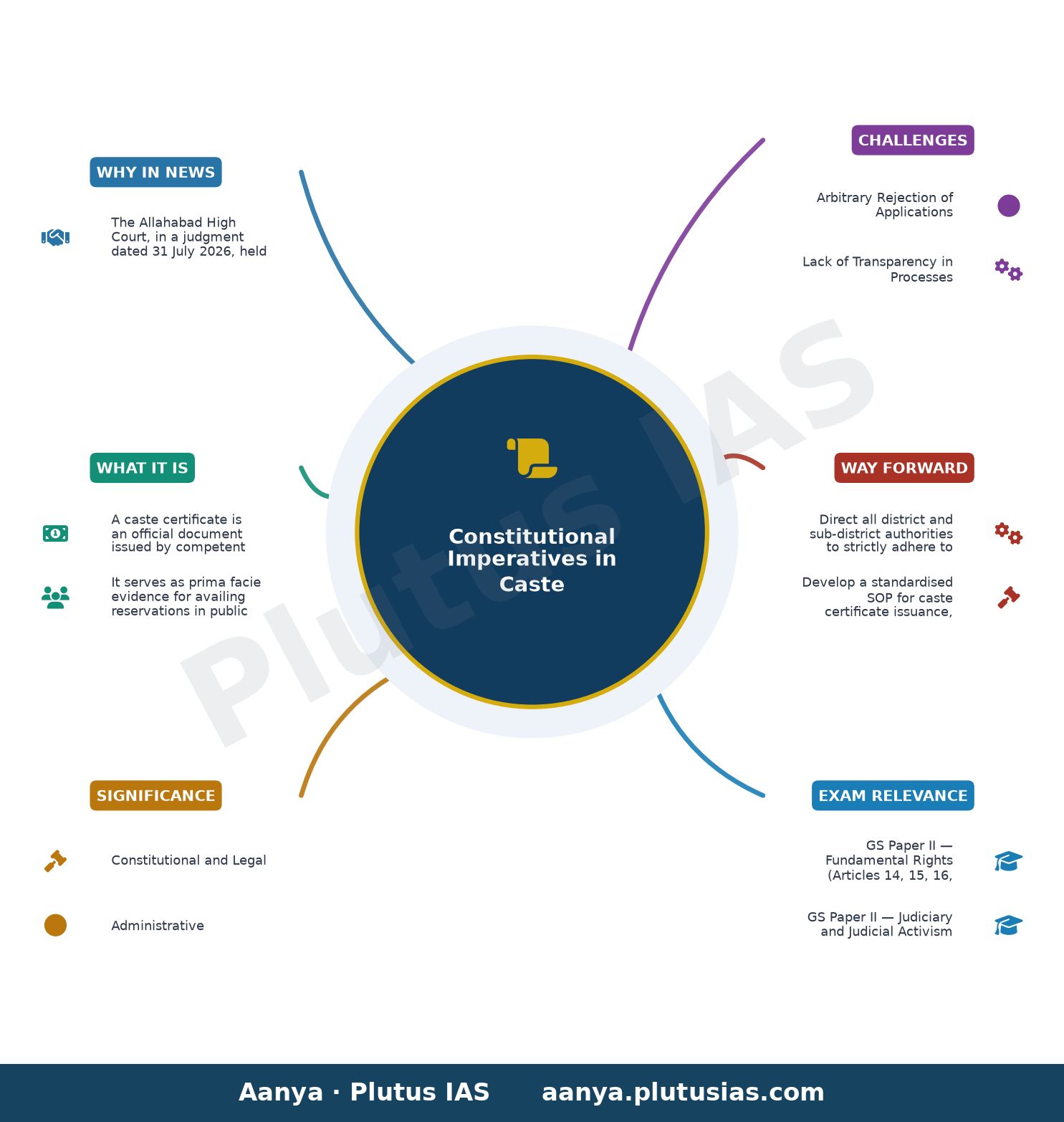
- GS Paper II — Fundamental Rights (Articles 14, 15, 16, 21) | GS Paper II — Judiciary and Judicial Activism | GS Paper IV — Governance, Transparency, and Accountability
- Prelims: Article 16(4), Article 341, Caste Certificate Rules, SC/ST (Prevention of Atrocities) Act, 1989, Right to Information Act, 2005, Judicial Review
- Essay: Transparency in Governance: A Pillar of Constitutional Democracy, Judicial Activism and Social Justice: Balancing Efficiency and Equity
Quick Revision: Caste certificate issuance must comply with Articles 14, 16, and 21 of the Constitution; arbitrary rejections are unconstitutional, and applicants must receive reasoned orders within two months, with a copy provided within seven days.
Why is this in the news?
The Allahabad High Court, in a judgment dated 31 July 2026, held that the rejection of a caste certificate application without providing a reasoned order is unconstitutional. The Court underscored that mere mention of ‘insufficient evidence’ on a departmental website is inadequate and violates the right to a reasoned decision and the principles of natural justice. This ruling is significant as it reinforces the constitutional safeguards for marginalised communities seeking affirmative action benefits under the Scheduled Castes category.
Background
- The issuance of caste certificates is a critical administrative function enabling access to reservations in education, employment, and political representation under Articles 15(4), 16(4), and 341 of the Constitution.
- State governments and local authorities (e.g., Tehsildars) are empowered to issue caste certificates, subject to due process and judicial oversight.
- Historically, caste certificates have been misused or denied arbitrarily, leading to exclusion of eligible beneficiaries from welfare schemes and constitutional protections.
- The Right to Information Act, 2005, and judicial precedents (e.g., *State of Kerala v. N.M. Thomas*, 1976) have emphasised transparency in administrative decisions affecting fundamental rights.
What is a Caste Certificate and Why is its Issuance Governed by Constitutional Safeguards?
- A caste certificate is an official document issued by competent authorities (e.g., Tehsildar, Revenue Department) certifying an individual’s caste as belonging to the Scheduled Castes (SC), Scheduled Tribes (ST), or Other Backward Classes (OBC), as notified by the Government of India.
- It serves as prima facie evidence for availing reservations in public employment, educational institutions, and legislative bodies under Articles 15(4), 16(4), and 341 of the Constitution.
- The issuance process involves verification of caste claims through documentary evidence (e.g., caste records, affidavits, or community certificates) and field enquiries by revenue officials.
- Arbitrary rejection of applications without providing reasons or opportunity for redressal violates the principles of natural justice (Audi alteram partem) and the right to a reasoned decision under Article 21 of the Constitution.
- Transparency in the issuance process is further reinforced by the Right to Information Act, 2005, which allows applicants to seek records of their applications and rejection orders.
Key Features
| Feature | Significance |
|---|---|
| Mandatory reasoned order for rejection | Ensures administrative accountability and prevents arbitrary denial of constitutional rights under Articles 14 and 16. |
| Provision of order copy to applicant | Facilitates transparency, enables legal recourse, and upholds the principle of natural justice. |
| Opportunity for objections and rectification | Allows applicants to address deficiencies before final adjudication, reducing errors and delays. |
| Standard Operating Procedure (SOP) formulation | Ensures uniformity, predictability, and efficiency in caste certificate issuance across jurisdictions. |
| Two-month timeline for disposal | Balances administrative efficiency with due process, preventing indefinite pendency of applications. |
Why it Matters
Constitutional and Legal
- Reinforces the right to equality (Article 14) and non-discrimination (Article 16) by ensuring fair and transparent procedures in caste certification.
- Upholds the principle of natural justice by mandating reasoned orders and opportunities for redressal.
- Strengthens judicial oversight over executive actions in matters affecting social justice and affirmative action.
Administrative
- Promotes procedural fairness and reduces arbitrariness in administrative decision-making.
- Encourages standardisation of processes, reducing regional disparities in caste certificate issuance.
- Enhances public trust in administrative systems by ensuring accountability and transparency.
Social Justice
- Facilitates access to affirmative action benefits for marginalised communities by ensuring timely and fair issuance of caste certificates.
- Reduces systemic barriers that deny Scheduled Caste (SC) communities their legitimate entitlements.
- Supports the realisation of socio-economic justice through equitable implementation of reservation policies.
Challenges
1. Arbitrary Rejection of Applications
- Risk of administrative apathy or bias leading to denial of rights without valid justification.
- Lack of uniformity in rejection criteria across jurisdictions, causing confusion and inequity.
- Delays in issuance due to procedural laxity, undermining the purpose of reservation policies.
UPSC Link: GS-II: Fundamental Rights (Articles 14, 16)
2. Lack of Transparency in Processes
- Absence of clear communication regarding deficiencies in applications, leaving applicants unaware of corrective measures.
- Dependence on departmental websites for notifications, which may exclude marginalised applicants with limited digital access.
- Inadequate documentation of reasons for rejection, complicating legal recourse and appeals.
UPSC Link: GS-II: Governance (Transparency and Accountability)
3. Delays in Certification
- Prolonged pendency of applications due to inefficient administrative processes, defeating the purpose of timely access to reservations.
- Inconsistent timelines across states, leading to disparities in implementation of reservation policies.
- Potential exploitation of delays by intermediaries or corrupt officials to extort bribes.
UPSC Link: GS-II: Administrative Reforms
4. Digital Divide and Accessibility
- Over-reliance on digital platforms for notifications and order dissemination may exclude applicants from rural or socio-economically disadvantaged backgrounds.
- Limited awareness among applicants about digital processes, leading to missed opportunities for rectification.
- Need for multi-modal communication (e.g., physical notices, helplines) to ensure inclusivity.
UPSC Link: GS-II: Social Justice (Inclusion)
Challenges — UPSC Perspective
| Issue | Concern |
|---|---|
| Arbitrary rejections | Undermines constitutional guarantees of equality and non-discrimination. |
| Lack of transparency | Hinders applicants’ ability to seek redressal or correct deficiencies. |
| Delays in certification | Defeats the purpose of reservation policies by delaying access to benefits. |
| Digital exclusion | Exacerbates socio-economic disparities in accessing administrative services. |
| Inconsistent processes | Leads to regional inequities in the implementation of reservation policies. |
Way Forward
- Direct all district and sub-district authorities to strictly adhere to the two-month timeline for processing caste certificate applications.
- Develop a standardised SOP for caste certificate issuance, incorporating the court’s directives on reasoned orders and transparency.
- Establish a grievance redressal mechanism at the district level to address delays or procedural lapses in certification.
- Conduct periodic audits of rejection orders to identify patterns of arbitrariness or systemic biases.
- Ensure multi-modal dissemination of orders and notifications, including physical copies and local language support, to bridge the digital divide.
- Train administrative officials on the principles of natural justice, procedural fairness, and constitutional obligations in caste certification.
- Monitor the implementation of the court’s directives through quarterly reports submitted to the High Court or a designated oversight body.
UPSC Value Addition
Keywords for Mains Answer-Writing
Caste Certificate issuance · Constitutional rights of citizens · Administrative justice · Right to fair hearing · Judicial review of administrative actions · Procedural fairness · Article 14 of the Constitution · Judicial activism in socio-economic rights · Due process of law · Transparency in governance · Judicial directions on administrative procedures · Scheduled Castes welfare · Rule of law · Natural justice · Judicial review of executive actions
Constitutional & Policy Linkages
- Article 14: Right to Equality
- Article 16: Equality of Opportunity in Public Employment
- Article 21: Right to Life and Personal Liberty (procedural fairness)
- Article 338: National Commission for Scheduled Castes (oversight role)
Concept Flow
Caste certificate application submitted by eligible applicant → Administrative authority processes application without reasoned order or transparency → Applicant denied rights without recourse → High Court intervenes, upholding constitutional principles → Court mandates reasoned orders, transparency, and timelines → Administrative authorities reform processes to ensure compliance → Marginalised communities gain equitable access to reservation benefits.
Prelims Practice Questions
Q1. Consider the following statements regarding the issuance of caste certificates in India:
1. The administrative authority must provide a reasoned order while rejecting an application for a caste certificate.
2. Rejection of an application solely on the ground of ‘insufficient evidence’ without a detailed explanation is constitutionally valid.
3. The High Court has directed that the rejection order must be provided to the applicant within seven days.
4. The concerned authority is required to prepare a Standard Operating Procedure (SOP) within three months for the issuance of caste certificates.
How many of the above statements are correct?
- Only one
- Only two
- Only three
- All
Answer: Only three — Statements 1, 3, and 4 are correct as per the Allahabad High Court’s directive. Statement 2 is incorrect because the Court held that rejection without a reasoned explanation is unconstitutional under Article 14 of the Constitution.
Q2. Assertion (A): The Allahabad High Court has held that administrative authorities must provide a copy of the order rejecting a caste certificate application to the applicant.
Reason (R): This is to ensure transparency and adherence to the principles of natural justice.
Options:
A. Both A and R are true, and R is the correct explanation of A.
B. Both A and R are true, but R is not the correct explanation of A.
C. A is true, but R is false.
D. A is false, but R is true.
- A
- B
- C
- D
Answer: A — Both Assertion (A) and Reason (R) are true, and Reason (R) correctly explains Assertion (A). The Court’s directive mandates the provision of a reasoned order copy to ensure transparency and natural justice.
Mains Practice Question
✍ The Allahabad High Court has recently held that rejecting a caste certificate application without providing a reasoned order is unconstitutional. Critically examine the legal and administrative implications of this judgment in the context of citizens’ rights and governance. (15 Marks)
Approach: MODEL-ANSWER SKELETON:
1. **Legal Basis**: Reference Article 14 (Right to Equality) and Article 21 (Right to Life and Personal Liberty) of the Constitution, emphasizing procedural fairness and natural justice.
2. **Judicial Precedents**: Cite relevant cases such as Maneka Gandhi v. Union of India (1978) on the principle of audi alteram partem and procedural fairness.
3. **Administrative Implications**: Discuss the need for reasoned orders in administrative decisions, citing the Court’s directive to provide a copy of the order within seven days and the requirement to prepare an SOP within three months.
4. **Citizens’ Rights**: Highlight the right to fair hearing, transparency, and accountability in governance, linking it to the Court’s emphasis on natural justice.
5. **Challenges**: Address potential challenges in implementation, such as delays in processing applications and the need for capacity-building among administrative officers.
6. **Conclusion**: Summarize the judgment’s significance in upholding constitutional rights and promoting good governance, while noting the need for systemic reforms to ensure compliance.
Source: amarujala.com
Generated by AanyaAi for educational purpose.

- स्वामित्व योजना: मध्यप्रदेश में 50 लाख संपत्तियों की मुफ्त रजिस्ट्री शुरू, जानिए पूरा विवरण - September 17, 2026
- MP Swamitva Yojana: Free Property Registration for 50L Rural Properties - September 17, 2026
- AI नियमों के लिए UN की पहल: क्या है वैश्विक दृष्टिकोण? - September 17, 2026

No Comments