


31 Jul Allahabad HC: Voluntary Conversion & Marriage is Constitutional Right
✎ The Allahabad High Court’s ruling reaffirms that voluntary religious conversion and inter-faith marriage by adults are constitutionally protected rights under Articles 21 and 25, provided such decisions are made without coercion…

Subject Relevance — Where This Topic Fits
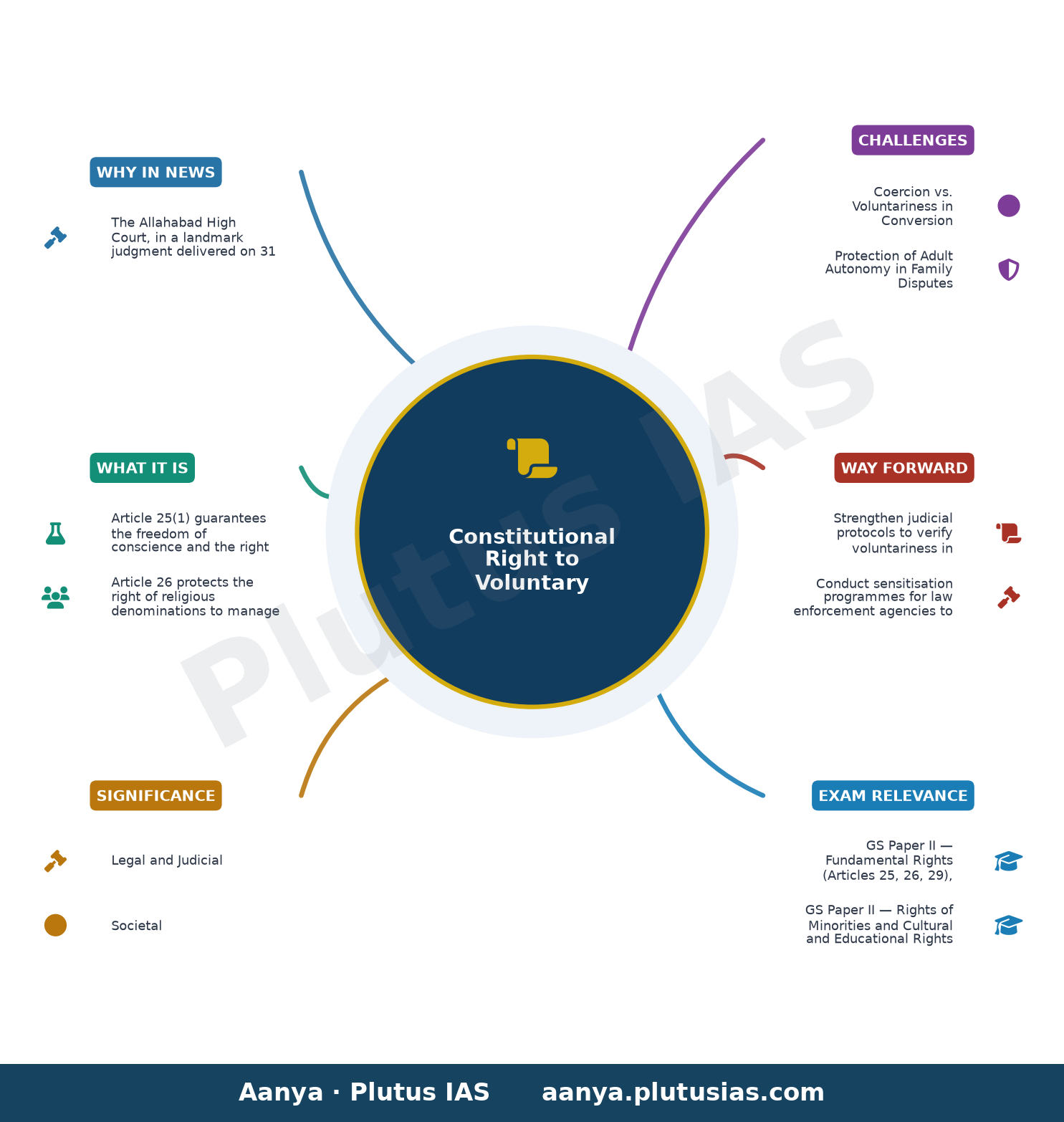
- GS Paper II — Fundamental Rights (Articles 25, 26, 29), Directive Principles of State Policy (Article 44), and Judicial Review | GS Paper II — Rights of Minorities and Cultural and Educational Rights (Articles 29–30) | GS Paper III — Social Justice and Empowerment of Marginalised Sections
- Prelims: Freedom of conscience (Article 25), Right to propagate religion (Article 25(1)), Minority rights (Article 29–30), Personal liberty (Article 21), Writ of Habeas Corpus, Inter-faith marriage, religious conversion, age of majority, consent, coercion, statutory rape, protection of women from Domestic Violence Act 2005
- Essay: Secularism in India: Promise and Practice, Personal Liberty vs. Social Order: The Tension Between Individual Autonomy and Community Norms
Quick Revision: The Allahabad High Court’s ruling reaffirms that voluntary religious conversion and inter-faith marriage by adults are constitutionally protected rights under Articles 21 and 25, provided such decisions are made without coercion or inducement.
Why is this in the news?
The Allahabad High Court, in a landmark judgment delivered on 31 July 2026, upheld the constitutional right of adult women to voluntarily convert their religion and marry according to their choice, provided such decisions are made without coercion or inducement. The ruling was delivered in response to a habeas corpus petition filed by two adult sisters who alleged illegal detention by their father after they converted to Islam and expressed their desire to marry men of their choice. The Court emphasised the primacy of individual autonomy under Articles 21 and 25 of the Constitution, directing the state to ensure their presence on 6 August 2026 for verification of their free will.
Background
- The Constitution of India guarantees freedom of conscience and the right to freely profess, practise, and propagate religion under Article 25(1), subject only to public order, morality, and health.
- The Supreme Court, in *S.R. Bommai v. Union of India* (1994), reaffirmed that secularism is a basic feature of the Constitution and that religious freedom cannot be abridged except under narrowly defined exceptions.
- Personal liberty under Article 21 includes the right to choose one’s partner and the right to privacy, as recognised in *Shakti Vahini v. Union of India* (2018) and *Joseph Shine v. Union of India* (2018).
- Inter-faith marriages in India often face societal opposition, familial pressure, and legal challenges, particularly when involving religious conversion.
- The Prohibition of Unlawful Religious Conversion Ordinances passed by several states (e.g., Uttar Pradesh, Madhya Pradesh) have sparked debates over their constitutionality and potential misuse to restrict individual choice.
- Judicial precedents such as *Lily Thomas v. Union of India* (2000) and *Sarla Mudgal v. Union of India* (1995) have addressed issues of religious conversion and bigamy, balancing individual rights with societal concerns.
Constitutional Framework Governing Religious Freedom, Conversion, and Inter-Faith Marriage in India
- Article 25(1) guarantees the freedom of conscience and the right to freely profess, practise, and propagate religion, subject to public order, morality, and health. This right is not absolute and can be regulated by the state under Article 25(2).
- Article 26 protects the right of religious denominations to manage their own affairs in matters of religion, but this does not extend to practices that violate public order or morality.
- Article 29 guarantees the right of minorities to conserve their distinct language, script, or culture, while Article 30 protects their right to establish and administer educational institutions.
- The age of majority in India is 18 years (Indian Majority Act, 1875), and adults are presumed to possess the capacity to make informed decisions regarding religion, marriage, and personal autonomy.
- The right to marry a person of one’s choice is a facet of the right to life and personal liberty under Article 21, as recognised by the Supreme Court in *Shakti Vahini v. Union of India* (2018).
- Religious conversion must be voluntary and devoid of coercion, fraud, or inducement; any conversion obtained through undue influence is liable to be invalidated under civil and criminal law.
- Inter-faith marriages are legally valid under the Special Marriage Act, 1954, and the Hindu Marriage Act, 1955, provided the parties meet the age and consent requirements.
- The state’s role is to protect individuals from coercion and ensure that their decisions are made freely, as reiterated by the Allahabad High Court in the instant case.
Key Features
| Feature | Significance |
|---|---|
| Constitutional Right to Freedom of Religion (Article 25) | Affirms the individual’s liberty to profess, practise, and propagate religion, including conversion, subject to public order, morality, and health. |
| Right to Marry (Article 21) | Recognises the right to choose a spouse as an integral part of the right to life and personal liberty. |
| Personal Autonomy of Adults | Upholds the legal principle that persons above 18 years possess full decision-making capacity in matters of faith and marriage. |
| Habeas Corpus Jurisdiction | Demonstrates the judiciary’s role in protecting individuals from unlawful detention or coercion. |
| Procedural Safeguards | Ensures that judicial scrutiny of conversion and marriage decisions is based on voluntariness, not assumption or external pressure. |
Why it Matters
Legal and Judicial
- Reinforces the constitutional framework governing religious freedom and personal liberty, aligning judicial precedent with constitutional text.
- Clarifies that judicial intervention in conversion and marriage cases must be grounded in evidence of coercion, not mere suspicion or familial dissent.
- Sets a precedent for future habeas corpus petitions involving adult women asserting autonomy over religious and marital choices.
Societal
- Affirms the principle of individual agency in matters of faith and marriage, countering patriarchal or communal pressures.
- Highlights the judiciary’s role as a safeguard against familial or societal coercion in personal decisions.
- May influence public discourse on interfaith marriages and conversion, promoting tolerance and constitutional values.
Institutional
- Demonstrates the judiciary’s commitment to protecting fundamental rights, even in contentious social matters.
- Reinforces the separation of judicial scrutiny from moral or societal disapproval in legal adjudication.
Challenges
1. Coercion vs. Voluntariness in Conversion
- Distinguishing genuine religious conversion from coercive or induced conversion remains a judicial and administrative challenge.
- Lack of standardised protocols to verify voluntariness in conversion cases can lead to subjective assessments.
- Potential for misuse of habeas corpus petitions to delay or obstruct personal choices under the guise of protection.
UPSC Link: GS-II: Fundamental Rights (Article 25)
2. Protection of Adult Autonomy in Family Disputes
- Balancing the right to autonomy with familial expectations and societal norms is a persistent challenge.
- Risk of judicial overreach or underreach in cases involving adult women, where familial pressure may be subtle but pervasive.
- Need for sensitisation of law enforcement agencies to respect adult decisions without imposing moral judgments.
UPSC Link: GS-II: Fundamental Rights (Article 21)
3. Interfaith Marriages and Social Harmony
- Interfaith marriages often face societal resistance, leading to familial and community backlash.
- Judicial interventions, while protective, may not fully address deep-rooted communal or patriarchal biases.
- Requirement for community-level awareness and education to foster acceptance of constitutional rights.
UPSC Link: GS-I: Social Empowerment
Challenges — UPSC Perspective
| Issue | Concern |
|---|---|
| Verification of Voluntariness | Lack of objective criteria to assess whether conversion or marriage decisions are truly voluntary. |
| Role of Law Enforcement | Potential bias or reluctance of police to intervene in familial disputes involving adult women. |
| Judicial Discretion | Risk of subjective interpretations of ‘coercion’ or ‘undue influence’ in conversion cases. |
| Societal Backlash | Fear of ostracisation or violence against individuals exercising their constitutional rights. |
| Procedural Delays | Lengthy judicial processes may undermine the urgency of protecting individual autonomy. |
Way Forward
- Strengthen judicial protocols to verify voluntariness in conversion and marriage cases through structured interviews and psychological assessments.
- Conduct sensitisation programmes for law enforcement agencies to ensure respect for adult autonomy in personal decisions.
- Promote community-level dialogues to foster acceptance of interfaith marriages and religious conversions as constitutional rights.
- Encourage the use of Alternative Dispute Resolution (ADR) mechanisms to address familial disputes without judicial intervention.
- Develop standard operating procedures (SOPs) for habeas corpus petitions involving adult women to ensure timely and fair adjudication.
- Enhance public awareness campaigns to educate citizens about their constitutional rights and the judiciary’s role in protecting them.
- Collaborate with civil society organisations to provide legal aid and support to individuals facing familial or societal coercion.
UPSC Value Addition
Keywords for Mains Answer-Writing
Constitutional rights · Freedom of conscience and religion · Freedom to profess, practice and propagate religion · Right to marry · Article 25 · Article 21 · Personal liberty · Constitutional morality · Inter-faith marriage · Adult autonomy · High Court jurisdiction · Constitutional rights vs social morality · Freedom of choice · Legal guardianship · Constitutional rights of minors · Directive Principles of State Policy · Safeguards against coercion · Constitutional benchmarks for personal decisions
Constitutional & Policy Linkages
- Article 25: Freedom of conscience and free profession, practice, and propagation of religion.
- Article 21: Protection of life and personal liberty, including the right to marry.
- Article 19(1)(a): Freedom of speech and expression, relevant to the propagation of religious beliefs.
- Article 14: Equality before law and equal protection of laws, ensuring non-discrimination in personal choices.
Concept Flow
Adult woman asserts right to convert religion and marry as per choice → Familial opposition and alleged coercion lead to habeas corpus petition → Judiciary examines voluntariness and adult autonomy under Articles 25 and 21 → Court rules that constitutional rights prevail in the absence of coercion → Judicial scrutiny ensures protection from unlawful detention or familial pressure → Judicial precedent reinforces individual agency in personal and religious matters
Prelims Practice Questions
Q1. Consider the following statements regarding the constitutional provisions related to freedom of religion and personal liberty in India:
1. Article 25 of the Constitution guarantees the freedom to freely profess, practice, and propagate religion.
2. Article 21 guarantees the right to life and personal liberty, including the right to make autonomous decisions regarding marriage.
3. The Constitution does not impose any restrictions on the freedom to convert one’s religion.
4. The High Courts in India do not have the jurisdiction to intervene in matters related to personal liberty and religion.
How many of the above statements are correct?
- Only one
- Only two
- Only three
- All four
Answer: Only three — Statements 1 and 2 are correct as they directly reflect the provisions of Articles 25 and 21 of the Indian Constitution. Statement 3 is incorrect because the Constitution imposes reasonable restrictions on the freedom to propagate religion under Article 25(2). Statement 4 is incorrect as High Courts have the jurisdiction to intervene in matters involving personal liberty and constitutional rights.
Q2. Assertion (A): The High Court of Allahabad has ruled that the decision to voluntarily convert to a religion and marry is a constitutional right of an adult individual.
Reason (R): The Constitution of India guarantees the freedom of conscience and the right to marry under Articles 25 and 21 respectively, subject to reasonable restrictions.
Options:
A. Both A and R are true, and R is the correct explanation of A.
B. Both A and R are true, but R is not the correct explanation of A.
C. A is true, but R is false.
D. A is false, but R is true.
Answer: ? — Both the assertion and reason are true. The Allahabad High Court’s ruling aligns with the constitutional guarantees under Articles 25 and 21. The reason correctly explains the assertion by citing the constitutional basis for the ruling.
Mains Practice Question
✍ Critically examine the constitutional framework governing the right to freedom of religion and personal liberty in the context of voluntary religious conversion and inter-faith marriage. How does the recent judgment of the Allahabad High Court reinforce the constitutional guarantees under Articles 25 and 21? (15 Marks)
Approach: MODEL-ANSWER SKELETON:
1. **Constitutional Foundations**:
– Article 25: Freedom of conscience and free profession, practice, and propagation of religion (subject to public order, morality, and health).
– Article 21: Right to life and personal liberty, including the right to make autonomous decisions regarding marriage and religion.
– Article 26: Freedom to manage religious affairs.
– Article 29: Protection of interests of minorities.
2. **Judicial Precedents**:
– **Re. Sarala Mudgal (1995)**: Supreme Court held that bigamy after conversion to Islam is not permissible under Hindu Marriage Act, 1955.
– **Lily Thomas v. Union of India (2000)**: Struck down Section 125(3) of CrPC for Hindu women, reinforcing gender equality in marriage laws.
– **Shayara Bano v. Union of India (2017)**: Triple Talaq unconstitutional, upholding gender justice.
– **Joseph Shine v. Union of India (2018)**: Decriminalized adultery, emphasizing personal autonomy.
3. **Allahabad High Court Ruling (2026)**:
– Affirmed that voluntary conversion and marriage decisions by adults are constitutional rights.
– Emphasized the absence of coercion or undue influence as a prerequisite for such decisions.
– Highlighted the role of the judiciary in protecting personal liberty against parental or societal interference.
4. **Balancing Constitutional Rights and Social Morality**:
– **Constitutional Morality vs. Social Morality**: The court’s ruling prioritizes constitutional morality over societal norms that may restrict personal choices.
– **Reasonable Restrictions**: Discuss the scope of reasonable restrictions under Article 25(2) and their application in cases of religious conversion and inter-faith marriage.
5. **Critique and Challenges**:
– **Parental and Societal Pressure**: Instances where families oppose inter-faith marriages or conversions, leading to legal disputes.
– **Misuse of Laws**: Potential misuse of laws such as the Uttar Pradesh Prohibition of Unlawful Conversion of Religion Act, 2021, to curb personal freedoms.
– **Gender Dynamics**: The intersectionality of gender and religion in such cases, particularly for women.
6. **Conclusion**:
– The Allahabad High Court’s ruling reinforces the supremacy of constitutional rights over societal or familial pressures.
– It underscores the need for judicial vigilance to ensure that personal liberty is not compromised in the name of tradition or morality.
Source: amarujala.com
Generated by AanyaAi for educational purpose.

- स्वामित्व योजना: मध्यप्रदेश में 50 लाख संपत्तियों की मुफ्त रजिस्ट्री शुरू, जानिए पूरा विवरण - September 17, 2026
- MP Swamitva Yojana: Free Property Registration for 50L Rural Properties - September 17, 2026
- AI नियमों के लिए UN की पहल: क्या है वैश्विक दृष्टिकोण? - September 17, 2026

No Comments