


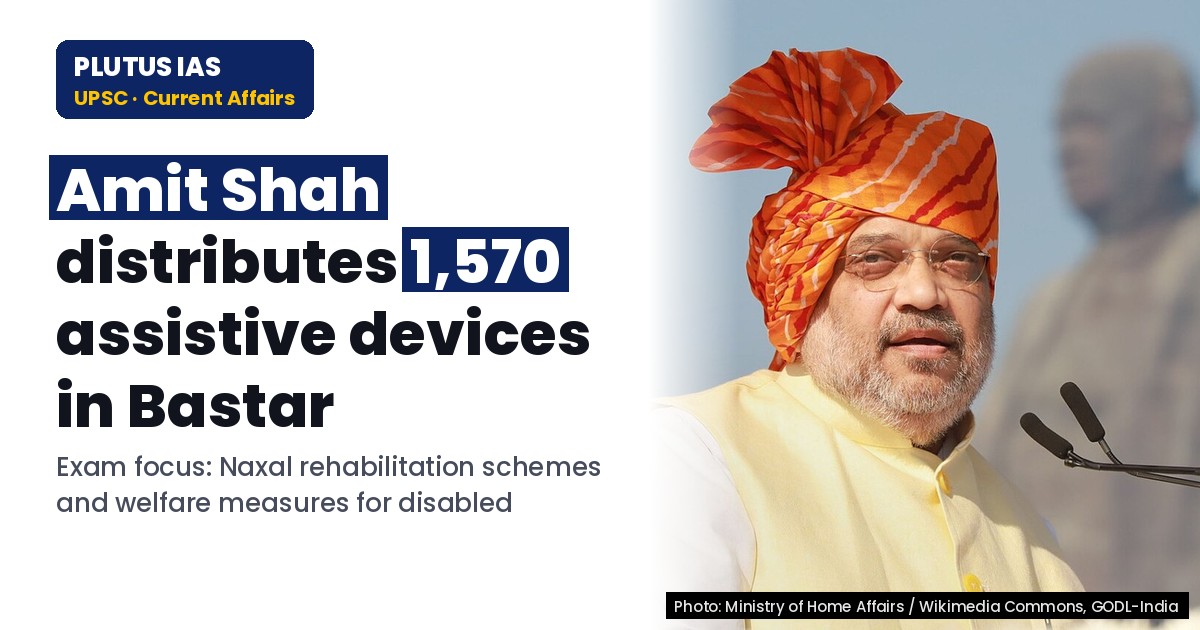
15 Oct Amrit Kaal: Modi’s 25 Years of Service & Naxal-Hit Disabled Welfare
✎ The rehabilitation of persons with disabilities in conflict zones is a constitutional and humanitarian imperative, requiring coordinated action between the Union and state governments under the ADIP Scheme, within the framework…
Subject Relevance — Where This Topic Fits
- GS Paper II — Governance, Administration and Challenges-planning, resource allocation, and challenges concerning socially and economically weaker sections | GS Paper III — Role of Social Sector/Services in the development process
- Prelims: Persons with Disabilities (Equal Opportunities, Protection of Rights and Full Participation) Act, 1995, Naxalism, Bastar region, Assistive devices for persons with disabilities, Rehabilitation schemes under Ministry of Social Justice and Empowerment
- Essay: Humanitarian obligations towards victims of conflict and violence, The role of state in post-conflict rehabilitation and social justice
Quick Revision: The rehabilitation of persons with disabilities in conflict zones is a constitutional and humanitarian imperative, requiring coordinated action between the Union and state governments under the ADIP Scheme, within the framework of the Rights of Persons with Disabilities Act, 2016.
Why is this in the news?
The distribution of assistive devices to persons with disabilities affected by Naxal violence in Bastar, Chhattisgarh, under the ‘Seva Sankalp Abhiyan’ marks a significant policy intervention aimed at post-conflict rehabilitation. The event, addressed by the Union Home Minister via video conference, underscores the government’s commitment to addressing the humanitarian fallout of decades of Naxal insurgency, particularly the creation of disabilities through improvised explosive devices (IEDs) and the subsequent need for inclusive rehabilitation measures.
Background
- Naxalism in India has persisted for over five decades, primarily affecting tribal-dominated regions such as Bastar in Chhattisgarh, leading to widespread displacement, loss of livelihoods, and severe human rights violations.
- The use of IEDs by Naxal insurgents has resulted in numerous cases of severe disabilities among civilians, compounding the humanitarian crisis in affected areas.
- The Union Government, through the Ministry of Home Affairs, has prioritised the complete eradication of Naxalism, with a declared deadline of 31 March 2026 for achieving this objective.
- Post-conflict rehabilitation is a constitutional obligation under Article 41 of the Directive Principles of State Policy, which directs the State to ensure public assistance in cases of disablement.
- The Ministry of Social Justice and Empowerment implements various schemes for the empowerment of persons with disabilities, including the distribution of assistive devices under the Assistance to Disabled Persons for Purchase/Fitting of Aids and Appliances (ADIP) Scheme.
- The ‘Seva Sankalp Abhiyan’ is a nationwide initiative launched to commemorate 25 years of public service by the Prime Minister, integrating social welfare activities across sectors.
Rehabilitation of Persons with Disabilities in Conflict Zones: Policy Framework and Implementation
- Assistive devices for persons with disabilities include prosthetics, wheelchairs, hearing aids, and mobility aids, which are critical for enhancing functional independence and quality of life.
- The ADIP Scheme, administered by the Ministry of Social Justice and Empowerment, provides financial assistance for the purchase or fitting of aids and appliances to eligible persons with disabilities, including those affected by conflict.
- The Union Home Ministry’s initiative in Bastar aligns with the broader framework of post-conflict rehabilitation, ensuring that the humanitarian impact of insurgency is mitigated through targeted welfare measures.
- The role of state governments, particularly Chhattisgarh, is pivotal in implementing rehabilitation schemes, as evidenced by the collaboration between the Union Government and the state administration in the distribution of assistive devices.
- The constitutional and statutory framework for disability rights in India is anchored in the Rights of Persons with Disabilities Act, 2016, which mandates non-discrimination, accessibility, and inclusive development.
- The ‘Seva Sankalp Abhiyan’ exemplifies the integration of commemorative public service with welfare delivery, leveraging national campaigns to address localised humanitarian needs.
- The rehabilitation process must adopt a multi-dimensional approach, including medical, psychological, vocational, and social rehabilitation, to ensure holistic recovery of victims.
- The Union Government’s commitment to eradicating Naxalism and addressing its aftermath reflects the principle of ‘justice as fairness,’ ensuring that victims of conflict are not left in a state of perpetual disadvantage.
Key Features
| Feature | Significance |
|---|---|
| Service Sankalp Abhiyaan | A nationwide outreach initiative launched to commemorate 25 years of service by the Prime Minister, integrating welfare distribution with commemorative symbolism. |
| Assistive Devices Distribution | Provision of artificial limbs and mobility aids to persons with disabilities, including victims of Naxal violence, enhancing functional independence and dignity. |
| Bastar Rehabilitation Focus | Targeted support to Bastar region, reflecting the region’s historical vulnerability to Naxal violence and underdevelopment. |
| Multi-Stakeholder Collaboration | Involvement of central and state governments, district administrations, and NGOs (e.g., Bhagwan Mahaveer Viklang Sahayata Samiti) for effective implementation. |
| Cultural Revitalisation Efforts | Initiatives like Bastar Olympics and Bastar Pandum aimed at rejuvenating tribal traditions and fostering community resilience. |
Why it Matters
Social Justice & Inclusive Development
- Demonstrates commitment to the constitutional mandate of ensuring social justice and equality for persons with disabilities under Article 41 and Article 46.
- Addresses intersectional vulnerabilities of tribal communities in conflict-affected regions, aligning with the Rights of Persons with Disabilities Act, 2016.
- Promotes dignity and rehabilitation of victims of violence, aligning with the UN Convention on the Rights of Persons with Disabilities (UNCRPD).
Governance & Public Policy
- Highlights the role of coordinated governance between central and state agencies in addressing complex socio-economic challenges.
- Showcases the integration of welfare delivery with commemorative initiatives to enhance public engagement and trust in governance.
- Illustrates the use of targeted schemes to address region-specific developmental gaps in conflict-affected areas.
Human Rights & Conflict Resolution
- Underscores the humanitarian imperative of addressing the aftermath of conflict, including the rehabilitation of victims of violence.
- Reflects a holistic approach to conflict resolution that extends beyond military measures to include social and economic rehabilitation.
- Emphasises the need to restore normalcy and trust in governance in regions historically affected by insurgency.
Challenges
1. Long-Term Rehabilitation of Conflict Victims
- Sustained psychological and social support required for victims of violence to reintegrate into society.
- Ensuring equitable access to rehabilitation services in remote and underdeveloped regions like Bastar.
- Addressing stigma and discrimination faced by persons with disabilities in accessing employment and social opportunities.
UPSC Link: GS-II: Welfare Schemes for Vulnerable Sections
2. Infrastructure and Service Delivery Gaps
- Persistent challenges in delivering basic services (healthcare, education, transport) in conflict-affected regions.
- Need for scalable models of public-private partnerships to enhance service delivery in remote areas.
- Ensuring last-mile connectivity for the distribution of assistive devices and welfare services.
UPSC Link: GS-II: Developmental Challenges in Tribal Areas
3. Sustainability of Cultural Revitalisation
- Balancing modern developmental pressures with the preservation of tribal cultural heritage.
- Ensuring community ownership and participation in cultural revival initiatives.
- Addressing funding and institutional capacity constraints in sustaining long-term cultural programmes.
UPSC Link: GS-I: Tribal Culture and Heritage
4. Monitoring and Evaluation of Welfare Schemes
- Ensuring transparency and accountability in the implementation of welfare schemes for persons with disabilities.
- Developing robust monitoring mechanisms to track the impact of rehabilitation efforts.
- Addressing data gaps in identifying and reaching marginalised beneficiaries in conflict zones.
UPSC Link: GS-II: Governance and Accountability
Challenges — UPSC Perspective
| Issue | Concern |
|---|---|
| Geographical Remoteness | Limited access to rehabilitation services in conflict-affected and tribal regions like Bastar. |
| Stigma and Social Exclusion | Perceived and actual barriers faced by persons with disabilities in accessing education, employment, and social opportunities. |
| Resource Constraints | Inadequate funding and infrastructure to sustain long-term rehabilitation and cultural revival programmes. |
| Data Deficiency | Lack of comprehensive data on the number and needs of persons with disabilities in conflict-affected regions. |
| Institutional Coordination | Challenges in aligning efforts of multiple stakeholders (government, NGOs, communities) for cohesive implementation. |
Government Initiatives — Must-Memorise for Prelims
- Niyad Nellanar Yojana (Bastar Development Scheme)
- Bastar Olympics Initiative
- Bastar Pandum (Cultural Revival Programme)
Way Forward
- Strengthen inter-departmental coordination between central and state agencies to ensure seamless implementation of rehabilitation schemes.
- Expand the scope of assistive device distribution to include psychological and vocational rehabilitation services.
- Develop a dedicated monitoring framework to track the progress and impact of welfare schemes for persons with disabilities.
- Enhance community participation in the design and delivery of cultural revival programmes to ensure sustainability.
- Invest in infrastructure development in conflict-affected regions to improve access to healthcare, education, and transport.
- Conduct periodic surveys to identify and address gaps in the identification and support of persons with disabilities.
- Promote public-private partnerships to leverage resources and expertise for effective rehabilitation and cultural revival.
- Incorporate disability-inclusive policies in all developmental schemes to ensure equitable outcomes for vulnerable groups.
UPSC Value Addition
Keywords for Mains Answer-Writing
Assistive devices for persons with disabilities · Naxal-affected regions rehabilitation · Divyangjan empowerment schemes · Service Sankalp Abhiyan · Bastar region development · Human rights violations and rehabilitation · Institutional support for disability inclusion · Government-NGO partnerships in welfare delivery · 31 March 2026 Naxal-free India target · District administration role in welfare distribution
Constitutional & Policy Linkages
- Article 41: Directive Principle of State Policy on securing right to public assistance in cases of disablement.
- Article 46: Promotion of educational and economic interests of Scheduled Tribes and weaker sections.
- Article 21: Right to Life and Personal Liberty, interpreted to include dignity and rehabilitation.
Concept Flow
Naxal insurgency in Bastar → Victims of IED blasts and violence sustain permanent disabilities → Constitutional and statutory rights to rehabilitation (Article 41, 46, RPwD Act, 2016) → Service Sankalp Abhiyaan and assistive device distribution → Multi-stakeholder collaboration for implementation → Long-term rehabilitation and cultural revival (Bastar Olympics, Bastar Pandum) → Restoration of dignity and social inclusion.
Prelims Practice Questions
Q1. Consider the following statements regarding the ‘Service Sankalp Abhiyan’ launched by the Government of India:
1. It is a nationwide initiative to commemorate 25 years of service and dedication by the Prime Minister.
2. The campaign includes distribution of assistive devices to persons with disabilities, including those affected by Naxal violence.
3. The campaign is exclusively targeted at urban populations and excludes rural beneficiaries.
4. The initiative is implemented in collaboration with state governments and non-governmental organizations.
How many of the above statements are correct?
- Only one
- Only two
- Only three
- All
Answer: All — Statements 1, 2, and 4 are correct. Statement 3 is incorrect as the campaign targets both urban and rural populations, including remote regions like Bastar.
Q2. Assertion (A): The Government of India has set a target to eliminate Naxalism from the country by 31 March 2026.
Reason (R): The elimination of Naxalism is expected to facilitate the rehabilitation of victims, including persons with disabilities, and restore normalcy in affected regions.
In the context of the above two statements, which one of the following is correct?
- Both A and R are true, and R is the correct explanation of A
- Both A and R are true, but R is not the correct explanation of A
- A is true, but R is false
- A is false, but R is true
Answer: A is true, but R is false — Both A and R are true. However, R is not the correct explanation of A, as the target date for eliminating Naxalism is a policy goal, while the rehabilitation of victims is a subsequent welfare measure.
Q3. Match the following initiatives with their respective objectives in the context of Bastar region development:
Column I (Initiative)
A. Niyad Nellanar Yojana
B. Bastar Olympic
C. Bastar Pandum
D. Chief Minister Samuhik Bus Yojana
Column II (Objective)
1. Revival of tribal art and culture
2. Provision of basic amenities in remote areas
3. Promotion of sports and youth engagement
4. Improvement of public transport connectivity
Select the correct match:
- A-2, B-3, C-1, D-4
- A-1, B-2, C-3, D-4
- A-4, B-1, C-2, D-3
- A-3, B-4, C-2, D-1
Answer: A-2, B-3, C-1, D-4 — The correct matches are: A-2 (Niyad Nellanar Yojana aims to provide basic amenities), B-3 (Bastar Olympic promotes sports), C-1 (Bastar Pandum revives tribal art and culture), D-4 (Chief Minister Samuhik Bus Yojana improves public transport).
Mains Practice Question
✍ The Government of India’s initiative to distribute assistive devices to persons with disabilities, including those affected by Naxal violence, under the ‘Service Sankalp Abhiyan’ reflects a multi-dimensional approach to social justice and governance. Critically examine the constitutional and policy framework that underpins such welfare measures. Also, assess the role of district administration and non-governmental organizations in ensuring effective implementation. (15 Marks)
Approach: MODEL-ANSWER SKELETON:
1. Constitutional Framework:
– Article 41 (Directive Principles of State Policy): State’s duty to provide public assistance in cases of disability.
– Article 46: Promotion of educational and economic interests of Scheduled Tribes and weaker sections.
– Article 21 (Right to Life and Personal Liberty): Includes the right to dignity and rehabilitation.
– Rights of Persons with Disabilities Act, 2016: Legal mandate for inclusive development and assistive devices.
2. Policy Framework:
– Deendayal Disabled Rehabilitation Scheme (DDRS): Central sector scheme for rehabilitation.
– Accessible India Campaign (Sugamya Bharat Abhiyan): Ensures accessibility in public infrastructure.
– National Policy for Persons with Disabilities, 2006: Framework for empowerment and inclusion.
– Aspirational Districts Programme: Focus on inclusive development in backward regions like Bastar.
3. Role of District Administration:
– Identification of beneficiaries through local surveys (e.g., Bastar region’s 1,570+ beneficiaries).
– Coordination with state welfare departments and NGOs for seamless delivery.
– Monitoring and grievance redressal mechanisms at the grassroots level.
– Implementation of schemes like Niyad Nellanar Yojana for basic amenities.
4. Role of Non-Governmental Organizations (NGOs):
– Partnerships with organizations like Bhagwan Mahaveer Viklang Sahayata Samiti (BMVSS) for assistive devices.
– Community mobilization and awareness campaigns.
– Advocacy for policy implementation and inclusion of marginalized groups.
– Example: BMVSS’s Jaipur Foot initiative for affordable prosthetic solutions.
5. Challenges and Way Forward:
– Ensuring last-mile delivery in remote and conflict-affected areas.
– Addressing stigma and social barriers faced by persons with disabilities.
– Strengthening inter-departmental coordination for holistic rehabilitation.
– Leveraging technology for real-time monitoring and feedback.
Balance of Views:
– Proponents argue that such initiatives restore dignity and enable socio-economic participation.
– Critics highlight gaps in implementation, such as underreporting of disabilities or delays in device distribution.
Conclusion:
– The initiative aligns with constitutional and policy mandates but requires robust monitoring for equitable impact.
Source: PIB (Press Information Bureau)
Generated by AanyaAi for educational purpose.
Related guides on our sites
- Anthropology VS PSIR
- Best PSIR optional coaching
- Best PSIR optional coaching online
- Best PSIR optional teacher

- NAMASTE Scheme: Enhancing Sanitation Workers’ Livelihoods & Safety - November 14, 2026
- एमएसएमई का विशेष अभियान 6.0: स्वच्छता और लंबित मामलों का निपटारा - November 14, 2026
- Sea Vigil-26: Coastal Defence Drills Off Visakhapatnam - November 14, 2026

No Comments