


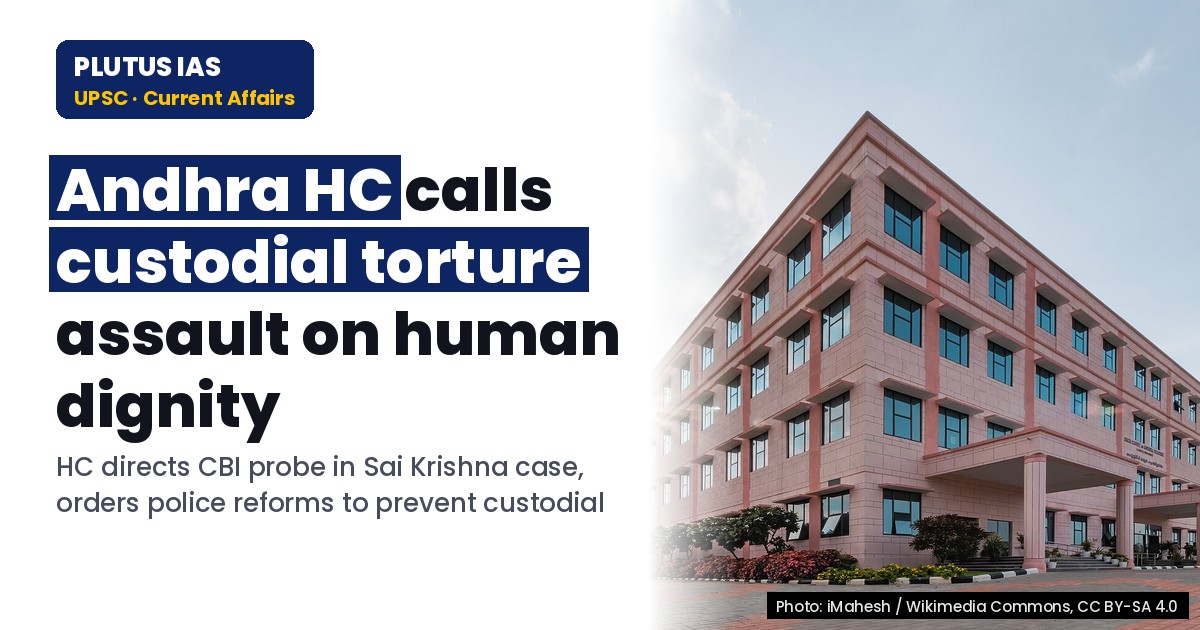
18 Oct Andhra HC: Custodial Torture Violates Human Dignity, Calls for CBI Probe
✎ Custodial torture is a violation of constitutional rights under Article 21, and the judiciary can direct the CBI to investigate such cases under Article 226, ensuring accountability and systemic reforms.
Subject Relevance — Where This Topic Fits
- GS Paper II — Fundamental Rights (Articles 21, 22, 226) | GS Paper III — Role of State and Civil Society in Upholding Human Rights | GS Paper IV — Ethics and Integrity in Governance (Human Dignity, Accountability)
- Prelims: Article 21 (Right to Life and Personal Liberty), Article 226 (Writs by High Courts), Section 6 of the Special Police Act, 1946, Custodial violence, Judicial review, CBI investigation, Compensation for human rights violations
- Essay: The erosion of human dignity in custodial spaces: A reflection on constitutional morality and institutional accountability, Balancing law enforcement imperatives with the protection of fundamental rights
Quick Revision: Custodial torture is a violation of constitutional rights under Article 21, and the judiciary can direct the CBI to investigate such cases under Article 226, ensuring accountability and systemic reforms.
Why is this in the news?
The Andhra Pradesh High Court’s judgment in the Sai Krishna custodial death case underscores the judiciary’s role in addressing custodial torture as a systemic violation of human dignity. By affirming the constitutional duty of the State to protect citizens’ rights and endorsing judicial oversight over investigative agencies, the ruling reaffirms the primacy of constitutional morality in governance. The case also highlights the judiciary’s proactive stance in directing the Central Bureau of Investigation (CBI) to probe cases of custodial violence, thereby reinforcing institutional accountability.
Background
- Custodial torture remains a persistent challenge in India despite constitutional and statutory safeguards, with numerous cases reported annually across states.
- The Supreme Court of India, in landmark judgments such as *D.K. Basu v. State of West Bengal* (1997) and *Nilabati Behera v. State of Orissa* (1993), has consistently held that custodial violence violates Articles 21 and 22 of the Constitution, which guarantee the right to life, personal liberty, and protection against arbitrary arrest.
- The Special Police Act, 1946, confers upon state police forces the primary responsibility for investigating cognizable offences, though it also provides for the transfer of such cases to the CBI with the state’s consent.
- The Sai Krishna case pertains to the custodial death of a detainee in Andhra Pradesh, prompting judicial scrutiny of police conduct and investigative procedures.
- The High Court’s observations align with global standards, such as the United Nations Convention Against Torture (UNCAT), which India has ratified, obligating the State to prevent and punish torture.
What is Custodial Torture and the Judicial Response?
- Custodial torture refers to the infliction of physical or psychological pain by law enforcement officials during detention, interrogation, or custody, violating the constitutional right to dignity (Article 21) and the prohibition of torture (Article 21 read with Article 51(c) of the Constitution).
- The Supreme Court has defined custodial torture as a ‘calculated assault on human dignity,’ emphasizing its incompatibility with democratic governance and the rule of law.
- Judicial review under Article 226 of the Constitution empowers High Courts to direct investigations into custodial violence, even in cases falling within the jurisdiction of state police, provided extraordinary circumstances warrant such intervention.
- The Sai Krishna judgment reaffirms that the State’s duty to protect citizens’ rights extends to ensuring fair and impartial investigations, including the possibility of transferring cases to the CBI when local police are implicated.
- The court highlighted the need for systemic reforms, including reorientation of police training to inculcate respect for human rights, continuous monitoring of lower-level officers, and modernisation of record-keeping to prevent manipulation of evidence.
- The judgment also underscores the State’s obligation to compensate victims of custodial violence, as part of remedial measures to restore dignity and deter future violations.
- The ruling aligns with the doctrine of ‘procedure established by law’ under Article 21, which mandates that any deprivation of liberty must adhere to fair, transparent, and accountable procedures.
Key Features
| Feature | Significance |
|---|---|
| Judicial recognition of custodial torture as a violation of human dignity | Reinforces constitutional protections under Article 21 (Right to Life and Personal Liberty) and aligns with international human rights norms. |
| Direction for CBI investigation in extraordinary cases | Demonstrates judicial oversight over state police machinery, ensuring impartiality in sensitive cases involving state actors. |
| Emphasis on police training and procedural reforms | Highlights systemic gaps in law enforcement training and the need for institutional safeguards against torture. |
| Judicial assertion of power under Article 226 | Reaffirms the High Court’s constitutional authority to intervene in matters of grave public concern, even against state legislation. |
| Call for compensation and preventive measures | Connects judicial remedies with administrative accountability, ensuring both punitive and corrective justice. |
Why it Matters
Legal and Constitutional
- Reinforces the principle that custodial torture is a violation of Article 21, which guarantees protection of life and personal liberty against arbitrary state action.
- Affirms the judiciary’s role in ensuring accountability of state agencies, particularly in cases involving custodial violence.
- Clarifies the scope of judicial review under Article 226, even in matters governed by state-specific legislation like the Special Police Act.
Institutional and Administrative
- Exposes systemic failures in police training, investigation protocols, and record-keeping, necessitating structural reforms.
- Underscores the need for independent oversight mechanisms to prevent abuse of authority by law enforcement.
- Highlights the role of compensation as a deterrent and a means of restitution for victims of custodial violence.
Human Rights Perspective
- Aligns with international conventions such as the UN Convention Against Torture, reinforcing India’s commitment to human rights obligations.
- Emphasizes the state’s duty to protect individuals from torture, even when perpetrated by its own agents.
- Links the issue to broader debates on police reform and the need for a rights-based approach to law enforcement.
Challenges
1. Systemic Police Brutality and Torture
- Deep-rooted institutional culture within law enforcement agencies that normalizes custodial violence.
- Lack of effective mechanisms to hold police officers accountable for human rights violations.
- Inadequate training on human rights and ethical investigation methods.
UPSC Link: GS Paper 2: Fundamental Rights
2. Judicial Overreach vs. Separation of Powers
- Potential tension between judicial activism and the constitutional doctrine of separation of powers.
- Risk of undermining state autonomy in law enforcement if judicial directives are perceived as excessive.
UPSC Link: GS Paper 2: Judiciary
3. Delayed and Inadequate Compensation
- Protracted legal processes delay compensation to victims’ families, defeating the purpose of restitution.
- Inconsistent application of compensation norms across states and jurisdictions.
UPSC Link: GS Paper 2: Fundamental Rights
4. Manipulation of Legal Records
- Instances of tampering with FIRs, post-mortem reports, and inquest proceedings to conceal custodial violence.
- Need for digital and transparent record-keeping to prevent manipulation.
UPSC Link: GS Paper 2: Police Reforms
5. Protection of Witnesses and Victims
- Lack of robust witness protection mechanisms, leading to intimidation and non-cooperation.
- Inadequate state support for victims of crime, including those who fear retaliation.
UPSC Link: GS Paper 2: Fundamental Rights
Challenges — UPSC Perspective
| Issue | Concern |
|---|---|
| Institutional Culture of Violence | Normalization of custodial torture within police departments. |
| Accountability Gaps | Absence of effective disciplinary or criminal action against erring officers. |
| Judicial-Executive Tension | Balancing judicial oversight with executive autonomy in law enforcement. |
| Procedural Manipulation | Tampering with legal records to obscure evidence of custodial violence. |
| Delayed Justice | Prolonged legal processes that delay compensation and closure for victims’ families. |
Way Forward
- Strengthen police training modules to include human rights education, ethical investigation, and sensitivity training.
- Implement digital record-keeping systems for FIRs, post-mortem reports, and inquest proceedings to prevent manipulation.
- Establish independent oversight bodies to monitor police conduct and investigate allegations of custodial violence.
- Fast-track compensation mechanisms for victims of custodial torture, ensuring timely restitution.
- Enhance witness protection programs to prevent intimidation and ensure cooperation in investigations.
- Conduct periodic audits of police stations and lock-ups to identify and address systemic issues.
- Promote community policing initiatives to build trust between law enforcement and the public.
- Encourage state governments to adopt the Model Police Act, 2015, to align with best practices in police governance.
UPSC Value Addition
Keywords for Mains Answer-Writing
Custodial violence · Human dignity · Judicial review under Article 226 · Constitutional remedies · Protection of Human Rights Act, 1993 · CBI investigation · Police reforms · Compensation for custodial torture · Doctrine of separation of powers · Federal structure · Special Police Act (SPA) · Judicial activism · Right to life and personal liberty (Article 21) · Protection of witnesses · Police accountability · Judicial scrutiny of executive actions
Constitutional & Policy Linkages
- Article 21: Right to Life and Personal Liberty (protection against custodial torture).
- Article 226: Writ Jurisdiction of High Courts (judicial review and intervention).
- Article 32: Writ Jurisdiction of Supreme Court (for aggrieved parties seeking redress).
- Article 51A: Fundamental Duties (promotion of human dignity and constitutional values).
Concept Flow
Custodial torture occurs → Violation of Article 21 (Right to Life and Personal Liberty) → High Court intervenes under Article 226 → Directs CBI investigation in extraordinary cases → Recommends systemic reforms in police training and procedures → Emphasizes compensation and preventive measures → Reinforces judicial oversight and accountability.
Prelims Practice Questions
Q1. Consider the following statements regarding custodial violence in India:
1. Custodial violence is explicitly prohibited under Article 21 of the Constitution of India.
2. The Protection of Human Rights Act, 1993, empowers the National Human Rights Commission to inquire into cases of custodial violence.
3. The Supreme Court of India has held that the power of judicial review under Article 32 cannot be invoked in cases of custodial violence.
How many of the above statements are correct?
- Only one
- Only two
- All three
- None
Answer: Only two — Statement 1 is correct: Article 21 guarantees the right to life and personal liberty, which includes protection from torture and inhuman treatment. Statement 2 is correct: The NHRC is statutorily empowered under the Protection of Human Rights Act, 1993, to inquire into complaints of custodial violence. Statement 3 is incorrect: The Supreme Court has repeatedly invoked Article 32 to address custodial violence, including directing CBI investigations.
Q2. Assertion (A): The Andhra Pradesh High Court in the Sai Krishna case ruled that custodial torture is a calculated assault on human dignity.
Reason (R): The court held that the State has a duty to enforce human rights and ensure a fair investigation even against its own officers.
In the context of the above statements, which of the following is correct?
- Both A and R are true, and R is the correct explanation of A
- Both A and R are true, but R is not the correct explanation of A
- A is true but R is false
- A is false but R is true
Answer: Both A and R are true, and R is the correct explanation of A — Both the Assertion (A) and Reason (R) are factually correct. The High Court explicitly termed custodial torture as an assault on human dignity and reiterated the State’s duty to uphold human rights, including in cases involving its own officers. The Reason (R) correctly explains the Assertion (A).
Q3. Match the following provisions with their respective roles in addressing custodial violence:
Column I (Provision) | Column II (Role)
1. Article 21 of the Constitution | A. Empowers the Supreme Court to issue writs for enforcement of fundamental rights
2. Article 226 of the Constitution | B. Guarantees protection of life and personal liberty
3. Protection of Human Rights Act, 1993 | C. Establishes the National Human Rights Commission
4. Section 176(1A) of the Code of Criminal Procedure, 1973 | D. Mandates inquiry into custodial deaths by a judicial magistrate
Select the correct match:
- 1-B, 2-A, 3-C, 4-D
- 1-A, 2-B, 3-D, 4-C
- 1-D, 2-C, 3-A, 4-B
- 1-C, 2-D, 3-B, 4-A
Answer: 1-B, 2-A, 3-C, 4-D — 1-B: Article 21 guarantees the right to life and personal liberty. 2-A: Article 226 empowers High Courts to issue writs for enforcement of fundamental rights. 3-C: The Protection of Human Rights Act, 1993, establishes the NHRC. 4-D: Section 176(1A) of CrPC mandates a judicial magistrate’s inquiry into custodial deaths.
Mains Practice Question
✍ Custodial torture constitutes a violation of the most fundamental human rights guaranteed by the Constitution of India. Critically examine this statement with reference to the recent observations of the Andhra Pradesh High Court in the Sai Krishna case. Also, outline the constitutional and statutory safeguards available to victims of custodial violence and assess their effectiveness in practice. (15 Marks)
Approach: MODEL-ANSWER SKELETON:
1. **Introduction (2 marks)**
– Define custodial torture and its constitutional implications.
– Briefly state the Andhra Pradesh High Court’s observations in the Sai Krishna case, emphasizing its classification of custodial torture as a ‘calculated assault on human dignity’ and a violation of Article 21.
2. **Constitutional Safeguards (4 marks)**
– Article 21: Right to life and personal liberty; judicial interpretation (e.g., Maneka Gandhi v. Union of India, 1978; DK Basu v. State of West Bengal, 1997).
– Article 20(3): Protection against self-incrimination.
– Article 22: Rights of arrested persons.
– Article 32 and 226: Writ jurisdiction for enforcement of fundamental rights.
– Directive Principles of State Policy (Articles 38, 39, 41, 42) as guiding principles for state action.
3. **Statutory Safeguards (4 marks)**
– Protection of Human Rights Act, 1993: Role of NHRC and State Human Rights Commissions (SHRCs).
– Code of Criminal Procedure, 1973: Provisions such as Section 176(1A) (mandatory magisterial inquiry in custodial deaths), Section 41 (arrest without warrant), and Section 50 (right to be informed of grounds of arrest).
– Indian Evidence Act, 1872: Presumptions against the police in cases of custodial violence (Section 114).
– Scheduled Castes and Scheduled Tribes (Prevention of Atrocities) Act, 1989: Enhanced punishment for custodial violence against marginalized communities.
4. **Institutional Mechanisms (3 marks)**
– Role of the National Human Rights Commission (NHRC) and State Human Rights Commissions (SHRCs) in investigating complaints.
– Judicial activism: Landmark judgments such as Nilabati Behera v. State of Orissa (1993), D.K. Basu v. State of West Bengal (1997), and Prakash Singh v. Union of India (2006) on police reforms.
– CBI’s role in high-profile cases (e.g., direction by courts under Article 226).
5. **Effectiveness and Challenges (2 marks)**
– Persistence of custodial violence despite constitutional and statutory safeguards.
– Challenges: Delay in investigations, lack of political will, inadequate training of police personnel, and systemic impunity.
– Suggested reforms: Police accountability mechanisms, independent oversight bodies, and stricter adherence to judicial guidelines.
**Balance of Views:**
– Acknowledge the progress made through judicial interventions and statutory safeguards.
– Highlight the gap between legal provisions and ground realities, citing data or reports (e.g., NHRC annual reports, NCRB data on custodial deaths).
– Emphasize the need for systemic reforms to align practice with constitutional ideals.
Source: The Hindu
Andhra Pradesh PCS (APPSC) — State PCS Practice
Prelims: In the context of the Andhra Pradesh High Court’s observation on custodial torture in the Sai Krishna case, which constitutional provision was highlighted as being violated by such practices?
- Article 21 (Right to Life and Personal Liberty)
- Article 19 (Freedom of Speech and Expression)
- Article 14 (Right to Equality)
- Article 22 (Protection against Arrest and Detention)
Answer: Article 21 (Right to Life and Personal Liberty) — The High Court emphasized that custodial torture violates Article 21 of the Indian Constitution, which guarantees the right to life and personal liberty.
Mains: Critically analyze the role of the Andhra Pradesh High Court’s judgment in the Sai Krishna case in addressing custodial torture. Discuss the legal and administrative measures required to prevent such violations in the state, with a focus on institutional accountability and public awareness.
Generated by AanyaAi for educational purpose.
Related guides on our sites
- Anthropology VS PSIR
- Best PSIR optional coaching
- Best PSIR optional coaching online
- Best PSIR optional teacher

- India-New Zealand FTA: MoC on Electronic Origin Data Exchange Signed - October 21, 2026
- सितंबर 2026 का कोर इंडस्ट्री इंडेक्स: जानिए अगस्त 2026 का अंतिम आँकड़ा - October 21, 2026
- Treasury Bills Auction: RBI Releases Full Results for UPSC Exam - October 21, 2026

No Comments