


03 Sep Andhra Pradesh Cabinet Approves ₹759 Crore Amaravati Sangamam Project & Land Pooling Plan
✎ Land pooling under the Andhra Pradesh Capital Region Act enables large-scale urban infrastructure projects by consolidating land parcels while ensuring fair compensation, whereas the Poultry Development Policy 2025–2029 aims to…
Subject Relevance — Where This Topic Fits
- GS Paper II — Functions and Responsibilities of the Union and the States, Issues and Challenges Pertaining to the Federal Structure | GS Paper III — Infrastructure: Energy, Ports, Roads, Airports, Railways and Human Resources | GS Paper III — Food Processing and Related Industries in India | GS Paper III — Land Reforms in India
- Prelims: Land Pooling Scheme, Inner Ring Road, Amaravati, Poultry Development Policy, APCRDA, Environment Controlled Poultry Sheds, Biosecurity in Poultry, NLM (National Livestock Mission), SERP (Society for Elimination of Rural Poverty), PMEGP (Prime Minister’s Employment Generation Programme)
- Essay: Urbanisation and Sustainable Development: Balancing Growth and Equity, Agricultural Transformation and Rural Livelihoods in India
Quick Revision: Land pooling under the Andhra Pradesh Capital Region Act enables large-scale urban infrastructure projects by consolidating land parcels while ensuring fair compensation, whereas the Poultry Development Policy 2025–2029 aims to modernise the sector through financial incentives, biosecurity measures, and value addition.
Why is this in the news?
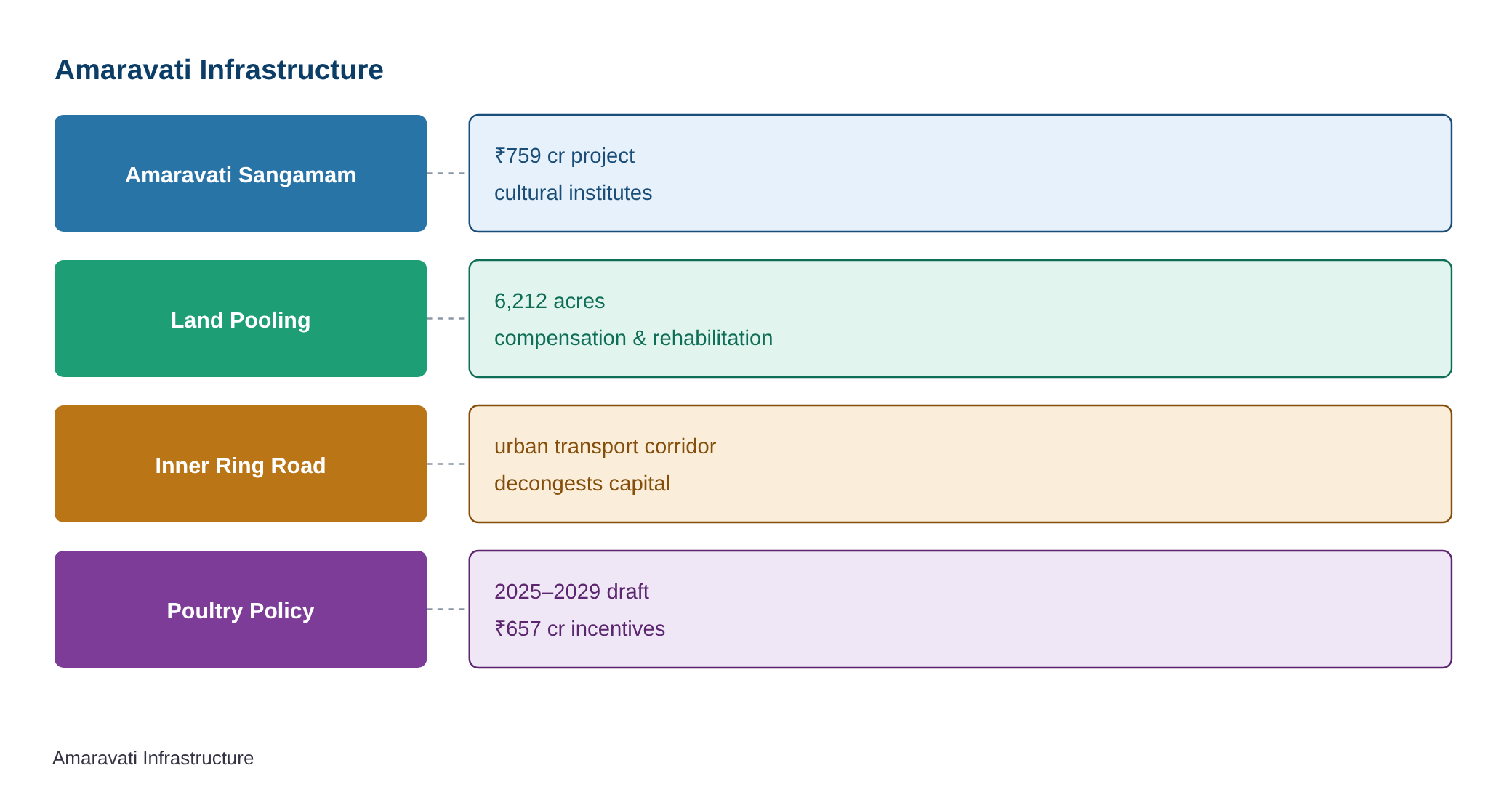
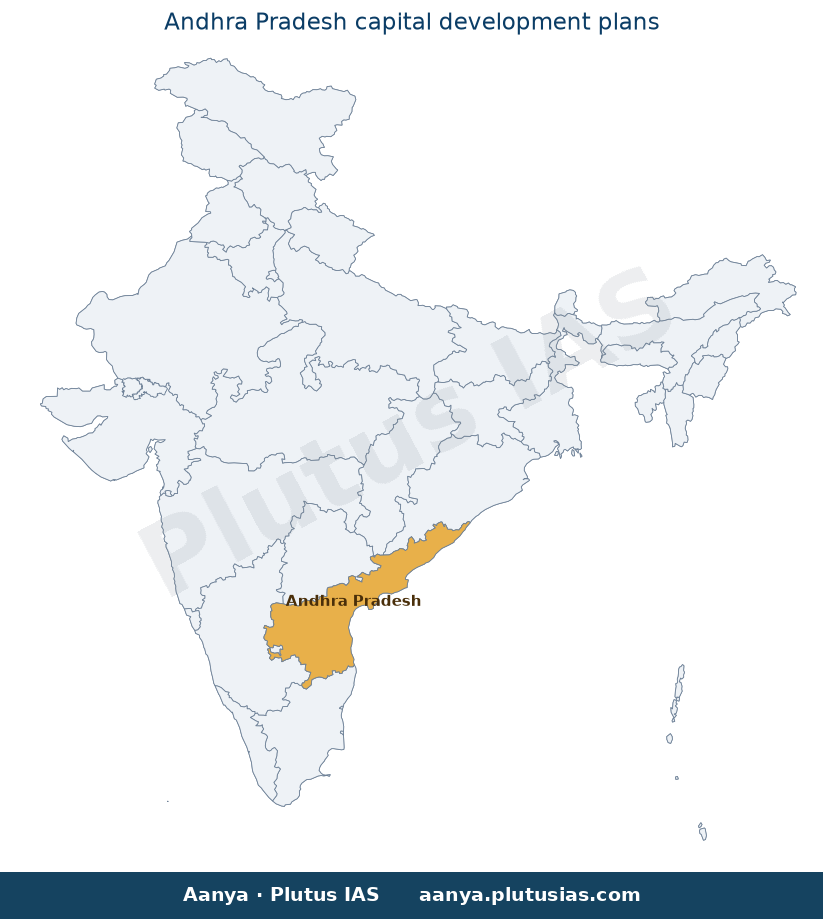
The Andhra Pradesh Cabinet has approved three significant governance initiatives: the ₹759 crore Amaravati Sangamam project, a land pooling scheme for 6,212 acres to facilitate the Inner Ring Road system, and the draft Andhra Pradesh Poultry Development Policy 2025–2029. These decisions underscore the state’s focus on urban infrastructure development, land-use efficiency, and agri-processing sector growth, aligning with broader national priorities in infrastructure and agricultural modernisation.
Background
- The Amaravati region was designated as the capital of Andhra Pradesh in 2014, following the bifurcation of the state, with the Andhra Pradesh Capital Region Development Authority (APCRDA) established to oversee its planned development.
- Land pooling is a mechanism under the Andhra Pradesh Capital Region (Development and Governance) Act, 2014, enabling the consolidation of land parcels for large-scale infrastructure projects while ensuring fair compensation and rehabilitation of landowners.
- The Inner Ring Road in Amaravati is envisaged as a critical urban transport corridor to decongest the capital region and enhance connectivity within the planned city.
- Poultry sector in India contributes significantly to agricultural GDP and rural livelihoods, with Andhra Pradesh being a major producer; the draft policy aims to address challenges such as high production costs, disease outbreaks, and low value addition.
- The Amaravati Sangamam project reflects the state’s emphasis on cultural and institutional infrastructure, including libraries and governance institutes, to foster knowledge-based urban development.
Key Components of the Approved Initiatives
- Amaravati Sangamam Project: A ₹759 crore multi-component initiative at Sakhamuru, Amaravati, comprising the Andhra Pradesh State Public Library, an auditorium, and the Global Institute of Good Governance. The project will be executed under Item Rate Contract/EPC Mode-2, with funding from DPL (₹310 crore), APHRDI (₹277 crore), and APCRDA (₹171 crore).
- Land Pooling Scheme for Inner Ring Road: A 6,212-acre land pooling plan covering 974 acres in Kanteuru village (Guntur district) and 5,238 acres in Tadikonda mandal, aimed at facilitating the Inner Ring Road system. The scheme includes provisions for a 100-metre buffer for the Errupalem-Namburu railway line and expansion of grid roads.
- Andhra Pradesh Poultry Development Policy 2025–2029: A draft policy targeting the poultry sector with a financial outlay of ₹657 crore, focusing on reducing production costs, promoting environment-controlled poultry sheds, strengthening disease surveillance and biosecurity, and enhancing processing, value addition, and exports.
- Governance and Funding Mechanisms: The Amaravati Sangamam project and land pooling scheme are being implemented through APCRDA.
Key Features
| Feature | Significance |
|---|---|
| Amaravati Sangamam Project (₹759 crore) | Establishes a multi-functional civic complex including a State Public Library, auditorium, and the Global Institute of Good Governance to enhance institutional infrastructure in Amaravati. |
| Land Pooling Scheme (6,212.50 acres) | Facilitates acquisition of land for the Inner Ring Road system and railway line buffer, ensuring systematic urban development and compensation to landowners. |
| Andhra Pradesh Poultry Development Policy 2025-2029 | Aims to reduce production costs, strengthen biosecurity, promote rural poultry, and boost exports through financial incentives and regulatory reforms. |
| Funding Allocation (₹759 crore project) | Distributed across DPL (₹310 crore), APHRDI (₹277 crore), and APCRDA (₹171 crore), demonstrating multi-source financing for capital projects. |
| Mandatory Registration of Poultry Farms | Introduces traceability and compliance mechanisms to improve disease surveillance and biosecurity in the poultry sector. |
Why it Matters
Urban Development & Infrastructure
- The Amaravati Sangamam project and Inner Ring Road land pooling are critical for Amaravati’s planned urban growth, aligning with the capital region’s long-term spatial strategy.
- The Inner Ring Road will improve connectivity within Amaravati, supporting economic activities and reducing congestion in the core areas.
- Land pooling ensures equitable compensation for farmers while enabling large-scale infrastructure projects without coercive acquisition.
Economic Growth & Employment
- The poultry policy’s financial incentives (₹657 crore) and focus on value-added products can stimulate rural economies and generate employment in agri-business.
- The Sangamam project’s construction and subsequent operations will create jobs in public services, administration, and tourism.
- Promotion of Environment Controlled Poultry Sheds can enhance productivity and reduce losses, benefiting small and marginal farmers.
Institutional Strengthening
- The Global Institute of Good Governance and State Public Library will serve as centres for research, policy formulation, and civic engagement.
- The policy framework for poultry development integrates with national programmes like NLM (National Livestock Mission) and SERP (Society for Elimination of Rural Poverty), enhancing synergy.
Regulatory & Governance Reforms
- Mandatory registration of poultry farms introduces a formal regulatory regime, improving traceability and disease control.
- The land pooling scheme demonstrates a participatory approach to land acquisition, balancing development needs with farmer interests.
Challenges
1. Land Acquisition & Farmer Compensation
- Ensuring fair and timely compensation for farmers under the land pooling scheme to avoid disputes and ensure voluntary participation.
- Balancing the scale of land pooling (6,212.50 acres) with the pace of project execution to prevent delays in infrastructure delivery.
UPSC Link: Land Acquisition Act, 2013 (Right to Fair Compensation)
2. Funding & Fiscal Sustainability
- Securing the remaining ₹310 crore for the Sangamam project from DPL and ensuring timely disbursement to avoid cost overruns.
- Sustaining the ₹657 crore poultry policy over four years without fiscal strain, particularly if state budget allocations are constrained.
UPSC Link: Fiscal Responsibility and Budget Management Act, 2003
3. Policy Implementation & Compliance
- Effectively monitoring the poultry policy’s incentives to ensure they reach intended beneficiaries, especially small farmers and rural communities.
- Enforcing mandatory registration of poultry farms to improve biosecurity and disease surveillance without imposing undue regulatory burdens.
UPSC Link: Agricultural Produce Market Committee Act, 1963 (for poultry trade regulation)
4. Urban Planning & Environmental Concerns
- Mitigating environmental impacts of large-scale infrastructure projects, such as noise, air pollution, and land degradation in Amaravati.
- Ensuring that the Inner Ring Road and associated projects do not disrupt existing agricultural land use or water bodies.
UPSC Link: Environment Protection Act, 1986 (EIA Notification, 2006)
5. Institutional Coordination
- Coordinating between APCRDA, APHRDI, and DPL to avoid overlaps or gaps in project execution and funding disbursement.
- Aligning the Global Institute of Good Governance with national and state-level governance initiatives to maximise its impact.
UPSC Link: 74th Constitutional Amendment Act, 1992 (Urban Local Bodies)
Challenges — UPSC Perspective
| Issue | Concern |
|---|---|
| Land Pooling Execution | Risk of delays due to farmer resistance or administrative bottlenecks in land acquisition. |
| Poultry Policy Outreach | Ensuring small farmers and rural communities benefit from financial incentives and training programmes. |
| Infrastructure Funding Gaps | Potential shortfall in state or central funds for the Sangamam project or Inner Ring Road. |
| Regulatory Enforcement | Challenges in mandatory poultry farm registration and biosecurity compliance. |
| Environmental Clearances | Delays in obtaining environmental approvals for large-scale infrastructure projects. |
| Urban-Rural Divide | Balancing Amaravati’s development with equitable growth in surrounding rural areas. |
Government Initiatives — Must-Memorise for Prelims
- Andhra Pradesh Poultry Development Policy 2025-2029
- Land Pooling Scheme for Amaravati Inner Ring Road
Way Forward
- Constitute a multi-stakeholder committee to oversee the Amaravati Sangamam project’s timely execution and fund disbursement.
- Launch farmer awareness campaigns to explain land pooling benefits and compensation mechanisms under the Inner Ring Road scheme.
- Establish a dedicated monitoring unit for the poultry policy to track incentive disbursement, beneficiary feedback, and disease surveillance outcomes.
- Fast-track environmental clearances for the Inner Ring Road and associated projects to avoid construction delays.
- Integrate the Global Institute of Good Governance with national governance programmes (e.g., Mission Karmayogi) for skill development and policy research.
- Develop a grievance redressal mechanism for farmers and poultry farmers to address disputes and compliance issues promptly.
- Publish quarterly progress reports on the Sangamam project and poultry policy to maintain transparency and accountability.
- Conduct impact assessments of the land pooling scheme and poultry policy after two years to evaluate socio-economic outcomes.
UPSC Value Addition
Keywords for Mains Answer-Writing
Land Pooling Scheme · Amaravati Capital Region · Andhra Pradesh Capital Region Development Authority (APCRDA) · Urban Planning and Governance · Poultry Development Policy · Public Infrastructure Financing · State Public Library · Global Institute of Good Governance · Inner Ring Road System · Land Acquisition and Rehabilitation · State Public Policy · Environment Controlled Poultry Sheds · Biosecurity and Disease Surveillance · Urban Local Bodies and Infrastructure
Constitutional & Policy Linkages
- 74th Constitutional Amendment Act, 1992 (Urban Local Bodies – for Amaravati’s governance structure)
- Article 243G (Functions of Municipalities – for urban planning and infrastructure)
Concept Flow
Land Pooling Scheme Announcement → Farmer Participation & Compensation → Land Acquisition for Inner Ring Road → Infrastructure Development → Urban Connectivity Improvement → Poultry Policy Drafting → Stakeholder Consultations → Financial Incentives Allocation → Mandatory Registration Implementation → Disease Surveillance & Biosecurity Enhancement → Amaravati Sangamam Project Approval → Multi-Source Funding (DPL, APHRDI, APCRDA) → Construction of Library, Auditorium, and Institute → Institutional Capacity Building → Urban Planning in Amaravati → Land Use Regulation → Infrastructure Financing → Service Delivery Improvement → Economic Growth Stimulus → State Budget Allocation → Fiscal Sustainability Assessment → Policy Implementation Review → Mid-Term Adjustments → Long-Term Impact Evaluation
Prelims Practice Questions
Q1. Consider the following statements regarding the Amaravati Sangamam project approved by the Andhra Pradesh Cabinet:
1. The project includes the establishment of the Andhra Pradesh State Public Library, an auditorium, and the Global Institute of Good Governance.
2. The project is being executed under the Item Rate Contract/EPC Mode-2 at an estimated cost of ₹759 crore inclusive of GST.
3. The funding for the project is entirely sourced from the Andhra Pradesh government’s own funds.
How many of the above statements are correct?
- Only one
- Only two
- All three
- None
Answer: Only two — Statement 1 is correct as the project includes these components. Statement 2 is correct as the project is being executed under the specified mode and cost. Statement 3 is incorrect as the funding includes contributions from DPL, APHRDI, and APCRDA.
Q2. Assertion (A): The Andhra Pradesh Cabinet approved a land pooling scheme for the proposed Inner Ring Road system in Amaravati, covering 6,212 acres.
Reason (R): Land pooling schemes are typically employed to facilitate large-scale infrastructure projects by aggregating land parcels from multiple owners.
In the context of the above two statements, which one of the following is correct?
- Both A and R are true, and R is the correct explanation of A.
- Both A and R are true, but R is not the correct explanation of A.
- A is true, but R is false.
- A is false, but R is true.
Answer: Both A and R are true, and R is the correct explanation of A. — Both the assertion and reason are true. The land pooling scheme is indeed aimed at aggregating land for infrastructure projects, making R the correct explanation of A.
Q3. Match the following components of the Amaravati Sangamam project with their respective functions:
Column I
A. Andhra Pradesh State Public Library
B. Global Institute of Good Governance
C. Auditorium
D. Inner Ring Road System
Column II
1. Facilitates cultural and intellectual activities
2. Enhances governance and administrative training
3. Serves as a repository of knowledge and literature
4. Provides connectivity within the capital region
Select the correct match:
- A-3, B-2, C-1, D-4
- A-1, B-2, C-3, D-4
- A-4, B-3, C-2, D-1
- A-2, B-1, C-4, D-3
Answer: A-3, B-2, C-1, D-4 — A matches with 3 (repository of knowledge), B with 2 (governance training), C with 1 (cultural activities), and D with 4 (connectivity).
Mains Practice Question
✍ The Amaravati Capital Region Development Authority (APCRDA) has recently approved a land pooling scheme for the proposed Inner Ring Road system, covering 6,212 acres. Critically examine the legal and administrative framework governing land pooling schemes in India. Also, discuss the socio-economic implications of such schemes for urban development and landowners. (15 Marks)
Approach: MODEL-ANSWER SKELETON:
1. **Legal Framework**:
– Reference the Land Acquisition Act, 2013 (now the Right to Fair Compensation and Transparency in Land Acquisition, Rehabilitation and Resettlement Act, 2013) and its provisions on land pooling.
– Discuss the role of state-specific legislations such as the Andhra Pradesh Capital Region Development Authority Act, 2014.
– Highlight the constitutional provisions under Article 300A (right to property) and the balance between public interest and individual rights.
2. **Administrative Framework**:
– Explain the role of APCRDA and other urban development authorities in implementing land pooling schemes.
– Discuss the process of land pooling, including consent of landowners, compensation mechanisms, and dispute resolution.
– Reference the recent Amaravati land pooling scheme as a case study, including the buffer for the Errupalem-Namburu railway line and grid road expansions.
3. **Socio-Economic Implications**:
– **For Urban Development**: Discuss how land pooling facilitates large-scale infrastructure projects, reduces urban sprawl, and promotes planned development.
– **For Landowners**: Analyze the benefits (e.g., assured compensation, development rights) and challenges (e.g., loss of land, displacement, and livelihood impacts).
– **For the Economy**: Highlight the potential for job creation, real estate development, and improved connectivity.
4. **Balanced View**:
– Present arguments for and against land pooling schemes, including concerns about transparency, equitable compensation, and displacement.
– Reference judicial precedents (e.g., cases on land acquisition and compensation) and expert opinions (e.g., reports by the NITI Aayog or Planning Commission).
5. **Conclusion**:
– Summarize the need for a robust legal and administrative framework to balance development goals with the rights of landowners.
– Emphasize the importance of participatory governance and transparent processes in land pooling schemes.
Source: The Hindu
Andhra Pradesh PCS (APPSC) — State PCS Practice
Prelims: Which of the following projects was recently approved by the Andhra Pradesh Cabinet with a budget of ₹759 crore for infrastructure development?
- Amaravati Sangamam Project
- Visakhapatnam-Chennai Industrial Corridor
- Godavari-Penna River Linking Project
- Krishna-Godavari Basin Oil Exploration
Answer: Amaravati Sangamam Project — The ₹759-crore Amaravati Sangamam project was approved by the Andhra Pradesh Cabinet for infrastructure development in Amaravati.
Mains: Discuss the significance of the Amaravati Sangamam project and the 6,212-acre land pooling plan for the socio-economic development of Andhra Pradesh. Highlight the potential challenges in its implementation.
Generated by AanyaAi for educational purpose.
Related guides on our sites
- Anthropology VS PSIR
- Best PSIR optional coaching
- Best PSIR optional coaching online
- Best PSIR optional teacher

- Shivraj Singh Chouhan launches ‘Khet Bachao Abhiyan’ to save farmland - October 23, 2026
- उत्तराखंड राज्यपाल की पीएम मोदी से महत्वपूर्ण बैठक: जानिए मुख्य बिंदु - October 23, 2026
- How India’s Rs 20,000 Cr CCUS Budget Can Drive Net-Zero Goals - October 23, 2026

No Comments