


08 Aug Andhra Pradesh Faces 52.4% Rainfall Deficit: Drought Looms for UPSC 2026
✎ A rainfall deficit of 52.4% in Andhra Pradesh by July-end, driven by El Niño and the absence of monsoon depressions, threatens kharif sowing, groundwater levels, and rural livelihoods, necessitating urgent drought management and…
Subject Relevance — Where This Topic Fits
- GS Paper I — Geography (Monsoon variability, drought conditions) | GS Paper III — Agriculture (Rainfed agriculture, drought management, agricultural distress) | GS Paper III — Environment (Climate change, El Niño-Southern Oscillation impacts) | GS Paper II — Governance (Disaster management, inter-state coordination, policy responses)
- Prelims: Southwest Monsoon, El Niño, IMD, drought declaration, rainfed agriculture, kharif sowing, agricultural contingency plans, Andhra Pradesh topography, Krishna-Godavari delta, Rayalaseema, Coastal Andhra Pradesh
- Essay: Climate change and its socio-economic consequences in India, Agricultural resilience in the face of climate variability
Quick Revision: A rainfall deficit of 52.4% in Andhra Pradesh by July-end, driven by El Niño and the absence of monsoon depressions, threatens kharif sowing, groundwater levels, and rural livelihoods, necessitating urgent drought management and contingency planning.
Why is this in the news?
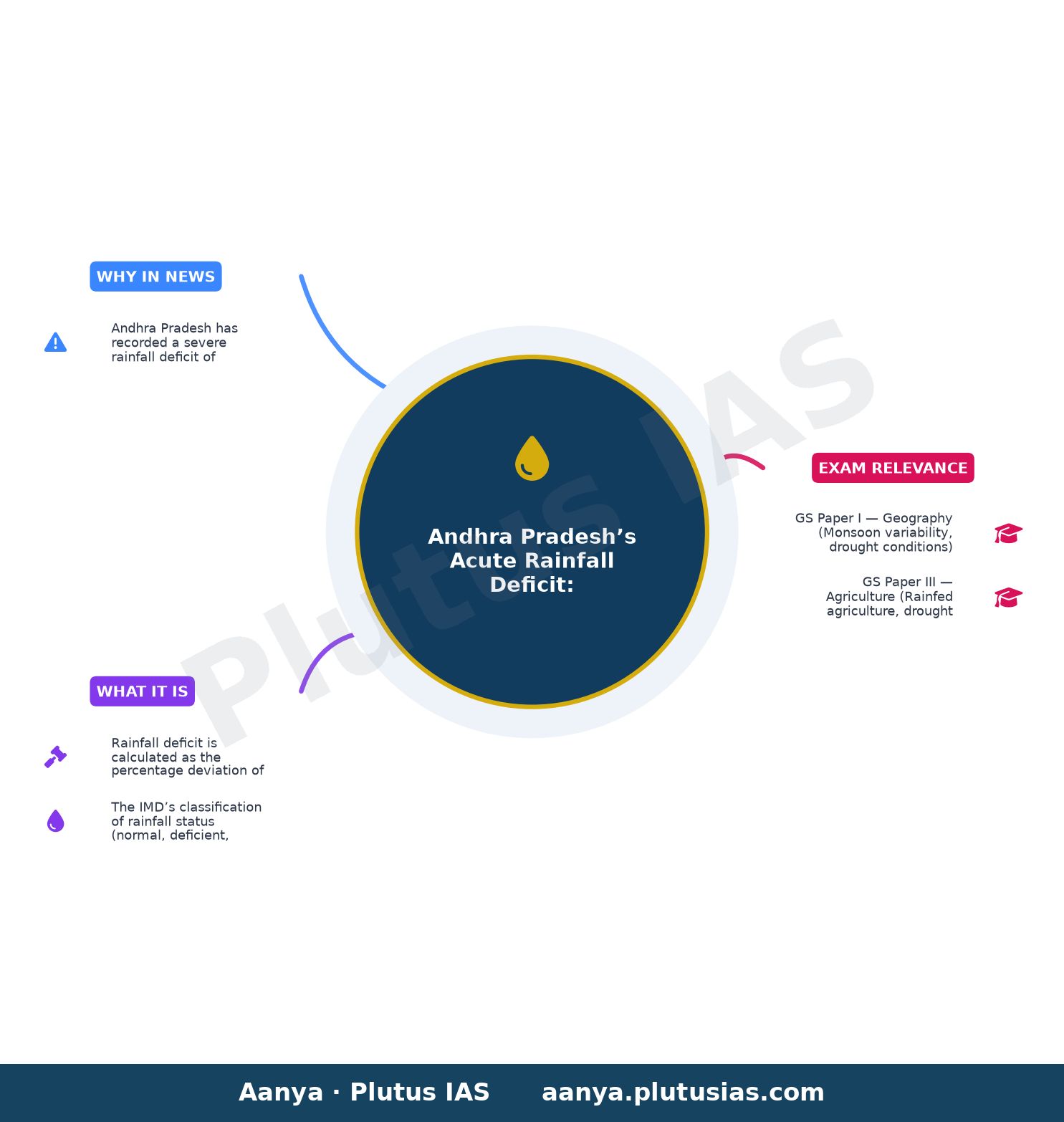
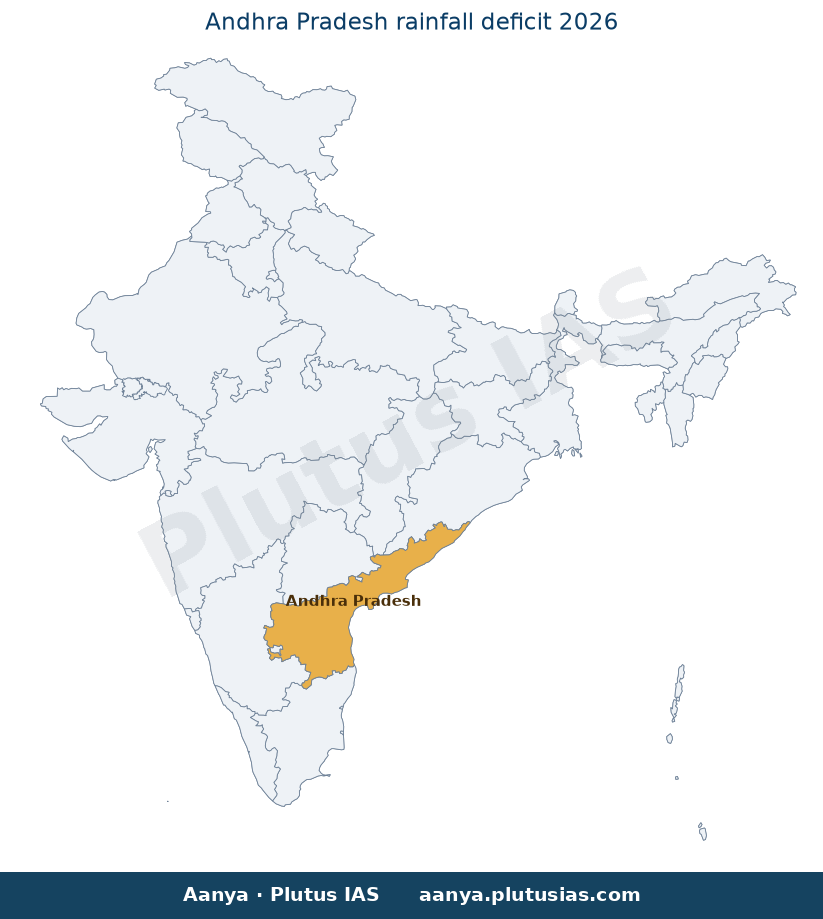
Andhra Pradesh has recorded a severe rainfall deficit of 52.4% by the end of July 2026, with no district reporting normal rainfall. This meteorological anomaly, compounded by the absence of significant rainfall from a Bay of Bengal depression, has raised concerns over agricultural output, water availability, and rural livelihoods. The situation has prompted calls for drought declaration and emergency support measures, particularly in light of the El Niño threat, which is known to suppress monsoon rainfall in peninsular India. The state government’s response, including directives for farmer support, underscores the policy urgency of the crisis.
Background
- Andhra Pradesh’s rainfall is primarily governed by the Southwest Monsoon, which contributes approximately 75% of the state’s annual precipitation, critical for kharif (monsoon) crops such as paddy, groundnut, and pulses.
- The state is divided into three agro-climatic zones: Coastal Andhra Pradesh (high rainfall), Rayalaseema (moderate to low rainfall), and the Krishna-Godavari delta (highly fertile but dependent on monsoon and canal irrigation).
- Historically, Andhra Pradesh has experienced droughts in 2015 (El Niño year) and 2018, with significant impacts on agricultural GDP and rural employment.
- The India Meteorological Department (IMD) classifies rainfall as ‘normal’ if it is within ±19% of the Long Period Average (LPA); ‘deficient’ if it is between -20% and -59%; and ‘large deficient’ if below -60%.
- El Niño events, associated with warming of the central and eastern Pacific Ocean, are statistically linked to reduced monsoon rainfall in India, particularly in southern and eastern regions.
What constitutes a rainfall deficit and its implications for Andhra Pradesh?
- Rainfall deficit is calculated as the percentage deviation of actual rainfall from the Long Period Average (LPA) for a given period. A deficit of 52.4% indicates a severe shortfall in monsoon rains by July-end, critical for kharif sowing.
- The IMD’s classification of rainfall status (normal, deficient, large deficient) is based on this deviation, with thresholds set at ±19%, -20% to -59%, and below -60% respectively.
- Andhra Pradesh’s topography, featuring the Eastern Ghats and coastal plains, influences rainfall distribution, with coastal districts typically receiving higher precipitation than the arid Rayalaseema region.
- Rainfed agriculture dominates Andhra Pradesh’s cropping pattern, with approximately 60% of the net sown area dependent on monsoon rainfall, making the state highly vulnerable to rainfall deficits.
- The Krishna and Godavari river basins, which support intensive agriculture in the delta regions, rely on both monsoon rainfall and reservoir storage, both of which are now under stress due to the deficit.
- Light showers (e.g., 22 mm in Marripudi mandal) provide negligible relief, as they do not replenish soil moisture sufficiently for crop growth or groundwater recharge.
- The absence of a significant weather system (e.g., a monsoon depression) over the Bay of Bengal, which typically brings widespread rainfall to coastal Andhra Pradesh, exacerbates the deficit.
- El Niño conditions, as forecast by global climate models, are associated with suppressed monsoon activity in India, increasing the likelihood of prolonged dry spells and delayed rainfall recovery.
UPSC Value Addition
Keywords for Mains Answer-Writing
Andhra Pradesh rainfall deficit · Southwest Monsoon variability · El Niño impact on India · Agricultural distress in India · Drought management in India · India Meteorological Department (IMD) forecasts · Bay of Bengal depression systems · Agricultural contingency plans · Climate change and monsoon patterns · State-level disaster response · Rainfed agriculture in India · Monsoon trough dynamics
Prelims Practice Questions
Q1. Consider the following statements regarding the South-West Monsoon in India:
1. The South-West Monsoon is primarily caused by the differential heating of land and sea.
2. The Andaman and Nicobar Islands receive the first monsoon showers in the country.
3. The monsoon trough typically shifts northwards during the peak monsoon season (July-August).
4. El Niño conditions are generally associated with normal or above-normal rainfall over India.
How many of the above statements are correct?
- Only one
- Only two
- Only three
- All four
Answer: Only two — Statement 1 is correct as the monsoon is driven by the thermal contrast between the heated Indian landmass and the cooler surrounding oceans. Statement 2 is correct; the monsoon arrives first in the Andaman and Nicobar Islands. Statement 3 is correct; the monsoon trough shifts northwards during peak season. Statement 4 is incorrect; El Niño conditions are typically associated with below-normal rainfall over India due to a weakened monsoon.
Q2. Assertion (A): The India Meteorological Department (IMD) has forecasted strong surface winds (40-50 kmph) over Coastal Andhra Pradesh and Rayalaseema in the near future.
Reason (R): A deep depression over western parts of central Chhattisgarh is moving southwestwards and is likely to weaken gradually, causing strong surface winds in isolated areas.
In the context of the above two statements, which one of the following is correct?
- Both A and R are true, and R is the correct explanation of A
- Both A and R are true, but R is NOT the correct explanation of A
- A is true, but R is false
- A is false, but R is true
Answer: Both A and R are true, and R is the correct explanation of A — Both the assertion and reason are factually correct. The IMD’s forecast of strong surface winds is directly linked to the movement and weakening of the deep depression over central India, which is expected to cause such winds in isolated areas over Coastal Andhra Pradesh and Rayalaseema.
Q3. Match the following districts of Andhra Pradesh with their respective rainfall deficit categories as reported by the Directorate of Economics and Statistics on July 30, 2026:
Column I (District) Column II (Rainfall Deficit Category)
A. Prakasam 1. Deficient
B. East Godavari 2. Large Deficient
C. Visakhapatnam 3. Normal (initially)
D. NTR District 4. Deficient (later stage)
Options:
A. A-2, B-2, C-2, D-4
B. A-2, B-2, C-1, D-4
C. A-1, B-2, C-2, D-3
D. A-2, B-1, C-2, D-4
- A
- B
- C
- D
Answer: A — Prakasam, East Godavari, and Visakhapatnam districts reported ‘large deficient’ rainfall, while NTR District initially had normal rainfall but later reported a ‘deficient’ category as the deficit increased.
Mains Practice Question
✍ Critically analyse the causes, consequences, and policy responses to the deficient rainfall in Andhra Pradesh, with particular reference to its impact on agriculture and the role of the India Meteorological Department (IMD). Also, examine the challenges posed by El Niño conditions in exacerbating such climatic vulnerabilities. (15 Marks)
Approach: MODEL-ANSWER SKELETON:
1. **Causes of Deficient Rainfall in Andhra Pradesh (3 marks)**
– **Southwest Monsoon variability**: Explain the role of the monsoon trough, its northward shift, and the absence of strong depressions over the Bay of Bengal affecting Andhra Pradesh.
– **El Niño conditions**: Discuss how El Niño disrupts the Walker circulation, weakening the monsoon winds and reducing rainfall over India, particularly in the southern and eastern regions.
– **Regional dynamics**: Highlight the movement of the deep depression over Chhattisgarh and Madhya Pradesh, which diverted monsoon activity away from Andhra Pradesh.
2. **Consequences on Agriculture and Rural Economy (4 marks)**
– **Rainfed agriculture dependency**: Andhra Pradesh has significant rainfed agriculture, making it highly vulnerable to monsoon failures.
– **Crop losses**: Discuss the impact on kharif crops (e.g., paddy, pulses, oilseeds) and the potential for reduced agricultural output.
– **Economic distress**: Highlight the consequences for farmers, including income loss, debt burden, and migration.
– **Groundwater depletion**: Explain how deficient rainfall accelerates groundwater extraction, exacerbating long-term water scarcity.
3. **Role of the India Meteorological Department (IMD) (3 marks)**
– **Forecasting and early warnings**: Discuss IMD’s role in providing seasonal and short-range forecasts, and its limitations in predicting localized rainfall deficits.
– **Data dissemination**: Highlight the importance of real-time data from the Directorate of Economics and Statistics and IMD’s role in monitoring rainfall deficits.
– **Collaboration with state agencies**: Examine the coordination between IMD, state agricultural departments, and disaster management authorities.
4. **Policy Responses and Challenges (3 marks)**
– **Drought management**: Discuss the Andhra Pradesh government’s initiatives, such as declaring drought-hit mandals, providing relief measures, and implementing contingency plans.
– **Agricultural contingency plans**: Highlight schemes like the Pradhan Mantri Fasal Bima Yojana (PMFBY) and state-level interventions (e.g., crop insurance, input subsidies).
– **Challenges**: Examine institutional bottlenecks, funding constraints, and the need for long-term climate-resilient agriculture.
5. **El Niño and Long-term Vulnerabilities (2 marks)**
– **Climate change linkages**: Discuss how climate change is intensifying El Niño events and increasing the frequency of extreme weather events.
– **Policy imperatives**: Highlight the need for integrated water resource management, crop diversification, and investment in irrigation infrastructure to mitigate future risks.
Source: The Hindu
Generated by AanyaAi for educational purpose.

- बिहार सरकार का बड़ा कदम: 25 हजार परिवारों को सौर ऊर्जा सहायता, 534 प्रखंडों में सोलर मार्ट खोले जाएंगे - September 23, 2026
- Bihar Launches Mega Solar Scheme: 25,000 Families to Benefit, 534 Solar Marts - September 23, 2026
- सुपर एल नीनो से भारत में 15,800 अतिरिक्त गर्मी से मौतें: जानिए पूरा मामला - September 23, 2026

No Comments