


08 Aug Andhra Pradesh Faces 52.4% Rainfall Deficit: Implications for UPSC Mains
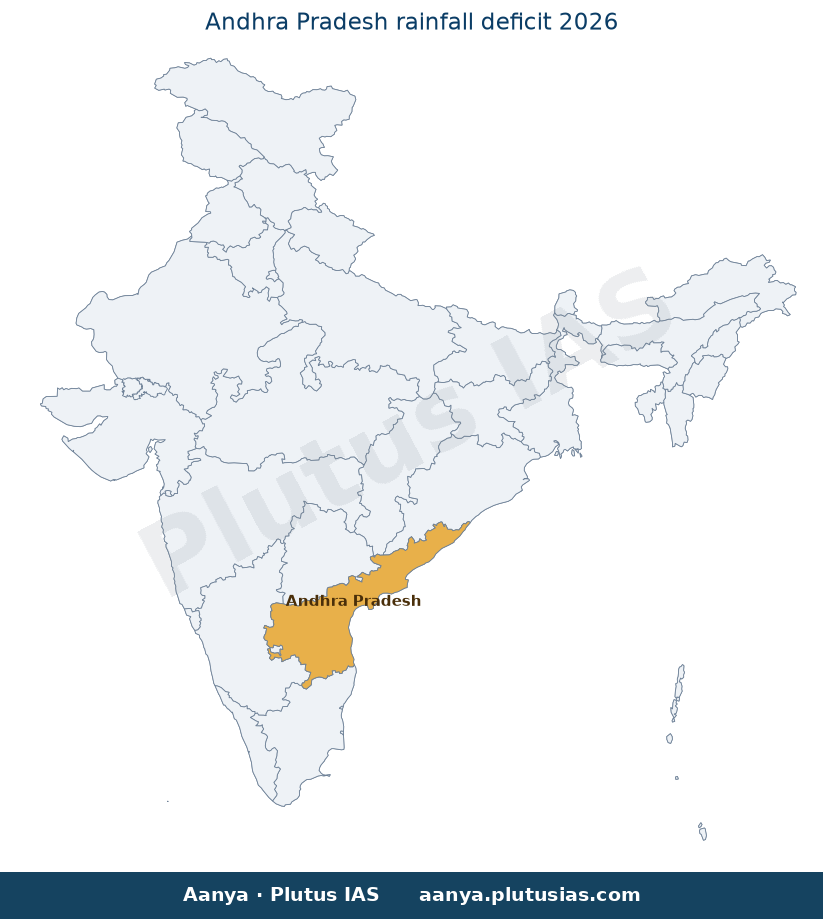
✎ A rainfall deficit of 52.4% in Andhra Pradesh by July-end 2026 is classified as a severe meteorological drought, primarily driven by a weak Southwest Monsoon and El Niño conditions, posing significant risks to rainfed agriculture…
Subject Relevance — Where This Topic Fits
- GS Paper I — Geography (Monsoon Variability, Drought Conditions, Climatic Patterns) | GS Paper III — Agriculture (Rainfed Agriculture, Drought Management, Farmer Welfare) | GS Paper II — Governance (Disaster Management, Inter-State Water Disputes, Policy Implementation)
- Prelims: Southwest Monsoon, Rainfall Deficit, El Niño, IMD, Drought Declaration, Rainfed Agriculture, Water Scarcity, Farmer Distress
- Essay: Climate Change and Its Impact on Agricultural Sustainability in India, The Role of Governance in Mitigating Natural Disasters: A Case Study of Drought Management
Quick Revision: A rainfall deficit of 52.4% in Andhra Pradesh by July-end 2026 is classified as a severe meteorological drought, primarily driven by a weak Southwest Monsoon and El Niño conditions, posing significant risks to rainfed agriculture and water security.
Why is this in the news?
Andhra Pradesh has reported a severe rainfall deficit of 52.4% by the end of July 2026, with no district recording normal rainfall. This meteorological anomaly, exacerbated by the absence of significant monsoon activity despite the formation of a deep depression over the Bay of Bengal, has triggered urgent discussions on drought declaration, agricultural distress, and state-level mitigation strategies. The situation underscores the vulnerability of rainfed agriculture in the region and the critical role of timely meteorological forecasting and disaster preparedness.
Background
- The Southwest Monsoon is the primary source of rainfall for Andhra Pradesh, contributing approximately 70-80% of the state’s annual precipitation, which is vital for kharif (monsoon) crops such as paddy, groundnut, and pulses.
- Andhra Pradesh’s agriculture is predominantly rainfed, with over 60% of the cultivated area dependent on monsoon rains, making it highly susceptible to variations in monsoon patterns.
- The state has experienced recurring drought conditions in recent decades, with notable events in 2015-16 and 2018-19, which led to significant agricultural losses and farmer distress.
- The state’s water resources are managed through a combination of major and minor irrigation projects, with the Krishna and Godavari rivers being the primary sources. However, deficient rainfall directly impacts reservoir levels and groundwater recharge.
What Constitutes a Rainfall Deficit and Its Agricultural Implications?
- A **rainfall deficit** is defined as the percentage shortfall in actual rainfall compared to the Long Period Average (LPA), which is the average rainfall recorded over a 30-year period. The IMD uses this benchmark to assess monsoon performance.
- In agricultural terms, a rainfall deficit of 52.4% is classified as a **severe drought condition**, particularly for rainfed crops, which rely entirely on monsoon rains. This can lead to reduced soil moisture, delayed sowing, and stunted crop growth.
- The **Southwest Monsoon** (June-September) is the lifeline for Andhra Pradesh’s agriculture, with the state receiving an average of 900-1,100 mm of rainfall annually. A deficit of this magnitude disrupts the entire agricultural calendar, affecting both kharif and rabi seasons.
- The **El Niño-Southern Oscillation (ENSO)** phenomenon is a key driver of monsoon variability. During El Niño years, the Indian monsoon tends to be weaker, leading to suppressed rainfall over central and peninsular India.
- The **India Meteorological Department (IMD)** issues seasonal and monthly rainfall forecasts, which are critical for agricultural planning. However, short-term meteorological anomalies, such as the deep depression over the Bay of Bengal, may not always translate into significant rainfall for the state.
- The **Kharif season** (June-October) is the most vulnerable period for Andhra Pradesh, as it coincides with the peak monsoon months. A delayed or deficient monsoon directly impacts the sowing of paddy, the state’s staple crop, and other rainfed crops like maize, pulses, and oilseeds.
- The **groundwater depletion** crisis in Andhra Pradesh exacerbates the impact of rainfall deficits. Over-extraction for irrigation, particularly in districts like Chittoor and Prakasam, reduces the resilience of agriculture to meteorological droughts.
- The **National Disaster Management Authority (NDMA)** and state agencies classify droughts into meteorological, hydrological, and agricultural droughts. The current situation in Andhra Pradesh primarily reflects a **meteorological drought**, which can escalate into agricultural and hydrological droughts if prolonged.
Key Features
| Feature | Significance |
|---|---|
| Rainfall deficit of 52.4% by July-end | Indicates severe meteorological drought conditions, disrupting agricultural cycles and water availability for kharif sowing. |
| Uniform deficiency across all districts | Eliminates spatial variation in rainfall, intensifying statewide agricultural and economic stress. |
| Light showers (max 22 mm) in isolated pockets | Insufficient to alleviate deficit; highlights the inefficacy of sporadic rainfall in addressing cumulative shortfall. |
| El Niño threat persisting | Increases probability of prolonged dry conditions, exacerbating drought risks in subsequent monsoon phases. |
| IMD forecast of negligible rainfall until August 3 | Confirms delayed monsoon recovery, necessitating urgent contingency planning for water and agriculture sectors. |
Why it Matters
Economic
- Agricultural output decline: Kharif crops (rice, pulses, oilseeds) face reduced sowing and yield, threatening food security and rural incomes.
- Input cost escalation: Farmers may resort to expensive irrigation or supplementary water sources, straining financial resources.
- Market disruptions: Supply chain bottlenecks for essential commodities due to reduced farm produce, potentially triggering inflation.
- Revenue loss: State exchequer faces reduced tax collections from agriculture and allied sectors, constraining fiscal space for drought mitigation.
Agricultural
- Kharif sowing delays: Critical for rice (Andhra Pradesh’s staple crop), pulses, and coarse cereals, with knock-on effects on rabi planning.
- Soil moisture deficit: Impedes seed germination and root development, reducing crop resilience to pests and diseases.
- Livestock stress: Reduced fodder availability and water scarcity impact dairy and poultry sectors, a key rural livelihood component.
- Groundwater depletion: Accelerated extraction for irrigation depletes aquifers, compromising long-term agricultural sustainability.
Hydrological
- Reservoir levels: Reduced inflows threaten irrigation projects (e.g., Nagarjuna Sagar, Srisailam), impacting hydroelectric generation and downstream states.
- Drinking water scarcity: Rural and urban water supply systems face pressure, necessitating rationing or alternative sources (e.g., tankers).
- Ecosystem degradation: Wetland ecosystems (e.g., Kolleru Lake) and riverine biodiversity suffer due to low water levels and salinity intrusion.
Social
- Migration pressures: Rural distress may trigger distress migration to urban centres, straining civic infrastructure and social cohesion.
- Nutritional deficits: Reduced agricultural output and income loss exacerbate food insecurity, particularly for marginalised communities.
- Health risks: Increased incidence of waterborne diseases (e.g., diarrhoea) and heat stress due to prolonged dry conditions.
Challenges
1. Agricultural productivity decline
- Delayed kharif sowing reduces crop duration, directly impacting yields and farmer incomes.
- Increased reliance on groundwater for irrigation depletes aquifers, risking long-term soil degradation.
- Pest outbreaks (e.g., brown plant hopper in rice) thrive in water-stressed conditions, compounding losses.
UPSC Link: GS3: Major Crops, Irrigation, Agricultural Drought
2. Water resource management crisis
- Reservoir storage deficits (e.g., Srisailam at 30% capacity) threaten irrigation and power generation.
- Competing demands between agriculture, urban supply, and industrial use intensify conflicts.
- Groundwater over-extraction leads to declining water tables, increasing pumping costs for farmers.
UPSC Link: GS3: Water Resources, Groundwater Depletion
3. Economic vulnerability of farmers
- Small and marginal farmers lack financial buffers to withstand prolonged drought, risking indebtedness.
- Crop insurance payouts may be delayed or insufficient, exacerbating liquidity crises.
- Distress sales of livestock and assets erode household capital, deepening poverty traps.
UPSC Link: GS3: Farm Subsidies, Agricultural Credit
4. Public health and nutrition risks
- Reduced dietary diversity due to crop failures increases micronutrient deficiencies (e.g., anaemia in women and children).
- Water scarcity limits hygiene practices, raising incidence of infectious diseases.
- Heat stress and dehydration-related illnesses surge during prolonged dry spells.
UPSC Link: GS2: Public Health, Nutrition
5. Climate change exacerbation
- El Niño conditions intensify monsoon variability, increasing frequency of meteorological droughts.
- Erratic rainfall patterns disrupt traditional agricultural calendars, reducing adaptive capacity.
- Long-term shifts in monsoon dynamics necessitate climate-resilient agricultural practices.
UPSC Link: GS3: Climate Change, Disaster Management
Challenges — UPSC Perspective
| Issue | Concern |
|---|---|
| Kharif sowing delays | Reduced crop yields and farmer incomes, threatening food security. |
| Groundwater depletion | Long-term agricultural unsustainability and increased pumping costs. |
| Reservoir storage deficits | Threat to irrigation, hydroelectric power, and inter-state water disputes. |
| Distress migration | Urban infrastructure strain and social cohesion risks. |
| Nutritional deficits | Exacerbation of malnutrition, particularly among vulnerable groups. |
| Pest outbreaks | Secondary damage to crops already stressed by water scarcity. |
Government Initiatives — Must-Memorise for Prelims
- Pradhan Mantri Krishi Sinchayee Yojana (PMKSY)
- Mahatma Gandhi National Rural Employment Guarantee Scheme (MGNREGS) for drought relief works
Way Forward
- Activate State-level Drought Monitoring Committees to assess real-time impacts and trigger early interventions.
- Prioritise drought-resistant crop varieties (e.g., millets, pulses) and short-duration paddy for kharif sowing.
- Accelerate groundwater recharge through watershed development (e.g., farm ponds, check dams) and promote micro-irrigation.
- Expand coverage of crop insurance (PMFBY) and expedite claim settlements to mitigate farmer distress.
- Implement water rationing in urban and rural areas, coupled with public awareness on conservation.
- Leverage MGNREGS for water conservation works (e.g., desilting tanks, afforestation) to create rural employment.
- Enhance meteorological forecasting collaboration with IMD for precise district-level advisories.
- Strengthen inter-state water-sharing mechanisms to manage reservoir releases and downstream demands.
UPSC Value Addition
Keywords for Mains Answer-Writing
Andhra Pradesh rainfall deficit · Southwest Monsoon variability · El Niño-Southern Oscillation (ENSO) · Drought management in India · Agricultural distress mitigation · Disaster Management Act, 2005 · National Disaster Response Force (NDRF) · State Disaster Response Fund (SDRF) · Climate-resilient agriculture · Inter-state river water disputes · IMD rainfall classification · El Niño impact on Indian monsoon · Agricultural insurance schemes · Farmer distress and policy responses · Bay of Bengal depressions · Rayalaseema and Coastal Andhra Pradesh rainfall patterns
Constitutional & Policy Linkages
- Article 21 (Right to Life) – Ensuring access to water for drinking and livelihood.
- Article 39(b) – Directive Principle promoting equitable distribution of resources.
Concept Flow
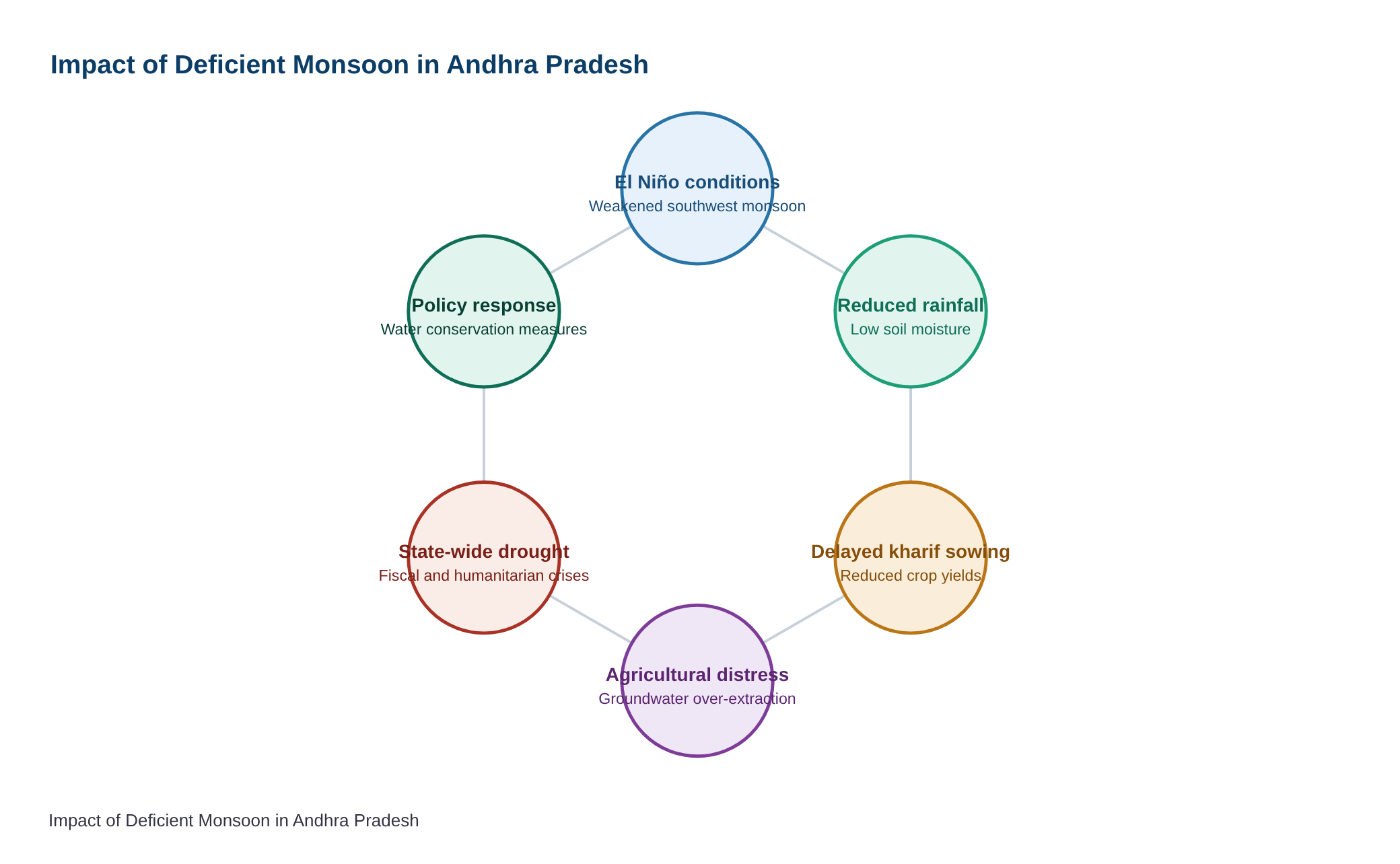
El Niño conditions → Weakened southwest monsoon → Reduced rainfall in Andhra Pradesh → Deficient rainfall → Low soil moisture and reservoir levels → Delayed kharif sowing → Delayed sowing → Reduced crop yields and farmer incomes → Agricultural distress → Agricultural distress → Groundwater over-extraction and migration → Long-term ecological and social impacts → Cumulative impacts → State-wide drought declaration → Fiscal and humanitarian crises → Policy response → Drought mitigation schemes and water conservation measures → Gradual recovery
Prelims Practice Questions
Q1. Consider the following statements regarding the classification of rainfall by the India Meteorological Department (IMD):
1. A rainfall deficit of 20% to 59% is classified as ‘deficient’.
2. A rainfall deficit of 60% or more is classified as ‘large deficient’.
3. ‘Normal’ rainfall is defined as 80% to 119% of the Long Period Average (LPA).
How many of the above statements are correct?
- Only one
- Only two
- All
- None
Answer: All — Statements 1 and 3 are correct. Statement 2 is incorrect; IMD classifies a rainfall deficit of 60% or more as ‘large deficient’.
Q2. Assertion (A): The El Niño-Southern Oscillation (ENSO) phenomenon significantly influences the Southwest Monsoon in India.
Reason (R): During El Niño years, the Indian subcontinent experiences below-normal rainfall due to the weakening of the Walker Circulation and reduced convection over the Bay of Bengal.
Options:
A. Both A and R are true, and R is the correct explanation of A.
B. Both A and R are true, but R is not the correct explanation of A.
C. A is true, but R is false.
D. A is false, but R is true.
Answer: ? — Both the assertion and reason are true. El Niño disrupts the Walker Circulation, reducing monsoon convection over the Indian subcontinent, thereby causing below-normal rainfall.
Q3. Match the following pairs related to drought management in India:
Column I (Institutions/Schemes) — Column II (Functions/Features)
1. National Disaster Response Force (NDRF) — A. Provides financial assistance to states for drought relief
2. State Disaster Response Fund (SDRF) — B. Conducts search and rescue operations during disasters
3. Pradhan Mantri Fasal Bima Yojana (PMFBY) — C. Provides crop insurance to farmers
4. Disaster Management Act, 2005 — D. Legal framework for disaster management in India
Options:
A. 1-B, 2-A, 3-C, 4-D
B. 1-D, 2-C, 3-B, 4-A
C. 1-A, 2-D, 3-C, 4-B
D. 1-C, 2-B, 3-A, 4-D
- A
- B
- C
- D
Answer: A — The correct match is: 1-B (NDRF conducts search and rescue), 2-A (SDRF provides financial assistance), 3-C (PMFBY provides crop insurance), 4-D (Disaster Management Act, 2005 is the legal framework).
Mains Practice Question
✍ The deficient rainfall in Andhra Pradesh, with a 52.4% deficit by July-end, exemplifies the challenges posed by climate variability to India’s agricultural sector. Critically examine the institutional and policy mechanisms available in India to address such drought conditions. Also, analyse the role of the El Niño-Southern Oscillation (ENSO) in exacerbating such climatic anomalies. (15 Marks)
Approach: MODEL-ANSWER SKELETON:
1. **Introduction (2 marks)**: Define drought and its classification (IMD norms: deficient, large deficient, scanty). Highlight Andhra Pradesh’s 52.4% deficit and its impact on agriculture.
2. **Institutional Mechanisms (5 marks)**:
– **Disaster Management Act, 2005**: Outline the legal framework (Sections 11, 23, 46) and the role of the National Disaster Management Authority (NDMA).
– **State Disaster Response Fund (SDRF)**: Explain its composition (40% Centre, 60% State) and utilisation for drought relief (e.g., water conservation, fodder distribution).
– **National Disaster Response Force (NDRF)**: Discuss its deployment for relief operations (e.g., water tankers, medical camps).
– **Agricultural Insurance Schemes**: Evaluate Pradhan Mantri Fasal Bima Yojana (PMFBY) and its limitations in addressing prolonged droughts.
3. **Policy Responses (5 marks)**:
– **Drought Management Plans**: Reference the National Drought Management Policy (2016) and state-level plans (e.g., Andhra Pradesh’s Drought Mitigation Strategy).
– **Crop Diversification and Climate-Resilient Agriculture**: Discuss schemes like the National Mission for Sustainable Agriculture (NMSA) and the adoption of drought-resistant crops.
– **Inter-State Water Sharing**: Highlight the role of the Krishna River Disputes Tribunal (KWDT-II) in addressing water-sharing conflicts during droughts.
– **Farmer Support Measures**: Analyse the effectiveness of direct benefit transfers (DBT) and subsidised inputs (e.g., seeds, fertilisers).
4. **Role of ENSO (3 marks)**:
– Explain ENSO (El Niño/La Niña) and its impact on the Southwest Monsoon (Walker Circulation, sea surface temperatures).
– Cite recent IMD forecasts linking El Niño to deficient rainfall in 2026.
– Discuss the limitations of forecasting in mitigating drought impacts.
5. **Conclusion (2 marks)**: Balance the strengths and weaknesses of existing mechanisms. Propose a multi-pronged approach combining institutional reforms, technological interventions (e.g., AI-based drought prediction), and community participation.
Source: The Hindu
Generated by AanyaAi for educational purpose.

- बिहार सरकार का बड़ा कदम: 25 हजार परिवारों को सौर ऊर्जा सहायता, 534 प्रखंडों में सोलर मार्ट खोले जाएंगे - September 23, 2026
- Bihar Launches Mega Solar Scheme: 25,000 Families to Benefit, 534 Solar Marts - September 23, 2026
- सुपर एल नीनो से भारत में 15,800 अतिरिक्त गर्मी से मौतें: जानिए पूरा मामला - September 23, 2026

No Comments