


08 Aug Andhra Pradesh Faces 52.4% Rainfall Deficit: UPSC & State PCS Analysis
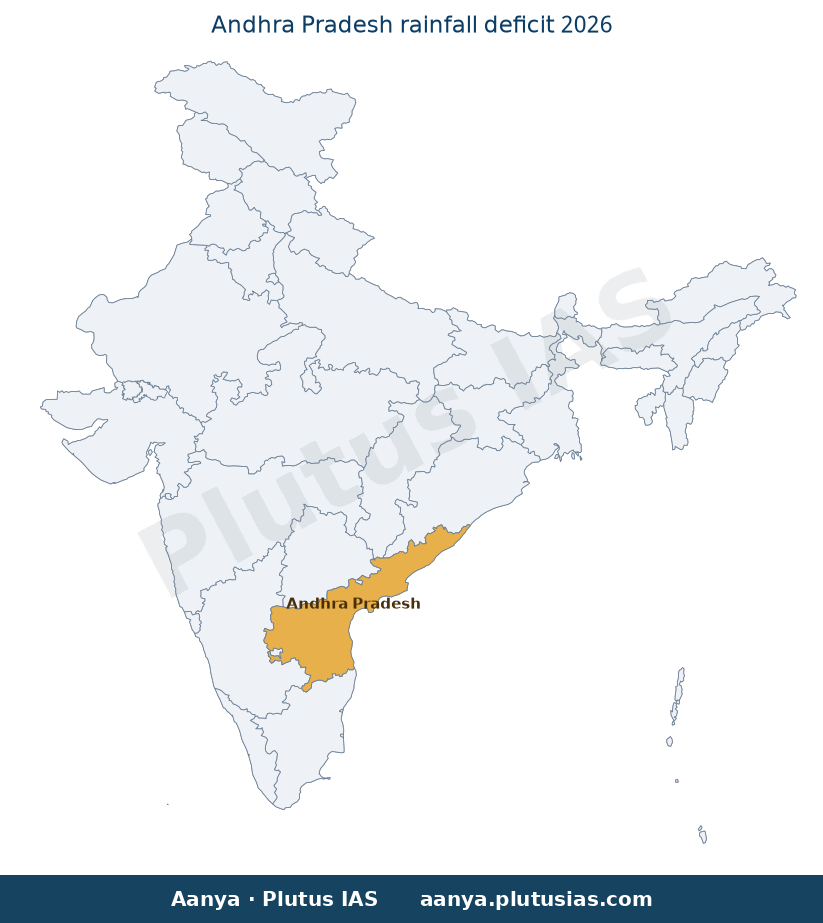
✎ Rainfall deficit in Andhra Pradesh is calculated as the percentage deviation from the Long Period Average (LPA), with a 52.4% deficit by July-end 2026 indicating severe hydrological stress, particularly for rainfed agriculture.
Subject Relevance — Where This Topic Fits
- GS Paper I — Geography of India (Monsoon Variability, Drought Conditions) | GS Paper III — Agriculture (Rainfed Agriculture, Drought Management, Farmer Welfare)
- Prelims: Southwest Monsoon, Rainfall Deficit, El Niño-Southern Oscillation (ENSO), Drought Declaration Criteria, Rainfed Agriculture, IMD Rainfall Classification, Water Stress, Crop Insurance Schemes
- Essay: Climate Change and Agricultural Resilience: Lessons from Andhra Pradesh, Drought as a Catalyst for Policy Innovation in India
Quick Revision: Rainfall deficit in Andhra Pradesh is calculated as the percentage deviation from the Long Period Average (LPA), with a 52.4% deficit by July-end 2026 indicating severe hydrological stress, particularly for rainfed agriculture.
Why is this in the news?
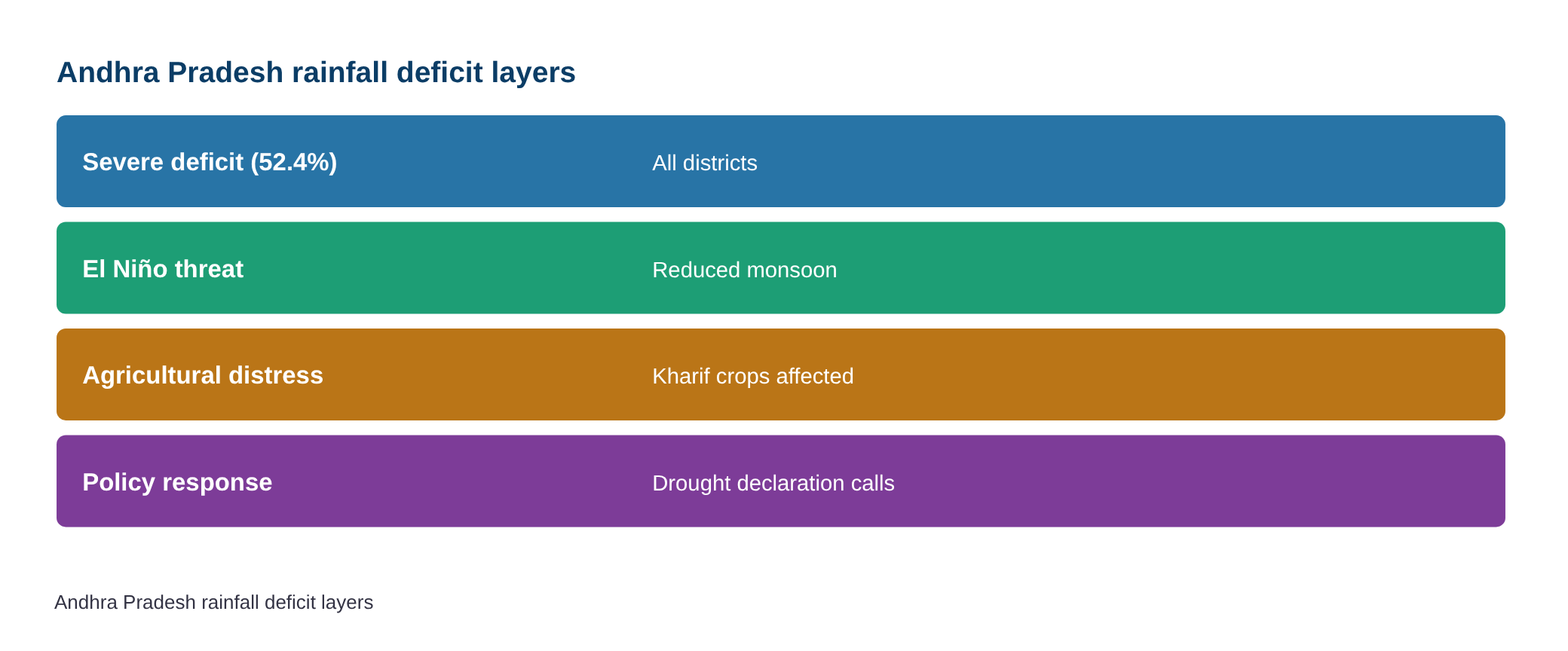
The India Meteorological Department (IMD) has reported a severe rainfall deficit of 52.4% in Andhra Pradesh by July-end 2026. This meteorological anomaly, exacerbated by the absence of significant monsoon activity in the Bay of Bengal branch, has triggered immediate agricultural distress and prompted calls for drought declaration by political stakeholders. The situation is further complicated by the looming threat of El Niño, which historically correlates with reduced monsoon precipitation in peninsular India, necessitating urgent policy interventions to mitigate socio-economic fallout.
Background
- Andhra Pradesh, a predominantly rainfed agricultural state, relies heavily on the Southwest Monsoon (June–September) for kharif crop cultivation, particularly paddy, pulses, and coarse cereals.
- The state’s average annual rainfall is approximately 1,100 mm, with coastal districts like East Godavari and Visakhapatnam receiving higher precipitation compared to Rayalaseema regions like Anantapur and Chittoor.
- Historical data indicates that Andhra Pradesh has faced recurrent droughts during El Niño years, such as 2015–16, when the state recorded a 24% rainfall deficit, leading to significant crop losses and farmer distress.
- The IMD classifies rainfall into five categories: excess (>20% above normal), normal (±19%), deficient (–20% to –59%), large deficient (–60% to –99%), and no rainfall (0%). The current deficit places all districts in the deficient or large deficient category.
- The state government’s recent directives, including comprehensive support for farmers, reflect a reactive policy response to hydrological stress, underscoring the need for proactive drought preparedness frameworks.
What Constitutes Rainfall Deficit and Its Implications for Andhra Pradesh?
- Rainfall deficit is calculated as the percentage deviation of actual rainfall from the Long Period Average (LPA), which is the average rainfall over a 50-year period for a given region and timeframe. A deficit of 52.4% indicates severe hydrological stress.
- The IMD’s classification of ‘deficient’ (–20% to –59%) and ‘large deficient’ (–60% to –99%) rainfall directly correlates with agricultural output, particularly for rainfed crops like paddy, maize, and millets, which account for ~60% of the state’s kharif acreage.
- Andhra Pradesh’s topography, with coastal plains, delta regions, and semi-arid Rayalaseema zones, exacerbates spatial disparities in rainfall distribution, making some districts like Prakasam and Chittoor more vulnerable to drought.
- El Niño, a warm phase of the ENSO cycle, is statistically linked to reduced monsoon rainfall in peninsular India, with a correlation coefficient of ~0.7 during strong El Niño events, as observed in 1982–83, 1997–98, and 2015–16.
- The IMD’s forecast of weak rainfall until August 3, 2026, and the projection of strong surface winds (40–50 kmph) in Coastal Andhra Pradesh and Rayalaseema, indicate limited relief in the immediate term, further stressing water resources.
- Drought conditions in Andhra Pradesh have cascading effects on the rural economy, including reduced farm incomes, increased indebtedness, migration to urban areas, and heightened pressure on groundwater resources, which are already overexploited in districts like Anantapur and Chittoor.
UPSC Value Addition
Keywords for Mains Answer-Writing
Andhra Pradesh rainfall deficit 2026 · Drought conditions India · El Niño impact on monsoon · IMD rainfall classification · Agricultural distress due to deficient rainfall · Drought management in India · Bay of Bengal depression 2026 · Rayalaseema and Coastal Andhra Pradesh rainfall · India Meteorological Department (IMD) forecasting · Agricultural contingency plans India · Rainfall deficit and crop failure · Drought declaration criteria India · Monsoon variability and climate change · State-level disaster management · Farmers’ distress mitigation measures
Prelims Practice Questions
Q1. Consider the following statements regarding rainfall classification by the India Meteorological Department (IMD):
1. Normal rainfall is defined as rainfall that is within ±19% of the Long Period Average (LPA).
2. Deficient rainfall is defined as rainfall that is between 19% below and 59% below the LPA.
3. Large deficient rainfall is defined as rainfall that is 60% or more below the LPA.
4. Excess rainfall is defined as rainfall that is 20% or more above the LPA.
How many of the above statements are correct?
- Only one
- Only two
- Only three
- All
Answer: All — Statements 1, 2, and 3 are correct as per IMD’s rainfall classification norms. Statement 4 is incorrect because excess rainfall is defined as 20% or more above the LPA, not 20% or more above the LPA.
Q2. Assertion (A): The India Meteorological Department (IMD) has forecasted that Andhra Pradesh will not receive significant rainfall until August 3, 2026.
Reason (R): A deep depression over western parts of central Chhattisgarh and Madhya Pradesh moved southwestwards, weakening into a depression and further into a low-pressure area, reducing the likelihood of heavy rainfall over Andhra Pradesh.
- Both A and R are true, and R is the correct explanation of A
- Both A and R are true, but R is not the correct explanation of A
- A is true, but R is false
- A is false, but R is true
Answer: Both A and R are true, but R is not the correct explanation of A — Both the assertion and reason are factually accurate. The IMD’s forecast of deficient rainfall for Andhra Pradesh is directly linked to the movement and weakening of the depression system over central India, which reduces moisture incursion into the state.
Q3. Match the following districts of Andhra Pradesh with their respective rainfall deficit categories as reported by the Directorate of Economics and Statistics on July 30, 2026:
Column I (District) Column II (Rainfall Deficit Category)
A. Prakasam 1. Deficient
B. East Godavari 2. Large Deficient
C. Visakhapatnam 3. Normal (initially but later turned deficient)
D. NTR District 4. Large Deficient
E. SPSR Nellore 5. Deficient
- {‘A-2, B-2, C-2, D-1, E-1’: False}
- {‘A-2, B-2, C-2, D-3, E-3’: True}
- {‘A-1, B-1, C-1, D-2, E-2’: False}
- {‘A-5, B-5, C-5, D-4, E-4’: False}
Answer: {‘A-2, B-2, C-2, D-3, E-3’: True} — Prakasam, East Godavari, and Visakhapatnam were reported as ‘large deficient.’ NTR and SPSR Nellore districts initially had normal rainfall but later turned ‘deficient.’
Mains Practice Question
✍ Critically examine the socio-economic and environmental implications of deficient rainfall in Andhra Pradesh, with reference to the 52.4% rainfall deficit reported by July-end 2026. Also, outline the constitutional and statutory provisions available for drought management in India. (15 Marks)
Approach: MODEL-ANSWER SKELETON:
1. **Introduction (2 marks)**:
– Define deficient rainfall and its classification by IMD (normal: ±19%, deficient: 19-59% below LPA, large deficient: ≥60% below LPA).
– State the reported deficit in Andhra Pradesh (52.4%) and its distribution across districts (Prakasam, East Godavari, Visakhapatnam, Annamayya, Chittoor as ‘large deficient’; others as ‘deficient’).
2. **Socio-economic implications (6 marks)**:
– **Agricultural distress**: Crop failure (kharif sowing affected), reduced kharif acreage, and impact on farmers’ income (cite data if available).
– **Water scarcity**: Depletion of reservoirs, groundwater levels, and drinking water shortages in rural and urban areas.
– **Livelihood impact**: Migration of agricultural laborers, distress sales of livestock, and increased indebtedness.
– **Food security**: Potential shortfall in foodgrain production, leading to inflation and supply chain disruptions.
– **Economic cost**: Loss of GDP contribution from agriculture (state’s agriculture contributes ~30% to GSDP), increased expenditure on relief measures.
3. **Environmental implications (3 marks)**:
– **Biodiversity loss**: Impact on wetlands, rivers, and dependent ecosystems.
– **Soil degradation**: Increased aridity, reduced soil moisture, and desertification risks in Rayalaseema and Coastal Andhra.
– **Climate change linkage**: El Niño conditions and their role in monsoon variability (cite IMD reports on El Niño-Southern Oscillation).
4. **Drought management: Constitutional and statutory provisions (4 marks)**:
– **Constitutional provisions**:
– **Article 21**: Right to life and livelihood (interpreted to include access to water).
– **Article 38**: Directive Principles of State Policy (promotion of welfare and minimisation of inequalities).
– **Article 47**: Duty of the State to raise the level of nutrition and standard of living.
– **Statutory provisions**:
– **Disaster Management Act, 2005**: Framework for drought as a notified disaster; roles of NDMA, SDMAs, and local authorities.
– **National Disaster Response Fund (NDRF)**: Financial assistance for drought relief.
– **National Agricultural Insurance Scheme (NAIS) and Pradhan Mantri Fasal Bima Yojana (PMFBY)**: Crop insurance mechanisms.
– **Drought Management Manual (2016)**: Guidelines for drought declaration, relief measures, and contingency planning.
– **State-level mechanisms**: Andhra Pradesh Drought Monitoring and Mitigation Centre; Mahatma Gandhi National Rural Employment Guarantee Scheme (MGNREGS) for water conservation works.
5. **Conclusion (2 marks)**:
– Emphasise the need for integrated drought management: early warning systems (IMD forecasts), sustainable agriculture (crop diversification, water-efficient techniques), and long-term climate adaptation strategies.
– Highlight the role of inter-state cooperation (e.g., sharing of river waters) and global climate commitments (Paris Agreement) in mitigating drought risks.
Source: The Hindu
Generated by AanyaAi for educational purpose.

- आपातकाल में ‘गायब’ शाह आयोग रिपोर्ट का रहस्यमयी पुनर्प्राप्ति - September 23, 2026
- What happened to the Shah Commission report on Emergency? UPSC analysis - September 23, 2026
- तमिलनाडु के लिए क्या है ‘एल नीनो’ और उत्तर-पूर्वी मानसून का खतरा? - September 23, 2026

No Comments