


14 Oct Andhra Pradesh’s Regional Conferences Ahead of CII Partnership Summit 2026
✎ The Andhra Pradesh government’s regional conferences are a strategic initiative to attract investment, generate employment, and position the state as an industrial hub by leveraging high-profile summits like the CII Partnership…
Subject Relevance — Where This Topic Fits
- GS Paper II — Government Policies and Interventions for Development in various sectors | GS Paper III — Investment Models, Employment Generation, Industrial Policy, and Infrastructure Development
- Prelims: Memorandum of Understanding (MoU), Public-Private Partnership (PPP), CII Partnership Summit, Andhra Pradesh Economic Development Board (APEDB), Quantum Valley, Semiconductor Policy, Urban Infrastructure Development, Renewable Energy Policy, Natural Farming, Horticulture Policy
- Essay: Role of state-led economic diplomacy in India’s development trajectory, Public-private partnerships as instruments of inclusive growth and employment generation
Quick Revision: The Andhra Pradesh government’s regional conferences are a strategic initiative to attract investment, generate employment, and position the state as an industrial hub by leveraging high-profile summits like the CII Partnership Summit.
Why is this in the news?
The Andhra Pradesh government’s decision to organise three regional conferences ahead of the 31st Confederation of Indian Industry (CII) Partnership Summit 2026 underscores its proactive strategy to attract investment, foster industrial diversification, and generate employment across multiple sectors. These conferences, aligned with the summit’s objectives, aim to consolidate investor confidence and position the state as a competitive destination for capital-intensive industries, thereby advancing its developmental agenda.
Background
- The CII Partnership Summit is an annual flagship event organised by the Confederation of Indian Industry (CII) to facilitate business-to-business and business-to-government interactions, promote investment, and showcase economic opportunities across Indian states.
- Andhra Pradesh has historically leveraged such summits to attract investments, particularly in sectors like electronics manufacturing, semiconductors, and renewable energy, aligning with its industrial policy and development vision.
- The state’s proactive approach includes organising regional conferences to decentralise engagement, address local economic needs, and build grassroots-level momentum prior to the main summit.
- The proposed investments of ₹79,628.04 crore and potential employment generation of 1,88,038 persons reflect the state’s emphasis on large-scale industrial projects with direct socio-economic impacts.
- The inclusion of emerging sectors such as Quantum Valley, semiconductors, and advanced materials aligns with national priorities under the Semiconductor Mission and Atal Innovation Mission.
- The Andhra Pradesh Economic Development Board (APEDB) serves as the nodal agency for investment promotion, facilitating MoUs and providing a transparent framework for investor engagement.
What are the Andhra Pradesh Regional Conferences and their Objectives?
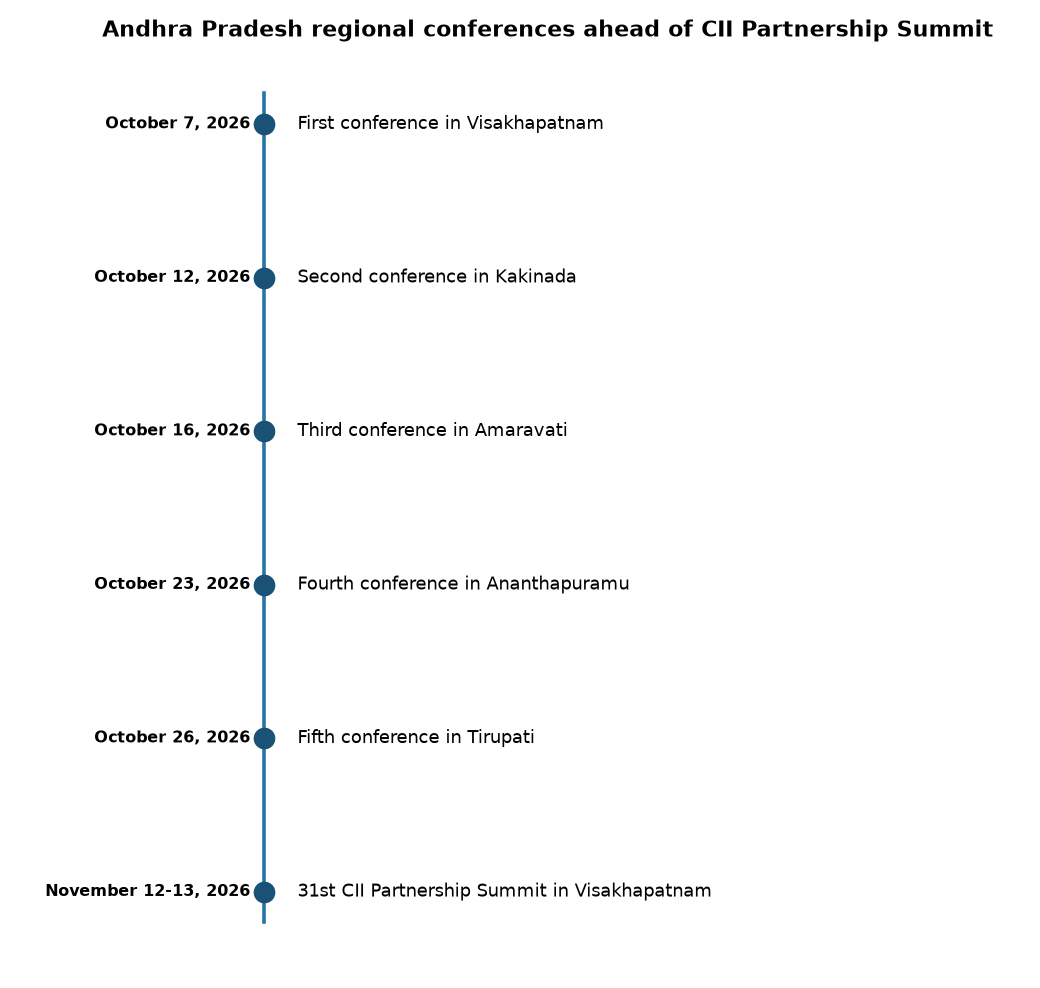
- The regional conferences are pre-summit events organised by the Andhra Pradesh government to engage with investors, industry stakeholders, and local entrepreneurs across three distinct geographical zones: Amaravati, Ananthapuramu, and Tirupati.
- These conferences serve as platforms for signing MoUs between the state government and private enterprises, outlining proposed investments, sectoral commitments, and employment generation targets.
- The primary objective is to create a conducive ecosystem for industrial development by showcasing the state’s strengths in governance, infrastructure, and sector-specific policies, thereby enhancing its appeal to domestic and international investors.
- By decentralising engagement, the state aims to ensure inclusive participation from micro, small, and medium enterprises (MSMEs) alongside large corporations, fostering balanced regional growth.
- The conferences are part of a broader strategy to align with the CII Partnership Summit, which serves as a high-profile platform for networking, policy announcements, and investment commitments.
- The state’s investment promotion efforts are complemented by sector-specific policies, such as the Andhra Pradesh Semiconductor Policy and Renewable Energy Policy, which provide fiscal incentives and regulatory support to investors.
- Transparency is ensured through the publication of tentative MoU lists and investment details on the APEDB website, enabling stakeholders to track progress and accountability.
Key Features
| Feature | Significance |
|---|---|
| Regional Conferences | Act as preparatory platforms to mobilise local stakeholders, assess regional strengths, and align sector-specific opportunities with investor expectations ahead of the CII Partnership Summit. |
| MoUs with Investment Commitments (₹79,628.04 crore) | Demonstrates tangible economic engagement and signals investor confidence in Andhra Pradesh’s industrial and infrastructural potential. |
| Sectoral Diversification (Quantum Valley, semiconductors, renewable energy, etc.) | Reflects a strategic shift towards high-technology and green industries, aligning with national priorities such as Atmanirbhar Bharat and the Global Value Chains initiative. |
| Employment Generation (1,88,038 persons) | Highlights the socio-economic impact of industrialisation, addressing unemployment while supporting inclusive growth. |
| State-Level Economic Development Board (APEDB) | Serves as the nodal agency for investment facilitation, ensuring streamlined processes for MoU negotiations and post-signature implementation. |
Why it Matters
Economic Significance
- The conferences and MoUs aim to position Andhra Pradesh as a key investment destination, leveraging its geographical advantages (coastal access, proximity to industrial corridors) and policy incentives.
- The focus on emerging sectors (semiconductors, quantum technologies, advanced materials) aligns with India’s push for self-reliance in critical technologies under the Semiconductor Mission and National Quantum Mission.
- Renewable energy and natural farming commitments reflect alignment with India’s climate commitments (Paris Agreement, LiFE Mission) and sustainable development goals.
- The scale of proposed investments (₹79,628.04 crore) and employment (1,88,038 persons) underscores the potential for transformative economic growth in the state.
Strategic Significance
- Andhra Pradesh’s coastal districts (Visakhapatnam, Kakinada) are positioned as hubs for maritime trade and industrial clusters, complementing national initiatives like Sagarmala and Bharatmala.
- The emphasis on aerospace, defence, and electronics manufacturing aligns with India’s defence indigenisation goals (Aatmanirbhar Bharat in Defence) and the PLI schemes for electronics.
- Quantum Valley and space sector engagements indicate the state’s ambition to emerge as a knowledge economy hub, contributing to India’s global competitiveness in frontier technologies.
Governance and Policy Significance
- The regional conferences exemplify a bottom-up approach to economic diplomacy, where state governments proactively engage with investors to bridge information asymmetries and accelerate project execution.
- The APEDB’s role highlights the importance of institutional mechanisms in investment facilitation, reducing bureaucratic delays and improving ease of doing business.
Challenges
1. Implementation and Execution Risks
- Delays in land acquisition and regulatory clearances may impede the timely execution of MoUs, particularly for large-scale projects in sectors like semiconductors and aerospace.
- Skill mismatches in the local workforce could hinder employment generation, necessitating targeted skilling programmes aligned with industry requirements.
- Infrastructure bottlenecks (power, logistics, urban infrastructure) may constrain the realisation of investment commitments, especially in hinterland districts like Ananthapuramu.
- Policy consistency and stability are critical to retain investor confidence, given the long gestation periods of projects in emerging sectors.
UPSC Link: GS3: Investment Models
2. Sector-Specific Challenges
- Semiconductor and electronics manufacturing require substantial capital expenditure and a robust supply chain ecosystem, posing entry barriers for new investors.
- Quantum technologies and advanced materials are in nascent stages globally, demanding significant R&D investments and collaboration with academia and research institutions.
- Renewable energy projects face challenges in land acquisition, inter-state power transmission, and grid integration, despite policy support.
UPSC Link: GS3: Science & Tech
3. Socio-Economic Challenges
- Balancing industrialisation with environmental sustainability is critical, particularly in sectors like natural farming and renewable energy, to avoid ecological degradation.
- Ensuring inclusive growth requires equitable distribution of investment benefits across districts, preventing regional disparities within the state.
UPSC Link: GS3: Sustainable Development
Challenges — UPSC Perspective
| Issue | Concern |
|---|---|
| Land Acquisition | Delays due to legal disputes, rehabilitation challenges, and resistance from local communities may stall projects. |
| Regulatory Clearances | Multi-layered approvals (environmental, forest, labour) can lead to bureaucratic inertia and cost overruns. |
| Skill Development | Mismatch between industry demands and local workforce capabilities may result in underemployment or migration. |
| Infrastructure Gaps | Inadequate power, water, and transport infrastructure in non-metropolitan districts could deter investors. |
| Policy Stability | Frequent changes in state or central policies may erode investor trust and deter long-term commitments. |
Government Initiatives — Must-Memorise for Prelims
- Andhra Pradesh Economic Development Board (APEDB) initiatives for investment facilitation
Way Forward
- Accelerate land acquisition and regulatory clearances through single-window clearance mechanisms to expedite project implementation.
- Develop sector-specific skill development programmes in collaboration with industry and academic institutions to address workforce gaps.
- Strengthen infrastructure in hinterland districts (e.g., Ananthapuramu, Tirupati) to support industrial clusters and reduce logistical costs.
- Establish dedicated R&D centres for emerging technologies (quantum, semiconductors) in partnership with central institutions like DRDO, ISRO, and IITs.
- Ensure transparent and time-bound dispute resolution mechanisms for investors to mitigate policy and regulatory risks.
- Promote public-private partnerships (PPPs) for urban infrastructure and renewable energy projects to leverage private sector efficiency.
- Monitor MoU progress through a real-time dashboard to track investments, employment generation, and project milestones.
- Align state-level policies with national schemes (PLI, Semiconductor Mission, National Quantum Mission) to maximise synergy and funding opportunities.
UPSC Value Addition
Keywords for Mains Answer-Writing
Andhra Pradesh Economic Development Board · CII Partnership Summit · Public-Private Partnerships (PPP) · State Investment Promotion · Regional Economic Development · Memoranda of Understanding (MoUs) · Investment Facilitation · Industrial Policy · Urban Infrastructure Development · Emerging Technologies and Innovation · Renewable Energy Sector · Tourism and Hospitality Infrastructure · Semiconductor and Electronics Manufacturing · State-Level Investment Conferences · Government-Industry Interface · Economic Diplomacy · Industrial Corridors · Quantum Technology · Aerospace and Defence Manufacturing · Natural Farming and Horticulture
Concept Flow
State-led economic diplomacy (regional conferences) → Investor engagement and MoU signing → Sectoral diversification (high-tech, green industries) → Employment generation and economic growth → Implementation challenges (land, skills, infrastructure) → Policy corrections and infrastructure development → Long-term industrialisation and global competitiveness.
Prelims Practice Questions
Q1. Consider the following statements regarding the CII Partnership Summit:
1. It is an annual event organised by the Confederation of Indian Industry (CII).
2. The 31st edition of the summit is scheduled to be held in Visakhapatnam in November 2026.
3. The summit exclusively focuses on agricultural and allied sectors.
4. Regional conferences are organised by state governments to build momentum ahead of the summit.
How many of the above statements are correct?
- Only one
- Only two
- Only three
- All
Answer: Only three — Statements 1, 2, and 4 are correct. Statement 3 is incorrect as the summit covers diverse sectors including emerging technologies, aerospace, defence, and renewable energy, among others.
Q2. Assertion (A): The Andhra Pradesh government is organising regional conferences ahead of the CII Partnership Summit to facilitate direct engagement between investors and state officials.
Reason (R): Such conferences are mandated under the Constitution of India as a mechanism for state-level economic planning and investment facilitation.
Options:
A. Both A and R are true, and R is the correct explanation of A.
B. Both A and R are true, but R is not the correct explanation of A.
C. A is true but R is false.
D. A is false but R is true.
Answer: ? — Assertion (A) is true as the conferences aim to attract investments through direct engagement. Reason (R) is false because there is no constitutional mandate for such conferences; they are part of the state’s economic diplomacy and investment promotion strategy.
Q3. Match the following sectors with their respective proposed investments in Andhra Pradesh as outlined in the regional conferences:
Column I (Sector) | Column II (Proposed Investment)
—————————————|———————————–
A. Quantum Valley and Emerging Tech | 1. ₹5,000 crore
B. Renewable Energy | 2. ₹12,000 crore
C. Electronics Manufacturing | 3. ₹8,500 crore
D. Tourism and Hospitality | 4. ₹18,000 crore
Options:
A. A-4, B-2, C-3, D-1
B. A-3, B-1, C-4, D-2
C. A-2, B-4, C-1, D-3
D. A-1, B-3, C-2, D-4
- A
- B
- C
- D
Answer: A — The correct match is: A-4 (Quantum Valley and Emerging Tech: ₹18,000 crore), B-2 (Renewable Energy: ₹12,000 crore), C-3 (Electronics Manufacturing: ₹8,500 crore), D-1 (Tourism and Hospitality: ₹5,000 crore).
Mains Practice Question
✍ The organisation of regional conferences by state governments in India, such as those being held in Andhra Pradesh ahead of the CII Partnership Summit, reflects a growing emphasis on sub-national economic diplomacy and investment facilitation. Critically examine the significance of such state-level initiatives in India’s federal economic governance framework. Also, discuss the constitutional and institutional mechanisms that enable states to undertake such initiatives. (15 Marks)
Approach: MODEL-ANSWER SKELETON:
1. **Introduction (2 marks)**
– Define state-level economic diplomacy and investment facilitation.
– Contextualise with the Andhra Pradesh example: purpose (attracting ₹79,628.04 crore investments), sectors (115 MoUs across emerging technologies, renewable energy, tourism, etc.), and mechanism (regional conferences).
2. **Significance of State-Level Initiatives (5 marks)**
– **Economic Growth and Employment**: Link to potential employment generation (1,88,038 persons) and sectoral diversification.
– **Competitive Federalism**: Explain how states compete to attract investments, citing examples like Gujarat’s Vibrant Gujarat or Tamil Nadu’s Global Investors Meet.
– **Inclusive Development**: Highlight focus on backward regions (Ananthapuramu, Tirupati) and sectors (natural farming, horticulture).
– **Policy Innovation**: Discuss how states experiment with policies (e.g., Andhra Pradesh’s Quantum Valley initiative).
– **Global Engagement**: Position India’s states as economic actors in global value chains (e.g., electronics manufacturing, semiconductors).
3. **Constitutional and Institutional Mechanisms (5 marks)**
– **Constitutional Provisions**:
– Article 246 (7th Schedule): Distribution of legislative powers between Centre and states.
– Article 293: Borrowing powers of states.
– Article 282: Grants-in-aid for specific purposes.
– **Institutional Frameworks**:
– State Investment Promotion Agencies (e.g., Andhra Pradesh Economic Development Board).
– Public-Private Partnership (PPP) frameworks (e.g., Model Concession Agreement 2015).
– Role of NITI Aayog in facilitating state-level reforms (e.g., Ease of Doing Business rankings).
– **Centre-State Coordination**: Mechanisms like the Inter-State Council (Article 263) and NITI Aayog’s Aspirational Districts Programme.
4. **Challenges and Limitations (2 marks)**
– **Resource Constraints**: Limited fiscal space for states to offer incentives.
– **Regulatory Hurdles**: Land acquisition, environmental clearances, and labour laws.
– **Centre-State Tensions**: Overlapping jurisdictions (e.g., concurrent list items like agriculture, industrial policy).
– **Sustainability**: Risk of over-reliance on MoUs without implementation follow-through.
5. **Conclusion (1 mark)**
– Summarise the evolving role of states as economic actors within India’s federal structure.
– Highlight the need for Centre-state collaboration to leverage state-level initiatives for national growth.
Source: The Hindu
Andhra Pradesh PCS (APPSC) — State PCS Practice
Prelims: As part of its preparation for the upcoming CII Partnership Summit, the Andhra Pradesh government has decided to organize three regional conferences. Which of the following is NOT a likely objective of these conferences?
- A. To assess the industrial potential and investment opportunities in different regions of Andhra Pradesh
- B. To facilitate direct interaction between investors and local entrepreneurs
- C. To announce a new state-wide industrial policy before the summit
- D. To showcase the cultural and tourism potential of Andhra Pradesh to attract investors
Answer: C. To announce a new state-wide industrial policy before the summit — The conferences are focused on economic and industrial development, not on announcing new policies or cultural showcases.
Mains: Discuss the significance of holding regional conferences in Andhra Pradesh ahead of the CII Partnership Summit. How can these conferences contribute to the state’s economic growth and investor confidence?
Generated by AanyaAi for educational purpose.
Related guides on our sites
- Current affairs for upsc 2026
- Best PSIR optional coaching for upsc
- Best economics optional coaching for upsc
- Best PSIR optional teacher for upsc

- MP CM’s surprise district visits under Jan Vishwas Abhiyan: Key governance steps - October 21, 2026
- महिला एवं बाल विकास मंत्रालय का विशेष अभियान 6: 30 अक्टूबर को राष्ट्रव्यापी अभियान - October 21, 2026
- MMRDA’s Thane Coastal Road-2 Approved: 680 Mangroves Lost in Ramsar Site - October 21, 2026

No Comments