


09 Aug Anil Akkara seeks CBI takeover of Kerala LIFE Mission Vigilance files
✎ The demand by former MLA Anil Akkara for the transfer of all Vigilance files related to the Kerala LIFE Mission case to the Central Bureau of Investigation (CBI) underscores the constitutional and legal complexities arising from…
Subject Relevance — Where This Topic Fits
- GS Paper II — Functions and Responsibilities of the Union and the States, Issues and Challenges Pertaining to the Federal Structure | GS Paper III — Challenges to Internal Security Through Communication Networks, Role of State and Non-State Actors in Creating Challenges to Internal Security | GS Paper IV — Ethics and Human Interface: Public/Civil Service Values and Ethics in Public Administration
- Prelims: Vigilance and Anti-Corruption Bureau (VACB), Central Bureau of Investigation (CBI), Lokpal and Lokayukta Act, 2013, Supreme Court of India, Federalism, Concurrent jurisdiction, Chargesheet, Money laundering, Public Interest Litigation (PIL), Union List vs State List
- Essay: The Necessity of Unified Investigative Mechanisms in High-Stakes Corruption Cases, Federalism vs. Centralisation: Balancing Accountability and Autonomy in Governance
Why is this in the news?
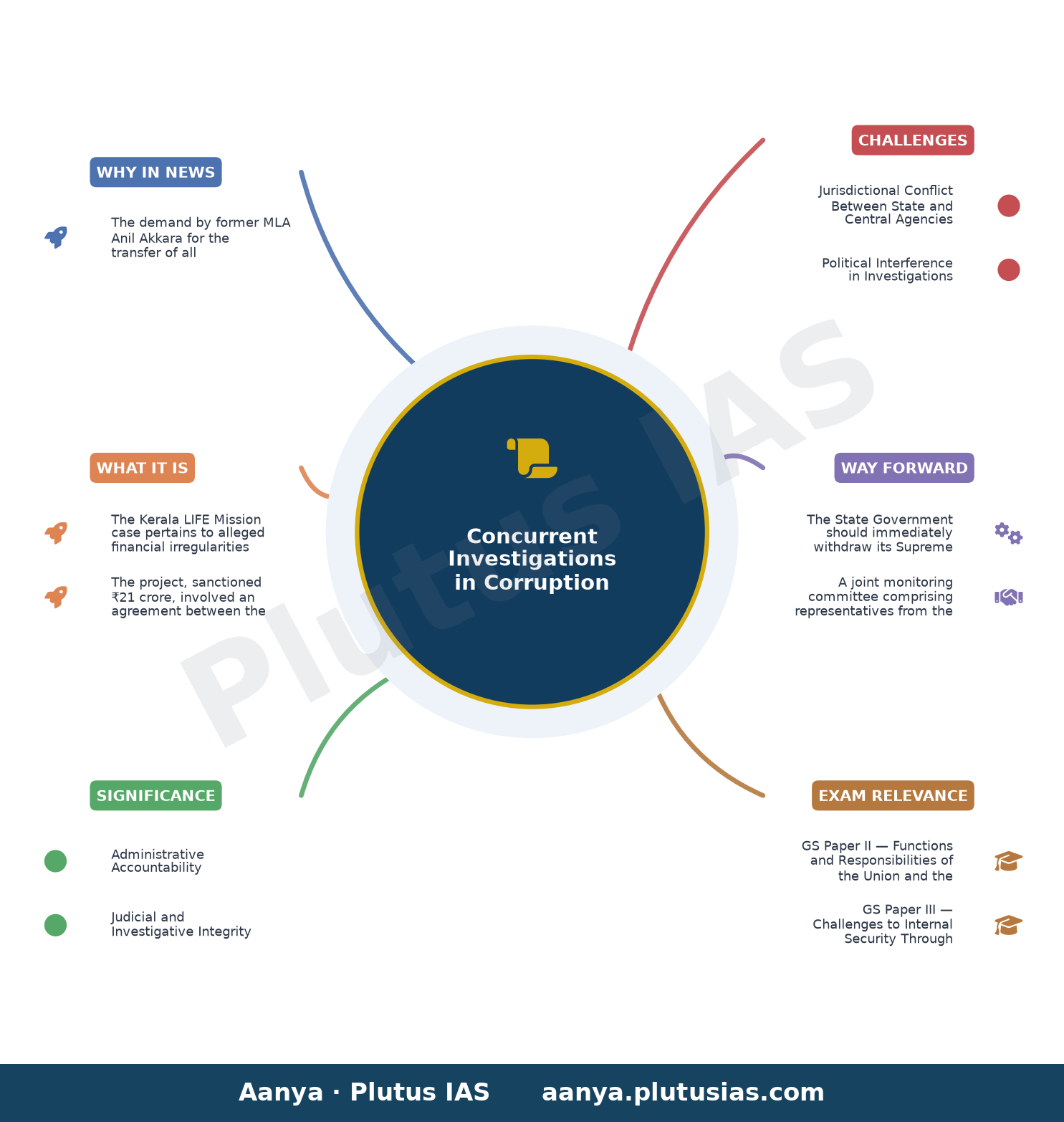
The demand by former MLA Anil Akkara for the transfer of all Vigilance files related to the Kerala LIFE Mission case to the Central Bureau of Investigation (CBI) underscores the constitutional and legal complexities arising from concurrent investigations by multiple agencies in high-profile corruption cases. This development highlights the tension between state autonomy and central investigative oversight, particularly when allegations of malfeasance implicate high-ranking officials, including the former Chief Minister. The case also brings into focus the procedural ambiguities in the allocation of investigative jurisdiction under the Indian federal structure, as well as the ethical imperatives of ensuring transparency and public trust in anti-corruption probes.
Background
- The LIFE Mission housing project was initiated in Kerala following the devastating 2018 floods as part of a rehabilitation programme, with an agreement signed between the Life Mission and the UAE-based Red Crescent for the construction of housing and a hospital at Wadakkanchery.
- The project was sanctioned ₹21 crore, with the construction contract awarded to Kochi-based firms Unitac Builders and Sane Ventures, owned by businessman Santhosh Eappen, raising allegations of irregularities in the award process.
- The CBI filed a chargesheet in the case, naming Santhosh Eappen, Sane Ventures, and the Life Mission as accused entities.
- The Vigilance and Anti-Corruption Bureau (VACB) of Kerala initiated parallel investigations, which the complainant alleges has led to inefficiencies and coordination challenges in the legal proceedings.
- The State government has filed a petition before the Supreme Court, which the complainant urges to be withdrawn to facilitate the CBI’s investigation.
- The case exemplifies the broader challenge of balancing federal autonomy with the need for centralised investigative oversight in cases of alleged systemic corruption.
What is the Kerala LIFE Mission Case?
- The Kerala LIFE Mission case pertains to alleged financial irregularities and corruption in the awarding of contracts for a housing and hospital project under the LIFE Mission, a rehabilitation initiative post the 2018 Kerala floods.
- The project, sanctioned ₹21 crore, involved an agreement between the Life Mission and the UAE-based Red Crescent, with construction contracts awarded to firms owned by Santhosh Eappen, leading to allegations of favouritism and kickbacks.
- The CBI has filed a chargesheet naming Santhosh Eappen, Sane Ventures, and the Life Mission as accused.
- The Vigilance and Anti-Corruption Bureau (VACB) of Kerala initiated a parallel investigation, which the complainant argues has resulted in inefficiencies and duplication of efforts, necessitating a unified investigative approach.
- The case implicates high-ranking officials, including former Principal Secretary M. Sivasankar and former Life Mission CEO U.V. Jose, as well as former Chief Minister Pinarayi Vijayan and Minister A.C. Moideen, raising questions about political accountability.
- The demand for transferring all Vigilance files to the CBI highlights the constitutional and legal ambiguities in concurrent investigations, particularly when allegations span multiple jurisdictions and involve complex financial transactions.
- The ethical dimension of the case lies in ensuring that investigations are transparent, credible, and free from political interference, thereby upholding public trust in the justice delivery system.
Key Features
| Feature | Significance |
|---|---|
| Parallel investigations by multiple agencies | Undermines efficiency, coordination, and credibility of legal proceedings due to conflicting findings and procedural overlaps. |
| Transfer of Vigilance files to CBI | Ensures a unified, transparent, and comprehensive investigation by consolidating all evidence under a single investigating agency. |
| CBI chargesheet in LIFE Mission case | Indicates prima facie evidence of irregularities in contract award, necessitating further investigation into accused entities and individuals. |
| Role of former Principal Secretary M. Sivasankar | Highlights potential systemic collusion or procedural lapses in administrative decision-making during the project execution. |
| Inclusion of LIFE Mission as an accused | Demonstrates institutional accountability for alleged financial misconduct in a rehabilitation program funded by international aid. |
Why it Matters
Administrative Accountability
- Exposes potential lapses in governance within Kerala’s rehabilitation programs, particularly in the LIFE Mission, a flagship post-flood housing initiative.
- Raises questions about the integrity of public-private partnerships in disaster recovery projects, especially when international aid is involved.
- Underscores the necessity of inter-agency coordination to prevent duplication of efforts and ensure robust oversight of public funds.
Judicial and Investigative Integrity
- Highlights the conflict between state-level vigilance agencies and central investigative bodies, necessitating Supreme Court intervention to resolve jurisdictional disputes.
- Demonstrates the role of the CBI in ensuring impartiality in high-profile corruption cases involving state actors and political figures.
- Emphasizes the importance of a single, authoritative investigation to maintain public trust in the justice delivery system.
Economic Implications
- Reveals potential misallocation of ₹21 crore sanctioned for flood victim rehabilitation, raising concerns about financial prudence in disaster management.
- Underscores the risks of corruption in public infrastructure projects, which can erode public confidence and deter future investments.
- Highlights the need for stricter financial audits and transparency in projects funded by international aid to prevent exploitation.
Political and Governance Repercussions
- Exposes the involvement of high-ranking officials, including former Chief Minister Pinarayi Vijayan and ministers, in alleged financial irregularities.
- Raises questions about the efficacy of Kerala’s anti-corruption mechanisms and the need for systemic reforms in vigilance and investigation agencies.
- Underscores the political fallout of corruption scandals in welfare programs, potentially influencing electoral dynamics and governance priorities.
Challenges
1. Jurisdictional Conflict Between State and Central Agencies
- Parallel investigations by the State Vigilance and Anti-Corruption Bureau (VACB) and the CBI create procedural overlaps, delaying justice and diluting evidence.
- Lack of cooperation from state agencies in handing over files to the CBI undermines the integrity of the investigation.
- Supreme Court intervention may be required to resolve disputes, further prolonging the legal process.
UPSC Link: GS-II: Functions and responsibilities of the Union and the States
2. Political Interference in Investigations
- Allegations of collusion between political figures and administrative officials in the LIFE Mission case raise concerns about systemic corruption.
- The involvement of high-ranking officials, including former ministers, complicates the investigation and may lead to attempts at obstruction.
- Public perception of political bias in investigations can undermine trust in the justice system.
UPSC Link: GS-II: Role of Civil Services in a democracy
3. Financial Mismanagement in Disaster Recovery Programs
- The alleged misallocation of ₹21 crore in a flood rehabilitation project highlights gaps in financial oversight and audit mechanisms.
- International aid funds, such as those from the UAE Red Crescent, require stringent monitoring to prevent misuse.
- Corruption in such programs can delay relief efforts and exacerbate the suffering of affected communities.
UPSC Link: GS-III: Disaster Management
4. Institutional Credibility and Public Trust
- Multiple investigations and delayed justice erode public confidence in the ability of state institutions to deliver accountability.
- The inclusion of LIFE Mission as an accused entity in the CBI chargesheet raises questions about the effectiveness of state-run welfare programs.
- A lack of transparency in investigations can fuel public skepticism and undermine governance legitimacy.
UPSC Link: GS-II: Transparency and accountability in governance
5. Coordinated Efforts in Multi-Agency Investigations
- Ensuring seamless transfer of files and evidence between state and central agencies requires robust inter-departmental coordination.
- Delays in file transfers or selective sharing of documents can compromise the integrity of the investigation.
- The CBI’s reliance on state agencies for evidence necessitates a collaborative approach to avoid procedural bottlenecks.
UPSC Link: GS-II: Centre-State relations
Challenges — UPSC Perspective
| Issue | Concern |
|---|---|
| Lack of inter-agency cooperation | Delays in justice delivery and potential evidence tampering due to conflicting investigative approaches. |
| Political interference in administrative processes | Undermines the autonomy of investigative agencies and compromises the integrity of the probe. |
| Financial mismanagement in disaster relief funds | Leads to misallocation of public resources and erodes public trust in government programs. |
| Supreme Court intervention required | Indicates systemic failures in resolving jurisdictional disputes between state and central agencies. |
| Public perception of biased investigations | Can fuel social unrest and undermine confidence in the justice system. |
Government Initiatives — Must-Memorise for Prelims
- LIFE Mission (Livelihood, Inclusion, Financial Empowerment) Kerala
Way Forward
- The State Government should immediately withdraw its Supreme Court plea and extend full cooperation to the CBI, including the transfer of all Vigilance files and evidence.
- A joint monitoring committee comprising representatives from the CBI, State Vigilance, and judicial authorities should be constituted to oversee the investigation and ensure transparency.
- The CBI should expedite the probe into the alleged roles of former Principal Secretary M. Sivasankar and former LIFE Mission CEO U.V. Jose to determine administrative culpability.
- A comprehensive audit of all LIFE Mission projects, particularly those funded by international aid, should be conducted to identify systemic vulnerabilities and prevent future irregularities.
- Strengthen inter-agency coordination mechanisms between state vigilance bodies and central investigative agencies to avoid parallel investigations in future cases.
- Enhance financial oversight and transparency in disaster recovery programs by implementing real-time digital tracking of fund disbursement and project execution.
- Conduct a public awareness campaign to educate citizens about their rights in disaster relief programs and the mechanisms for reporting corruption.
- Review and reform Kerala’s anti-corruption framework to ensure greater autonomy for investigative agencies and reduce political interference.
UPSC Value Addition
Keywords for Mains Answer-Writing
LIFE Mission scam Kerala 2018 floods rehabilitation project · Central Bureau of Investigation powers under Delhi Special Police Establishment Act · State Vigilance and Anti-Corruption Bureau jurisdiction and coordination with CBI · Supreme Court role in transfer of investigation from state agencies to CBI · Article 142 of the Constitution and judicial oversight of investigative agencies · Federation and concurrent list subjects related to criminal law and investigation · Rule of law and separation of powers in investigative governance · Corruption in public housing projects and accountability mechanisms · Inter-agency cooperation in high-profile economic offences · Judicial activism in ensuring fair probe and public confidence in justice delivery
Constitutional & Policy Linkages
- Article 14: Equality before law and equal protection of laws
- Article 226: High Court’s power to issue writs for enforcement of fundamental rights
- Article 32: Supreme Court’s power to issue writs for enforcement of fundamental rights
Concept Flow
2018 Kerala floods lead to the launch of LIFE Mission for flood victim rehabilitation → UAE Red Crescent sanctions ₹21 crore for housing and hospital construction in Wadakkanchery → Contract awarded to Unitac Builders and Sane Ventures, owned by Santhosh Eappen, amid alleged irregularities → CBI files chargesheet naming Santhosh Eappen, Sane Ventures, LIFE Mission, and others as accused → State Vigilance and Anti-Corruption Bureau (VACB) conducts parallel investigation, delaying justice → Former MLA Anil Akkara demands transfer of all Vigilance files to CBI to ensure a unified probe → Supreme Court intervention sought to resolve jurisdictional disputes between state and central agencies
Prelims Practice Questions
Q1. Consider the following statements regarding the powers of the Central Bureau of Investigation (CBI) in India:
1. The CBI derives its powers from the Delhi Special Police Establishment Act, 1946.
2. The CBI can investigate any offence without the consent of the state government if it pertains to central government employees.
3. The Supreme Court can direct the CBI to investigate a case under Article 32 of the Constitution.
4. The CBI is a statutory body established under the Constitution of India.
How many of the above statements are correct?
- Only one
- Only two
- Only three
- All four
Answer: Only three — Statements 1 and 3 are correct. The CBI derives powers from the DSPE Act, 1946, and the Supreme Court can direct the CBI to investigate under Article 32. Statement 2 is incorrect as the CBI requires state consent for investigation in a state unless the case is transferred by the Supreme Court under Article 142. Statement 4 is incorrect as the CBI is not a constitutional body but a statutory one.
Q2. Assertion (A): The State Vigilance and Anti-Corruption Bureau (VACB) is constitutionally empowered to investigate cases of corruption involving state government officials.
Reason (R): The Constitution of India places subjects like ‘Police’ and ‘Public Order’ in the State List, thereby vesting investigative powers in state agencies.
Options:
A. Both A and R are true, and R is the correct explanation of A.
B. Both A and R are true, but R is not the correct explanation of A.
C. A is true, but R is false.
D. A is false, but R is true.
Answer: ? — Both Assertion (A) and Reason (R) are true. The Constitution places ‘Police’ and ‘Public Order’ in the State List (List II, Seventh Schedule), empowering state agencies like the VACB to investigate corruption cases involving state officials. However, the Reason (R) does not fully explain the Assertion (A) as the VACB’s powers are statutory and not explicitly mentioned in the Constitution.
Q3. Match the following investigative agencies with their respective jurisdictions:
Column I (Agency)
A. Central Bureau of Investigation (CBI)
B. State Vigilance and Anti-Corruption Bureau (VACB)
C. National Investigation Agency (NIA)
D. Enforcement Directorate (ED)
Column II (Jurisdiction)
1. Investigates offences related to scheduled offences under the NIA Act, 2008
2. Investigates corruption cases involving central government employees
3. Investigates economic offences related to foreign exchange violations
4. Investigates corruption cases involving state government officials
Select the correct match:
- A-2, B-4, C-1, D-3
- A-1, B-3, C-2, D-4
- A-4, B-1, C-3, D-2
- A-3, B-2, C-4, D-1
Answer: A-2, B-4, C-1, D-3 — The correct match is: A (CBI) – 2 (investigates corruption involving central government employees), B (VACB) – 4 (investigates corruption involving state government officials), C (NIA) – 1 (investigates scheduled offences under the NIA Act), and D (ED) – 3 (investigates economic offences related to foreign exchange violations).
Mains Practice Question
✍ The demand for transfer of investigative files from the State Vigilance and Anti-Corruption Bureau (VACB) to the Central Bureau of Investigation (CBI) in the Kerala LIFE Mission case underscores the tension between federalism and the imperative of a fair and impartial probe. Critically analyse the constitutional and statutory framework governing the coordination between state investigative agencies and the CBI. Also, assess the role of the Supreme Court in ensuring a credible investigation while balancing federal concerns. (15 Marks)
Approach: MODEL-ANSWER SKELETON:
1. **Constitutional Framework**:
– State List (List II, Seventh Schedule) empowers states to legislate on ‘Police’ and ‘Public Order’, including corruption investigations.
– Concurrent List (List III) includes ‘Criminal Law’ and ‘Criminal Procedure’, enabling Parliament to legislate on investigative agencies like the CBI.
– Article 246(2) and 246(3) delineate the division of legislative competence.
2. **Statutory Provisions**:
– CBI derives powers from the Delhi Special Police Establishment Act, 1946 (DSPE Act), which requires state consent for investigation in a state (Section 6).
– Exceptions: Supreme Court (Article 32) or High Court (Article 226) can direct the CBI to investigate without state consent (e.g., Vineet Narain v. Union of India, 1998).
– Article 142 empowers the Supreme Court to pass any order necessary for complete justice, including transferring investigations.
3. **Judicial Precedents**:
– **Vineet Narain v. Union of India (1998)**: Supreme Court directed the CBI to investigate without state consent in a case involving high-level corruption.
– **State of West Bengal v. Committee for Protection of Democratic Rights, West Bengal (2010)**: Supreme Court held that the CBI can investigate in a state without consent if directed by the Court.
– **S.P. Gupta v. Union of India (1981)**: Emphasised the judiciary’s role in ensuring fair investigations and protecting fundamental rights.
4. **Federal Concerns and Challenges**:
– **Autonomy vs. Accountability**: States argue that transfer of files undermines their autonomy, while the Centre contends that centralised investigations ensure impartiality.
– **Parallel Investigations**: Multiple agencies investigating the same case can lead to conflicts, delays, and dilution of evidence (as seen in the LIFE Mission case).
– **Public Confidence**: Credibility of investigations is paramount; parallel probes risk eroding trust in the justice delivery system.
5. **Supreme Court’s Role**:
– **Judicial Activism**: The Court has historically intervened to ensure fair probes in high-profile cases (e.g., 2G spectrum case, coal scam).
– **Balancing Act**: The Court must balance federalism with the need for a credible investigation, often invoking Article 142.
– **Consequences of Non-Cooperation**: If states resist cooperation, the Court may direct the CBI to take over, as in the LIFE Mission case.
6. **Way Forward**:
– **Statutory Amendments**: Clarify the conditions under which the CBI can investigate in a state without consent.
– **Inter-Agency Protocols**: Establish mechanisms for seamless coordination between state and central agencies.
– **Transparency**: Ensure that investigative agencies share evidence and findings to avoid duplication and conflicts.
**Balanced View**: While federalism is a cornerstone of India’s polity, the imperative of a fair and impartial probe in cases of large-scale corruption or public interest may necessitate centralised investigations. The Supreme Court’s proactive role in such matters is justified to uphold the rule of law and public trust.
Source: The Hindu
Generated by AanyaAi for educational purpose.

- KWML’s Feasibility Reports for Water Metro in 18 Cities: UPSC & PCS Insights - October 3, 2026
- ओडिशा में वन्यजीव अनुसंधान अनुदान कार्यक्रम शुरू, सिमिलिपाल में 300 कैमरे और बढ़ेंगे - October 3, 2026
- India Summons Pakistan High Commission Official Over Violation - October 3, 2026

No Comments