


08 Aug Badrinath Highway All-Weather Project Fails After First Monsoon: Quality Concerns for UPSC
Retaining wallNational Highway 58All-Weather RoadPilgrimage route✎ The Badrinath All-Weather Road Project exemplifies the urgent need for climate-resilient infrastructure in the Himalayas, where geological fragility and extreme weather demand rigorous geotechnical audits and adaptive engineering…
Subject Relevance — Where This Topic Fits
- GS Paper III — Infrastructure: Energy, Ports, Roads, Airports, Railways
- Prelims: All-Weather Road Project, NHIDCL, Himalayan geology, Landslide zones, Geotechnical engineering
- Essay: Climate change and infrastructure resilience in fragile ecosystems
Quick Revision: The Badrinath All-Weather Road Project exemplifies the urgent need for climate-resilient infrastructure in the Himalayas, where geological fragility and extreme weather demand rigorous geotechnical audits and adaptive engineering solutions.
Why is this in the news?
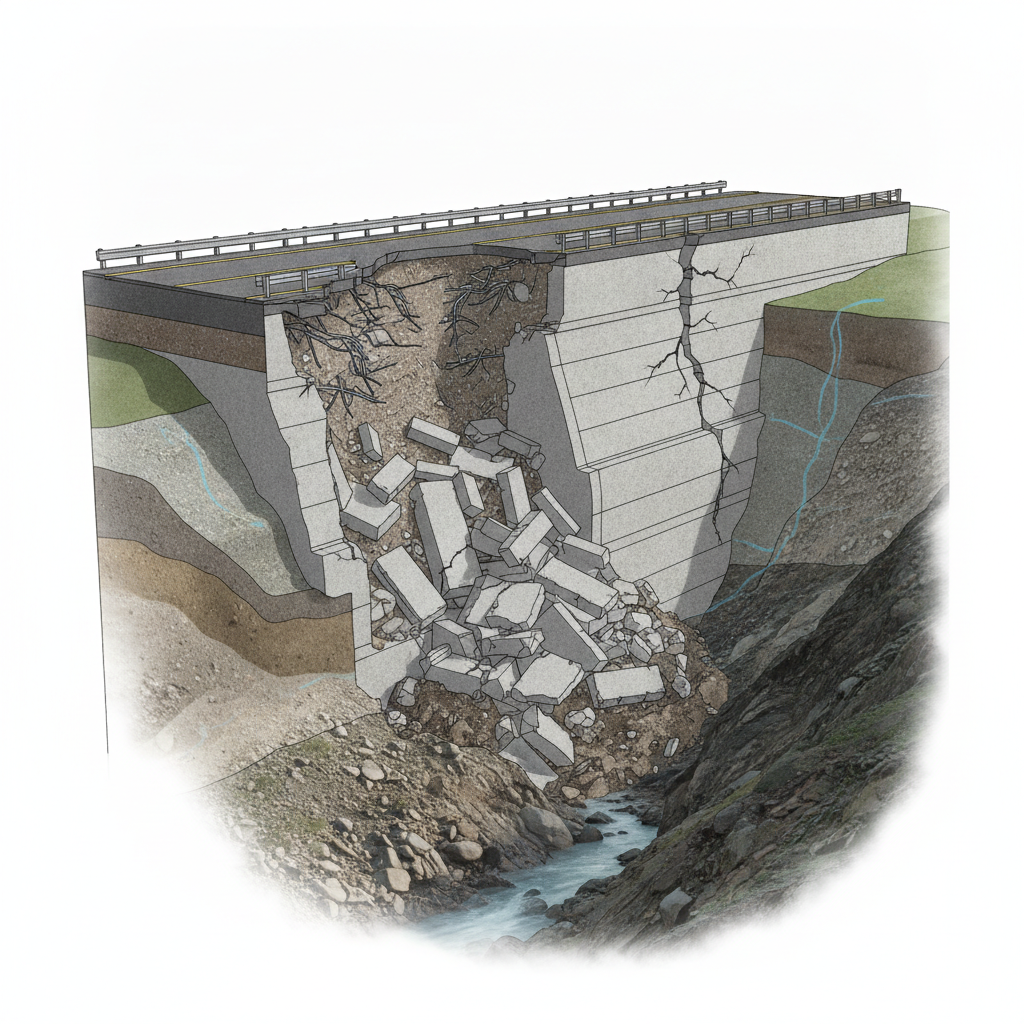
The Badrinath All-Weather Road Project, a flagship infrastructure initiative in Uttarakhand’s Himalayan region, has suffered structural failures within weeks of its construction, with a 15-metre segment of a retaining wall collapsing in the Kamedha area and significant cracks appearing in another segment near Pipalkoti. This incident underscores the critical challenges of executing large-scale infrastructure projects in ecologically fragile and seismically active zones, particularly in the context of increasing extreme weather events attributed to climate change.
Background
- The Badrinath Highway (National Highway 58) is a strategically vital route connecting the Char Dham pilgrimage sites, including Badrinath, and serves as a lifeline for Uttarakhand’s tourism and local economy.
- The All-Weather Road Project was launched under the Central Road and Infrastructure Fund (CRIF) to ensure year-round connectivity to the Badrinath Dham, mitigating the impact of seasonal landslides and snowfall.
- The project is executed by the National Highways and Infrastructure Development Corporation Limited (NHIDCL), a nodal agency under the Ministry of Road Transport and Highways (MoRTH).
- Uttarakhand lies in the Himalayan seismic zone (Zone IV and V), making it highly susceptible to landslides, soil erosion, and tectonic instability.
- The region has witnessed recurring disasters, including the 2013 Kedarnath floods and multiple landslides, highlighting the need for robust geotechnical assessments in infrastructure planning.
- Climate projections for the Himalayas indicate a rise in extreme precipitation events, further exacerbating the risk of slope instability and structural failures.
What is the Badrinath All-Weather Road Project?
- A centrally sponsored infrastructure initiative aimed at constructing a climate-resilient road network between Rishikesh and Badrinath, ensuring year-round connectivity despite adverse weather conditions.
- The project involves widening, strengthening, and stabilising the existing highway, including the construction of retaining walls, drainage systems, and slope protection measures.
- The total estimated cost of the project is approximately ₹12,000 crore, with multiple phases of construction underway under NHIDCL’s supervision.
- The project is part of the broader Char Dham Connectivity Programme, which includes the development of roads to Gangotri, Yamunotri, and Kedarnath, enhancing pilgrimage infrastructure.
- Geotechnical challenges in the Himalayas include steep gradients, fragile rock formations, high seismicity, and intense monsoon rainfall, all of which necessitate advanced engineering solutions.
- Retaining walls and slope stabilisation structures are critical components of the project, designed to prevent landslides and soil erosion, particularly in high-risk zones like Pipalkoti.
- The project incorporates modern techniques such as soil nailing, rock bolting, and geosynthetic reinforcements to enhance the stability of cut slopes and embankments.
- Despite these measures, the recent failures indicate gaps in site-specific risk assessment, construction quality control, and post-construction monitoring.
- The project also faces socio-environmental challenges, including land acquisition disputes, forest clearance delays, and the need for sustainable construction practices to minimise ecological damage.
Key Features
| Feature | Significance |
|---|---|
| All-Weather Road Project (Badrinath Highway) | A strategic infrastructure initiative to ensure year-round connectivity to the Badrinath Dham, a critical pilgrimage site and part of the Char Dham Yatra. |
| Safety Wall Construction | Designed to mitigate landslides and soil erosion in geologically sensitive zones along the highway, ensuring structural integrity and passenger safety. |
| Geological Vulnerability (Comeda & Belakuci Zones) | Identification of high-risk landslide-prone areas requiring immediate and sustained mitigation measures to prevent recurring failures. |
| Technical Failures in Construction | Premature collapse of retaining walls and cracks in newly constructed safety barriers, indicating flaws in design, materials, or execution. |
| Post-Monsoon Assessment | The need for rigorous post-monsoon evaluation of infrastructure projects in Himalayan regions to assess resilience against natural disasters. |
Why it Matters
Strategic Infrastructure
- Ensures uninterrupted pilgrimage access to Badrinath Dham, a site of religious and cultural significance in Uttarakhand.
- Facilitates regional connectivity, supporting tourism, trade, and emergency response logistics in the Himalayan belt.
- Part of the broader Char Dham Yatra project, which is a national priority under the Ministry of Road Transport and Highways.
Geological and Environmental Impact
- Highlights the fragility of Himalayan ecosystems and the risks posed by unplanned infrastructure development in ecologically sensitive zones.
- Underscores the necessity of integrating geological surveys and climate-resilient design in mountain road projects.
- Raises concerns about long-term environmental degradation due to construction-induced landslides.
Economic Implications
- Delays in project completion may lead to revenue losses from tourism and increased maintenance costs for the highway authority.
- Potential reduction in investor confidence in infrastructure projects in the Himalayas, impacting future development.
- Disruptions in pilgrimage activities can have socio-economic repercussions for local communities dependent on tourism.
Challenges
1. Geological Instability in Himalayan Regions
- Frequent landslides and soil erosion in the Himalayas are exacerbated by heavy rainfall, seismic activity, and unscientific construction practices.
- Lack of comprehensive geological and geotechnical studies prior to project initiation leads to structural failures.
- Climate change-induced extreme weather events further intensify the vulnerability of such infrastructure.
UPSC Link: GS Paper 1: Geophysical phenomena
2. Quality Control and Construction Oversight
- Premature failure of retaining walls and safety barriers indicates lapses in quality control during construction.
- Inadequate supervision by project authorities (NHIDCL) and contractors results in substandard materials and execution.
- Absence of real-time monitoring systems to assess structural integrity during and after construction.
UPSC Link: GS Paper 3: Infrastructure development
3. Environmental Degradation and Ecological Balance
- Unplanned blasting and excavation for road construction destabilize slopes, triggering landslides.
- Deforestation and soil disturbance in fragile ecosystems lead to biodiversity loss and long-term environmental damage.
- Violation of environmental norms and lack of adherence to the Environmental Impact Assessment (EIA) 2006 guidelines.
UPSC Link: GS Paper 3: Environmental conservation
4. Regulatory and Governance Gaps
- Inadequate enforcement of the National Green Tribunal (NGT) directives and environmental clearance conditions.
- Lack of coordination between central agencies (NHIDCL), state authorities, and local communities in project planning.
- Delayed post-monsoon assessments and reactive rather than proactive mitigation measures.
UPSC Link: GS Paper 2: Government policies and interventions
5. Socio-Economic Disruptions
- Failure of infrastructure projects disrupts local economies dependent on pilgrimage and tourism.
- Increased risk to pilgrims and commuters due to unsafe road conditions, leading to potential accidents and loss of life.
- Erosion of public trust in government-led infrastructure initiatives, impacting future project approvals.
UPSC Link: GS Paper 1: Social empowerment
Challenges — UPSC Perspective
| Issue | Concern |
|---|---|
| Premature structural failure | Indicates poor construction quality, inadequate materials, or flawed engineering design. |
| Geological instability | Himalayan terrain is inherently prone to landslides, requiring advanced mitigation strategies. |
| Climate change impact | Increased frequency of extreme weather events exacerbates infrastructure vulnerabilities. |
| Regulatory non-compliance | Violation of environmental norms and lack of adherence to EIA guidelines. |
| Governance gaps | Lack of coordination between agencies and delayed post-monsoon assessments. |
| Economic losses | Delays and failures result in financial burdens on the exchequer and local communities. |
Government Initiatives — Must-Memorise for Prelims
- Char Dham Mahamarg Vikas Pariyojana (CDMVP)
- National Highways Development Project (NHDP)
Way Forward
- Conduct comprehensive geological and geotechnical surveys before initiating any construction in Himalayan regions.
- Implement climate-resilient design standards, including reinforced retaining walls and drainage systems to mitigate landslides.
- Enforce strict quality control measures and third-party audits during construction and post-construction phases.
- Strengthen inter-agency coordination between NHIDCL, state authorities, and local communities for real-time monitoring.
- Adopt a proactive approach with regular post-monsoon assessments and preemptive maintenance to prevent failures.
- Ensure strict adherence to the Environmental Impact Assessment (EIA) 2006 guidelines and NGT directives.
- Invest in public awareness campaigns to educate pilgrims and commuters about safety protocols and hazard zones.
- Explore innovative technologies such as remote sensing and AI-driven risk prediction models for early detection of structural vulnerabilities.
UPSC Value Addition
Keywords for Mains Answer-Writing
All-Weather Road Project · Badrinath Highway · Geological fragility of Himalayas · National Highways and Infrastructure Development Corporation Limited (NHIDCL) · Landslide vulnerability zones · Himalayan ecosystem · Himalayan ecology and climate change · Geotechnical stability · Environmental Impact Assessment (EIA) · Himalayan road infrastructure · Disaster resilience in infrastructure · Himalayan state development
Constitutional & Policy Linkages
- Article 21 (Right to Life and Personal Liberty) – Ensuring safe infrastructure for pilgrims and commuters.
Concept Flow
Geological fragility of Himalayan terrain → Unscientific construction practices → Structural failures in retaining walls → Landslides and soil erosion → Disruptions in pilgrimage and tourism → Socio-economic losses and public distrust → Need for climate-resilient infrastructure and stricter regulatory oversight.
Prelims Practice Questions
Q1. Consider the following statements regarding the All-Weather Road Project in Uttarakhand:
1. The project aims to provide year-round connectivity to the Badrinath Dham.
2. The National Highways and Infrastructure Development Corporation Limited (NHIDCL) is the implementing agency.
3. The project is located entirely within the state of Himachal Pradesh.
4. The project has been designed to withstand extreme weather events including heavy rainfall.
How many of the above statements are correct?
- Only one
- Only two
- Only three
- All
Answer: Only three — Statements 1 and 2 are correct. Statement 3 is incorrect as the project is located in Uttarakhand. Statement 4 is incorrect as the recent collapse of retaining walls indicates inadequate design for extreme weather.
Q2. Assertion (A): The Himalayas are highly susceptible to landslides due to their geological youth and fragile ecosystem.
Reason (R): The Himalayas are still tectonically active, and their slopes are composed of young, unconsolidated sediments.
In the context of the above statements, which of the following is correct?
- Both A and R are true, and R is the correct explanation of A
- Both A and R are true, but R is not the correct explanation of A
- A is true, but R is false
- A is false, but R is true
Answer: Both A and R are true, and R is the correct explanation of A — Both the assertion and reason are true. The Himalayas are geologically young and tectonically active, making them highly susceptible to landslides. The reason correctly explains the assertion.
Q3. Match the following pairs with respect to the Himalayan region and its challenges:
Column I
A. Landslide vulnerability zones
B. All-Weather Road Project
C. Geological fragility
D. NHIDCL
Column II
1. Implementing agency for road infrastructure
2. Areas prone to slope failure
3. Tectonically active mountain range
4. Year-round connectivity initiative
- A-2, B-4, C-3, D-1
- A-1, B-3, C-2, D-4
- A-3, B-2, C-4, D-1
- A-4, B-1, C-2, D-3
Answer: A-2, B-4, C-3, D-1 — A-2 (Landslide vulnerability zones are areas prone to slope failure), B-4 (All-Weather Road Project aims for year-round connectivity), C-3 (Himalayas are a tectonically active mountain range), D-1 (NHIDCL is the implementing agency for road infrastructure).
Mains Practice Question
✍ The recent collapse of retaining walls and damage to the All-Weather Road Project on the Badrinath Highway underscores the persistent challenge of ensuring geotechnical stability in Himalayan infrastructure. Critically examine the factors responsible for such failures and suggest measures to enhance the resilience of road infrastructure in ecologically fragile Himalayan regions. (15 Marks)
Approach: MODEL-ANSWER SKELETON:
1. **Introduction (2 marks)**: Briefly introduce the All-Weather Road Project and its significance for pilgrimage and regional connectivity. State the recent failures (e.g., collapse of retaining walls in Chamoli district) as a case study.
2. **Factors Responsible for Failures (6 marks)**:
– **Geological Factors**: Tectonic activity, young and unconsolidated sediments, steep slopes, and high seismicity in the Himalayas.
– **Hydrological Factors**: Heavy monsoon rainfall leading to soil saturation, erosion, and slope instability.
– **Engineering Challenges**: Inadequate geotechnical investigations, improper design of retaining structures, and lack of consideration for extreme weather events.
– **Environmental Degradation**: Deforestation, unregulated construction, and climate change-induced glacial melt and permafrost thaw.
– **Regulatory Gaps**: Weak enforcement of Environmental Impact Assessment (EIA) norms, lack of post-construction monitoring, and inadequate disaster risk reduction measures.
3. **Measures to Enhance Resilience (5 marks)**:
– **Improved Geotechnical Investigations**: Conduct detailed slope stability analyses, use advanced technologies (e.g., LiDAR, remote sensing) for terrain mapping, and incorporate climate projections.
– **Robust Engineering Design**: Adopt flexible and adaptive engineering solutions (e.g., anchored retaining walls, gabion structures, bioengineering techniques) tailored to local conditions.
– **Regulatory Reforms**: Strengthen EIA norms, enforce compliance with construction guidelines, and integrate disaster risk reduction into infrastructure planning.
– **Ecosystem-Based Approaches**: Promote afforestation, slope stabilization through vegetation, and avoid construction in high-risk zones.
– **Community Engagement**: Involve local communities in monitoring and maintenance, and incorporate traditional knowledge of hazard mitigation.
4. **Conclusion (2 marks)**: Emphasize the need for a multi-disciplinary, sustainable, and adaptive approach to Himalayan infrastructure development. Highlight the role of NHIDCL, state agencies, and central ministries in ensuring long-term resilience.
Source: amarujala.com
Generated by AanyaAi for educational purpose.

- Gujarat HC orders FIR in ITS officer’s 2023 custodial death - October 3, 2026
- डीआरआई ने मुंबई एयरपोर्ट पर सोने-हीरे की तस्करी गिरोह का किया पर्दाफाश, 8 गिरफ्तार - October 3, 2026
- Chhattisgarh CM Rural Bus Scheme: 850 Villages Connected in 1 Year - October 3, 2026

No Comments