


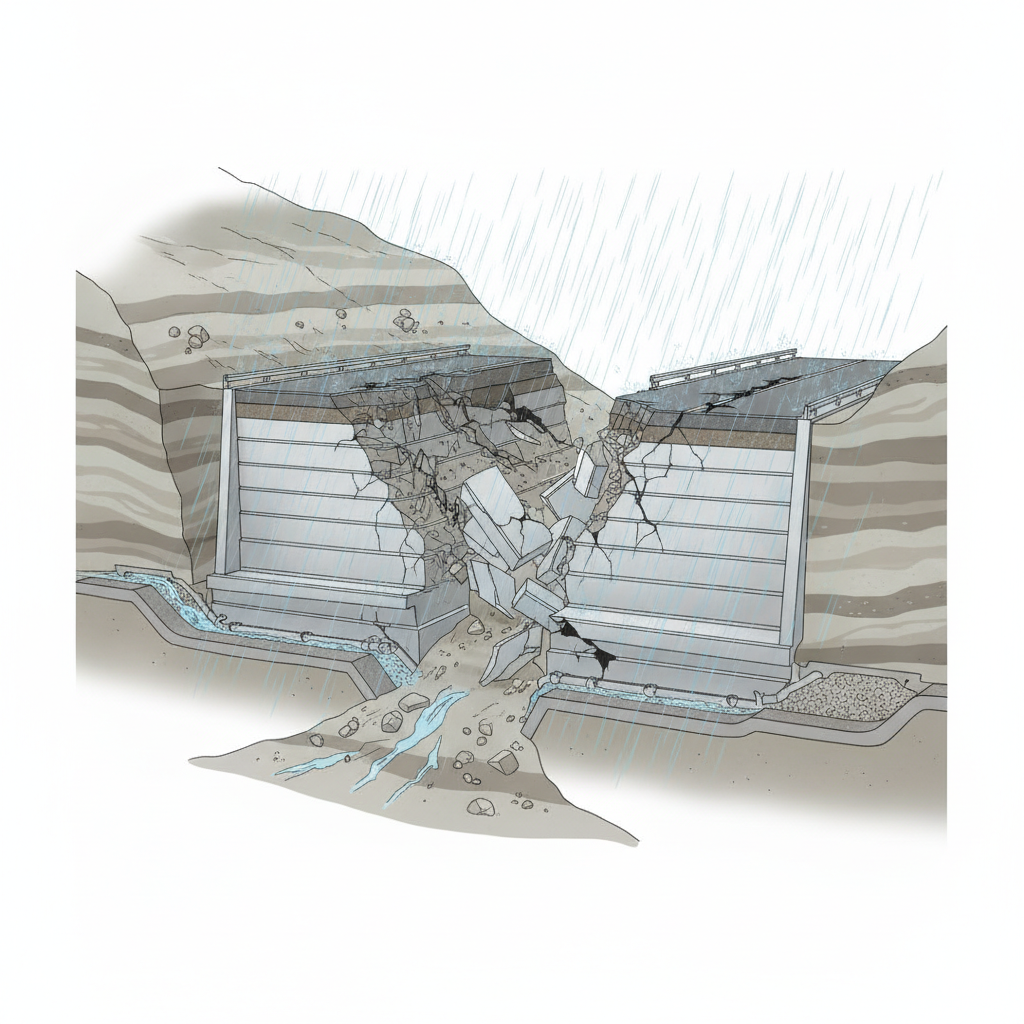
08 Aug Badrinath Highway: All-Weather Road Project Fails Monsoon Test in First Rain
Highway segmentSafety wallMonsoon spell✎ The structural failure of the Badrinath Highway retaining wall underscores the critical importance of geotechnical stability assessments and long-term maintenance in Himalayan road projects, where even minor design flaws can lead…
Subject Relevance — Where This Topic Fits
- GS Paper II — Governance, Transparency and Accountability in Infrastructure Projects | GS Paper III — Infrastructure: Roads and Disaster Management | GS Paper III — Environmental Conservation and Himalayan Ecology
- Prelims: All-Weather Road Project, NHIDCL, Landslide-prone zones, Retaining walls, Geotechnical stability, Himalayan ecology, Disaster resilience, Erosion control measures
- Essay: Infrastructure Development vs. Environmental Sustainability: The Case of Himalayan Highways, Balancing Economic Growth and Ecological Preservation in Fragile Ecosystems
Quick Revision: The structural failure of the Badrinath Highway retaining wall underscores the critical importance of geotechnical stability assessments and long-term maintenance in Himalayan road projects, where even minor design flaws can lead to catastrophic consequences during the first monsoon season.
Why is this in the news?
The Badrinath Highway segment of the All-Weather Road Project has experienced structural failures within months of completion, with significant cracks appearing in another section near Belakuchi. These failures, occurring after the first monsoon spell, underscore critical deficiencies in geotechnical assessment, construction quality, and long-term resilience of Himalayan road infrastructure, raising concerns about the project’s sustainability and the efficacy of disaster mitigation measures.
Background
- The Badrinath Highway is part of the Char Dham All-Weather Road Project, a centrally sponsored initiative aimed at providing year-round connectivity to the four pilgrimage sites in Uttarakhand: Badrinath, Kedarnath, Gangotri, and Yamunotri.
- The project is executed by the National Highways and Infrastructure Development Corporation Limited (NHIDCL), a public sector undertaking under the Ministry of Road Transport and Highways.
- The Himalayan region is inherently prone to landslides, soil erosion, and seismic activity due to its fragile geological structure, steep slopes, and heavy monsoon rainfall.
- All-Weather Road Projects in the Himalayas are designed to overcome seasonal disruptions caused by snow, landslides, and floods, necessitating robust engineering solutions such as retaining walls, tunnels, and slope stabilisation techniques.
- Past incidents, including the 2013 Kedarnath floods and recurrent landslides in Uttarakhand, have highlighted the region’s vulnerability to extreme weather events and the need for disaster-resilient infrastructure.
- The project has faced criticism for inadequate environmental impact assessments, hasty construction schedules, and insufficient consideration of local geological conditions.
What is the All-Weather Road Project in the Himalayas?
- The All-Weather Road Project is a flagship initiative under the Ministry of Road Transport and Highways, aimed at ensuring year-round accessibility to key pilgrimage sites and strategic border areas in the Himalayas.
- The project encompasses the development of four major highways: Badrinath, Kedarnath, Gangotri, and Yamunotri, with a total estimated cost of over ₹12,000 crore.
- The primary objective is to eliminate seasonal disruptions caused by snow, landslides, and floods, thereby enhancing connectivity for pilgrims, local communities, and defence logistics.
- Key engineering interventions include the construction of tunnels, retaining walls, slope stabilisation measures, and drainage systems to mitigate landslide risks.
- The project is implemented by NHIDCL in collaboration with state agencies and private contractors, with a focus on modern construction techniques and materials.
- The Himalayan terrain presents unique challenges, including high seismic zones, fragile rock formations, and unpredictable weather patterns, necessitating specialised geotechnical assessments.
- The project has been marred by delays, cost overruns, and environmental concerns, with critics arguing that the rush to complete the project has compromised safety and sustainability.
- Recent failures in the Badrinath Highway segment highlight the need for rigorous post-construction monitoring, regular maintenance, and adaptive management strategies to address evolving geotechnical risks.
Key Features
| Feature | Significance |
|---|---|
| All-Weather Road Project under Badrinath Highway | Aims to provide year-round connectivity to the Char Dham pilgrimage route, enhancing accessibility and socio-economic integration of remote Himalayan regions. |
| Geotechnical interventions (retaining walls, anchoring) | Critical for stabilising landslide-prone slopes and preventing debris flow into the highway corridor, ensuring structural integrity. |
| Construction quality and durability | Directly impacts the safety of pilgrims, local residents, and logistics transport, particularly during monsoon seasons. |
| Monitoring and maintenance protocols | Essential for assessing structural health post-construction and mitigating risks from dynamic geological conditions. |
| Role of National Highways & Infrastructure Development Corporation Limited (NHIDCL) | Executing agency responsible for technical oversight, quality control, and post-disaster restoration of critical infrastructure. |
Why it Matters
Strategic Connectivity
- Ensures uninterrupted access to Badrinath Dham, a key pilgrimage site, during adverse weather conditions, reducing socio-economic disruptions.
Economic Integration
- Facilitates year-round movement of goods and services, boosting local economies in Uttarakhand’s hinterland.
Disaster Resilience
- Strengthens infrastructure resilience in ecologically fragile Himalayan terrain, a critical need given increasing climate variability.
Pilgrimage Safety
- Reduces risks to devotees and infrastructure from landslides, rockfalls, and debris flows during monsoon periods.
Challenges
1. Geological Instability
- Himalayan terrain is inherently unstable due to tectonic activity, steep slopes, and high precipitation, making large-scale construction inherently risky.
UPSC Link: Geological Survey of India (GSI) landslide mapping
2. Construction Quality Deficiencies
- Premature failure of retaining walls and geotechnical structures indicates lapses in design, material selection, or execution standards.
UPSC Link: National Building Code (NBC) 2016
3. Climate Change Amplification
- Increased frequency and intensity of extreme weather events (e.g., cloudbursts, prolonged rainfall) exacerbate slope instability and erosion.
UPSC Link: IPCC AR6 Report on Himalayan Climate
4. Regulatory and Oversight Gaps
- Inadequate pre-construction geological surveys, weak enforcement of environmental safeguards, and delayed post-construction monitoring.
UPSC Link: Environment Impact Assessment (EIA) 2006
5. Maintenance and Upkeep Challenges
- High operational costs and logistical difficulties in accessing remote sites for routine inspections and repairs.
UPSC Link: National Disaster Management Authority (NDMA) guidelines
Challenges — UPSC Perspective
| Issue | Concern |
|---|---|
| Premature structural failure | Failure of retaining walls within months of construction raises questions about engineering standards and material durability. |
| Active landslide zones | Regions like Kedar and Belakuchi remain geologically active, requiring dynamic risk assessment rather than static solutions. |
| Climate-induced risks | Monsoon intensity and glacial meltwater exacerbate slope instability, necessitating adaptive engineering designs. |
| Contractor accountability | Lack of clear liability frameworks for post-construction failures delays corrective actions and erodes public trust. |
| Ecological fragility | Large-scale construction in fragile ecosystems risks biodiversity loss and long-term environmental degradation. |
Government Initiatives — Must-Memorise for Prelims
- Char Dham Mahamarg Vikas Pariyojana (CDMVP)
- A centrally sponsored scheme for all-weather road connectivity to Char Dham pilgrimage sites, including Badrinath.
Way Forward
- Conduct detailed geological and geotechnical surveys prior to construction, incorporating real-time monitoring systems for slope stability.
- Enforce mandatory third-party quality audits during all phases of construction, with penalties for non-compliance.
- Adopt climate-resilient engineering designs, including flexible retaining structures and drainage systems to handle extreme precipitation.
- Establish a dedicated maintenance fund and rapid-response teams for post-monsoon structural assessments and repairs.
- Strengthen inter-agency coordination between NHIDCL, GSI, NDMA, and state agencies for integrated risk management.
- Integrate traditional knowledge of local communities in stabilisation techniques, particularly in ecologically sensitive zones.
- Implement a public dashboard for real-time monitoring of construction quality and structural health of critical infrastructure.
UPSC Value Addition
Keywords for Mains Answer-Writing
Badrinath Dham All-Weather Road Project · National Highways Authority of India (NHAI) · Geotechnical stability in Himalayan regions · Landslide mitigation measures · Himalayan ecology and infrastructure · Environmental Impact Assessment (EIA) for road projects · Slope stability techniques · Disaster resilience in infrastructure · Geological Survey of India (GSI) · National Disaster Management Authority (NDMA) · Himalayan ecosystem fragility · Sustainable infrastructure development · Geohazard assessment · Engineering ethics in public projects
Concept Flow
Geological instability in Himalayan terrain → Inadequate pre-construction surveys → Poor design/material selection → Premature structural failure → Increased landslide risk → Disruption of pilgrimage routes and local economies → Need for adaptive engineering and real-time monitoring
Prelims Practice Questions
Q1. Consider the following statements regarding the Badrinath Dham All-Weather Road Project:
1. The project is being executed by the National Highways and Infrastructure Development Corporation Limited (NHIDCL).
2. The project aims to provide all-weather connectivity to the Badrinath Dham in Uttarakhand.
3. The project has faced challenges due to landslides and geological instability in the Himalayan region.
4. The project is exempt from Environmental Impact Assessment (EIA) requirements under the EIA Notification 2006.
How many of the above statements are correct?
- Only one
- Only two
- Only three
- All
Answer: Only three — Statements 1, 2, and 3 are correct. Statement 4 is incorrect as the project is not exempt from EIA requirements; it must comply with environmental regulations.
Q2. Assertion (A): The Badrinath Dham All-Weather Road Project has faced failures in geotechnical stability during the first monsoon season.
Reason (R): The project was executed without adequate geological surveys and slope stability assessments in the fragile Himalayan terrain.
Options:
A. Both A and R are true, and R is the correct explanation of A.
B. Both A and R are true, but R is NOT the correct explanation of A.
C. A is true but R is false.
D. A is false but R is true.
Answer: ? — Both A and R are true, and R correctly explains A. The failure of the project to withstand the first monsoon season is directly linked to inadequate geological and geotechnical assessments in the Himalayan region.
Q3. Match the following columns related to infrastructure projects in the Himalayas:
Column I (Project/Initiative) | Column II (Executing Agency)
1. Badrinath Dham All-Weather Road Project | A. National Highways Authority of India (NHAI)
2. Char Dham Project | B. National Highways and Infrastructure Development Corporation Limited (NHIDCL)
3. Atal Tunnel | C. Border Roads Organisation (BRO)
4. Zojila Tunnel | D. Ministry of Road Transport and Highways (MoRTH)
Options:
A. 1-B, 2-D, 3-C, 4-A
B. 1-B, 2-A, 3-D, 4-C
C. 1-A, 2-B, 3-C, 4-D
D. 1-C, 2-D, 3-A, 4-B
Answer: ? — 1-B (NHIDCL executes the Badrinath Dham All-Weather Road Project), 2-A (NHAI is the executing agency for the Char Dham Project), 3-D (MoRTH is responsible for the Atal Tunnel), 4-C (BRO executes the Zojila Tunnel project).
Mains Practice Question
✍ The failure of the Badrinath Dham All-Weather Road Project to withstand even a single monsoon season underscores systemic deficiencies in geotechnical planning, environmental governance, and institutional accountability in Himalayan infrastructure projects. Critically examine the challenges in ensuring geotechnical stability and disaster resilience in such projects, with reference to the Himalayan ecosystem’s fragility and the role of statutory bodies like the Geological Survey of India (GSI) and the National Disaster Management Authority (NDMA). (15 Marks)
Approach: MODEL-ANSWER SKELETON:
1. **Introduction (2 marks)**
– Briefly introduce the Badrinath Dham All-Weather Road Project and its significance for pilgrimage and regional connectivity.
– State the observed failure (e.g., collapse of retaining walls, landslides) and its immediate impact on infrastructure and public safety.
2. **Geotechnical and Geological Challenges (4 marks)**
– Explain the Himalayan ecosystem’s fragility: young, tectonically active mountains, high seismic activity, and heavy monsoon rainfall.
– Discuss the role of the Geological Survey of India (GSI) in conducting geological surveys and hazard zonation mapping.
– Highlight the need for comprehensive geotechnical investigations (e.g., slope stability analysis, soil testing) before project execution.
3. **Environmental and Regulatory Governance (4 marks)**
– Examine the Environmental Impact Assessment (EIA) process for road projects in ecologically sensitive zones.
– Discuss the role of the National Green Tribunal (NGT) and compliance with the EIA Notification 2006.
– Critique the adequacy of environmental clearances and post-clearance monitoring mechanisms.
4. **Institutional Accountability and Disaster Resilience (3 marks)**
– Analyze the role of the National Disaster Management Authority (NDMA) in disaster risk reduction and preparedness.
– Discuss the need for integrating disaster resilience into project design (e.g., use of gabion walls, drainage systems, and bioengineering techniques).
– Critically assess the accountability of executing agencies (e.g., NHIDCL) and the lack of penalties for non-compliance with safety standards.
5. **Way Forward (2 marks)**
– Propose measures for improving geotechnical stability: mandatory third-party audits, real-time monitoring systems, and use of advanced technologies (e.g., LiDAR, remote sensing).
– Emphasize the need for a multi-stakeholder approach involving local communities, scientists, and policymakers to ensure sustainable infrastructure development.
Balance of views:
– Acknowledge the economic and strategic importance of such projects.
– Critique the trade-offs between rapid infrastructure development and environmental sustainability.
Source: amarujala.com
Generated by AanyaAi for educational purpose.

- KWML’s Feasibility Reports for Water Metro in 18 Cities: UPSC & PCS Insights - October 3, 2026
- ओडिशा में वन्यजीव अनुसंधान अनुदान कार्यक्रम शुरू, सिमिलिपाल में 300 कैमरे और बढ़ेंगे - October 3, 2026
- India Summons Pakistan High Commission Official Over Violation - October 3, 2026

No Comments