


05 Aug Bankers’ Books Evidence Bill 2026: Key Amendments for UPSC & State PCS
✎ The Bankers’ Books Evidence Bill, 2026 seeks to modernise evidence laws for digital banking, while the Supreme Court (Number of Judges) Amendment Bill, 2026 aims to amend judicial capacity to address case pendency.
Subject Relevance — Where This Topic Fits
- GS Paper II — Parliament and State Legislatures — Structure, Functioning, Conduct of Business, Powers & Privileges and Issues Arising out of these | GS Paper III — Indian Economy and Issues Relating to Planning, Mobilisation of Resources, Growth, Development and Employment — Banking Sector Reforms | GS Paper III — Challenges to Internal Security through Communication Networks — Legal Framework for Financial Data
- Prelims: Bankers’ Books Evidence Act, 1891, Supreme Court (Number of Judges) Act, 1956, Payment and Settlement Systems Act, 2007, Anti-Defection Law (Tenth Schedule), Adjournment Motion, Jantar Mantar protests
- Essay: Judicial Reforms and Constitutional Governance: Balancing Efficiency and Accountability, The Role of Parliament in Ensuring Financial Transparency and Judicial Efficiency
Quick Revision: The Bankers’ Books Evidence Bill, 2026 seeks to modernise evidence laws for digital banking, while the Supreme Court (Number of Judges) Amendment Bill, 2026 aims to amend judicial capacity to address case pendency.
Why is this in the news?
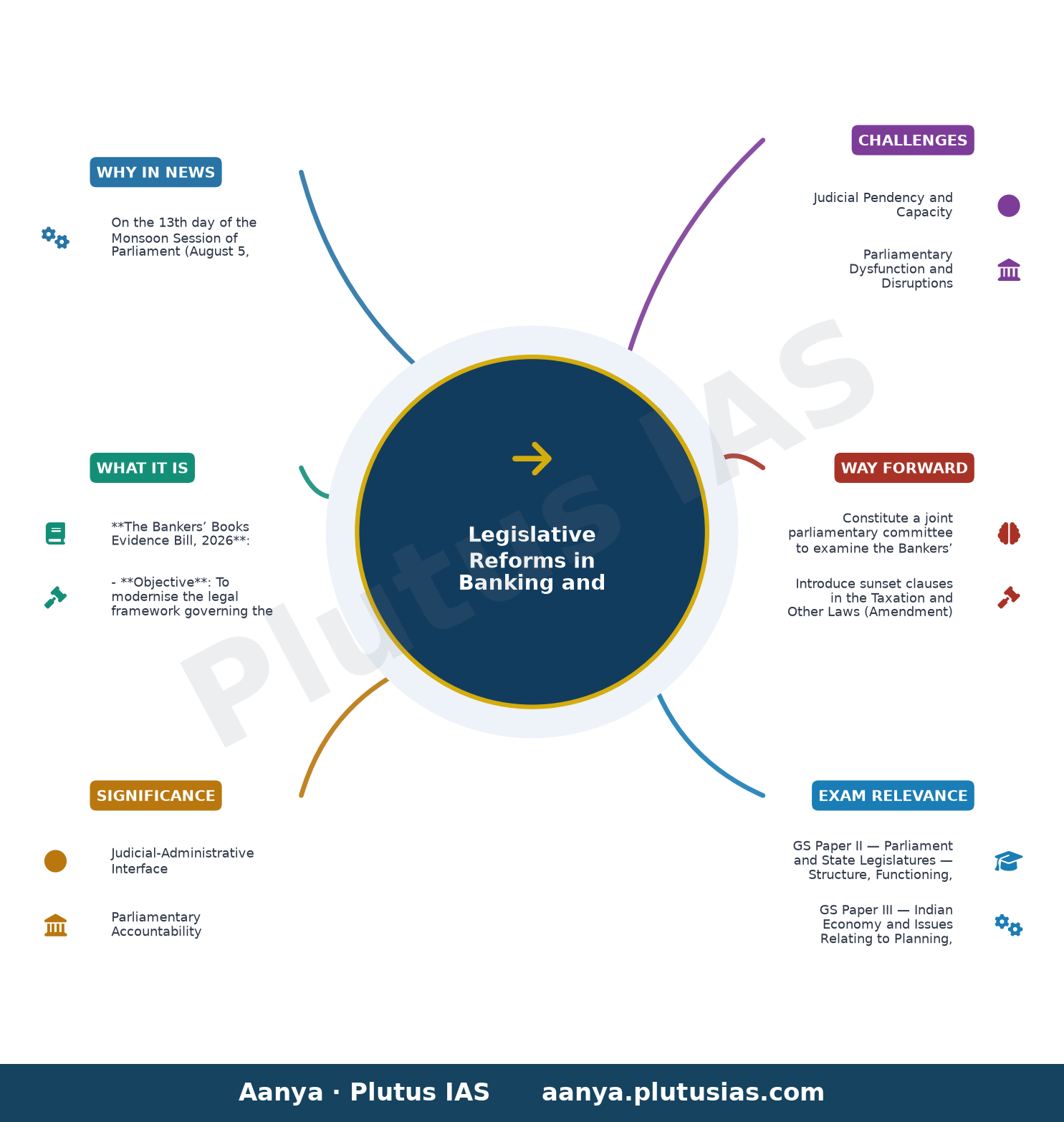
On the 13th day of the Monsoon Session of Parliament (August 5, 2026), the Lok Sabha is scheduled to consider and pass The Bankers’ Books Evidence Bill, 2026 and The Taxation and Other Laws (Amendment) Bill, 2026, while the Rajya Sabha will take up the Supreme Court (Number Of Judges) Amendment Bill, 2026. These bills reflect ongoing efforts to align legal frameworks with contemporary digital banking practices and judicial workload demands, while also highlighting parliamentary processes such as adjournment motions and the legislative agenda during the Monsoon Session.
Background
- The Bankers’ Books Evidence Act, 1891, currently governs the admissibility of bank records as evidence in Indian courts, a framework that predates the digital transformation of banking and lacks provisions for electronic records and digital signatures.
- The Payment and Settlement Systems Act, 2007, regulates payment systems in India, including digital transactions, and has been amended periodically to address evolving financial technologies and risks such as fraud and cybercrime.
- Parliamentary sessions, including the Monsoon Session, are critical for legislative business, with both Houses required to transact pending bills before the session concludes.
- Adjournment motions are parliamentary tools used by Opposition MPs to draw attention to urgent public issues, such as the proposed anti-defection law and allegations of police excesses during protests at Jantar Mantar.
Key Features of The Bankers’ Books Evidence Bill, 2026 and The Supreme Court (Number of Judges) Amendment Bill, 2026
- **The Bankers’ Books Evidence Bill, 2026**:
- – **Objective**: To modernise the legal framework governing the admissibility of bank records as evidence in courts by incorporating provisions for digital records, electronic signatures, and electronic communication.
- – **Scope**: Applies to all banks operating in India, including scheduled commercial banks, cooperative banks, and payments banks, ensuring uniformity in evidence rules.
- – **Digital Integration**: Recognises electronic bank statements, transaction logs, and digital signatures as valid evidence, aligning with the Information Technology Act, 2000, and Reserve Bank of India (RBI) guidelines.
- – **Procedural Safeguards**: Introduces mechanisms for the authentication of digital records, including blockchain-based verification and cryptographic signatures, to prevent tampering and ensure chain of custody.
- – **Legal Recognition**: Empowers courts to issue summons or orders for the production of digital bank records, with provisions for penalties for non-compliance or obstruction.
- – **Interoperability**: Facilitates seamless sharing of bank records between financial institutions, regulatory bodies (e.g., RBI, SEBI), and law enforcement agencies for investigative purposes.
- **The Supreme Court (Number of Judges) Amendment Bill, 2026**:
- – **Objective**: To amend the Supreme Court (Number of Judges) Act, 1956, to amend the number of Judges in Supreme Court for consideration.
- – **Rationale**: The increase is justified by the growing complexity of cases, including those involving constitutional interpretation, environmental law, and digital rights, which require specialised judicial expertise.
- – **Constitutional Provision**: The amendment aligns with Article 124(1) of the Constitution, which empowers Parliament to determine the number of judges in the Supreme Court, subject to the President’s assent.
Key Features
| Feature | Significance |
|---|---|
| Bankers’ Books Evidence Bill, 2026 | Modernises the legal framework for admissibility of bank records as evidence, aligning with digital banking practices and reducing procedural delays in financial litigation. |
| Taxation and Other Laws (Amendment) Bill, 2026 | Introduces amendments to streamline tax administration and payment systems, enhancing compliance and reducing ambiguities in the Income-tax Act, 2025. |
| Supreme Court (Number of Judges) Amendment Bill, 2026 | Proposes adjustments to the sanctioned strength of Supreme Court judges, potentially impacting judicial capacity and case disposal rates. |
| Adjournment Motions on Anti-Defection Law | Highlights parliamentary demand for reform in defection laws to balance party discipline with intra-party dissent and ideological coherence. |
| Adjournment Motion on Police Excesses | Raises critical concerns regarding law enforcement conduct during protests, underscoring the need for accountability in public order management. |
Why it Matters
Judicial-Administrative Interface
- Facilitates swifter judicial proceedings by simplifying evidence admissibility from bank records, reducing backlog in financial crimes and economic offences.
- Enhances transparency in tax administration through targeted amendments, potentially improving ease of doing business and investor confidence.
- Adjustments to Supreme Court judge strength may influence judicial pendency and the pace of constitutional adjudication.
Parliamentary Accountability
- Adjournment motions reflect heightened scrutiny of executive actions, particularly in areas of democratic accountability and civil liberties.
- Debates on anti-defection laws underscore the tension between party discipline and individual conscience, a recurring theme in India’s parliamentary democracy.
Economic Governance
- Streamlined financial evidence laws can deter financial fraud and money laundering by expediting legal processes.
- Taxation amendments may address gaps in digital payment ecosystems, aligning with India’s push for a cashless economy.
Challenges
1. Judicial Pendency and Capacity
- Increased sanctioned strength of Supreme Court judges may not proportionally reduce pendency without concurrent reforms in case management.
- Digital evidence from bank records, while expediting trials, risks admissibility challenges if authentication protocols are not robust.
UPSC Link: Judicial Pendency (Article 21, Article 32)
2. Parliamentary Dysfunction and Disruptions
- Frequent adjournment motions and disruptions impede legislative productivity, delaying critical reforms.
- Opposition’s focus on anti-defection and police excesses may overshadow economic governance priorities in parliamentary discourse.
UPSC Link: Parliamentary Procedures (Article 105, Article 118)
3. Taxation Ambiguities and Compliance
- Amendments to tax laws may introduce transitional complexities, particularly for digital payment systems and cross-border transactions.
- Risk of ambiguity in new provisions leading to litigation, undermining the goal of simplifying tax administration.
UPSC Link: Taxation Reforms (Article 265, Article 286)
4. Police Conduct and Civil Liberties
- Allegations of excessive force during protests highlight the need for clear guidelines on crowd control and use of force.
- Potential for erosion of public trust in law enforcement if accountability mechanisms remain weak.
UPSC Link: Fundamental Rights (Article 19, Article 21)
5. Defection and Intra-Party Democracy
- Current anti-defection laws (Tenth Schedule) are criticised for stifling dissent and encouraging opportunistic politics.
- Lack of consensus on reforming defection laws risks perpetuating instability in legislatures.
UPSC Link: Anti-Defection Law (Tenth Schedule)
Challenges — UPSC Perspective
| Issue | Concern |
|---|---|
| Digital Evidence Authentication | Risk of forged or manipulated bank records entering legal proceedings due to inadequate digital forensics infrastructure. |
| Parliamentary Disruptions | Frequent adjournments and protests in Parliament reduce time for legislative scrutiny and debate. |
| Taxation Transitional Gaps | Amendments may create compliance burdens for businesses during the transition period, particularly in digital payment ecosystems. |
| Police Accountability | Absence of independent oversight mechanisms for protest-related police actions may lead to unchecked excesses. |
| Defection and Dissent | Overly rigid anti-defection laws may suppress legitimate intra-party dissent, undermining democratic debate. |
Way Forward
- Constitute a joint parliamentary committee to examine the Bankers’ Books Evidence Bill, 2026, with technical inputs from RBI and SEBI to ensure robust digital evidence protocols.
- Introduce sunset clauses in the Taxation and Other Laws (Amendment) Bill, 2026 to review amendments after 12 months for efficacy and unintended consequences.
- Enhance the Supreme Court’s case management system to utilise additional judges effectively, including digital case tracking and prioritisation frameworks.
- Establish an independent oversight body to investigate allegations of police excesses during protests, with powers to recommend disciplinary action.
- Reform the Tenth Schedule to allow dissent within parties on issues of conscience or policy, while maintaining party discipline on votes of confidence.
- Strengthen digital forensics infrastructure in courts and law enforcement agencies to authenticate electronic bank records reliably.
- Encourage pre-legislative consultations for all financial and taxation bills to minimise transitional disruptions and improve stakeholder buy-in.
- Publish annual parliamentary productivity reports to track bill passage rates and adjournment motion trends, fostering transparency.
UPSC Value Addition
Keywords for Mains Answer-Writing
Bankers’ Books Evidence Act, 1891 · Section 2A of the Bankers’ Books Evidence Act · Digital banking practices and legal evidence · Taxation and Other Laws (Amendment) Bill, 2026 · Payment and Settlement Systems Act, 2007 · Anti-defection law · Tenth Schedule of the Constitution · Constitutional morality · Supreme Court (Number of Judges) Amendment Bill, 2026 · Collegium system · Judicial appointments · Adjournment motions in Parliament · Parliamentary accountability · Judicial review of legislative actions
Constitutional & Policy Linkages
- Article 14 (Equality before Law)
- Article 19(1)(a) (Freedom of Speech)
- Article 21 (Right to Life and Personal Liberty)
- Article 105 (Parliamentary Privileges)
- Article 118 (Rules of Procedure)
Concept Flow
Parliamentary scrutiny of financial evidence laws → Modernisation of Bankers’ Books Evidence Act → Faster adjudication of financial crimes → Enhanced investor confidence → Economic growth → Adjournment motions on police excesses → Scrutiny of law enforcement conduct → Demand for accountability mechanisms → Strengthening of civil liberties → Democratic resilience → Adjournment motions on anti-defection law → Parliamentary debate on party discipline vs dissent → Potential reform of Tenth Schedule → Balancing stability and democracy → Strengthening legislative ethics → Introduction of Taxation and Other Laws (Amendment) Bill → Streamlining of tax administration → Reduction in litigation → Improved compliance → Revenue optimisation → Supreme Court (Number of Judges) Amendment Bill → Adjustment of sanctioned strength → Potential impact on judicial pendency → Faster constitutional adjudication → Strengthening rule of law
Prelims Practice Questions
Q1. Consider the following statements regarding the Bankers’ Books Evidence Bill, 2026:
1. The Bill seeks to amend the Bankers’ Books Evidence Act, 1891.
2. It aims to align the Act with contemporary digital banking practices.
3. The Bill proposes to introduce Section 2A to facilitate the use of bank records as evidence in legal proceedings.
4. The Bill is intended to replace the Reserve Bank of India Act, 1934.
How many of the above statements are correct?
- Only one
- Only two
- Only three
- All four
Answer: Only three — Statements 1, 2, and 3 are correct as they directly relate to the objectives and provisions of the Bankers’ Books Evidence Bill, 2026. Statement 4 is incorrect as the Bill does not seek to replace the RBI Act, 1934.
Q2. Assertion (A): The Tenth Schedule of the Constitution of India, also known as the Anti-Defection Law, allows for the disqualification of legislators on the grounds of voluntarily giving up membership of a political party.
Reason (R): The Tenth Schedule was inserted by the Constitution (Fifty-Second Amendment) Act, 1985, to curb political defections and promote party discipline.
In the context of the above two statements, which one of the following is correct?
- Both A and R are true, and R is the correct explanation of A.
- Both A and R are true, but R is NOT the correct explanation of A.
- A is true, but R is false.
- A is false, but R is true.
Answer: Both A and R are true, and R is the correct explanation of A. — Both the Assertion (A) and Reason (R) are correct. The Tenth Schedule indeed allows for disqualification on the grounds of voluntarily giving up membership of a political party, and it was inserted by the Constitution (Fifty-Second Amendment) Act, 1985, to curb defections. The Reason (R) correctly explains the Assertion (A).
Q3. Which of the following amendments is proposed by the Supreme Court (Number of Judges) Amendment Bill, 2026?
A. Increase in the number of judges in the Supreme Court from 34 to 35.
B. Increase in the number of judges in the Supreme Court from 34 to 36.
C. Increase in the number of judges in the Supreme Court from 34 to 37.
D. Increase in the number of judges in the Supreme Court from 34 to 38.
- A
- B
- C
- D
Answer: A — The Supreme Court (Number of Judges) Amendment Bill, 2026 proposes to increase the number of judges in the Supreme Court from 34 to 35. This is based on the constitutional provision under Article 124(1) of the Constitution of India.
Mains Practice Question
✍ Critically examine the constitutional and legal implications of the Bankers’ Books Evidence Bill, 2026 in the context of contemporary digital banking practices and judicial scrutiny. Also, discuss how this Bill aligns with the principles of natural justice and procedural fairness. (15 Marks)
Approach: MODEL-ANSWER SKELETON:
1. **Introduction (2 marks)**: Briefly introduce the Bankers’ Books Evidence Act, 1891, and its relevance in the digital era. Mention the proposed amendments in the Bankers’ Books Evidence Bill, 2026, particularly the introduction of Section 2A.
2. **Provisions and Objectives (3 marks)**: Explain the key provisions of the Bill, such as the admissibility of digital bank records as evidence under Section 2A, and its alignment with contemporary digital banking practices (e.g., e-KYC, digital signatures, blockchain-based transactions).
3. **Constitutional and Legal Implications (4 marks)**: Discuss the constitutional implications, including the right to privacy (Article 21), the right against self-incrimination (Article 20(3)), and the principle of natural justice (audi alteram partem). Highlight how the Bill balances the need for efficient legal proceedings with the protection of individual rights.
4. **Judicial Scrutiny (3 marks)**: Examine the role of judicial review in ensuring that the use of bank records as evidence does not infringe upon fundamental rights. Cite relevant Supreme Court judgments (e.g., Puttaswamy (2017) on privacy, Selvi (2010) on self-incrimination).
5. **Procedural Fairness (3 marks)**: Discuss the procedural safeguards required to ensure fairness, such as the need for prior notice to the account holder, the opportunity to present evidence, and the role of the judiciary in overseeing the admissibility of digital records.
6. **Conclusion (2 marks)**: Summarize the balance struck by the Bill between efficiency in legal proceedings and the protection of constitutional rights. Offer a reasoned conclusion on its potential impact on the banking sector and judicial processes.
Source: The Indian Express
Generated by AanyaAi for educational purpose.

- बॉम्बे हाईकोर्ट ने गणेशोत्सव में ध्वनि एवं वायु प्रदूषण पर उठाई चिंता - September 22, 2026
- Bombay HC Raps Noise, Air Pollution During Ganeshotsav: Key UPSC Perspective - September 22, 2026
- जल जीवन मिशन 2.0: कुशल कार्यबल निर्माण के लिए पहली वर्चुअल सम्मेलन आयोजित - September 22, 2026

No Comments