


24 Sep RBI to Auction ₹34,000 Crore Govt Securities on Sept 25, 2026: Key Details for UPSC & PCS
 Government SecurityPrimary DealersUnderwriting AuctionReserve Bank of India
✎ Underwriting auctions for Government Securities are a critical tool in sovereign debt management, ensuring successful issuance through Primary Dealers' commitments, price discovery via multiple price auctions, and operational…
Subject Relevance — Where This Topic Fits
- GS Paper III — Indian Economy: Issues relating to mobilization of resources, Government Budgeting
- Prelims: Primary Dealer (PD), Government Security (G-Sec), Underwriting Auction, Minimum Underwriting Commitment (MUC), Additional Competitive Underwriting (ACU), e-Kuber system, Multiple Price Auction
- Essay: Role of financial markets in resource mobilization for national development, Fiscal discipline and transparency in public debt management
Quick Revision: Underwriting auctions for Government Securities are a critical tool in sovereign debt management, ensuring successful issuance through Primary Dealers’ commitments, price discovery via multiple price auctions, and operational efficiency through the RBI’s e-Kuber platform.
Why is this in the news?
The Reserve Bank of India (RBI) has announced an underwriting auction for the sale of a Government Security (6.94% GS 2036) amounting to ₹34,000 crore, scheduled for September 25, 2026. This auction, conducted under the extant underwriting framework, underscores the operational aspects of sovereign debt issuance and the role of Primary Dealers (PDs) in ensuring market stability and successful placement of government securities.
Background
- Government securities (G-Secs) are debt instruments issued by the Government of India to meet its fiscal deficit and fund developmental expenditures.
- The RBI, acting as the debt manager for the Government, conducts auctions for G-Secs to ensure efficient price discovery and broad-based participation.
- Underwriting auctions are a mechanism to guarantee the sale of G-Secs by providing a backstop commitment to primary dealers, thereby reducing market risk and enhancing liquidity.
- The extant framework for underwriting commitments was notified by the RBI on November 14, 2007, and has since been periodically reviewed to align with evolving market conditions.
- Primary Dealers (PDs) are specialized financial institutions registered with the RBI to participate in G-Sec auctions, underwriting commitments, and market-making activities.
- The auction process leverages the RBI’s e-Kuber platform, a centralized core banking solution, to facilitate electronic bidding and settlement.
What is an Underwriting Auction for Government Securities?
- An underwriting auction is a mechanism employed by the RBI to ensure the successful sale of Government Securities (G-Secs) by guaranteeing a minimum subscription through Primary Dealers (PDs).
- The auction operates under a two-tier commitment structure: Minimum Underwriting Commitment (MUC) and Additional Competitive Underwriting (ACU), which together ensure market stability and investor confidence.
- The MUC is the minimum amount each PD is obligated to underwrite, while the ACU allows PDs to bid competitively for additional underwriting commitments beyond the MUC.
- The notified amount for the auction (₹34,000 crore in this case) represents the total value of the G-Sec to be issued, with PDs committing to subscribe to a portion of this amount.
- The auction is conducted using a multiple price-based method, where successful bidders pay the price they bid, ensuring efficient price discovery and allocation.
- Underwriting commissions are paid to PDs as compensation for assuming the risk of unsold securities, credited to their RBI current accounts on the issue date.
- The e-Kuber system, RBI’s proprietary platform, facilitates seamless electronic bidding, settlement, and real-time monitoring of auction outcomes.
- This mechanism is integral to India’s sovereign debt management strategy, ensuring that the Government’s borrowing program is executed with minimal market disruption.
Key Features
| Feature | Significance |
|---|---|
| Notified Amount (₹34,000 crore) | Represents the total face value of Government Security (6.94% GS 2036) being auctioned for fiscal borrowing. |
| Underwriting Auction Mechanism | Ensures liquidity and price discovery for Government Securities by involving Primary Dealers (PDs) in the auction process. |
| Minimum Underwriting Commitment (MUC) per PD (₹810 crore) | Mandatory commitment by Primary Dealers to underwrite a portion of the notified amount, ensuring market stability. |
| Additional Competitive Underwriting (ACU) Auction | Allows Primary Dealers to bid competitively for additional underwriting commitments beyond MUC, enhancing market participation. |
| Electronic Bidding via e-Kuber System | Facilitates transparent, efficient, and real-time bidding by Primary Dealers, reducing operational delays and errors. |
Why it Matters
Public Debt Management
- Enables the Government of India to raise the required fiscal resources through market borrowings while adhering to the Fiscal Responsibility and Budget Management (FRBM) Act, 2003.
- Supports the Union Budget’s borrowing programme by ensuring timely and cost-effective issuance of Government Securities.
- Contributes to the development of a deep and liquid secondary market for Government Securities, essential for monetary policy transmission.
Role of Primary Dealers (PDs)
- Primary Dealers act as market-makers, ensuring continuous liquidity in Government Securities and facilitating price discovery.
- The underwriting framework incentivizes PDs to maintain adequate inventory levels, reducing volatility in bond markets.
- PDs’ participation in ACU auctions enhances competition, leading to better pricing for Government borrowings.
Monetary Policy Transmission
- Government Securities serve as benchmarks for interest rates in the economy, influencing lending and deposit rates across sectors.
- The auction process ensures that the yield on Government Securities reflects market expectations, aiding the Reserve Bank of India (RBI) in implementing monetary policy.
- A well-functioning Government Securities market is critical for the effective transmission of policy rates to the broader economy.
Fiscal Sustainability
- Structured issuance of Government Securities helps manage the fiscal deficit within sustainable limits, as mandated by fiscal rules.
- The auction mechanism ensures transparency and predictability in Government borrowing, reducing uncertainty in financial markets.
- Long-term Government Securities (e.g., GS 2036) align with the Government’s objective of lengthening the maturity profile of its debt.
Challenges
1. Market Volatility and Yield Fluctuations
- Uncertain macroeconomic conditions, such as inflation or geopolitical tensions, can lead to sharp movements in Government Security yields.
- High volatility may deter investor participation, affecting the success of the auction and increasing borrowing costs.
UPSC Link: GS-III: Indian Economy – Money and Banking
2. Liquidity Constraints in Secondary Markets
- Inadequate liquidity in the secondary market for Government Securities can discourage participation from retail and institutional investors.
- Low liquidity may result in wider bid-ask spreads, increasing transaction costs for investors.
UPSC Link: GS-III: Indian Economy – Financial Markets
3. Interest Rate Risk for Investors
- Long-term Government Securities (e.g., GS 2036) expose investors to interest rate risk, particularly in a rising interest rate environment.
- Investors may demand higher yields to compensate for this risk, increasing the Government’s borrowing costs.
UPSC Link: GS-III: Indian Economy – Inflation and Interest Rates
4. Compliance with Fiscal Rules
- Ensuring that the total borrowing does not exceed the fiscal deficit target set by the FRBM Act requires precise planning and execution.
- Deviations from fiscal targets due to unforeseen circumstances (e.g., economic slowdowns) can undermine investor confidence.
UPSC Link: GS-III: Indian Economy – Fiscal Policy
5. Operational Efficiency in Auction Process
- Technical glitches or delays in the e-Kuber system could disrupt the auction process, leading to inefficiencies.
- Ensuring seamless integration between the RBI, Primary Dealers, and investors is critical for the smooth conduct of auctions.
UPSC Link: GS-III: Indian Economy – Digital Infrastructure
Challenges — UPSC Perspective
| Issue | Concern |
|---|---|
| Macroeconomic Uncertainty | Potential for sudden shifts in inflation, growth, or global financial conditions affecting bond yields. |
| Secondary Market Liquidity | Risk of inadequate trading activity in Government Securities post-issuance, reducing market depth. |
| Interest Rate Risk | Exposure of investors to losses due to rising interest rates, particularly in long-term securities. |
| Fiscal Deficit Management | Challenge of balancing borrowing requirements with adherence to fiscal deficit targets. |
| Technological Dependence | Vulnerability to system failures or cyber risks in electronic auction platforms. |
| Investor Sentiment | Fluctuations in investor confidence due to external shocks or policy changes affecting demand. |
Way Forward
- Enhance transparency in auction processes by publishing detailed post-auction reports, including bid-cover ratios and yield trends.
- Strengthen secondary market liquidity through measures such as introducing more trading platforms and encouraging participation from mutual funds and insurance companies.
- Diversify the investor base by promoting Government Securities among retail investors through initiatives like the Retail Direct Scheme.
- Monitor macroeconomic indicators closely to anticipate yield movements and adjust auction timings or notified amounts accordingly.
- Invest in upgrading the e-Kuber system to ensure robustness, security, and scalability for high-frequency auctions.
- Collaborate with Primary Dealers to assess market conditions and refine underwriting commitments to balance risk and participation.
- Conduct periodic reviews of the FRBM Act’s fiscal deficit targets to ensure alignment with economic realities and market expectations.
- Promote financial literacy programs to educate investors about the benefits and risks of Government Securities, particularly long-term bonds.
UPSC Value Addition
Keywords for Mains Answer-Writing
Government Securities · Underwriting Auction · Primary Dealers · Minimum Underwriting Commitment · Additional Competitive Underwriting · Government Borrowing · Public Debt Management · Monetary Policy Framework · RBI Core Banking Solutions · Multiple Price Auction · Debt Market Instruments · Fiscal Consolidation · Capital Market Regulation · Financial Market Infrastructure · Public Accountability in Borrowing
Concept Flow
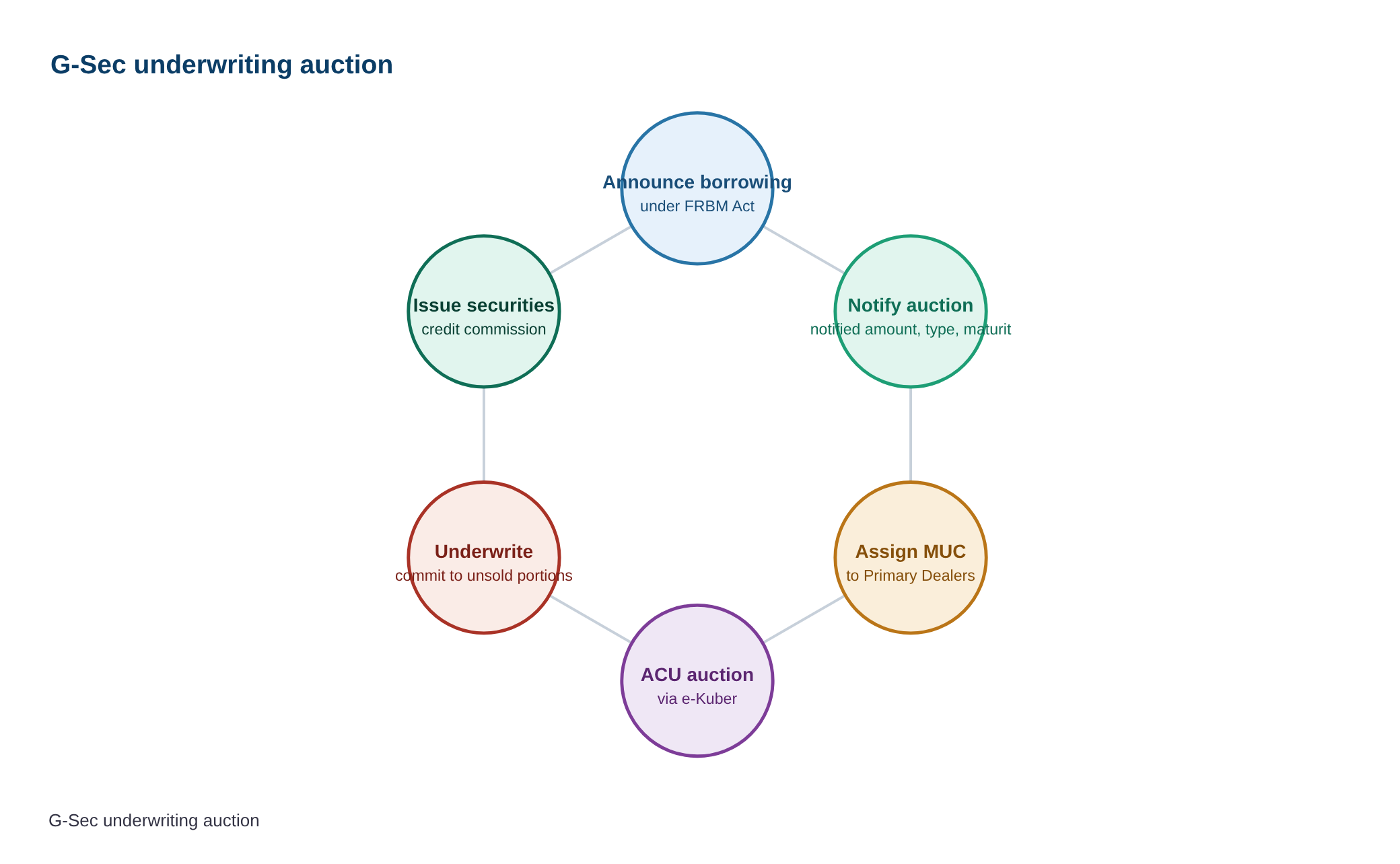
Government of India announces borrowing programme under FRBM Act → RBI notifies the auction details (notified amount, security type, maturity) for Government Securities → Primary Dealers (PDs) are assigned Minimum Underwriting Commitment (MUC) to ensure market stability → PDs participate in Additional Competitive Underwriting (ACU) auction via e-Kuber system → Successful bidders underwrite the securities, committing to purchase unsold portions → Securities are issued, and underwriting commission is credited to PDs’ accounts → Government receives funds, and the securities enter secondary market for trading
Prelims Practice Questions
Q1. Consider the following statements regarding the Underwriting Auction for Government Securities in India:
1. The auction is conducted through a single-price method.
2. Primary Dealers (PDs) are required to submit bids electronically through the RBI’s e-Kuber system.
3. The Minimum Underwriting Commitment (MUC) for each Primary Dealer is ₹810 crore.
4. The auction is held on the last Friday of every month.
How many of the above statements are correct?
- Only one
- Only two
- Only three
- All four
Answer: Only three — Statements 2 and 3 are correct. The auction uses a multiple-price method (Statement 1 is incorrect), and the auction is held on a specified date (not necessarily the last Friday; Statement 4 is incorrect).
Q2. Assertion (A): The Minimum Underwriting Commitment (MUC) ensures that Primary Dealers underwrite a minimum portion of Government Securities.
Reason (R): The MUC is designed to maintain liquidity and stability in the government securities market.
Options:
A. Both A and R are true, and R is the correct explanation of A.
B. Both A and R are true, but R is not the correct explanation of A.
C. A is true, but R is false.
D. A is false, but R is true.
Answer: ? — Both Assertion (A) and Reason (R) are true, and R correctly explains A. The MUC is a regulatory mechanism to ensure Primary Dealers participate in underwriting government securities, thereby supporting market liquidity and stability.
Q3. Match the following terms related to Government Securities with their descriptions:
Column I
1. Government Security
2. Primary Dealer
3. Underwriting Auction
4. Minimum Underwriting Commitment (MUC)
Column II
A. A financial institution authorized by RBI to underwrite and trade government securities.
B. The minimum amount of government securities a Primary Dealer must underwrite.
C. A debt instrument issued by the Government of India to raise funds.
D. An auction mechanism where Primary Dealers bid for government securities underwritten by RBI.
Options:
A. 1-D, 2-A, 3-C, 4-B
B. 1-C, 2-A, 3-D, 4-B
C. 1-B, 2-D, 3-A, 4-C
D. 1-A, 2-B, 3-C, 4-D
Answer: ? — Correct matches: 1-C (Government Security), 2-A (Primary Dealer), 3-D (Underwriting Auction), 4-B (Minimum Underwriting Commitment).
Mains Practice Question
✍ The issuance of Government Securities through underwriting auctions is a critical component of India’s public debt management strategy. Critically examine the role of Primary Dealers in this mechanism, with reference to their obligations under the Minimum Underwriting Commitment (MUC) and Additional Competitive Underwriting (ACU) framework. Also, elucidate the significance of the multiple-price auction method in ensuring market efficiency and transparency in the government securities market. (15 Marks)
Approach: MODEL-ANSWER SKELETON:
1. **Introduction (2 points)**
– Define Government Securities and their role in public debt management.
– Briefly explain the purpose of underwriting auctions in the context of fiscal policy and monetary stability.
2. **Role of Primary Dealers (PDs) (4 points)**
– Define Primary Dealers as market makers in government securities.
– Explain their obligations under the MUC (₹810 crore per PD) and ACU framework.
– Discuss how PDs act as intermediaries between RBI and the market, ensuring liquidity and price discovery.
– Reference the RBI’s notification dated November 14, 2007, governing these obligations.
3. **Minimum Underwriting Commitment (MUC) and ACU Framework (3 points)**
– Explain the rationale behind MUC: ensuring broad participation and reducing market concentration.
– Describe the ACU framework: competitive bidding by PDs to underwrite additional government securities.
– Discuss the significance of these mechanisms in maintaining market stability and investor confidence.
4. **Multiple-Price Auction Method (3 points)**
– Define multiple-price auction: bidders pay the price they bid, not a uniform price.
– Explain its advantages: promotes efficient price discovery, reduces underpricing, and ensures transparency.
– Reference the RBI’s use of the e-Kuber system for electronic bidding, enhancing accessibility and reducing operational risks.
5. **Challenges and Criticisms (2 points)**
– Discuss potential challenges: market manipulation risks, concentration of underwriting among a few PDs.
– Critique the effectiveness of MUC in ensuring equitable participation across PDs.
6. **Conclusion (1 point)**
– Summarize the importance of the underwriting auction mechanism in India’s debt market governance.
– Emphasize the balance between market efficiency, transparency, and regulatory oversight.
Source: RBI
Generated by AanyaAi for educational purpose.
Related guides on our sites
- Best economics optional coaching for upsc
- Best economics optional teacher for upsc
- How to prepare for GS paper 1 for UPSC CSE mains exam
- Best UPSC coaching for IFOS exam

- डीडीयू-जीकेवाई 2.0: ग्रामीण युवाओं को कौशल एवं रोजगार से जोड़ने की केंद्र सरकार की पहल - September 24, 2026
- DDU-GKY 2.0: UPSC Focused Guide on Rural Skill Scheme for 2026-27 - September 24, 2026
- यूपीएससी/पीसीएस: 25 सितंबर 2026 को सरकारी प्रतिभूतियों की बोली प्रक्रिया, ₹34,000 करोड़ का पुनर्प्रस्ताव - September 24, 2026

No Comments