


25 Sep Bombay HC Challenges Maharashtra SIR: Voter Deletion & ECI Powers Under Lens
✎ The Special Intensive Revision (SIR) process, conducted under Article 324 of the Constitution, must adhere to judicial precedents ensuring transparency, fairness, and natural justice in electoral roll management.
Subject Relevance — Where This Topic Fits
- GS Paper II — Polity and Governance — Constitutional Framework, Electoral Reforms, and Judicial Review | GS Paper II — Polity and Governance — Fundamental Rights and Electoral Rights | GS Paper III — Internal Security — Electoral Integrity and Voter Participation
- Prelims: Special Intensive Revision (SIR), Electoral Rolls, ECI powers under Article 324, Supreme Court judgments on electoral rolls (e.g., *Anukul Chandra Pradhan v. Union of India*), ECINET, Absent, Shifted, Dead, Duplicate (ASDD) criteria, Bombay High Court, Right to Vote (Article 326), Judicial Review of Administrative Actions
- Essay: Electoral integrity as the bedrock of democratic governance: Challenges and reforms, Judicial activism in safeguarding constitutional rights: The role of the higher judiciary in electoral processes
Quick Revision: The Special Intensive Revision (SIR) process, conducted under Article 324 of the Constitution, must adhere to judicial precedents ensuring transparency, fairness, and natural justice in electoral roll management.
Why is this in the news?
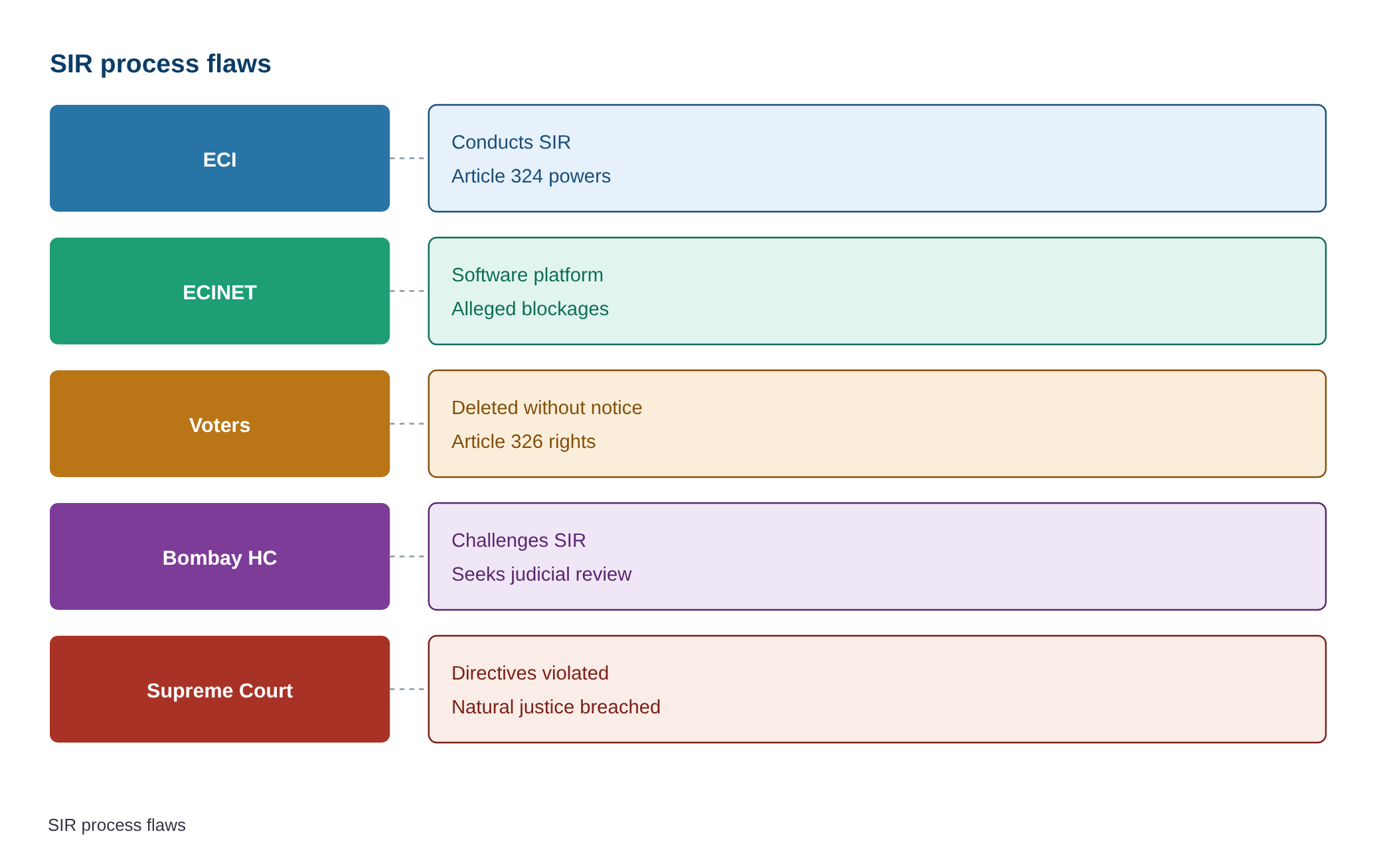
Two writ petitions have been filed in the Bombay High Court challenging the Special Intensive Revision (SIR) process in Maharashtra, alleging systemic deletions of voters, lack of transparency in methodology, and contravention of Supreme Court directives on electoral roll management. The petitions, filed amid an investigative report by *The Indian Express*, seek judicial intervention to restore deleted voters, investigate alleged software blockages, and ensure compliance with constitutional norms governing electoral rolls. The cases raise critical questions about the ECI’s exercise of powers under Article 324 of the Constitution and the protection of electoral rights under Article 326.
Background
- The Special Intensive Revision (SIR) is a periodic exercise conducted by the Election Commission of India (ECI) to update and rationalise electoral rolls, ensuring accuracy and inclusivity in voter lists.
- The SIR process in Maharashtra has faced scrutiny following an investigative report by *The Indian Express*, which highlighted discrepancies in voter deletions and alleged software blockages during the revision.
- Concerns have been raised about the exclusion of voters without statutory notice, opportunity of hearing, or reasoned orders, potentially violating principles of natural justice and electoral fairness.
- The Bombay High Court’s intervention is sought to address allegations of arbitrary deletions and to ensure that the SIR process adheres to constitutional and statutory safeguards.
- The cases also highlight the role of ECINET (Election Commission’s Integrated Network), a software platform used for electoral roll management, in the alleged irregularities.
What is the Special Intensive Revision (SIR) Process?
- The SIR is a periodic, door-to-door enumeration exercise conducted by the Election Commission of India (ECI) under Article 324 of the Constitution, aimed at updating, verifying, and rationalising electoral rolls to ensure accuracy and inclusivity.
- The process involves revisiting every polling station area to update voter details, remove duplicates, and address discrepancies such as absent, shifted, dead, or duplicate entries (ASDD criteria).
- The ECI has issued guidelines for SIR, including the use of ECINET, a centralised software platform for managing electoral rolls, to streamline data collection and verification.
- The SIR process is mandated to ensure that electoral rolls are error-free, inclusive, and compliant with the Representation of the People Act, 1950, and the Conduct of Election Rules, 1961.
- The ECI’s powers under Article 324 are wide-ranging but are subject to judicial review to prevent arbitrary or unconstitutional actions, as established in judicial precedents.
- The SIR process includes provisions for public scrutiny, objections, and hearings, with final rolls published after due process to ensure transparency and accountability.
- Recent challenges to the SIR process in Maharashtra have raised concerns about the implementation of these safeguards, particularly regarding voter deletions and software-related issues.
Key Features
| Feature | Significance |
|---|---|
| Special Intensive Revision (SIR) | A periodic exercise conducted by the Election Commission of India (ECI) to update electoral rolls by identifying and removing erroneous entries, such as duplicate, dead, or shifted voters, to ensure accuracy and integrity of voter lists. |
| Electoral Roll Management | The systematic process of maintaining and updating voter rolls, including deletion of ineligible voters, to uphold the constitutional right to vote under Article 326. |
| Judicial Review of Administrative Actions | The power of the judiciary to examine the legality and fairness of administrative decisions, including those by the ECI, to prevent arbitrary or unconstitutional actions. |
| Independent Judicial Committee | A proposed body to investigate allegations of data deletions and software blockages during the SIR process, ensuring transparency and accountability in electoral roll management. |
| Fundamental Rights Protection | The constitutional safeguards, including the right to vote (Article 326) and right to equality (Article 14), that may be implicated by alleged irregularities in the SIR process. |
Why it Matters
Electoral Integrity
- The SIR process is critical for maintaining the accuracy and credibility of electoral rolls, which directly impacts the fairness of elections and the exercise of the right to vote.
- Allegations of arbitrary deletions or software blockages could undermine public trust in the electoral system, a cornerstone of democratic governance.
- The Bombay High Court’s intervention ensures that electoral processes adhere to constitutional and legal standards, reinforcing the rule of law.
Constitutional Governance
- The petitions invoke past Supreme Court judgments to argue that the ECI’s actions must align with democratic principles and constitutional norms, particularly regarding the management of electoral rolls.
- The right to vote, as enshrined in Article 326, is a fundamental aspect of the Constitution, and any interference must be justified by law and due process.
- The judiciary’s role in reviewing administrative actions ensures that executive powers are exercised within constitutional boundaries.
Administrative Accountability
- The pleas highlight the need for transparency in the SIR process, including disclosure of dissenting opinions within the ECI and reasons for deletions or exclusions.
- The appointment of an independent judicial committee could provide an impartial mechanism to investigate alleged irregularities, enhancing public confidence in electoral processes.
- The petitions underscore the importance of procedural fairness, such as providing statutory notice and an opportunity of hearing before excluding voters.
Judicial Oversight of Elections
- The Bombay High Court’s consideration of these petitions demonstrates the judiciary’s role in safeguarding electoral democracy by ensuring that administrative actions comply with constitutional and legal standards.
- The court’s potential directions could set precedents for future electoral roll management processes across India, reinforcing the importance of due diligence and transparency.
Challenges
1. Transparency in Electoral Roll Management
- Lack of clarity in the criteria and methodology used for deletions during the SIR process, leading to allegations of arbitrary exclusions.
- Failure to disclose dissenting opinions within the ECI, which may indicate internal disagreements over the legality or fairness of the SIR process.
- Absence of statutory notice and opportunity of hearing for voters before exclusion, raising concerns about procedural fairness.
UPSC Link: GS-II: Electoral Reforms and Judicial Review
2. Judicial Review of Administrative Actions
- Balancing the ECI’s administrative autonomy with the judiciary’s role in reviewing its actions to prevent abuse of power.
- Ensuring that judicial interventions do not disrupt the electoral process or create uncertainty in the lead-up to elections.
- Addressing the potential conflict between the need for expeditious electoral roll updates and the requirement for thorough, fair, and transparent procedures.
UPSC Link: GS-II: Separation of Powers and Judicial Activism
3. Protection of Fundamental Rights
- Safeguarding the right to vote (Article 326) from arbitrary or unconstitutional exclusions during the SIR process.
- Ensuring that the right to equality (Article 14) is not violated by discriminatory or capricious actions in electoral roll management.
- Balancing the need for electoral integrity with the protection of individual rights, particularly for marginalized or vulnerable groups.
UPSC Link: GS-II: Fundamental Rights and Electoral Democracy
4. Technological and Procedural Integrity
- Addressing concerns about software blockages or data deletions that may compromise the integrity of the SIR process.
- Ensuring that technological tools used in electoral roll management, such as ECINET, are secure, transparent, and compliant with legal standards.
- Preventing the misuse of technology to manipulate or obstruct the SIR process, which could undermine public trust in elections.
UPSC Link: GS-II: E-Governance and Electoral Reforms
5. Political and Social Implications
- Mitigating the potential for political disputes or social unrest arising from allegations of electoral roll manipulation or irregularities.
- Ensuring that the SIR process does not disproportionately affect specific communities or groups, which could exacerbate social tensions.
- Balancing the need for electoral reforms with the imperative of maintaining social cohesion and public confidence in democratic institutions.
UPSC Link: GS-II: Electoral Reforms and Social Harmony
Challenges — UPSC Perspective
| Issue | Concern |
|---|---|
| Lack of Transparency in SIR Process | Allegations of arbitrary deletions and software blockages without clear criteria or disclosure of dissenting opinions. |
| Procedural Fairness in Exclusions | Failure to provide statutory notice or opportunity of hearing before excluding voters, violating principles of natural justice. |
| Judicial Review vs. Administrative Autonomy | Balancing the ECI’s autonomy in managing electoral rolls with the judiciary’s role in ensuring constitutional compliance. |
| Technological Integrity in ECINET | Concerns about the security and transparency of software used in the SIR process, including potential data deletions or blockages. |
| Protection of Fundamental Rights | Risk of violations of the right to vote (Article 326) and right to equality (Article 14) due to irregularities in the SIR process. |
| Social and Political Stability | Potential for disputes or unrest arising from allegations of electoral roll manipulation or exclusion of specific communities. |
Way Forward
- The Election Commission of India (ECI) should proactively disclose the criteria, methodology, and reasons for deletions during the SIR process to enhance transparency and public trust.
- The ECI should ensure that all exclusions from electoral rolls are preceded by statutory notice and an opportunity of hearing, in compliance with principles of natural justice.
- The Bombay High Court may consider appointing an independent judicial committee to investigate allegations of data deletions and software blockages, ensuring impartial scrutiny.
- The ECI should publish dissenting opinions within the Commission regarding the SIR process, if any, to demonstrate internal accountability and adherence to constitutional norms.
- The ECI should conduct a comprehensive review of the technological tools used in the SIR process, including ECINET, to ensure their security, transparency, and compliance with legal standards.
- The judiciary should set clear precedents for the balance between administrative autonomy and judicial review in electoral matters, guiding future electoral reforms.
- Civil society organizations and media should continue to monitor the SIR process, ensuring that any irregularities are promptly addressed and reported.
- The ECI should engage with stakeholders, including political parties and civil society, to build consensus on electoral roll management reforms and address concerns proactively.
UPSC Value Addition
Keywords for Mains Answer-Writing
Special Intensive Revision (SIR) of electoral rolls · Electoral Rolls Management in India · Constitutional provisions governing electoral rolls · Supreme Court judgments on electoral rolls · Election Commission of India (ECI) powers and functions · Right to Vote and Fundamental Rights · Judicial review of administrative actions · Bombay High Court and electoral disputes · Electoral roll deletions and restoration · Independence of Election Commission · Procedural fairness in electoral processes · Judicial oversight of electoral processes
Constitutional & Policy Linkages
- [‘Article 326: Right to Vote’, ‘Ensures universal adult suffrage and the right to vote in elections.’]
- [‘Article 14: Right to Equality’, ‘Prohibits arbitrary exclusions or discriminatory practices in electoral roll management.’]
Concept Flow
Conduct of Special Intensive Revision (SIR) by ECI → Allegations of arbitrary deletions and software blockages during SIR process → Filing of writ petitions in Bombay High Court challenging SIR process → Petitions seek restoration of deleted voters, transparency, and judicial review → Judicial consideration of petitions and potential appointment of independent committee → ECI’s response to court directives and potential reforms in electoral roll management → Implementation of reforms and restoration of public trust in electoral processes
Prelims Practice Questions
Q1. Consider the following statements regarding the Special Intensive Revision (SIR) of electoral rolls in India:
1. The SIR is conducted exclusively by the Election Commission of India (ECI) under Article 324 of the Constitution.
2. The ECI has the power to delete names from electoral rolls if it deems necessary, subject to judicial review.
3. The deletion of names during SIR must be preceded by a statutory notice and an opportunity of hearing to the concerned voter.
4. The Bombay High Court has recently directed the ECI to form an independent judicial committee to investigate all deletions during the current SIR process in Maharashtra.
How many of the above statements are correct?
- Only one
- Only two
- Only three
- All four
Answer: Only three — Statements 1 and 2 are correct as the ECI conducts SIR under Article 324 and has the power to delete names, subject to judicial review. Statement 3 is correct as procedural fairness requires notice and hearing before deletion. Statement 4 is incorrect as the Bombay High Court has only *sought* the formation of such a committee; no such direction has been issued.
Q2. Assertion (A): The Election Commission of India (ECI) is a constitutional body with powers to supervise, direct, and control the electoral process in India.
Reason (R): The ECI derives its powers from Article 324 of the Constitution of India, which vests it with the authority to ensure free and fair elections.
Options:
A. Both A and R are true, and R is the correct explanation of A.
B. Both A and R are true, but R is NOT the correct explanation of A.
C. A is true, but R is false.
D. A is false, but R is true.
- A
- B
- C
- D
Answer: A — Both Assertion (A) and Reason (R) are true, and R correctly explains A. Article 324 of the Constitution explicitly vests the ECI with the power to supervise, direct, and control elections, including the preparation of electoral rolls.
Q3. Match the following constitutional provisions with their respective subjects:
Column I (Constitutional Provision)
1. Article 324
2. Article 325
3. Article 326
4. Article 327
Column II (Subject)
A. No person to be ineligible for inclusion in electoral rolls on grounds of religion, race, caste, or sex
B. Superintendence, direction, and control of elections vested in the Election Commission
C. Elections to the House of the People and Legislative Assemblies to be on the basis of adult suffrage
D. Power of Parliament to make provision with respect to elections to Legislatures
Options:
1-A, 2-B, 3-C, 4-D
1-B, 2-A, 3-C, 4-D
1-C, 2-D, 3-A, 4-B
1-D, 2-C, 3-B, 4-A
- 1-A, 2-B, 3-C, 4-D
- 1-B, 2-A, 3-C, 4-D
- 1-C, 2-D, 3-A, 4-B
- 1-D, 2-C, 3-B, 4-A
Answer: 1-B, 2-A, 3-C, 4-D — The correct match is: Article 324 (B), Article 325 (A), Article 326 (C), and Article 327 (D).
Mains Practice Question
✍ The deletion of names from electoral rolls during the Special Intensive Revision (SIR) process has been challenged in the Bombay High Court on grounds of procedural impropriety and alleged violation of constitutional norms. Critically examine the legal and constitutional framework governing the SIR process, with particular reference to the powers of the Election Commission of India (ECI), the principles of natural justice, and the role of judicial review. Also, discuss the implications of such challenges for the sanctity of electoral rolls and the conduct of free and fair elections in India. (15 Marks)
Approach: MODEL-ANSWER SKELETON:
1. **Constitutional and Legal Framework**:
– Article 324 of the Constitution vests the ECI with the power to superintend, direct, and control elections, including the preparation of electoral rolls.
– The Representation of the People Act, 1950, and the Conduct of Elections Rules, 1961, govern the preparation and revision of electoral rolls.
– The ECI’s powers are quasi-judicial and subject to judicial review under Article 226 and 32 of the Constitution.
2. **Procedural Fairness and Natural Justice**:
– The deletion of names must comply with principles of natural justice, including notice and opportunity of hearing (as held in *Union of India v. Association for Democratic Reforms*, 2002).
– The SIR process must ensure transparency, including the publication of reasons for deletions and the methodology used (e.g., ASDD criteria).
– The ECI’s decisions must be reasoned and non-arbitrary, as emphasized in *Krishna Kumar v. Union of India* (2017).
3. **Judicial Review and Recent Challenges**:
– The Bombay High Court’s intervention in the Maharashtra SIR case highlights the judiciary’s role in ensuring adherence to constitutional norms.
– Challenges to the SIR process may seek restoration of deleted names, formation of independent committees, or quashing of SIR directions if procedural lapses are established.
– The judiciary’s scrutiny ensures that electoral rolls remain accurate, inclusive, and legally compliant.
4. **Implications for Electoral Integrity**:
– The sanctity of electoral rolls is fundamental to free and fair elections. Unjust deletions or procedural lapses can disenfranchise voters and undermine democratic principles.
– The ECI must balance efficiency in electoral roll management with the protection of voters’ rights, as emphasized in *PUCL v. Union of India* (2003).
– The judiciary’s proactive role in reviewing SIR processes reinforces public trust in the electoral system.
5. **Conclusion**:
– The SIR process must adhere to constitutional and statutory provisions while upholding principles of fairness and transparency.
– Judicial review acts as a safeguard against arbitrary actions by the ECI, ensuring that electoral rolls remain accurate and inclusive.
Source: The Indian Express
Maharashtra PCS (MPSC) — State PCS Practice
Prelims: Which of the following is a key contention raised in the two pleas filed in the Bombay High Court challenging the Maharashtra State Industrial and Investment Policy (SIR) 2023-2028, as highlighted in the Amid Express investigation report?
- A. Lack of transparency in the selection of beneficiaries under the SIR policy
- B. Violation of the ‘One District One Product’ (ODOP) scheme guidelines by the SIR policy
- C. Excessive focus on urban industrial zones, neglecting rural areas of Maharashtra
- D. Overlapping jurisdiction with the Centre’s PLI (Production Linked Incentive) scheme
Answer: A. Lack of transparency in the selection of beneficiaries under the SIR policy — The Amid Express investigation report alleges that the Maharashtra SIR policy lacks transparency in beneficiary selection, raising concerns about potential favoritism and lack of due process.
Mains: Critically analyze the constitutional and administrative challenges posed by the Maharashtra State Industrial and Investment Policy (SIR) 2023-2028, as highlighted in the Amid Express investigation report. Suggest measures to ensure transparency and accountability in the implementation of such state-level industrial policies in Maharashtra.
Generated by AanyaAi for educational purpose.
Related guides on our sites
- Best economics services coaching
- Anthropology VS PSIR
- Best PSIR optional coaching
- Best PSIR optional coaching online

- डीसीपीसी का विशेष अभियान 6.0: ई-कचरा प्रबंधन और कार्यस्थल दक्षता पर नया फोकस - September 26, 2026
- Special Campaign 6.0: DCP&C to Focus on E-Waste, Cleanliness & Workplace Efficiency - September 26, 2026
- यूपी में हाइब्रिड सोलर सिस्टम: पीएम सूर्यघर योजना में बिजली कटौती से मुक्ति का विकल्प - September 26, 2026

No Comments