


05 Aug Bombay HC Orders Removal of Deepfake Videos Targeting Nitin Gadkari on Ethanol Policy
✎ The Bombay High Court’s order underscores the judiciary’s role in addressing digital defamation while highlighting the urgent need for a statutory mechanism to regulate deepfakes under India’s constitutional and legal framework.
Subject Relevance — Where This Topic Fits
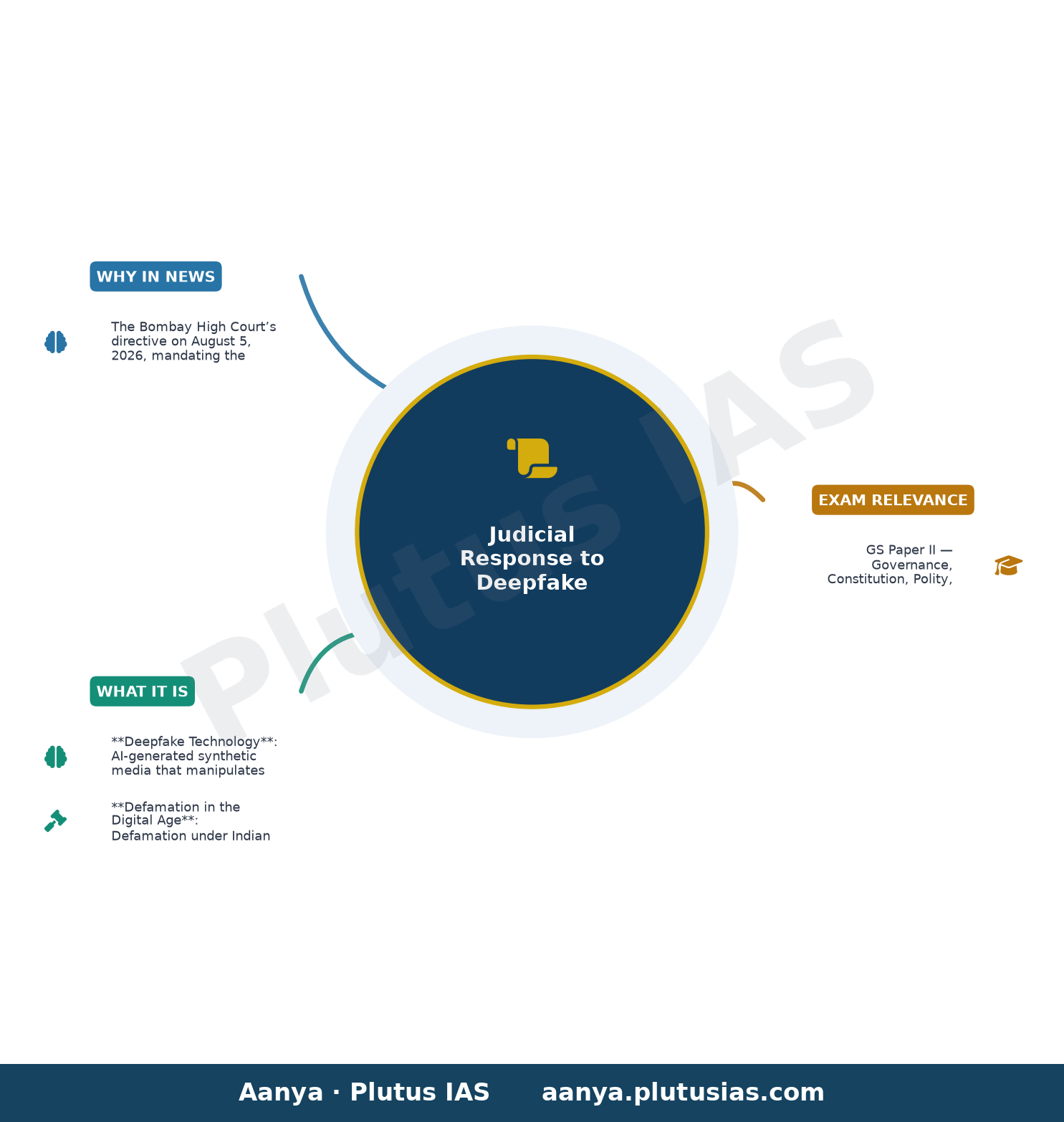
- GS Paper II — Governance, Constitution, Polity, Social Justice and International Relations (Digital Governance, Fundamental Rights, Right to Privacy)
- Prelims: Deepfake technology, Ethanol Blending Programme (EBP), Article 19(1)(a) and Article 21, Information Technology (Intermediary Guidelines and Digital Media Ethics Code) Rules, 2021, Right to be Forgotten, Ministry of Electronics and Information Technology (MeitY), Defamation under IPC Section 499, Judicial activism in digital governance
- Essay: The intersection of technology and ethics: Balancing innovation with constitutional morality, Judicial intervention in the digital age: Protecting dignity in the era of deepfakes
Quick Revision: The Bombay High Court’s order underscores the judiciary’s role in addressing digital defamation while highlighting the urgent need for a statutory mechanism to regulate deepfakes under India’s constitutional and legal framework.
Why is this in the news?
The Bombay High Court’s directive on August 5, 2026, mandating the removal of deepfake videos targeting Union Minister Nitin Gadkari over the Ethanol Blending Programme (EBP) underscores the judiciary’s proactive role in addressing digital defamation. The order highlights systemic gaps in India’s regulatory framework for curbing abusive AI-generated content, particularly its reliance on judicial intervention for redressal. This case is significant as it intersects with broader debates on free speech, privacy, and the ethical implications of deepfake technology in public discourse.
Background
- The Ethanol Blending Programme (EBP), introduced by the central government, aims to reduce import dependence on crude oil by blending ethanol with petrol.
- Deepfake technology, powered by artificial intelligence, enables the creation of hyper-realistic synthetic media, posing severe threats to individual reputation, public trust, and democratic discourse.
- India’s legal framework for regulating digital content is fragmented, with the Information Technology (Intermediary Guidelines and Digital Media Ethics Code) Rules, 2021, serving as the primary regulatory instrument for intermediaries like social media platforms.
- The absence of a statutory mechanism for the expeditious removal of abusive or defamatory content without judicial intervention has been a persistent challenge, as noted by the Bombay High Court.
- The case reflects the growing trend of public figures seeking judicial recourse against AI-generated misinformation and defamatory content, highlighting the inadequacy of existing safeguards.
- The Union Ministry of Information and Technology’s involvement in the proceedings underscores the government’s role in shaping digital governance policies.
Understanding Deepfakes, Defamation, and the Ethanol Blending Programme (EBP)
- **Deepfake Technology**: AI-generated synthetic media that manipulates or fabricates audio, video, or images to depict individuals saying or doing things they never did. It exploits advancements in machine learning, particularly generative adversarial networks (GANs) and diffusion models.
- **Defamation in the Digital Age**: Defamation under Indian law (IPC Section 499) extends to digital platforms, where false statements can cause reputational harm. The rise of deepfakes exacerbates this by making fabricated content appear authentic.
- **Ethanol Blending Programme (EBP)**: A government initiative to blend ethanol with petrol to reduce crude oil imports, enhance energy security, and promote sustainable agriculture. It falls under the jurisdiction of the Ministry of Petroleum and Natural Gas.
- **Judicial Intervention in Digital Governance**: Courts have increasingly stepped in to address gaps in digital regulation, particularly where statutory mechanisms are absent or ineffective. The Bombay High Court’s order reflects this trend.
- **Intermediary Liability**: Social media platforms and search engines are classified as intermediaries under the IT Rules, 2021, and are required to remove unlawful content upon receiving a court order or government directive.
- **Right to Privacy and Publicity Rights**: Individuals have a constitutional right to privacy (Article 21) and a common law right to publicity, which protects against the unauthorised use of their likeness in deepfake content.
- **Ethical and Policy Challenges**: The lack of a dedicated regulatory framework for deepfakes in India necessitates judicial activism, but long-term solutions require legislative action to balance free speech, innovation, and individual rights.
- **Global Precedents**: Jurisdictions like the EU (AI Act) and the US (California’s Deepfake Ban) have introduced specific regulations targeting deepfakes, highlighting India’s need for a comprehensive legal framework.
UPSC Value Addition
Keywords for Mains Answer-Writing
Deepfake regulation · Ethanol Blending Programme (EBP) · Ministry of Petroleum and Natural Gas · Artificial Intelligence (AI) governance · Personality rights under Indian law · Defamation in cyberspace · Right to be forgotten · Intermediary liability under IT Rules 2021 · Judicial activism in tech governance · AI-generated misinformation · Constitutional remedies for online harm · Ethanol policy and energy security
Prelims Practice Questions
Q1. Consider the following statements regarding the Ethanol Blending Programme (EBP) in India:
1. The EBP was introduced by the central government in 2003.
2. The current administration achieved 20% ethanol blending with petrol in 2025-2026.
3. The EBP is managed by the Ministry of Road Transport and Highways.
4. E20 petrol is cheaper than regular petrol in India.
How many of the above statements are correct?
- Only one
- Only two
- Only three
- All
Answer: Only three — Statements 1 and 2 are correct. The EBP was introduced in 2003, and the 20% blending target was achieved in 2025-2026. Statement 3 is incorrect as the EBP is managed by the Ministry of Petroleum and Natural Gas, not the Ministry of Road Transport and Highways. Statement 4 is incorrect; E20 petrol is not cheaper than regular petrol due to higher production costs.
Q2. Assertion (A): The Bombay High Court’s order in 2026 directed social media platforms to remove deepfake videos targeting Union Minister Nitin Gadkari.
Reason (R): The court found the content to be defamatory and in violation of personality rights.
In the context of the above statements, which of the following is correct?
- Both A and R are true, and R is the correct explanation of A.
- Both A and R are true, but R is not the correct explanation of A.
- A is true, but R is false.
- A is false, but R is true.
Answer: Both A and R are true, but R is not the correct explanation of A. — Both the assertion and reason are true. The Bombay High Court ordered the removal of deepfake videos as they were defamatory and violated personality rights, making R the correct explanation of A.
Q3. Match the following columns related to cyber governance in India:
Column I
A. Intermediary Liability
B. Deepfake Regulation
C. Right to be Forgotten
D. Defamation in Cyberspace
Column II
1. IT Rules, 2021
2. Indian Penal Code, Section 499
3. Personal Data Protection Bill, 2019
4. Bombay High Court Order, 2026
- A-1, B-4, C-3, D-2; A-2, B-3, C-1, D-4; A-3, B-2, C-4, D-1; A-4, B-1, C-2, D-3
- answer_list_indexes_to_match_columns_directly
- answer_list_indexes_to_match_columns_directly
- answer_list_indexes_to_match_columns_directly
Answer: A-1, B-4, C-3, D-2; A-2, B-3, C-1, D-4; A-3, B-2, C-4, D-1; A-4, B-1, C-2, D-3 — A. Intermediary Liability is governed by the IT Rules, 2021. B. Deepfake regulation is addressed in the Bombay High Court Order, 2026. C. The Right to be Forgotten is part of the Personal Data Protection Bill, 2019. D. Defamation in cyberspace is covered under Section 499 of the Indian Penal Code.
Mains Practice Question
✍ The proliferation of deepfake technology poses a significant threat to democratic discourse and individual rights in India. Critically analyse the legal and institutional mechanisms available to address this menace, with particular reference to the Bombay High Court’s order in the Gadkari case. Also, examine the limitations of these mechanisms in ensuring timely redressal of online harms. (15 Marks)
Approach: MODEL-ANSWER SKELETON:
1. **Context and the Bombay High Court’s Order (2026)**
– Brief recap of the Gadkari case: deepfake videos targeting the Union Minister over the Ethanol Blending Programme (EBP).
– Court’s directive: removal of defamatory content and future similar content; concern over lack of pre-emptive mechanisms.
– Legal basis: defamation under IPC Section 499, personality rights, and intermediary liability under IT Rules 2021.
2. **Legal and Institutional Mechanisms**
– **Statutory Framework**:
– IT Rules 2021 (due diligence by intermediaries, grievance redressal mechanisms).
– Indian Penal Code (Sections 499, 500 for defamation; Section 66D for cyber impersonation).
– Personal Data Protection Bill (proposed right to be forgotten under Clause 20).
– **Judicial Precedents**:
– Ashish Bhalla v. Suresh Chawdhury (2016) on defamation in cyberspace.
– Subramanian Swamy v. Union of India (2016) on criminal defamation.
– Recent Supreme Court observations on AI-generated misinformation (e.g., Anuradha Bhasin v. Union of India, 2020).
– **Institutional Mechanisms**:
– Role of the Press Council of India (PCI) and News Broadcasters & Digital Association (NBDA).
– Grievance Appellate Committees (GACs) under IT Rules 2021.
3. **Limitations and Challenges**
– **Jurisdictional Issues**: Cross-border nature of digital content; enforcement challenges.
– **Delayed Redressal**: Over-reliance on judicial intervention (as noted by the Bombay High Court).
– **Technological Limitations**: Difficulty in detecting deepfakes; lack of AI-based monitoring tools.
– **Free Speech Concerns**: Balancing regulation with freedom of expression (Article 19(1)(a)).
– **Intermediary Liability**: Ambiguity in the ‘safe harbour’ provisions (Section 79 of IT Act) and their application.
4. **Way Forward**
– Strengthening self-regulatory mechanisms (e.g., industry-led AI ethics boards).
– Legislative reforms: expedite the Personal Data Protection Bill; introduce a dedicated ‘Deepfake Act’.
– Institutional capacity-building: training for law enforcement and judiciary on digital forensics.
– Public awareness campaigns on deepfake detection and reporting.
5. **Conclusion**
– While existing mechanisms provide a foundation, proactive and multi-stakeholder approaches are essential to address the dynamic threat of deepfakes. The Gadkari case underscores the need for systemic reforms to ensure timely and effective redressal of online harms.
Source: The Hindu
Generated by AanyaAi for educational purpose.

- विकलांग सैन्य कैडेटों को पेंशन देने से रोक रही सरकार की नीति: केंद्र ने सुप्रीम कोर्ट में बताया - September 23, 2026
- Centre Tells SC: Policy Blocks Disability Pension for Outboarded Cadets - September 23, 2026
- यूपीएससी तैयारी: स्कूलों में स्वच्छता सुविधाओं की कमी, 5 करोड़ बच्चे प्रभावित - September 23, 2026

No Comments