


09 Aug Bombay HC Ruling: No Automatic Vesting of Private Land as Forest in Maharashtra
✎ The Maharashtra Private Forests (Acquisition) Act, 1975, does not permit automatic vesting of private lands as ‘private forests’; such vesting requires strict adherence to the statutorily prescribed procedure, including notice…
Subject Relevance — Where This Topic Fits
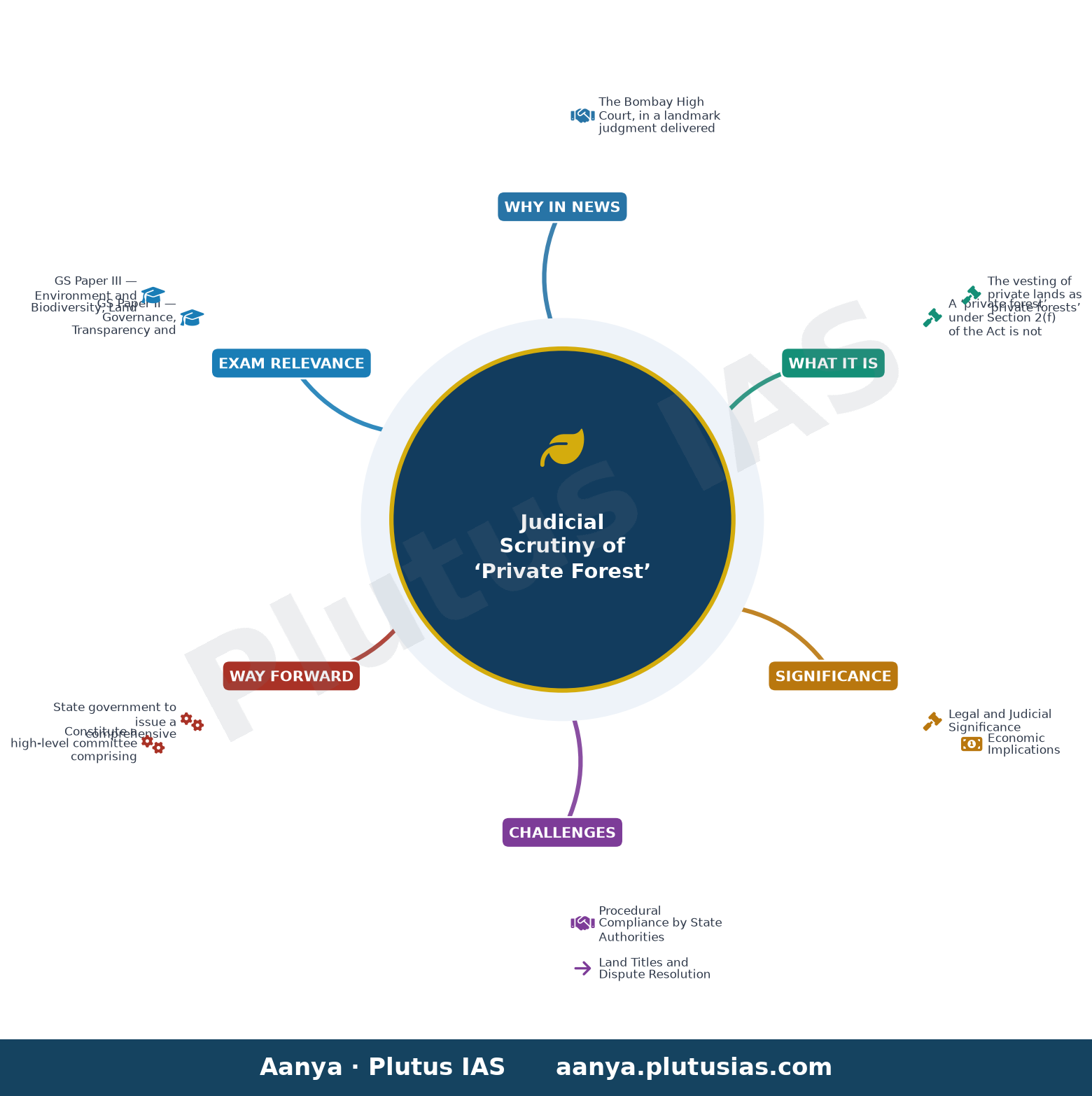
- GS Paper II — Governance, Transparency and Accountability | GS Paper III — Environment and Biodiversity, Land Reforms
- Prelims: Maharashtra Private Forests (Acquisition) Act, 1975, Section 2(f) of the Act, Supreme Court rulings on forest rights, vesting of private lands, procedural due process in land acquisition, forest conservation laws, land title disputes, revenue records and encumbrances
- Essay: The tension between conservation imperatives and property rights in India’s forest governance, Judicial activism in environmental governance: Balancing ecological protection and individual rights
Quick Revision: The Maharashtra Private Forests (Acquisition) Act, 1975, does not permit automatic vesting of private lands as ‘private forests’; such vesting requires strict adherence to the statutorily prescribed procedure, including notice, hearing, and a formal declaration.
Why is this in the news?
The Bombay High Court, in a landmark judgment delivered on 9 August 2026, ruled that the Maharashtra government cannot automatically declare private lands as ‘private forests’ under the Maharashtra Private Forests (Acquisition) Act, 1975, without following the statutorily prescribed procedure. The ruling addresses a long-standing grievance of landholders—including individuals, housing societies, and developers—whose lands were unilaterally classified as state-owned forests, leading to title disputes and litigation. The judgment underscores the necessity of procedural compliance and the protection of landholder rights in forest conservation regimes.
Background
- The Maharashtra Private Forests (Acquisition) Act, 1975, was enacted to acquire certain privately owned forest lands for conservation, vesting them in the State while extinguishing private rights and titles.
- The State government had, however, interpreted the Act expansively, treating numerous privately owned lands—including those with no prior forest status—as ‘private forests’ automatically vested in the State upon the Act’s commencement.
- This interpretation led to widespread litigation, as landholders challenged the State’s unilateral actions, arguing that their rights were extinguished without due process or compensation.
- The Supreme Court has repeatedly held that automatic vesting of private lands as forests without following statutory procedure is unconstitutional and violates fundamental rights under Articles 14, 19(1)(f), and 300A of the Constitution.
- The Bombay High Court’s ruling aligns with these precedents, emphasising that the State must adhere to the procedural safeguards prescribed under the Act and earlier forest laws before declaring any land as a ‘private forest’.
What constitutes a ‘private forest’ under the Maharashtra Private Forests (Acquisition) Act, 1975?
- A ‘private forest’ under Section 2(f) of the Act is not synonymous with any privately owned land containing trees; it is a legally defined category with strict criteria.
- The vesting of private lands as ‘private forests’ under the Act is not automatic; it requires a formal declaration through a prescribed procedure, including notice to landholders, consideration of objections, and a decision by the competent authority.
- The Act extinguishes all rights, titles, and interests in the land upon vesting, but only after the due process is completed, ensuring that landholders are not deprived of their rights without fair procedure.
Key Features
| Feature | Significance |
|---|---|
| Definition of ‘private forest’ under Maharashtra Private Forests (Acquisition) Act, 1975 | Clarifies that not all privately owned lands with trees qualify; only specific categories under Section 2(f) are included, preventing arbitrary classification. |
| Requirement of due process before vesting | Mandates notice to landholders and consideration of objections by a committee, ensuring procedural fairness and preventing automatic vesting. |
| Judicial scrutiny of government action | Highlights the judiciary’s role in ensuring executive adherence to statutory and constitutional norms, particularly in land rights disputes. |
| Impact on land titles and ownership | Provides legal certainty to landholders by invalidating automatic vesting, thereby protecting their property rights. |
| Precedent value for similar disputes | Sets a binding precedent for other states with analogous legislation, reinforcing the necessity of due process in land acquisition. |
Why it Matters
Legal and Judicial Significance
- Reinforces the principle that the state cannot bypass statutory procedures in land acquisition, aligning with the doctrine of rule of law.
- Affirms the supremacy of judicial review over executive actions, particularly in matters affecting property rights under Articles 300A and 265 of the Constitution.
- Provides clarity on the interpretation of ‘private forests’ under the 1975 Act, reducing ambiguity in land classification.
- Strengthens the protection of landholders’ rights against arbitrary state action, in line with constitutional safeguards.
Economic Implications
- Restores legal certainty to land titles, potentially unlocking economic value in disputed lands for development, agriculture, or conservation.
- May reduce litigation costs and delays for landholders, fostering investment in real estate and infrastructure projects.
- Encourages transparency in land governance, which is critical for Maharashtra’s economic growth and urban planning.
Administrative and Policy Implications
- Highlights the need for administrative reforms in the Revenue and Forest Departments to ensure compliance with statutory procedures.
- Emphasises the importance of inter-departmental coordination to prevent conflicting land classifications.
- Urges the Maharashtra government to align its policies with judicial precedents and statutory requirements.
Challenges
1. Procedural Compliance by State Authorities
- Risk of continued non-compliance by state agencies despite judicial directives, leading to persistent litigation.
- Challenge of ensuring uniform application of due process across all districts and departments.
- Need for capacity-building among officials to implement the prescribed procedures effectively.
UPSC Link: Land Reforms – Procedural Safeguards
2. Land Titles and Dispute Resolution
- Proliferation of conflicting land records and titles due to historical irregularities in land classification.
- Difficulty in resolving long-standing disputes where lands have been classified as ‘private forests’ without due process.
- Requirement for a robust grievance redressal mechanism to address landholder grievances efficiently.
UPSC Link: Land Revenue Administration – Dispute Resolution
3. Judicial Backlog and Enforcement
- Potential delay in enforcement of the High Court’s ruling due to the sheer volume of pending petitions (184 in this case).
- Challenge of ensuring timely implementation of court orders across multiple jurisdictions.
- Need for specialised tribunals or fast-track courts to expedite land-related disputes.
UPSC Link: Judicial Reforms – Land Disputes
4. Balancing Conservation and Development
- Conflict between conservation objectives under the 1975 Act and developmental needs of landholders.
- Challenge of identifying and protecting genuine forest lands while ensuring fair treatment of landowners.
- Requirement for a balanced policy framework that integrates conservation with socio-economic development.
UPSC Link: Forest Conservation – Sustainable Development
5. Inter-State Coordination
- Variations in state-level forest and land laws may lead to inconsistencies in land classification and rights.
- Need for harmonised policies to prevent jurisdictional disputes and ensure equitable treatment of landholders.
- Importance of inter-state cooperation in addressing transboundary land disputes.
UPSC Link: Inter-State Relations – Land Governance
Challenges — UPSC Perspective
| Issue | Concern |
|---|---|
| Non-compliance with statutory procedures | State agencies may continue to bypass due process, leading to prolonged litigation and uncertainty. |
| Historical land record discrepancies | Conflicting records and classifications create difficulties in determining true ownership and land use. |
| Judicial backlog in land disputes | High volume of pending cases delays resolution, impacting landholder rights and economic activities. |
| Balancing conservation and development | Ensuring forest conservation while protecting landholders’ rights requires nuanced policy interventions. |
| Lack of inter-departmental coordination | Conflicting actions by Revenue, Forest, and other departments exacerbate land disputes. |
Way Forward
- State government to issue a comprehensive circular directing all departments to strictly follow the due process under the Maharashtra Private Forests (Acquisition) Act, 1975, before declaring any land a ‘private forest’.
- Constitute a high-level committee comprising representatives from the Revenue, Forest, and Law Departments to oversee the implementation of the High Court’s ruling and address systemic issues.
- Undertake a statewide audit of land records to reconcile historical discrepancies and ensure accurate classification of ‘private forests’.
- Establish a grievance redressal mechanism, possibly through dedicated land tribunals, to expedite the resolution of disputes arising from the High Court’s ruling.
- Amend the 1975 Act to incorporate explicit procedural safeguards, including timelines for notifications and objection redressal, to prevent future litigation.
- Conduct capacity-building programmes for revenue and forest officials to enhance their understanding of statutory procedures and judicial precedents.
- Promote awareness among landholders about their rights and the prescribed procedures under the Act to enable informed participation in the process.
- Collaborate with the judiciary to establish fast-track courts or special benches for land disputes to reduce judicial backlog.
UPSC Value Addition
Keywords for Mains Answer-Writing
Bombay High Court judgment on private forests · Maharashtra Private Forests (Acquisition) Act, 1975 · vesting of private lands as state forests · due process and natural justice in land acquisition · Section 2(f) of the Maharashtra Private Forests Act · Supreme Court rulings on forest rights · land title disputes in Maharashtra · judicial review of executive actions in forest conservation · procedural safeguards under forest laws · balance between conservation and property rights
Concept Flow
Classification of land as ‘private forest’ under Section 2(f) of the 1975 Act → State’s claim of automatic vesting in government → Landholders challenge the vesting in High Court → Court rules due process must be followed → State’s failure to comply with statutory procedures → Judicial scrutiny of executive action → Reinforcement of rule of law and property rights → Impact on land titles and economic activities → Need for administrative and policy reforms.
Prelims Practice Questions
Q1. Consider the following statements regarding the Maharashtra Private Forests (Acquisition) Act, 1975:
1. The Act vests all privately owned forest lands in the State Government automatically upon its enactment.
2. Section 2(f) of the Act defines ‘private forest’ to include lands already declared or recorded as forests under earlier laws.
3. The Act empowers the State Government to extinguish all rights, titles, and interests of owners without any procedural safeguards.
How many of the above statements are correct?
- Only one
- Only two
- All three
- None
Answer: Only two — Statement 1 is incorrect because the Act does not vest lands automatically; it requires a statutory process. Statement 2 is correct as Section 2(f) includes lands declared or recorded as forests under earlier laws. Statement 3 is incorrect because the Act mandates procedural safeguards, including notice and consideration of objections.
Q2. Assertion (A): The Bombay High Court ruled that the Maharashtra Government cannot automatically declare private lands as ‘private forests’ without following due process under the Maharashtra Private Forests (Acquisition) Act, 1975.
Reason (R): The Supreme Court has repeatedly held that executive actions vesting private lands in the State must adhere to the principles of natural justice and statutory procedure.
Options:
A. Both A and R are true, and R is the correct explanation of A.
B. Both A and R are true, but R is not the correct explanation of A.
C. A is true, but R is false.
D. A is false, but R is true.
- A
- B
- C
- D
Answer: A — Both the Assertion (A) and Reason (R) are true. The Bombay High Court’s ruling aligns with the Supreme Court’s repeated emphasis on due process and natural justice in land acquisition matters. R correctly explains A.
Q3. Match the following provisions of the Maharashtra Private Forests (Acquisition) Act, 1975 with their correct descriptions:
Column I (Provision) | Column II (Description)
1. Section 2(f) | A. Vesting of private lands in the State Government
2. Section 4 | B. Definition of ‘private forest’
3. Section 5 | C. Procedure for acquisition of private forests
4. Section 6 | D. Powers of the State Government to declare lands as private forests
- 1-B, 2-C, 3-D, 4-A
- 1-D, 2-B, 3-A, 4-C
- 1-B, 2-D, 3-A, 4-C
- 1-C, 2-A, 3-B, 4-D
Answer: 1-B, 2-C, 3-D, 4-A — Section 2(f) defines ‘private forest’. Section 4 outlines the procedure for acquisition. Section 5 deals with the vesting of lands in the State Government. Section 6 pertains to the powers of the State Government to declare lands as private forests.
Mains Practice Question
✍ The Bombay High Court has recently held that the Maharashtra Government cannot automatically vest private lands as ‘private forests’ under the Maharashtra Private Forests (Acquisition) Act, 1975 without following the due process prescribed under the Act and the principles of natural justice. Critically examine the implications of this judgment for landholders, forest conservation policies, and the balance between property rights and ecological imperatives. (15 Marks)
Approach: MODEL-ANSWER SKELETON:
1. **Introduction (2 marks)**
– Briefly state the Bombay High Court’s ruling and its legal basis (Maharashtra Private Forests (Acquisition) Act, 1975; Section 2(f); Supreme Court precedents on due process).
– Highlight the core issue: automatic vesting vs. procedural safeguards.
2. **Implications for Landholders (4 marks)**
– **Restoration of Property Rights**: Landholders (individuals, societies, developers) regain legal titles, ending years of uncertainty.
– **Procedural Safeguards**: Emphasis on notice, hearing, and consideration of objections under the Act.
– **Precedent Value**: Ruling reinforces judicial review of executive actions, protecting citizens from arbitrary state actions.
– **Economic Impact**: Potential boost to real estate, agriculture, and infrastructure projects in disputed lands.
3. **Forest Conservation Policies (4 marks)**
– **Legal Scrutiny of Forest Declarations**: State must now rigorously follow Section 2(f) criteria (e.g., lands recorded as forests pre-1975) to declare private forests.
– **Conservation Challenges**: Risk of dilution in forest protection if procedural lapses are exploited to exclude lands from conservation.
– **Judicial Activism vs. Executive Discretion**: Courts balancing conservation goals with property rights, as seen in Supreme Court rulings like *T.N. Godavarman Thirumulpad v. Union of India* (1997).
– **Role of Expert Committees**: Need for transparent, science-based classification of forests to avoid misuse of the Act.
4. **Balance Between Property Rights and Ecological Imperatives (3 marks)**
– **Constitutional Framework**: Article 300A (right to property) vs. Article 48A (Directive Principle on protection of forests).
– **Judicial Trends**: Courts increasingly prioritising due process and property rights (e.g., *Subhash Kumar v. State of Bihar*, 1991).
– **Policy Dilemma**: How to reconcile conservation goals with the rights of landholders without undermining ecological security.
5. **Conclusion (2 marks)**
– Summarise the judgment’s significance in upholding the rule of law and natural justice.
– Stress the need for a balanced approach: conservation must be achieved through transparent, legally sound processes, not executive overreach.
– Reference to recent Supreme Court judgments (e.g., *N.D. Jayal v. Union of India*, 2004) on forest rights and procedural fairness.
Source: The Indian Express
Generated by AanyaAi for educational purpose.

- भारत सेमीकंडक्टर उद्योग में ‘सकारात्मक चक्र’ की ओर: अशोक चंदक - September 24, 2026
- India’s Semiconductor Ecosystem Enters Positive Spiral: SEMICON 2.0 Insights - September 24, 2026
- आईआईडब्ल्यूडब्ल्यू 2026: जल सुरक्षा के लिए नवाचार, जलवायु-लचीलेपन और डिजिटल समाधान - September 24, 2026

No Comments