


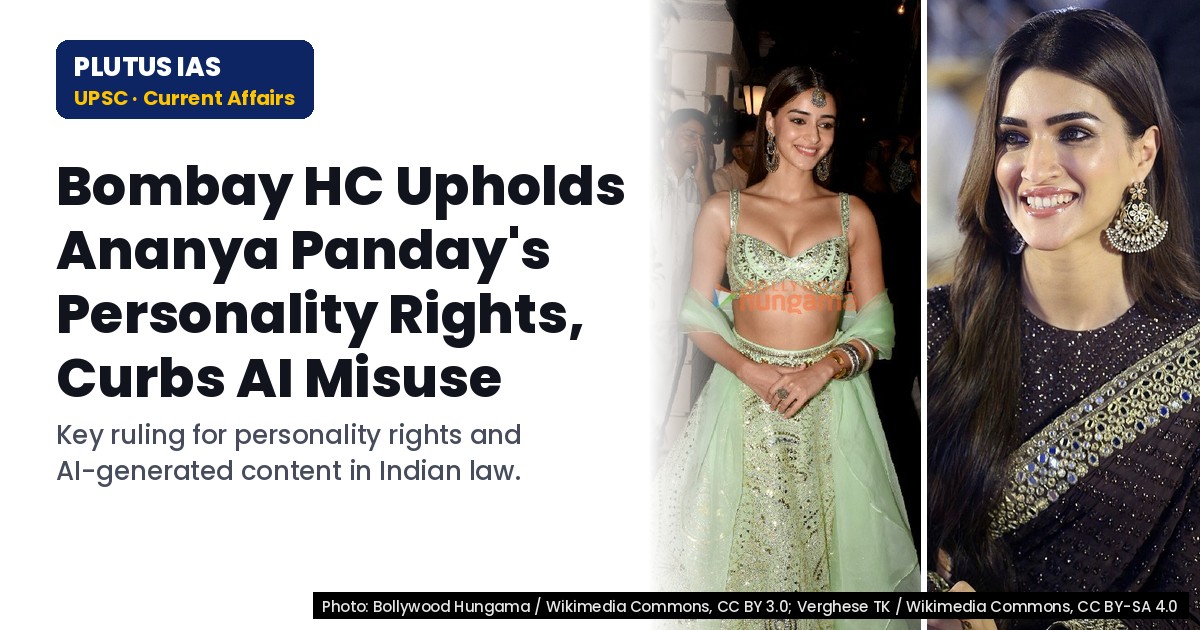
07 Nov Bombay HC Upholds Personality Rights, Curbs AI Misuse
✎ Personality rights protect an individual's identity from unauthorised commercial use, a principle increasingly invoked against AI-generated content and deepfakes in the digital era.
Subject Relevance — Where This Topic Fits
- GS Paper II — Governance, Constitution, Polity, Social Justice | GS Paper III — Science and Technology, Cyber Security
- Prelims: Personality Rights, Right to Privacy, Publicity Rights, Moral Rights, Artificial Intelligence (AI), Deepfakes, Information Technology Act, 2000, Copyright Act, 1957, Bombay High Court, Delhi High Court
- Essay: Balancing individual rights with technological advancements in the digital age., The evolving legal landscape in response to emerging technologies like Artificial Intelligence.
Quick Revision: Personality rights protect an individual’s identity from unauthorised commercial use, a principle increasingly invoked against AI-generated content and deepfakes in the digital era.
Why is this in the news?
The Bombay High Court recently granted an ad-interim order protecting the personality rights of actress Ananya Panday, directing the takedown of objectionable AI-generated content and other unauthorised uses of her likeness. This ruling follows similar petitions by other public figures seeking legal recourse against the misuse of their names, photographs, voices, and AI-generated content without consent, highlighting the growing legal challenges posed by advanced digital technologies.
Background
- Personality rights encompass an individual’s right to control the commercial use of their name, image, likeness, and other identifying features.
- These rights are often invoked by public figures, such as celebrities, to prevent unauthorised commercial exploitation of their identity.
- The advent of Artificial Intelligence (AI) has introduced new complexities, enabling the creation of ‘deepfakes’ and other manipulated content that can infringe upon an individual’s privacy and personality.
- Indian courts have increasingly been approached by celebrities seeking protection against such unauthorised use, including instances involving AI-generated content.
- The Delhi High Court had previously granted partial interim relief to actress Kriti Sanon against sexually explicit deepfakes and manipulated images, though it refrained from imposing a blanket restriction, acknowledging the nuanced nature of personality rights.
- The legal framework in India addresses aspects of personality rights through various statutes, including the Copyright Act, 1957, and the Information Technology Act, 2000.
What are Personality Rights?
- Personality rights are a cluster of rights that protect an individual’s identity from unauthorised commercial exploitation.
- They generally include the right to publicity (the right to control the commercial use of one’s identity) and the right to privacy (the right to be left alone and control personal information).
- These rights are particularly relevant for public figures whose identity holds commercial value.
- Infringement occurs when an individual’s name, image, voice, or other identifying characteristics are used without consent, especially for commercial purposes.
- In India, while not explicitly codified as a standalone statute, personality rights are recognised and enforced through judicial pronouncements, drawing from constitutional provisions like Article 21 (Right to Life and Personal Liberty) and common law principles.
- The rise of AI-generated content, such as deepfakes, poses significant challenges to personality rights by enabling the creation of highly realistic but fabricated images, videos, and audio.
- Courts often issue injunctions, direct takedowns of infringing content, and may award damages to protect these rights.
- The scope of protection typically balances individual rights with freedom of speech and expression, often excluding legitimate news coverage, criticism, satire, or parody.
Key Features
| Feature | Significance |
|---|---|
| Personality Rights | Legal entitlements protecting an individual’s identity, including name, likeness, voice, and other identifying characteristics, from unauthorized commercial exploitation. |
| Right to Privacy | A fundamental right ensuring an individual’s autonomy over their personal information and freedom from unwarranted intrusion. |
| Right to Publicity | The exclusive right of an individual to control the commercial use of their identity, particularly for promotional purposes. |
| Moral Rights | Rights pertaining to the integrity of an individual’s work and reputation, including the right to attribution and protection against derogatory treatment. |
| AI-Generated Content | Digital media created or manipulated using artificial intelligence algorithms, raising new challenges for intellectual property and personal rights. |
| Ad-Interim Order | A temporary court directive issued during the pendency of a lawsuit, intended to preserve the status quo or prevent immediate harm. |
Why it Matters
Legal Precedent and Evolution
- The Bombay High Court’s ruling establishes a significant precedent for the protection of personality rights in the digital age, particularly concerning AI-generated content.
- It reinforces the judiciary’s role in adapting existing legal frameworks to address emerging technological challenges, such as deepfakes and AI-driven identity manipulation.
- The distinction between general personality rights and specific infringements, as highlighted by the Delhi High Court, indicates a nuanced approach to legal remedies.
Protection of Individual Rights
- The judgment safeguards an individual’s right to privacy, publicity, and dignity against unauthorized commercial exploitation and misrepresentation.
- It empowers public figures and individuals to control their digital identity and prevent the misuse of their likeness, voice, and other personal attributes.
- This protection is crucial in an era where AI tools can create highly realistic but fabricated content, potentially damaging reputations and causing financial harm.
Implications for Digital Platforms and AI Ethics
- The directive for takedown of objectionable content places a responsibility on digital platforms to monitor and act against infringements of personality rights.
- It underscores the ethical considerations in the development and deployment of AI technologies, particularly regarding consent, authenticity, and potential for misuse.
- The requirement for platforms to provide user details and IP records can enhance accountability and deter malicious actors exploiting AI for illicit purposes.
Economic and Commercial Impact
- By protecting personality rights, the ruling helps preserve the commercial value associated with an individual’s identity, which is often a significant asset for celebrities and public figures.
- It creates a more secure environment for individuals to engage in commercial endorsements and branding, ensuring that their image is not exploited without consent or compensation.
- The legal clarity can foster fair competition and prevent businesses from gaining an unfair advantage by unauthorized use of prominent personalities.
Challenges
1. Defining and Enforcing Personality Rights
- The scope and precise definition of personality rights, especially in the context of rapidly evolving AI technologies, remain subject to judicial interpretation.
- Enforcing these rights across diverse digital platforms and international jurisdictions presents significant practical and legal complexities.
- Distinguishing between legitimate artistic expression, satire, and actionable infringement requires careful judicial scrutiny.
UPSC Link: Law; Intellectual Property Rights
2. Regulation of AI-Generated Content
- The proliferation of AI tools capable of generating highly realistic images, videos, and audio necessitates robust regulatory frameworks to prevent misuse.
- Balancing the promotion of AI innovation with the need to protect individual rights and prevent harm is a critical policy challenge.
- Establishing clear guidelines for consent, attribution, and liability for AI-generated content is essential.
UPSC Link: Science & Technology; AI Ethics
3. Digital Platform Accountability
- Ensuring that digital platforms promptly identify, remove, and prevent the re-upload of infringing content requires significant technical and operational capabilities.
- The extent of platform liability for user-generated content, particularly when it involves AI manipulation, is an ongoing area of legal debate.
- Implementing mechanisms for swift redressal and user data disclosure while respecting privacy norms is a complex task.
UPSC Link: Governance; IT Act
4. Technological Advancements and Misuse
- The continuous advancement of AI capabilities, including deepfake technology, poses an ever-increasing threat to personal identity and reputation.
- The ease with which AI-generated content can be created and disseminated makes it challenging to track and mitigate its impact effectively.
- Educating the public about the risks of AI-manipulated content and promoting digital literacy are crucial preventive measures.
UPSC Link: Science & Technology; Cyber Security
Challenges — UPSC Perspective
| Issue | Concern |
|---|---|
| Ambiguity in Legal Definitions | The exact contours of personality rights, particularly in relation to privacy and publicity, are still evolving in Indian jurisprudence. |
| Cross-Jurisdictional Enforcement | Enforcing takedown orders and preventing content dissemination across global digital platforms presents significant legal and logistical hurdles. |
| Rapid Technological Evolution | The pace of AI development often outstrips the legislative and judicial capacity to formulate comprehensive regulatory responses. |
| Balancing Rights and Freedoms | Striking a balance between protecting individual personality rights and upholding freedom of speech, expression, and artistic parody is a delicate act. |
| Platform Liability and Responsibility | Determining the extent of responsibility for digital platforms in monitoring, moderating, and removing infringing AI-generated content remains a complex area. |
| User Anonymity and Traceability | Identifying the creators of malicious AI-generated content, especially when users employ anonymity tools, poses a significant challenge for law enforcement. |
Way Forward
- Develop a comprehensive legal framework specifically addressing personality rights in the digital age, including provisions for AI-generated content.
- Establish clear guidelines for digital platforms regarding their responsibilities in content moderation, takedown procedures, and user data disclosure for infringement cases.
- Promote international cooperation and agreements to facilitate cross-border enforcement of personality rights and combat the global dissemination of harmful AI-generated content.
- Invest in public awareness campaigns to educate citizens about the risks of deepfakes and AI-manipulated content, fostering digital literacy and critical media consumption.
- Encourage the development and adoption of ethical AI standards and technologies that incorporate safeguards against misuse and prioritize user consent and data privacy.
- Strengthen the capacity of judicial and law enforcement agencies to handle cases involving advanced digital technologies and AI-related infringements.
- Explore the feasibility of establishing a dedicated regulatory body or a specialized tribunal to address disputes related to digital rights and AI ethics.
UPSC Value Addition
Keywords for Mains Answer-Writing
Personality rights · Right to privacy · Right to publicity · Right to live with dignity · Artificial Intelligence (AI) · Deepfakes · Intellectual Property Rights · Information Technology Act, 2000 · Intermediary Guidelines · Fundamental Rights · Article 21 · Judicial precedent
Constitutional & Policy Linkages
- Article 21: Protection of Life and Personal Liberty.
- Article 19(1)(a): Freedom of Speech and Expression (with reasonable restrictions).
Concept Flow
Unauthorized use of identity/likeness → Creation of AI-generated content → Infringement of personality rights → Legal recourse by affected individual → Court intervention and ad-interim order → Takedown directive and content removal → Establishment of legal precedent
Prelims Practice Questions
Q1. Consider the following statements regarding ‘Personality Rights’ in India:
1. Personality rights are explicitly defined and codified under a specific statute in India.
2. These rights encompass an individual’s right to control the commercial use of their name, image, voice, and other identifying features.
3. The right to privacy, as enshrined in Article 21 of the Constitution, forms a foundational basis for personality rights.
How many of the above statements are correct?
- Only one
- Only two
- Only three
- None
Answer: Only two — Statement 1 is incorrect: Personality rights are not explicitly codified under a single statute in India but are largely derived from common law principles, intellectual property statutes, and constitutional rights. Statement 2 is correct: Personality rights indeed grant individuals control over the commercial exploitation of their unique identity attributes. Statement 3 is correct: The Supreme Court’s recognition of the right to privacy under Article 21, particularly in cases like Puttaswamy, has significantly strengthened the constitutional underpinning of personality rights.
Q2. Which of the following legal provisions or principles is most directly relevant to addressing the misuse of AI-generated content, such as deepfakes, that infringes upon an individual’s identity and reputation?
(A) The Indian Penal Code, 1860, for defamation.
(B) The Information Technology Act, 2000, particularly its provisions concerning intermediary liability and objectionable content.
(C) The Copyright Act, 1957, for infringement of artistic works.
(D) The Patents Act, 1970, for protection of inventions.
- A
- B
- C
- D
Answer: B — While defamation under the IPC may apply, the Information Technology Act, 2000, especially its rules like the Information Technology (Intermediary Guidelines and Digital Media Ethics Code) Rules, 2021, is more directly relevant for addressing online content, including AI-generated deepfakes, and imposing obligations on intermediaries for their removal. Copyright Act and Patents Act are not directly applicable to personality rights infringement by deepfakes.
Mains Practice Question
✍ Critically examine the evolving jurisprudence on personality rights in India, particularly in the context of emerging challenges posed by Artificial Intelligence (AI) and deepfake technology. Discuss the role of judicial pronouncements in safeguarding individual identity and dignity. (15 Marks)
Approach: MODEL-ANSWER SKELETON:
1. **Introduction (20 words):** Define personality rights (right to control commercial use of identity) and briefly mention their increasing relevance due to AI.
2. **Evolving Jurisprudence on Personality Rights (80 words):**
* **Common Law Basis:** Explain how these rights are largely judge-made, drawing from tort law (passing off, defamation) and intellectual property principles.
* **Constitutional Foundation:** Detail the link to Article 21 (Right to Life and Personal Liberty) and the Right to Privacy (K.S. Puttaswamy judgment).
* **Components:** Differentiate between Right to Publicity (commercial exploitation) and Right to Privacy (non-commercial aspects, dignity).
* **Judicial Precedents:** Mention key High Court judgments (e.g., Delhi HC in Anil Kapoor, Jackie Shroff, Amitabh Bachchan cases; Bombay HC in Ananya Panday case) affirming these rights.
3. **Challenges Posed by AI and Deepfake Technology (70 words):**
* **Unauthorised Creation:** Explain how AI facilitates the creation of realistic but fake images, videos, and audio without consent.
* **Misuse and Exploitation:** Discuss commercial exploitation, reputational damage, and potential for harassment/intimidation.
* **Difficulty in Attribution:** Highlight the challenge of identifying creators and distributors of deepfakes.
* **Global Nature:** Mention the cross-jurisdictional challenges in enforcement.
4. **Role of Judicial Pronouncements (60 words):**
* **Proactive Approach:** Courts are issuing ad-interim injunctions and takedown orders (e.g., Bombay HC in Ananya Panday, Delhi HC in Kriti Sanon).
* **Balancing Rights:** Acknowledge the need to balance personality rights with freedom of speech and expression (Article 19(1)(a)), as seen in the Delhi HC’s refusal of blanket restrictions.
* **Directing Intermediaries:** Courts are increasingly holding online platforms accountable and directing them to remove objectionable content and provide user details.
* **Expanding Scope:** Judicial interpretations are adapting existing legal frameworks to new technological realities.
5. **Conclusion (20 words):** Summarise the judiciary’s crucial role in adapting legal principles to protect individual rights in the digital age, while also highlighting the need for legislative clarity.
Source: Times of India
Generated by AanyaAi for educational purpose.
Related guides on our sites
- How to prepare for GS paper 1 for UPSC CSE mains exam
- Best UPSC coaching for IFOS exam
- Best mentorship programme for upsc
- UPSC+BA degree

- Bombay HC Upholds Personality Rights, Curbs AI Misuse - November 7, 2026
- अल्पसंख्यक कल्याण योजनाओं की लंबित स्थिति की समीक्षा - November 6, 2026
- Semicon India 2.0 Portal Launched, Boosts Electronics Manufacturing - November 6, 2026

No Comments