


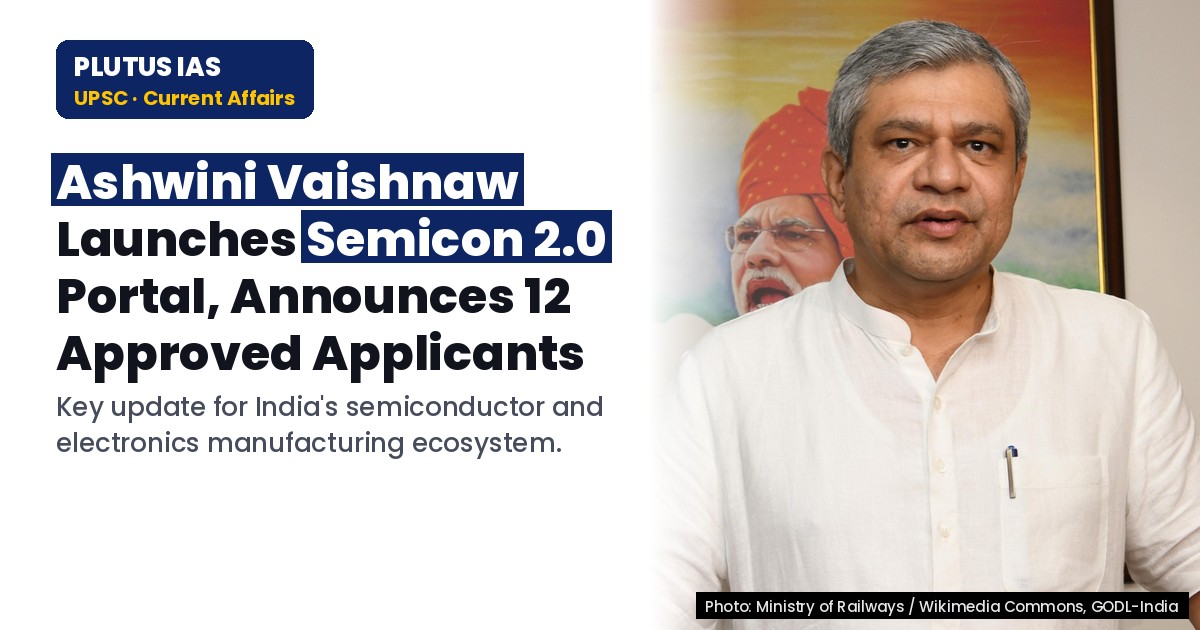
06 Nov Semicon India 2.0 Portal Launched, Boosts Electronics Manufacturing
✎ The Semicon India Program, under the India Semiconductor Mission, is a multi-pronged government initiative with a significant financial outlay, focused on establishing a comprehensive domestic semiconductor ecosystem through…
Subject Relevance — Where This Topic Fits
- GS Paper III — Economy | GS Paper III — Science and Technology | GS Paper III — Infrastructure
- Prelims: Semicon India Program, India Semiconductor Mission (ISM), Electronics Components Manufacturing Scheme (ECMS), Chips to Startup (C2S) program, Semiconductor manufacturing, Domestic value chain
- Essay: India’s aspiration to become a global manufacturing hub: opportunities and challenges., The role of government policies in fostering technological self-reliance and economic growth.
Quick Revision: The Semicon India Program, under the India Semiconductor Mission, is a multi-pronged government initiative with a significant financial outlay, focused on establishing a comprehensive domestic semiconductor ecosystem through strategic pillars encompassing design, manufacturing, R&D, and talent development.
Why is this in the news?
The Union Minister for Electronics and Information Technology launched the Semicon 2.0 web application portal and announced the approval of 12 additional applications under the Electronics Components Manufacturing Scheme (ECMS). This initiative marks a significant step in strengthening India’s semiconductor and electronics ecosystem, with the application process commencing for the second, third, and fourth pillars of the Semicon India Program.
Background
- The Government of India has been actively pursuing strategic initiatives and policy measures to establish a robust semiconductor ecosystem within the country.
- The India Semiconductor Mission (ISM) was established to drive the development and growth of this ecosystem.
- The first phase of the ‘Semicon India Program’ (Semicon 1.0) successfully approved 12 projects across six states, attracting investments exceeding INR 1.64 lakh crore.
- Under Semicon 1.0, commercial production has commenced in five projects by October 2026, alongside support for startups through EDA tools, funding, and venture capital.
- The Chips to Startup (C2S) program has provided EDA tools to 332 institutions and trained approximately 70,000 students.
- The Union Cabinet has approved Semicon 2.0 with a financial outlay of INR 1,27,500 crore, signifying the next phase of India’s semiconductor journey.
What is Semicon India Program and its components?
- The Semicon India Program is a comprehensive initiative by the Government of India aimed at building a robust semiconductor and display manufacturing ecosystem in the country.
- Semicon 2.0, approved with a substantial financial outlay, focuses on six strategic pillars to achieve this objective.
- Pillar 1 focuses on Chip Design, fostering indigenous design capabilities.
- Pillar 2 addresses Machines and Materials, crucial for the manufacturing process.
- Pillar 3 aims at establishing more Fabrication (Fab) units, which are essential for semiconductor production.
- Pillar 4 seeks to strengthen the Assembly, Testing, Marking, and Packaging (ATMP)/Outsourced Semiconductor Assembly and Test (OSAT) industry.
- Pillar 5 is dedicated to Research and Development (R&D), promoting innovation and technological advancement.
- Pillar 6 emphasizes Talent Development, ensuring a skilled workforce for the semiconductor sector.
- The Electronics Components Manufacturing Scheme (ECMS) is a related scheme designed to incentivize the manufacturing of electronic components, thereby strengthening the domestic supply chain.
Key Features
| Feature | Significance |
|---|---|
| Semicon India Program (Semicon 2.0) | A comprehensive initiative with a financial outlay of INR 1,27,500 crore, approved by the Union Cabinet, aimed at establishing a robust semiconductor ecosystem in India. |
| Semicon 2.0 Web Application Portal | Launched to facilitate the application process for the second, third, and fourth pillars of the Semicon India Program, streamlining access for industry stakeholders. |
| Electronics Components Manufacturing Scheme (ECMS) | Under this scheme, 12 additional applications have been approved, involving an estimated investment of INR 7,503 crore, reinforcing domestic electronics manufacturing. |
| Six Strategic Pillars of Semicon 2.0 | Focuses on critical areas including chip design, machinery and materials, establishment of more manufacturing units (fabs), strengthening ATMP/OSAT industry, research and development, and talent development. |
| Domestic Value Chain Development | Shifting India’s electronics manufacturing focus from mere assembly to comprehensive development of domestic value chains, encompassing modules, components, materials, and advanced technologies. |
| MSME Sector Involvement | Approximately 50% of the units approved under the ECMS are from the Micro, Small, and Medium Enterprises (MSME) sector, fostering inclusive growth and strengthening domestic supply chains. |
Why it Matters
Economic Significance
- Fosters domestic manufacturing capabilities, reducing reliance on imports for critical electronic components and semiconductors.
- Attracts substantial investment into the electronics and semiconductor sectors, stimulating economic growth and job creation.
- Enhances India’s position in the global electronics supply chain, promoting export potential and foreign exchange earnings.
- Supports the growth of Micro, Small, and Medium Enterprises (MSMEs) by creating new opportunities within the domestic supply chain.
Strategic Significance
- Strengthens national security by ensuring a resilient and self-reliant supply of essential semiconductor components, crucial for defence and critical infrastructure.
- Positions India as a significant player in advanced technology manufacturing, contributing to strategic autonomy in the digital age.
- Promotes research and development in cutting-edge technologies, fostering innovation and technological leadership.
- Contributes to the ‘Atmanirbhar Bharat’ vision by building a comprehensive domestic semiconductor ecosystem.
Technological Significance
- Facilitates the establishment of advanced manufacturing units (fabs) for semiconductors and related components.
- Promotes the development of a skilled workforce in semiconductor design, manufacturing, and related fields through talent development initiatives.
- Encourages the adoption of advanced materials, equipment, chemicals, and gases essential for semiconductor production.
- Drives technological advancement across various sectors reliant on semiconductors, including telecommunications, automotive, and consumer electronics.
Challenges
1. High Capital Investment and Long Gestation Periods
- Establishing semiconductor fabrication units (fabs) requires immense capital expenditure and has a prolonged return on investment cycle.
- The financial commitment for advanced manufacturing facilities necessitates sustained government support and private sector participation.
UPSC Link: Economy: Industrial Policy
2. Technological Complexity and Rapid Obsolescence
- The semiconductor industry is characterized by extremely complex manufacturing processes and rapid technological advancements, requiring continuous upgrades.
- Maintaining competitiveness necessitates significant investment in research and development to keep pace with global innovations.
UPSC Link: Science & Tech: IT, Electronics
3. Skilled Manpower Shortage
- There is a significant demand for highly specialized engineers and technicians in semiconductor design, manufacturing, and testing.
- Developing a robust talent pool requires extensive training programs and collaboration between academia and industry.
UPSC Link: HRD: Skill Development
4. Global Competition and Geopolitical Dynamics
- The global semiconductor market is dominated by a few major players, making it challenging for new entrants to establish a foothold.
- Geopolitical tensions and trade policies can impact supply chains and access to critical technologies and materials.
UPSC Link: Economy: International Trade
5. Infrastructure and Ecosystem Development
- Requires a robust supporting ecosystem, including reliable power supply, clean water, specialized chemicals, and logistics infrastructure.
- Developing this comprehensive infrastructure across multiple locations presents logistical and coordination challenges.
UPSC Link: Economy: Infrastructure
Challenges — UPSC Perspective
| Issue | Concern |
|---|---|
| Capital Intensity | High initial investment and long payback periods for semiconductor manufacturing facilities. |
| Technological Gap | Bridging the gap with established global leaders in advanced semiconductor technologies. |
| Talent Availability | Ensuring a sufficient supply of highly skilled engineers and researchers for the semiconductor sector. |
| Supply Chain Resilience | Building robust domestic supply chains for critical raw materials, equipment, and components. |
| Global Market Access | Navigating international trade dynamics and securing market access for Indian-made semiconductors. |
| Environmental Impact | Managing the significant environmental footprint associated with semiconductor manufacturing, including water and energy consumption. |
Government Initiatives — Must-Memorise for Prelims
- Semicon India Program
- Electronics Components Manufacturing Scheme (ECMS)
- Chips to Startup (C2S) program
- India Semiconductor Mission (ISM)
Way Forward
- Prioritize targeted investments in research and development to foster indigenous innovation in semiconductor design and manufacturing processes.
- Strengthen academia-industry collaboration to develop specialized curricula and training programs, addressing the skilled manpower shortage.
- Streamline regulatory approvals and provide consistent policy support to create an attractive and predictable investment environment for domestic and international players.
- Focus on developing a comprehensive ancillary ecosystem, including suppliers of specialized chemicals, gases, and equipment, to enhance local value addition.
- Promote international partnerships and collaborations to access advanced technologies, expertise, and global market opportunities.
- Implement robust quality control and standardization mechanisms to ensure the global competitiveness and reliability of Indian-made semiconductor products.
- Incentivize sustainable manufacturing practices to minimize the environmental impact of semiconductor production and ensure long-term viability.
UPSC Value Addition
Keywords for Mains Answer-Writing
Semiconductor Ecosystem · Semicon India Program · Electronics Manufacturing · India Semiconductor Mission (ISM) · Domestic Value Chain · MSME Opportunities · Strategic Pillars · Atmanirbhar Bharat · Research and Development · Talent Development
Concept Flow
Government launches Semicon India Program and ECMS. → Financial incentives and policy support attract investments. → Domestic and international firms establish manufacturing units. → Production of electronic components and semiconductors increases. → India’s electronics manufacturing ecosystem strengthens. → Economic growth and strategic autonomy in technology achieved.
Prelims Practice Questions
Q1. Consider the following statements regarding the Semicon India Program:
1. The program aims to establish a robust semiconductor ecosystem in India.
2. Semicon 2.0 has been approved with a financial outlay of ₹1,27,500 crore under the India Semiconductor Mission (ISM).
3. The Electronics Components Manufacturing Scheme (ECMS) is a component of the broader Semicon India Program.
How many of the above statements are correct?
- Only one
- Only two
- All three
- None
Answer: All three — Statement 1 is correct: The core objective of the Semicon India Program is indeed to foster a strong semiconductor ecosystem. Statement 2 is correct: Semicon 2.0, with its specified financial outlay, has been approved under the ISM. Statement 3 is correct: ECMS is explicitly mentioned as a scheme under which applications have been approved, indicating its integration within the larger semiconductor and electronics manufacturing initiatives.
Q2. Which of the following are key strategic pillars of Semicon 2.0?
1. Chip Design
2. Machines and Materials
3. Establishment of More Manufacturing Units (Fabs)
4. Strengthening ATMP/OSAT Industry
5. Research and Development
6. Talent Development
Select the correct answer using the code given below:
- 1, 2, 3, 4 and 5 only
- 2, 3, 4, 5 and 6 only
- 1, 3, 4, 5 and 6 only
- 1, 2, 3, 4, 5 and 6
Answer: 1, 2, 3, 4, 5 and 6 — All six listed points are explicitly mentioned as strategic pillars of Semicon 2.0 in the provided text, indicating a comprehensive approach to semiconductor ecosystem development.
Mains Practice Question
✍ Discuss the strategic objectives and implementation framework of the Semicon India Program in fostering a robust domestic semiconductor ecosystem. Evaluate its potential impact on India’s electronics manufacturing value chain and the ‘Atmanirbhar Bharat’ initiative. (15 Marks)
Approach: The answer should commence by outlining the strategic objectives of the Semicon India Program, including its aim to establish a comprehensive semiconductor ecosystem. It must detail the implementation framework, specifically mentioning Semicon 1.0 and Semicon 2.0, along with their respective financial outlays (e.g., ₹1,27,500 crore for Semicon 2.0) and the six strategic pillars (Chip Design, Machines and Materials, Fabs, ATMP/OSAT, R&D, Talent Development). The discussion should then transition to evaluating the program’s potential impact on India’s electronics manufacturing value chain, highlighting aspects like moving beyond assembly to comprehensive domestic value creation, strengthening domestic supply chains, and creating opportunities for MSMEs (e.g., ~50% of approved units under ECMS are MSMEs). Finally, the answer should connect these impacts to the broader ‘Atmanirbhar Bharat’ initiative, emphasizing self-reliance in critical technologies and global competitiveness. Reference to the India Semiconductor Mission (ISM) as the overarching body is crucial.
Source: PIB (Press Information Bureau)
Generated by AanyaAi for educational purpose.
Related guides on our sites
- Anthropology VS PSIR
- Best PSIR optional coaching
- Best PSIR optional coaching online
- Best PSIR optional teacher

- Semicon India 2.0 Portal Launched, Boosts Electronics Manufacturing - November 6, 2026
- गृह लक्ष्मी योजना: ग्रामीण महिलाओं के जीवन में बदलाव की प्रेरक कहानियाँ - November 6, 2026
- PM SHRI School Science Exhibition: Innovation & Problem-Solving - November 6, 2026

No Comments