


05 Nov BRICS Carbon Market Partnership: UPSC & State PCS Analysis
✎ The BRICS Carbon Markets Partnership aims to foster coordinated climate action among member states through capacity-building, experience-sharing, and the potential harmonisation of national carbon market frameworks.
Subject Relevance — Where This Topic Fits
- GS Paper II — International Relations | GS Paper III — Economy | GS Paper III — Environment
- Prelims: BRICS, Carbon Markets, Emissions Trading System (ETS), Carbon Credit Trading Scheme (CCTS), Measurement, Reporting, and Verification (MRV), Climate Finance
- Essay: Multilateralism and Global Governance in the 21st Century, Sustainable Development and Climate Change: Challenges and Opportunities for Emerging Economies
Quick Revision: The BRICS Carbon Markets Partnership aims to foster coordinated climate action among member states through capacity-building, experience-sharing, and the potential harmonisation of national carbon market frameworks.
Why is this in the news?
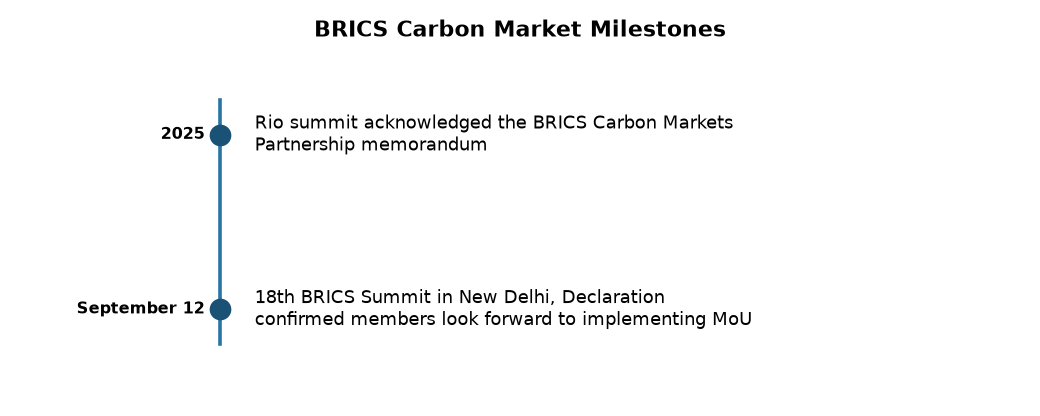
The 18th BRICS Summit in New Delhi reiterated commitment to the Memorandum of Understanding on the BRICS Carbon Markets Partnership, initially acknowledged at the Rio summit in 2025. While the current commitment focuses on capacity-building and experience-sharing without a direct trading framework, the ongoing discussions highlight the potential for BRICS nations to transition from fragmented national carbon markets to a more coordinated international framework, especially as India’s BRICS presidency concludes.
Background
- BRICS nations collectively represent a significant portion of global greenhouse gas emissions and host a substantial number of carbon credit projects worldwide.
- Several BRICS members, including Brazil, China, India, and Indonesia, operate voluntary carbon markets and are developing or maturing compliance-based emissions trading systems.
- China’s Emissions Trading System (ETS) has expanded its sectoral coverage to include steel, cement, and aluminium, indicating a growing regulatory scope.
- India’s Carbon Credit Trading Scheme (CCTS) has established emission-intensity targets for numerous entities across key sectors and introduced an offset mechanism.
- Brazil has enacted legislation to establish the Brazilian Greenhouse Gas Emissions Trading System (SBCE), adopting a cap-and-trade approach.
- Despite these individual advancements, the existing national carbon markets within BRICS are largely unlinked, presenting a challenge for achieving synergistic climate action.
Understanding Carbon Markets and the BRICS Partnership
- Carbon markets are mechanisms that allow for the buying and selling of carbon credits, where each credit typically represents one tonne of carbon dioxide equivalent (CO2e) emissions reduced or removed.
- They can be voluntary, where entities voluntarily purchase credits to offset their emissions, or compliance-based, where governments set caps on emissions and entities trade allowances to meet their obligations.
- An Emissions Trading System (ETS) is a market-based approach to control pollution by providing economic incentives for achieving reductions in the emissions of pollutants.
- The BRICS Carbon Markets Partnership aims to facilitate cooperation among member states on carbon market development, capacity-building, and experience-sharing.
- A crucial initial step for the partnership is the establishment of a common framework for Measurement, Reporting, and Verification (MRV) to ensure transparency and comparability of emission reductions.
- Harmonisation of rules and standards across national carbon markets within BRICS could pave the way for future interoperability and potentially a linked trading framework.
- The partnership seeks to leverage the collective experience and scale of BRICS nations to enhance the effectiveness and integrity of global carbon markets.
- Such coordination can contribute to achieving national climate targets and global climate goals under agreements like the Paris Agreement.
Key Features
| Feature | Significance |
|---|---|
| BRICS Carbon Markets Partnership | A collaborative initiative among BRICS nations to foster cooperation in carbon markets, initially focusing on capacity-building and experience-sharing. |
| New Delhi Declaration (18th BRICS Summit) | Reiterated commitment to implementing the Memorandum of Understanding on the BRICS Carbon Markets Partnership, signifying continued political will. |
| Fragmented Carbon Markets | Existing carbon markets within BRICS nations operate independently, lacking interoperability and a common regulatory framework. |
| Common Rulebook Requirement | The primary need for operationalising the partnership is a standardised set of rules for measurement, reporting, and verification (MRV), rather than an immediate common trading platform. |
| India’s Carbon Credit Trading Scheme (CCTS) | A domestic compliance mechanism in India, notifying emission-intensity targets for specified entities and establishing an offset mechanism. |
Why it Matters
Environmental Significance
- Facilitating coordinated efforts among major developing economies to address climate change through market-based mechanisms.
- Potentially enhancing the effectiveness of global carbon reduction initiatives by integrating diverse national approaches.
Economic Significance
- Creating a larger, more liquid carbon market, which could improve price discovery and reduce transaction costs for carbon credits.
- Promoting green investments and technology transfer among BRICS nations by incentivising emissions reductions.
- Offering new avenues for economic cooperation and trade in environmental goods and services within the bloc.
Strategic Significance
- Strengthening the BRICS bloc’s influence in global climate governance and negotiations.
- Providing a platform for developing countries to shape the future of international carbon markets, aligning with their specific development contexts.
- Enhancing energy security through diversification towards cleaner energy sources incentivised by carbon pricing.
Challenges
1. Lack of a Common Rulebook
- Disparate national standards for measurement, reporting, and verification (MRV) hinder the comparability and fungibility of carbon credits.
- Absence of harmonised methodologies creates barriers to linking national carbon markets and establishing a unified trading framework.
UPSC Link: Environmental Governance
2. Interoperability Issues
- National carbon markets within BRICS operate independently, preventing seamless cross-border trading and mutual recognition of credits.
- Differences in market design, scope, and regulatory oversight complicate efforts to establish a coordinated trading framework.
UPSC Link: International Economic Relations
3. Varying Levels of Market Maturity
- Some BRICS members possess well-developed compliance and voluntary carbon markets, while others are in nascent stages, leading to asymmetry in capacity and experience.
- Divergent national priorities and economic structures may influence the pace and extent of market integration.
UPSC Link: Economic Development
4. Absence of Trading Framework, Targets, and Timelines
- The current commitment is limited to capacity-building and experience-sharing, lacking concrete mechanisms for carbon credit trading.
- The absence of specific targets and timelines impedes the operationalisation and measurable progress of the partnership.
UPSC Link: Climate Change Policy
Challenges — UPSC Perspective
| Issue | Concern |
|---|---|
| Fragmented National Markets | Prevents economies of scale, limits liquidity, and complicates cross-border carbon credit transactions. |
| Inconsistent MRV Standards | Undermines the credibility and comparability of emissions reductions, hindering mutual recognition of carbon credits. |
| Lack of Common Trading Platform | Restricts the potential for a unified carbon price signal across BRICS nations, reducing market efficiency. |
| Limited Scope of Current Partnership | Focus on capacity-building without a clear pathway to a trading framework delays substantive climate action through market mechanisms. |
| Diverse Regulatory Landscapes | Differences in national laws and regulations governing carbon markets create legal and operational complexities for integration. |
Government Initiatives — Must-Memorise for Prelims
- Carbon Credit Trading Scheme (CCTS)
Way Forward
- Prioritise the development of a common rulebook for Measurement, Reporting, and Verification (MRV) of emissions and carbon credits among BRICS members.
- Establish a technical working group to harmonise standards and methodologies for carbon accounting and credit generation.
- Facilitate bilateral and multilateral pilot projects to test interoperability between existing national carbon markets.
- Develop a phased roadmap for the BRICS Carbon Markets Partnership, including specific targets and timelines for market integration.
- Invest in capacity-building initiatives to strengthen institutional frameworks and technical expertise in carbon market operations across all BRICS nations.
- Explore the potential for a BRICS-wide registry system for carbon credits to enhance transparency and prevent double counting.
- Engage with international organisations and existing carbon market mechanisms to learn best practices and ensure global alignment.
UPSC Value Addition
Keywords for Mains Answer-Writing
BRICS Carbon Markets Partnership · Global Carbon Markets · Emissions Trading Systems (ETS) · Carbon Credit Trading Scheme (CCTS) · Measurement, Reporting, Verification (MRV) · Climate Change Mitigation · International Cooperation · Sustainable Development Goals · Cap-and-Trade Systems · Voluntary Carbon Markets
Concept Flow
BRICS nations commit to Carbon Markets Partnership → Fragmented national carbon markets exist with diverse rules → Need for common rulebook for MRV identified → Harmonisation of standards enables interoperability → Coordinated framework facilitates cross-border carbon trading → Enhanced market efficiency supports climate action goals
Prelims Practice Questions
Q1. Consider the following statements regarding carbon markets:
1. A compliance carbon market is typically established by national or international regulations to achieve emission reduction targets.
2. Voluntary carbon markets allow individuals, companies, or governments to purchase carbon credits to offset their emissions on a voluntary basis.
3. India’s Carbon Credit Trading Scheme (CCTS) operates as a purely voluntary market without any mandated emission intensity targets.
How many of the above statements are correct?
- Only one
- Only two
- Only three
- None
Answer: Only two — Statement 1 is correct: Compliance markets are regulatory-driven. Statement 2 is correct: Voluntary markets facilitate voluntary offsetting. Statement 3 is incorrect: India’s CCTS has notified emission-intensity targets for entities, indicating a compliance component, not purely voluntary.
Q2. Which of the following countries are mentioned as hosting over a third of the carbon credit projects registered worldwide, according to the news?
- Brazil, China, India, and Indonesia
- India, China, European Union, and United States
- Brazil, Russia, India, and China
- Indonesia, South Africa, European Union, and United Kingdom
Answer: Brazil, China, India, and Indonesia — The article explicitly states that Brazil, China, India, and Indonesia host over a third of the carbon credit projects registered worldwide.
Mains Practice Question
✍ The BRICS Carbon Markets Partnership aims to foster cooperation among member states in developing and integrating their carbon markets. Critically examine the potential benefits and challenges associated with establishing a common rulebook and coordinated trading framework for BRICS nations. (15 Marks)
Approach: INTRODUCTION: Briefly introduce the BRICS Carbon Markets Partnership and its objective as stated in the New Delhi Declaration.
POTENTIAL BENEFITS:
1. Enhanced Market Efficiency: Discuss how a common rulebook can reduce transaction costs, increase liquidity, and improve price discovery across fragmented markets.
2. Increased Climate Ambition: Explain how a coordinated framework can facilitate higher emission reduction targets and more effective climate action by leveraging collective strengths.
3. Technology Transfer and Capacity Building: Detail the opportunities for sharing best practices, technical expertise, and infrastructure development among BRICS members.
4. Global Influence: Argue how a unified BRICS approach could strengthen their negotiating position in international climate forums and shape global carbon market standards.
5. Economic Opportunities: Mention potential for green investment, job creation, and sustainable development through a robust carbon market.
CHALLENGES:
1. Divergent National Regulations and Market Structures: Discuss the complexities arising from varying levels of market maturity, regulatory frameworks (e.g., cap-and-trade vs. offset mechanisms), and national priorities among BRICS members (e.g., China’s ETS, India’s CCTS, Brazil’s SBCE).
2. Measurement, Reporting, and Verification (MRV) Standards: Highlight the difficulty in harmonizing MRV protocols to ensure transparency, credibility, and prevent double-counting of emissions reductions.
3. Political Will and Trust: Address the need for sustained political commitment and mutual trust to overcome national interests and establish a truly integrated system.
4. Price Volatility and Market Stability: Explain the challenges in managing price fluctuations and ensuring market stability across diverse economies.
5. Governance and Enforcement Mechanisms: Discuss the complexities of establishing a robust governance structure and enforcement mechanisms for a multinational carbon market.
CONCLUSION: Summarize the importance of a phased approach, starting with a common rulebook for MRV, and emphasize the strategic significance of the partnership for global climate action and sustainable economic growth within BRICS.
Source: The Hindu
Generated by AanyaAi for educational purpose.
Related guides on our sites
- Best PSIR optional coaching for upsc
- Best PSIR optional teacher for upsc
- Best teacher of PSIR optional for upsc
- Best PSIR optional coaching in delhi for UPSC

- BRICS Carbon Market Partnership: UPSC & State PCS Analysis - November 5, 2026
- घटिया दवा निर्माताओं के लाइसेंस तत्काल निलंबित करने का प्रस्ताव - November 4, 2026
- Odisha-J-PAL Pact: Evidence-Based Policymaking for UPSC - November 4, 2026

No Comments