


06 Aug Cabinet Approves ₹23,731 Crore National Gobardhan Scheme for CBG Expansion
✎ Gobardhan is a ₹23,731 crore, decade-long scheme to scale up Compressed Biogas production tenfold, integrate rural biomass into the energy mix, and establish India’s circular bio-economy by leveraging guaranteed offtake, stable…
Subject Relevance — Where This Topic Fits
- GS Paper III — Environment, Conservation, Environmental Pollution and Degradation | GS Paper III — Infrastructure: Energy | GS Paper III — Agricultural Marketing and Issues | GS Paper III — Government Budgeting and Policies
- Prelims: Compressed Biogas (CBG), Circular Bio-Economy, Gobardhan Scheme, Biomass Feedstock, Renewable Natural Gas, Energy Transition, Waste-to-Wealth, Sustainable Alternative Towards Affordable Transportation (SATAT)
- Essay: India’s Energy Transition: Balancing Growth, Sustainability and Inclusivity, Circular Economy as a Pathway to Sustainable Development Goals
Quick Revision: Gobardhan is a ₹23,731 crore, decade-long scheme to scale up Compressed Biogas production tenfold, integrate rural biomass into the energy mix, and establish India’s circular bio-economy by leveraging guaranteed offtake, stable pricing, and pipeline infrastructure.
Why is this in the news?
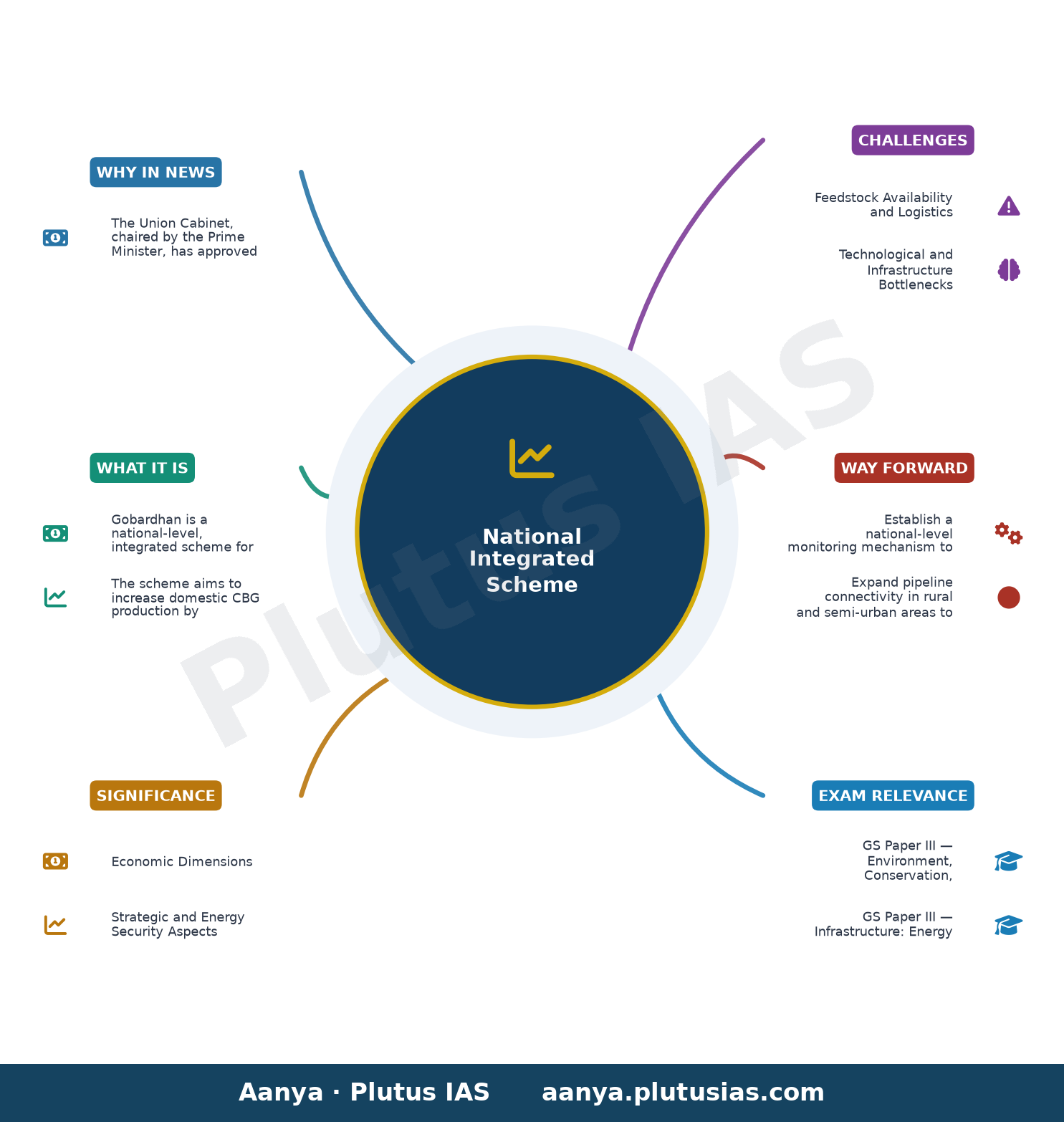
The Union Cabinet, chaired by the Prime Minister, has approved the National Integrated Scheme ‘Gobardhan’ for Compressed Biogas (CBG) with a total outlay of ₹23,731 crore. This scheme, to be implemented from FY 2026-27 to FY 2035-36, aims to catalyse a tenfold increase in domestic CBG production, integrate rural biomass resources into the clean energy matrix, and establish a robust framework for a circular bio-economy in India. The approval underscores the government’s commitment to leveraging agricultural residues, cattle dung, municipal organic waste, and other biomass to enhance energy security, reduce fossil fuel dependence, and promote rural prosperity.
Background
- India’s energy demand is projected to grow significantly, with natural gas consumption expected to rise from 60 billion cubic meters (BCM) in 2023 to over 100 BCM by 2030, necessitating diversification of energy sources.
- The SATAT initiative, launched in 2018, laid the foundation for a CBG ecosystem by incentivizing entrepreneurs to set up CBG plants and supply CBG to oil marketing companies (OMCs) under long-term purchase agreements.
- The National Bioenergy Programme (NBP) and the Market Development Assistance (MDA) scheme for organic manure have supported the establishment of over 200 CBG plants, demonstrating the viability of biomass-to-energy models across diverse feedstocks and geographies.
- India’s commitment to net-zero emissions by 2070 and the 2030 targets under the Paris Agreement necessitate accelerated adoption of renewable energy sources, including CBG, to decarbonize the transport and industrial sectors.
What is the Gobardhan Scheme?
- Gobardhan is a national-level, integrated scheme for promoting Compressed Biogas (CBG) production from agricultural residues, cattle dung, press mud, municipal organic waste, and other biomass feedstocks, thereby fostering a circular bio-economy.
- The scheme aims to increase domestic CBG production by approximately ten times, aligning with India’s energy transition goals.
- A total financial outlay of ₹23,731 crore is earmarked for the scheme, to be disbursed over FY 2026-27 to FY 2035-36, with a focus on demand assurance, stable pricing, capital subsidies, pipeline connectivity, and access to finance.
- The scheme introduces six components: assured demand, beneficial and stable pricing, capital support, pipeline infrastructure, loan support and technology development to enhance project viability and investor confidence.
- Gobardhan will create a predictable market for CBG producers by mandating long-term purchase agreements with OMCs, ensuring price stability and reducing revenue risks for investors.
- The scheme integrates CBG with existing natural gas infrastructure, as CBG is chemically equivalent to natural gas (RNG), enabling seamless blending and utilization in the existing gas grid for transport, industrial, and domestic applications.
- By promoting localised circular economies around CBG plants, the scheme will generate employment in feedstock supply, transportation, plant operations, and organic manure production, while addressing waste management and reducing greenhouse gas emissions.
- Gobardhan aligns with the ‘Atmanirbhar Bharat’ vision by reducing import dependence on fossil fuels, enhancing rural incomes, and positioning India as a global leader in sustainable bio-energy solutions.
Key Features
| Feature | Significance |
|---|---|
| Total Outlay of ₹23,731 crore | Provides substantial financial backing for large-scale deployment of compressed biogas (CBG) infrastructure over a decade (2026-36). |
| Guaranteed offtake and stable pricing mechanism | Ensures market certainty for CBG producers, reducing investment risk and attracting private capital. |
| Capital subsidy and credit support | Lowers entry barriers for entrepreneurs, particularly in rural areas, by defraying initial capital costs. |
| Pipeline infrastructure integration | Enables seamless injection of CBG into existing gas grid, enhancing national energy distribution efficiency. |
| Technology development and R&D focus | Promotes innovation in feedstock processing, biogas upgrading, and end-use applications to improve efficiency and scalability. |
Why it Matters
Economic Dimensions
- Transforms agricultural residues, cattle dung, and municipal waste into high-value energy and organic fertiliser, creating rural livelihoods and reducing waste management costs.
- Stimulates private investment in CBG plants, estimated to generate employment across feedstock supply chains, plant operations, and distribution networks.
- Reduces import dependence on conventional fuels by substituting 10% of projected natural gas demand with domestically produced CBG by 2036.
Strategic and Energy Security Aspects
- Aligns with India’s commitment to the Paris Agreement by reducing methane emissions from agricultural waste and promoting renewable energy integration.
- Enhances energy security by diversifying the national gas mix and reducing vulnerability to global fuel price volatility.
- Supports the National Bioenergy Programme’s objective of scaling up bioenergy capacities to 15 GW by 2030.
Environmental and Circular Economy Benefits
- Mitigates greenhouse gas emissions by capturing methane from decomposing organic waste, a potent short-lived climate pollutant.
- Promotes circular economy principles by converting waste streams into resources, thereby reducing landfill use and soil degradation.
- Contributes to the achievement of Sustainable Development Goals (SDG 7, 12, and 13) through clean energy access and responsible consumption.
Social and Rural Development Dimensions
- Empowers farmers and rural entrepreneurs by providing additional income streams from feedstock supply and plant operations.
- Improves rural sanitation and public health by incentivising the collection and processing of organic waste.
- Strengthens grassroots participation in India’s energy transition, fostering inclusive growth and reducing urban-rural disparities.
Challenges
1. Feedstock Availability and Logistics
- Seasonal variability in agricultural residues and cattle dung may lead to feedstock shortages during certain periods.
- High transportation costs for bulky organic waste can erode project economics, particularly in remote areas.
- Competition with existing uses of agricultural waste (e.g., animal feed, compost) may create supply chain conflicts.
UPSC Link: GS III: Energy, Environment
2. Technological and Infrastructure Bottlenecks
- Limited domestic capacity for biogas upgrading technology may necessitate imports, increasing costs.
- Inadequate pipeline connectivity in rural areas could hinder the integration of CBG into the national gas grid.
- Standardisation of biogas quality parameters is essential to ensure compatibility with existing infrastructure.
UPSC Link: GS III: Science & Tech
3. Financial Viability and Risk Perception
- High initial capital expenditure for CBG plants may deter small-scale investors despite subsidies.
- Volatility in natural gas prices could impact the competitiveness of CBG relative to conventional fuels.
- Banks and financial institutions may perceive CBG projects as high-risk due to unproven long-term cash flows.
UPSC Link: GS III: Economy
4. Regulatory and Policy Implementation Gaps
- Fragmented regulatory frameworks across states may create compliance challenges for investors.
- Lack of uniform procurement policies for CBG could lead to market distortions.
- Delays in land acquisition and environmental clearances may stall project timelines.
UPSC Link: GS II: Governance
5. Public Awareness and Behavioural Barriers
- Low awareness among farmers and rural communities about the economic benefits of CBG adoption.
- Resistance to change in traditional waste management practices may slow adoption rates.
- Perception of CBG as an inferior fuel compared to conventional natural gas could hinder market acceptance.
UPSC Link: GS IV: Ethics & Human Values
Challenges — UPSC Perspective
| Issue | Concern |
|---|---|
| Feedstock seasonality | Disruptions in supply chain due to seasonal agricultural cycles. |
| High transport costs | Economic viability threatened by logistical expenses for organic waste. |
| Technology imports | Dependence on foreign biogas upgrading systems increases costs. |
| Pipeline connectivity gaps | Rural areas may remain disconnected from the national gas grid. |
| Investor risk perception | Banks may hesitate to finance CBG projects due to perceived uncertainties. |
| Regulatory fragmentation | Inconsistent state-level policies create compliance complexities. |
Government Initiatives — Must-Memorise for Prelims
- Sustainable Alternative Towards Affordable Transportation (SATAT)
- Market Development Assistance (MDA) for Organic Fertilisers
- Biomass Aggregation Machinery (BAM) Scheme
- Pipeline Infrastructure Development (PID) Scheme
- National Bioenergy Programme
Way Forward
- Establish a national-level monitoring mechanism to track feedstock availability, plant utilisation, and market integration.
- Expand pipeline connectivity in rural and semi-urban areas to enable seamless CBG injection into the gas grid.
- Enhance R&D funding for indigenous biogas upgrading technologies to reduce import dependence.
- Launch targeted awareness campaigns for farmers, cooperatives, and rural entrepreneurs on CBG economics and benefits.
- Strengthen state-level regulatory frameworks by standardising procurement policies and streamlining clearances.
- Develop innovative financing models, such as green bonds or viability gap funding, to attract private capital.
- Promote public-private partnerships for large-scale CBG plants in high-waste-generation zones (e.g., sugarcane belts).
- Integrate CBG adoption with existing government schemes like PM-KISAN and MGNREGA to enhance rural participation.
UPSC Value Addition
Keywords for Mains Answer-Writing
Compressed Bio-Gas (CBG) · Gobardhan Scheme · Circular Bio-Economy · Energy Transition · National Bio-Energy Programme · Sustainable Alternative Towards Affordable Transportation (SATAT) · Bio-CNG · Waste-to-Wealth · Renewable Energy Integration · Agricultural Residue Management · Bio-Fertiliser Value Chain · Energy Security · Carbon Neutrality · Greenhouse Gas Emission Reduction · Rural Entrepreneurship
Concept Flow
Agricultural residues, cattle dung, and municipal waste → Biogas generation through anaerobic digestion → Compressed Biogas (CBG) production → Injection into national gas grid → Substitution of conventional fuels → Reduction in import dependence and greenhouse gas emissions. → Rural entrepreneurship and farmer participation → Additional income streams from feedstock supply and plant operations → Rural economic upliftment and energy transition. → Waste-to-energy conversion → Circular economy principles → Sustainable resource management and public health improvement. → Government subsidies and guaranteed offtake → Reduction in investment risk → Attraction of private capital and large-scale CBG deployment. → Pipeline infrastructure development → Enhanced energy distribution efficiency → National energy security and grid resilience. → Technology development and R&D → Indigenous innovation in biogas upgrading → Cost reduction and scalability of CBG projects. → Policy integration with SATAT and National Bioenergy Programme → Synergistic scaling of bioenergy capacities → Achievement of renewable energy targets.
Prelims Practice Questions
Q1. Consider the following statements regarding the Gobardhan Scheme:
1. The scheme aims to increase domestic Compressed Bio-Gas (CBG) production by approximately tenfold.
2. It provides capital assistance and guaranteed procurement for CBG producers.
3. The scheme is administered by the Ministry of New and Renewable Energy.
4. It includes provisions for pipeline connectivity to integrate CBG into the existing gas infrastructure.
How many of the above statements are correct?
- Only one
- Only two
- Only three
- All four
Answer: Only three — Statements 1, 2, and 4 are correct. The scheme is administered by the Ministry of Petroleum and Natural Gas, not the Ministry of New and Renewable Energy, making statement 3 incorrect.
Q2. Assertion (A): Compressed Bio-Gas (CBG) is chemically equivalent to natural gas and can be seamlessly integrated into existing gas infrastructure.
Reason (R): CBG is produced from agricultural residues, animal dung, and municipal organic waste through anaerobic digestion and is purified to meet natural gas standards.
Options:
A. Both A and R are true, and R is the correct explanation of A.
B. Both A and R are true, but R is not the correct explanation of A.
C. A is true, but R is false.
D. A is false, but R is true.
- A
- B
- C
- D
Answer: A — Both the assertion and reason are true. CBG is chemically equivalent to natural gas and can be integrated into existing infrastructure. The reason correctly explains the assertion.
Q3. Match the following initiatives with their respective ministries/departments:
Initiatives:
1. SATAT Initiative
2. National Bio-Energy Programme
3. Bio-Fertiliser Market Development Assistance (MDA) Scheme
4. Biomass Aggregation Machinery (BAM) Scheme
Ministries/Departments:
A. Ministry of Petroleum and Natural Gas
B. Ministry of Agriculture and Farmers’ Welfare
C. Ministry of New and Renewable Energy
D. Ministry of Rural Development
Options:
1-A, 2-C, 3-B, 4-D
1-A, 2-C, 3-D, 4-B
1-C, 2-A, 3-B, 4-D
1-C, 2-A, 3-D, 4-B
- 1-A, 2-C, 3-B, 4-D
- 1-A, 2-C, 3-D, 4-B
- 1-C, 2-A, 3-B, 4-D
- 1-C, 2-A, 3-D, 4-B
Answer: 1-A, 2-C, 3-B, 4-D — SATAT is under the Ministry of Petroleum and Natural Gas (1-A). The National Bio-Energy Programme is under the Ministry of New and Renewable Energy (2-C). The Bio-Fertiliser MDA Scheme is under the Ministry of Agriculture and Farmers’ Welfare (3-B). The Biomass Aggregation Machinery Scheme is under the Ministry of Rural Development (4-D).
Mains Practice Question
✍ The Gobardhan Scheme represents a paradigm shift in India’s energy and waste management strategies by integrating circular economy principles with renewable energy production. Critically analyse the scheme’s potential to address India’s energy security challenges while simultaneously promoting rural prosperity and environmental sustainability. (15 Marks)
Approach: MODEL-ANSWER SKELETON:
1. **Introduction (2 marks)**: Define the Gobardhan Scheme, its objectives, and its alignment with the circular bio-economy model. Mention the financial outlay (₹23,731 crore) and the timeline (2026-27 to 2035-36).
2. **Energy Security Dimensions (4 marks)**:
– Explain how CBG production can reduce reliance on imported fossil fuels and enhance energy security.
– Highlight the integration of CBG into existing gas infrastructure (e.g., pipelines, CNG stations) and its role in diversifying the energy mix.
– Reference the increasing demand for natural gas in transport, industry, and domestic sectors.
3. **Rural Prosperity and Waste Management (4 marks)**:
– Discuss the scheme’s potential to create rural entrepreneurship opportunities through CBG plant operations, organic fertiliser production, and feedstock supply chains.
– Analyse how the scheme incentivises the utilisation of agricultural residues and animal dung, reducing open burning and improving soil health.
– Mention the ‘waste-to-wealth’ model and its socio-economic benefits for farmers and local communities.
4. **Environmental Sustainability (3 marks)**:
– Evaluate the scheme’s contribution to reducing greenhouse gas emissions and mitigating air pollution.
– Discuss its role in promoting sustainable agricultural practices and reducing chemical fertiliser use.
– Highlight the alignment with India’s Nationally Determined Contributions (NDCs) under the Paris Agreement.
5. **Challenges and Limitations (2 marks)**:
– Briefly outline potential challenges such as feedstock availability, technological adoption, financing, and regulatory hurdles.
– Suggest measures to overcome these challenges, e.g., strengthening supply chain logistics, providing subsidies, and fostering public-private partnerships.
**Balanced View Required**: Acknowledge the scheme’s transformative potential while critically assessing its feasibility and scalability.
Source: PIB (Press Information Bureau)
Generated by AanyaAi for educational purpose.

- तमिलनाडु में मुर्गे की लड़ाई पर पूर्ण प्रतिबंध नहीं: डीजीपी कार्यालय ने मद्रास उच्च न्यायालय को बताया - September 21, 2026
- Tamil Nadu’s DGP Clarifies: No Blanket Ban on Rooster Fights, Only Anti-Cruelty & Gambling Rules - September 21, 2026
- ग्वालियर में दूरसंचार विनिर्माण क्षेत्र: बेंगलुरु में निवेशकों की बैठक आयोजित - September 21, 2026

No Comments