


31 Jul Cabinet Approves PM-KISAN Scheme Extension till 2030-31 with ₹3.15L Cr Outlay
✎ PM-KISAN is a Direct Benefit Transfer (DBT) scheme providing ₹6,000 annual income support to land-holding farmer families via Aadhaar-linked bank accounts, ensuring transparency, reducing leakages, and enhancing agricultural…
Subject Relevance — Where This Topic Fits
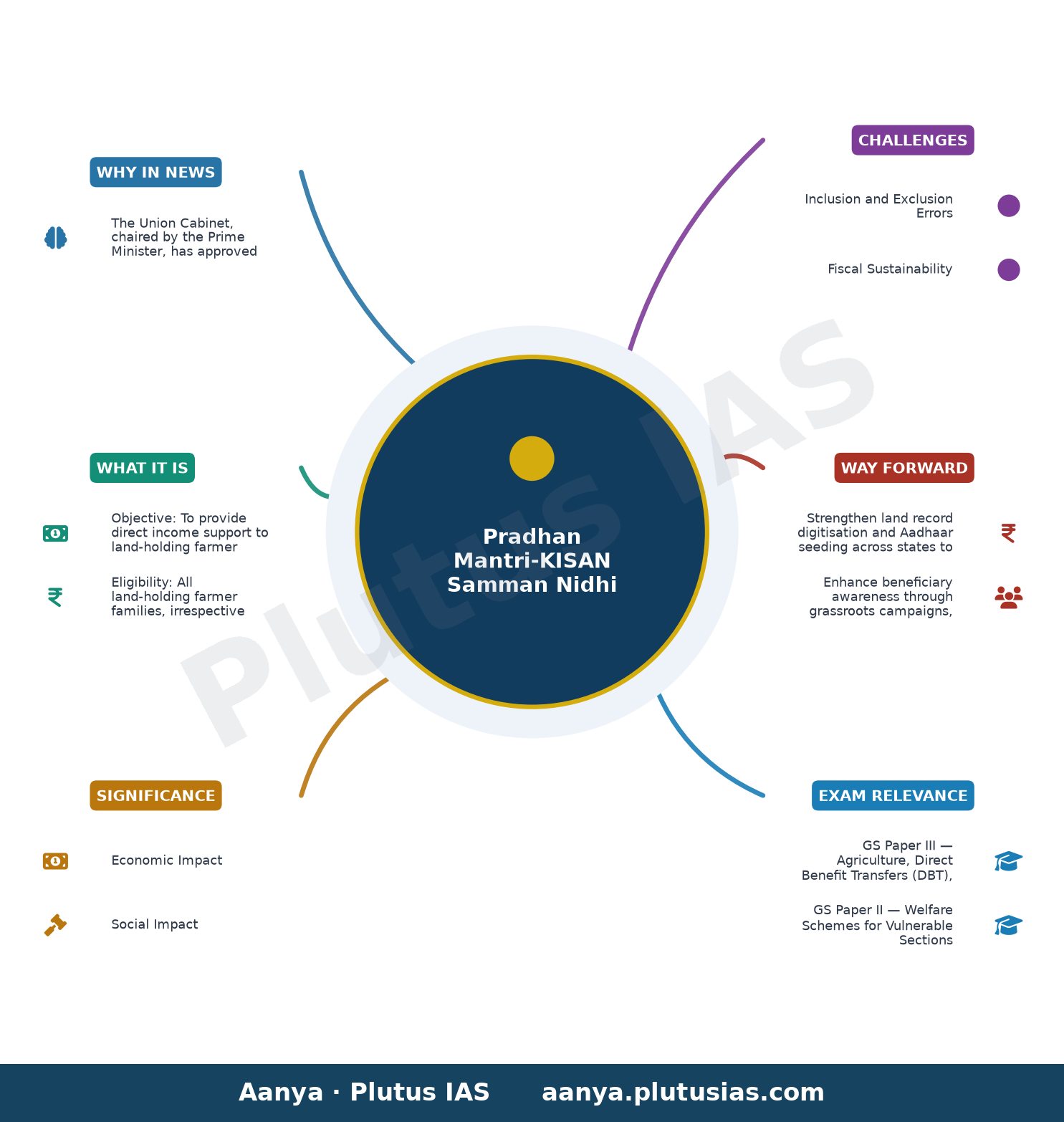
- GS Paper III — Agriculture, Direct Benefit Transfers (DBT), Government Schemes and Programmes | GS Paper II — Welfare Schemes for Vulnerable Sections
- Prelims: Pradhan Mantri-KISAN Samman Nidhi (PM-KISAN), Direct Benefit Transfer (DBT), Aadhaar-enabled Payment System (AePS), Kisan Credit Card (KCC), Farm Income Support, Agricultural Productivity, Digital India in Agriculture
- Essay: Agrarian Distress and Policy Interventions: The Role of Direct Income Support, Digital Governance as a Catalyst for Rural Transformation
Quick Revision: PM-KISAN is a Direct Benefit Transfer (DBT) scheme providing ₹6,000 annual income support to land-holding farmer families via Aadhaar-linked bank accounts, ensuring transparency, reducing leakages, and enhancing agricultural productivity.
Why is this in the news?
The Union Cabinet, chaired by the Prime Minister, has approved the continuation of the Pradhan Mantri-KISAN Samman Nidhi (PM-KISAN) scheme for the period 2026-27 to 2030-31 with a financial outlay of ₹3.15 lakh crore. This decision underscores the Government’s sustained commitment to enhancing farm income, reducing agrarian distress, and leveraging technology-driven welfare delivery to strengthen rural livelihoods.
Background
- Launched in February 2019, PM-KISAN is a Central Sector Scheme under the Ministry of Agriculture and Farmers’ Welfare, aimed at providing income support to land-holding farmer families.
- The scheme operates on a Direct Benefit Transfer (DBT) model, transferring ₹6,000 annually in three equal instalments directly to the bank accounts of eligible farmers.
- The scheme has been instrumental during crises such as the COVID-19 pandemic, with over ₹1.71 lakh crore disbursed to support farmers’ livelihoods.
What is the Pradhan Mantri-KISAN Samman Nidhi (PM-KISAN) Scheme?
- Objective: To provide direct income support to land-holding farmer families to ensure financial stability, enhance agricultural investment, and mitigate agrarian distress.
- Eligibility: All land-holding farmer families, irrespective of size of landholding, subject to exclusion criteria such as higher income tax payers and institutional landholders.
- Benefit Structure: ₹6,000 per annum per eligible farmer family, disbursed in three equal instalments of ₹2,000 each at four-month intervals.
- Mechanism: Funds are transferred directly to beneficiaries’ bank accounts under the DBT framework, ensuring transparency and minimising leakages.
- Technology Integration: Utilises Aadhaar for beneficiary identification, geo-tagging for land records, and real-time monitoring through the PM-KISAN portal to prevent duplication and ensure timely disbursement.
- Impact on Agricultural Productivity: Independent evaluations by NITI Aayog’s Development Monitoring and Evaluation Office (DMEO) indicate that 92% of beneficiaries utilised funds for agricultural activities, while 85% reported improved farm income and reduced dependence on informal credit.
- Macro-Level Contribution: Between 2020-21 and 2025-26, the scheme coincided with a 9.65% growth in agricultural GDP, 10.53% increase in productivity, and 21.18% rise in total foodgrain production, highlighting its role in agricultural transformation.
Key Features
| Feature | Significance |
|---|---|
| Direct Benefit Transfer (DBT) | Ensures transparent, leakage-proof, and timely transfer of ₹6,000 per eligible farmer family annually, reducing intermediaries and enhancing efficiency in welfare delivery. |
| Aadhaar-based Authentication | Facilitates unique identification of beneficiaries, prevents duplication, and ensures accurate targeting of small and marginal farmers. |
| Three Equal Instalments | Distributed across the agricultural year (April-July, August-November, December-March), aligning with critical farm input cycles to support seasonal investments. |
| Digital Verification System | Integrates land records, Aadhaar, and bank account details to authenticate eligibility, ensuring only genuine beneficiaries receive benefits. |
| Gender Inclusivity | Approximately 25% of beneficiaries are women farmers, promoting financial autonomy and equity in rural agrarian economies. |
Why it Matters
Economic Impact
- Augments farmers’ liquidity, enabling investment in high-yield inputs, mechanisation, and irrigation, thereby enhancing agricultural productivity and output.
- Reduces dependence on informal credit sources, mitigating debt traps and financial distress among smallholders.
- Stimulates rural demand, creating multiplier effects in allied sectors such as agri-inputs, logistics, and local trade.
- Contributes to macroeconomic stability by supporting food security through sustained agricultural production.
Social Impact
- Provides a predictable income floor, reducing vulnerability to market fluctuations and climate shocks in rainfed agriculture.
- Empowers women farmers by recognising their role in agricultural operations and ensuring direct financial access.
- Enhances rural household resilience, particularly in regions with high agrarian distress or low non-farm employment opportunities.
Governance & Technology
- Demonstrates the efficacy of technology-driven governance in welfare delivery, setting a precedent for other DBT schemes.
- Strengthens fiscal federalism by ensuring Centre-state cooperation in beneficiary identification and fund disbursement.
- Serves as a model for ‘minimum government, maximum governance’ through automated verification and direct transfers.
Agricultural Sector Growth
- Supports the government’s goal of doubling farmers’ income by 2022 (extended to 2030-31), aligning with the National Mission for Sustainable Agriculture.
- Facilitates adoption of climate-resilient practices and precision farming technologies through improved financial capacity.
- Bolsters India’s position in global food security by ensuring stable domestic production and supply chains.
Challenges
1. Inclusion and Exclusion Errors
- Risk of exclusion of genuine beneficiaries due to incomplete or outdated land records, particularly in states with weak digitisation of land records.
- Potential inclusion of ineligible large landholders or non-farmers due to loopholes in verification processes.
- Dependence on Aadhaar seeding for bank accounts may exclude marginalised groups without Aadhaar or formal banking access.
UPSC Link: GS III: Agricultural Marketing & Issues
2. Fiscal Sustainability
- Long-term viability of the ₹3.15 lakh crore outlay amid competing demands from other welfare schemes and fiscal constraints.
- Need for periodic review of benefit quantum to ensure it remains relevant to inflation and input costs in agriculture.
- Pressure on state exchequers to co-finance the scheme, given the Centre-state cost-sharing model in DBT schemes.
UPSC Link: GS III: Government Budgeting
3. Implementation Bottlenecks
- Delays in fund disbursement due to technical glitches in the DBT portal or bank account seeding issues.
- Low awareness among small and marginal farmers, especially in remote areas, leading to underutilisation of benefits.
- Coordination challenges between central agencies (e.g., PM-KISAN portal) and state departments managing land records.
UPSC Link: GS II: Centre-State Relations
4. Agricultural Productivity Constraints
- Limited impact on structural issues such as fragmented landholdings, lack of irrigation, and market access, which require long-term solutions beyond income support.
- Risk of benefit being used for consumption rather than productive investment, particularly in regions with low agricultural dynamism.
- Climate change-induced yield variability may undermine the income stabilisation effect of the scheme.
UPSC Link: GS III: Agriculture & Environment
5. Monitoring and Evaluation
- Need for robust, independent impact assessments to measure the scheme’s effectiveness in achieving stated objectives (e.g., income doubling, productivity gains).
- Lack of real-time data on utilisation patterns of benefits (e.g., proportion spent on inputs vs. consumption).
- Challenge of attributing agricultural outcomes solely to PM-KISAN, given the influence of other factors like monsoon, policy interventions, and global prices.
UPSC Link: GS IV: Ethics in Governance
Challenges — UPSC Perspective
| Issue | Concern |
|---|---|
| Land Record Digitisation | Incomplete or outdated records may lead to exclusion or inclusion errors in beneficiary identification. |
| Aadhaar-Seeding Gaps | Farmers without Aadhaar or linked bank accounts may be excluded from the scheme. |
| Fiscal Burden | Long-term sustainability of ₹3.15 lakh crore allocation amid competing developmental priorities. |
| Awareness Deficit | Low penetration of scheme information in remote or tribal areas, reducing uptake. |
| Climate Vulnerability | Extreme weather events may offset the income stabilisation benefits of the scheme. |
| Productive Investment | Risk of benefit being diverted to consumption rather than agricultural inputs or technology adoption. |
Government Initiatives — Must-Memorise for Prelims
- Pradhan Mantri Kisan Samman Nidhi (PM-KISAN)
- Direct Benefit Transfer (DBT) Mechanism
- Digital India Initiative (Aadhaar-enabled services)
- National Mission for Sustainable Agriculture (NMSA)
Way Forward
- Strengthen land record digitisation and Aadhaar seeding across states to minimise inclusion/exclusion errors.
- Enhance beneficiary awareness through grassroots campaigns, especially in tribal and remote regions.
- Integrate PM-KISAN with agricultural extension services to guide farmers on optimal utilisation of benefits for productivity gains.
- Introduce performance-linked incentives for states to improve land record management and DBT efficiency.
- Conduct periodic, independent impact evaluations to assess the scheme’s contribution to farmers’ income and agricultural growth.
- Explore convergence with other schemes (e.g., PM-KISAN Maan Dhan Yojana) to provide a comprehensive social security net for farmers.
- Develop climate-resilient strategies, such as weather-indexed insurance or drought-resistant crop advisories, to mitigate climate risks.
- Expand the scope of DBT to include input subsidies and market-linked price support, reducing fragmentation in welfare delivery.
UPSC Value Addition
Keywords for Mains Answer-Writing
Pradhan Mantri Kisan Samman Nidhi (PM-KISAN) · Direct Benefit Transfer (DBT) · Agrarian distress alleviation · Farm income support · Digital governance in welfare delivery · Rural economy strengthening · Agricultural productivity enhancement · Financial inclusion of farmers · Aadhaar-enabled Direct Benefit Transfer (AeDBT) · Self-reliant India (Atmanirbhar Bharat)
Constitutional & Policy Linkages
- Article 39(b): Directive Principle of State Policy mandating equitable distribution of resources, including agricultural income support.
- Article 48: Directive Principle promoting modern and scientific agriculture, aligning with PM-KISAN’s objective of enhancing productivity.
Concept Flow
Farmers’ Income Vulnerability -> Government launches PM-KISAN (2019) -> Direct Benefit Transfer (DBT) via Aadhaar-seeded accounts -> Timely ₹6,000/year instalments -> Increased liquidity for agricultural inputs -> Enhanced productivity and output -> Rural demand stimulation -> Economic growth and food security -> Scheme extended to 2030-31 with ₹3.15 lakh crore outlay.
Prelims Practice Questions
Q1. Consider the following statements regarding the Pradhan Mantri Kisan Samman Nidhi (PM-KISAN) scheme:
1. It provides direct income support of ₹6,000 per year to eligible landholding farmer families in three equal instalments.
2. The scheme is implemented through the Aadhaar-enabled Direct Benefit Transfer (AeDBT) system.
3. The financial outlay for the scheme from 2026-27 to 2030-31 is ₹3.15 lakh crore.
4. The scheme is limited to small and marginal farmers only.
How many of the above statements are correct?
- Only one
- Only two
- Only three
- All four
Answer: Only three — Statements 1, 2, and 3 are correct. Statement 4 is incorrect as the scheme covers all landholding farmer families, not limited to small and marginal farmers.
Q2. Assertion (A): The Pradhan Mantri Kisan Samman Nidhi (PM-KISAN) scheme is a flagship initiative under the Digital India programme.
Reason (R): The scheme leverages Aadhaar-based authentication and Direct Benefit Transfer (DBT) for transparent and efficient delivery of benefits.
Options:
A. Both A and R are true, and R is the correct explanation of A.
B. Both A and R are true, but R is not the correct explanation of A.
C. A is true, but R is false.
D. A is false, but R is true.
Answer: ? — Both A and R are true, and R correctly explains A. The PM-KISAN scheme is indeed a flagship initiative under Digital India, utilising Aadhaar-based authentication and DBT for transparent and efficient delivery.
Q3. Match the following columns with reference to the Pradhan Mantri Kisan Samman Nidhi (PM-KISAN) scheme:
Column I (Feature) | Column II (Description)
——————-|———————–
1. Financial outlay for 2026-31 | A. ₹6,000 per year to eligible farmer families
2. Number of instalments per year | B. ₹3.15 lakh crore
3. Annual financial support per farmer family | C. Three equal instalments
4. Beneficiary identification mechanism | D. Aadhaar-enabled Direct Benefit Transfer (AeDBT)
Options:
A. 1-B, 2-C, 3-A, 4-D
B. 1-A, 2-B, 3-C, 4-D
C. 1-C, 2-A, 3-B, 4-D
D. 1-D, 2-C, 3-B, 4-A
Answer: ? — Correct matches: 1-B (Financial outlay for 2026-31 is ₹3.15 lakh crore), 2-C (Number of instalments per year is three), 3-A (Annual financial support per farmer family is ₹6,000), 4-D (Beneficiary identification mechanism is Aadhaar-enabled Direct Benefit Transfer).
Mains Practice Question
✍ The Pradhan Mantri Kisan Samman Nidhi (PM-KISAN) scheme represents a paradigm shift in India’s approach to addressing agrarian distress. Critically examine its design, implementation challenges, and impact on farm incomes and rural economy. Also assess its role in promoting digital governance and financial inclusion. (15 Marks)
Approach: MODEL-ANSWER SKELETON:
1. **Design and Objectives** (3 points):
– Direct income support of ₹6,000 per year to landholding farmer families in three equal instalments via DBT.
– Universal coverage (all landholding farmers, not limited by landholding size).
– Aadhaar-enabled authentication and DBT for transparency and efficiency.
2. **Implementation Challenges** (4 points):
– Identification of genuine beneficiaries (land records, exclusion errors, inclusion errors).
– Digital divide and access to banking infrastructure in remote areas.
– Delay in fund disbursement due to procedural bottlenecks.
– Coordination between central, state, and local authorities.
3. **Impact on Farm Incomes and Rural Economy** (4 points):
– Empirical evidence from NITI Aayog’s DMEO: 92% of beneficiaries used funds for agricultural activities; 85% reported improved farm income and reduced dependence on informal credit.
– Contribution to increased agricultural productivity (9.65% growth in 2020-21 to 2025-26) and foodgrain production (21.18% growth).
– Reduction in rural indebtedness and enhanced economic resilience.
– Gender inclusion: 25% of beneficiaries are women, receiving ₹1.06 lakh crore.
4. **Digital Governance and Financial Inclusion** (3 points):
– PM-KISAN as a model for Aadhaar-enabled DBT, reducing leakages and improving targeting.
– Strengthening financial inclusion by linking farmers to formal banking systems.
– Enhancing transparency, accountability, and reducing corruption in welfare delivery.
5. **Critique and Limitations** (3 points):
– Limited scope: Does not address structural issues like land fragmentation, price volatility, or access to markets.
– Fiscal sustainability: Long-term viability of ₹3.15 lakh crore outlay amid competing priorities.
– Need for complementary measures: Irrigation, storage, market access, and technology adoption.
6. **Conclusion** (2 points):
– PM-KISAN is a significant step toward addressing agrarian distress and promoting rural welfare.
– Its success underscores the potential of digital governance in welfare delivery but must be complemented by broader agricultural reforms.
Source: PIB (Press Information Bureau)
Generated by AanyaAi for educational purpose.

- कर्नाटक सरकार ने पूर्ण रूप से लागू करेगी अनुच्छेद 371(जे), जानिए क्या है इसका महत्व - September 16, 2026
- Karnataka to Fully Implement Article 371(J) for Kalyana Karnataka Development - September 16, 2026
- एल नीनो से प्रभावित केरल की चाय उत्पादन में 2% की गिरावट, जानें कारण और प्रभाव - September 16, 2026

No Comments