


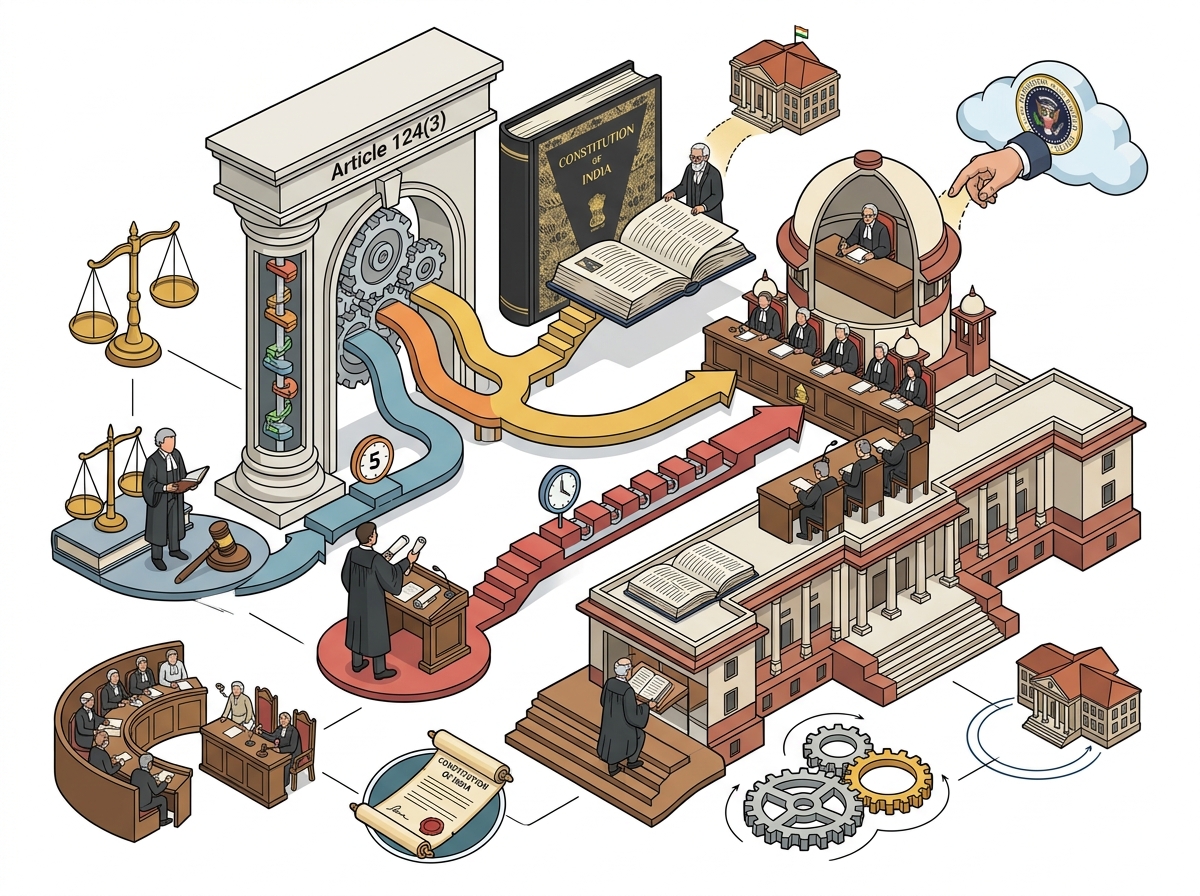
01 Sep Can Legal Academics Become Supreme Court Judges? Article 124(3) Explained
✎ Article 124(3) of the Constitution permits the appointment of a ‘distinguished jurist’ to the Supreme Court, a provision introduced to diversify judicial expertise but remains unutilised despite its constitutional validity and…
Subject Relevance — Where This Topic Fits
- GS Paper II — Polity and Governance (Constitutional Provisions, Judiciary) | GS Paper IV — Ethics in Governance (Appointment Processes and Transparency)
- Prelims: Article 124(3), Supreme Court of India, High Court Judge, Advocate of High Court, distinguished jurist, Constituent Assembly Debates, judicial restraint, judicial appointments
- Essay: Judicial appointments: Balancing independence and diversity, The role of constitutional provisions in shaping institutional evolution
Quick Revision: Article 124(3) of the Constitution permits the appointment of a ‘distinguished jurist’ to the Supreme Court, a provision introduced to diversify judicial expertise but remains unutilised despite its constitutional validity and global precedents.
Why is this in the news?
The Supreme Court Judge Justice Ujjal Bhuyan recently highlighted the underutilisation of Article 124(3) of the Constitution, which permits the appointment of a ‘distinguished jurist’ to the Supreme Court, despite its inclusion since 1950. This observation underscores the need to examine the constitutional intent, historical context, and institutional practices governing judicial appointments in India, particularly the scope for incorporating legal academia into the higher judiciary.
Background
- Article 124(3) of the Indian Constitution was incorporated in 1950, providing three distinct pathways for appointment to the Supreme Court: (a) service as a High Court Judge for at least five years, (b) practice as an advocate in a High Court for at least ten years, or (c) appointment as a ‘distinguished jurist’ in the President’s opinion.
- The provision was introduced to diversify the professional backgrounds of Supreme Court judges beyond the conventional judicial and legal practice routes, reflecting the framers’ intent to broaden the pool of talent.
- The Constituent Assembly debates of 1949-50, particularly the interventions by members such as H.V. Kamath, emphasised the inclusion of eminent legal scholars and jurists to enhance the intellectual and academic rigour of the judiciary.
- The United States Supreme Court has historically appointed legal academics, such as Felix Frankfurter (Harvard Law School professor), demonstrating the global precedent for incorporating jurists into apex courts.
- Despite the constitutional provision, no legal academic has been appointed to the Supreme Court under this category in over seven decades, raising questions about institutional preferences, selection criteria, and the evolving role of legal academia in judicial appointments.
- The Supreme Court has, on multiple occasions, reiterated the importance of judicial independence and the need for appointments to be based on merit, competence, and integrity, though the specific criteria for ‘distinguished jurists’ remain undefined.
What does the constitutional provision for appointment of ‘distinguished jurists’ entail?
- Article 124(3) of the Constitution of India provides three distinct routes for appointment to the Supreme Court: (i) service as a High Court Judge for at least five years, (ii) practice as an advocate in a High Court for at least ten years, or (iii) appointment as a ‘distinguished jurist’ in the President’s opinion.
- The term ‘distinguished jurist’ is not defined in the Constitution, leaving its interpretation to the discretion of the President, who acts on the advice of the Council of Ministers and the collegium system for judicial appointments.
- The provision was introduced to diversify the professional backgrounds of Supreme Court judges, recognising that legal scholarship and juristic learning are not confined to judicial service or legal practice.
- The Constituent Assembly debates indicate that the inclusion of this category was intended to ensure that the Supreme Court benefits from the expertise of legal academics, thereby enriching judicial reasoning and decision-making.
- Historical precedents, such as the appointment of Felix Frankfurter to the U.S. Supreme Court, demonstrate that legal academics can bring unique perspectives to constitutional interpretation and judicial restraint.
- The lack of utilisation of this provision over seven decades suggests potential institutional biases, unclear selection criteria, or a preference for traditional pathways in judicial appointments.
- The provision aligns with the broader constitutional principle of judicial independence, ensuring that the apex court remains a repository of diverse legal expertise beyond the confines of judicial hierarchy.
UPSC Value Addition
Keywords for Mains Answer-Writing
Article 124(3) Constitution of India · Supreme Court Judge appointment · distinguished jurist · Constituent Assembly debates · Judicial appointments process · Felix Frankfurter precedent · judicial diversity · judicial restraint doctrine · President’s discretion in judicial appointments · legal academia in judiciary
Prelims Practice Questions
Q1. Consider the following statements regarding the appointment of Supreme Court Judges in India: 1. A person must have served as a High Court Judge for at least five years to be eligible for appointment as a Supreme Court Judge. 2. The Constitution explicitly defines the term ‘distinguished jurist’ and prescribes a minimum period of professional experience for such persons. 3. The President’s power to appoint a ‘distinguished jurist’ as a Supreme Court Judge is discretionary. 4. The Constituent Assembly debates reflect an intention to diversify the professional backgrounds of Supreme Court Judges. How many of the above statements are correct?
- Only one
- Only two
- Only three
- All
Answer: Only three — Statements 1, 3, and 4 are correct. Statement 2 is incorrect because the Constitution does not define ‘distinguished jurist’ nor prescribe any minimum period of professional experience for such a person.
Q2. Assertion (A): The provision for appointing a ‘distinguished jurist’ as a Supreme Court Judge under Article 124(3) has been used frequently since the adoption of the Constitution. Reason (R): The framers of the Constitution intended to diversify the professional backgrounds of Supreme Court Judges by including this provision.
- Both A and R are true, and R is the correct explanation of A
- Both A and R are true, but R is not the correct explanation of A
- A is true, but R is false
- A is false, but R is true
Answer: ? — Assertion (A) is false because the provision has never been used. Reason (R) is true as the Constituent Assembly debates reflect this intention.
Q3. Match the following provisions related to the appointment of Supreme Court Judges with their respective constitutional articles: Column I: A. Minimum five years as High Court Judge B. Practised as an advocate for at least ten years C. Distinguished jurist Column II: 1. Article 124(3)(a) 2. Article 124(3)(b) 3. Article 124(3)(c)
- A-1, B-2, C-3
- A-2, B-1, C-3
- A-3, B-2, C-1
- A-1, B-3, C-2
Answer: A-1, B-2, C-3 — A (Minimum five years as High Court Judge) matches with Article 124(3)(a). B (Practised as an advocate for at least ten years) matches with Article 124(3)(b). C (Distinguished jurist) matches with Article 124(3)(c).
Mains Practice Question
✍ Article 124(3) of the Constitution of India provides for the appointment of Supreme Court Judges through three distinct routes, including the category of a ‘distinguished jurist’. Critically examine the rationale behind this provision and analyse why it has remained unused for over seven decades. Also, assess the potential implications of appointing legal academics to the Supreme Court Bench. (15 Marks)
Approach: MODEL-ANSWER SKELETON:
1. **Rationale behind the provision (4 Marks)**
– Constitutional intent: Reference Constituent Assembly debates (May 24, 1949) and H.V. Kamath’s amendment to diversify professional backgrounds.
– Inspiration from foreign precedents: Cite Felix Frankfurter’s appointment to the U.S. Supreme Court (1939) as a model.
– Need for judicial diversity: Highlight the importance of incorporating legal scholarship and academic perspectives in judicial decision-making.
2. **Reasons for non-utilisation (5 Marks)**
– Lack of clarity: Absence of a definition for ‘distinguished jurist’ or prescribed criteria.
– Institutional preference: Dominance of the ‘judge-advocate’ route due to established norms and collegium system.
– Perceived lack of judicial temperament: Concerns about legal academics lacking practical courtroom experience.
– Systemic inertia: Resistance to change within the judiciary and executive.
3. **Potential implications of appointing legal academics (6 Marks)**
– **Positive:**
– Enhanced legal scholarship: Bringing doctrinal depth and academic rigour to judicial reasoning.
– Diversity of perspectives: Countering the insularity of judicial appointments dominated by the Bar and Bench.
– Strengthening constitutional interpretation: Academic insights on fundamental rights, federalism, and separation of powers.
– **Challenges:**
– Judicial temperament: Risk of over-academicisation leading to abstract reasoning over practical justice.
– Collegium dynamics: Potential resistance from the existing judiciary.
– Executive discretion: Concerns about politicisation if the President’s discretion is exercised arbitrarily.
– **Way forward:** Propose a structured framework (e.g., a committee of experts) to identify and evaluate potential candidates, ensuring transparency and objectivity.
Source: The Hindu
Generated by AanyaAi for educational purpose.
Related guides on our sites
- Best PSIR optional coaching for upsc
- Best PSIR optional teacher for upsc
- Best teacher of PSIR optional for upsc
- Best PSIR optional coaching in delhi for UPSC

- India-Australia AUSTRAHIND 2026 Exercise: Key Highlights for UPSC & State PCS - October 22, 2026
- एससीओ बैठक में भारत का आतंकवाद विरोध: क्षेत्रीय सहयोग पर जोर - October 22, 2026
- SEC Directs Strict SC Order Compliance for Andhra ULB Polls - October 22, 2026

No Comments