


01 Sep Can Legal Scholars Be Appointed as Supreme Court Judges? UPSC Key Points
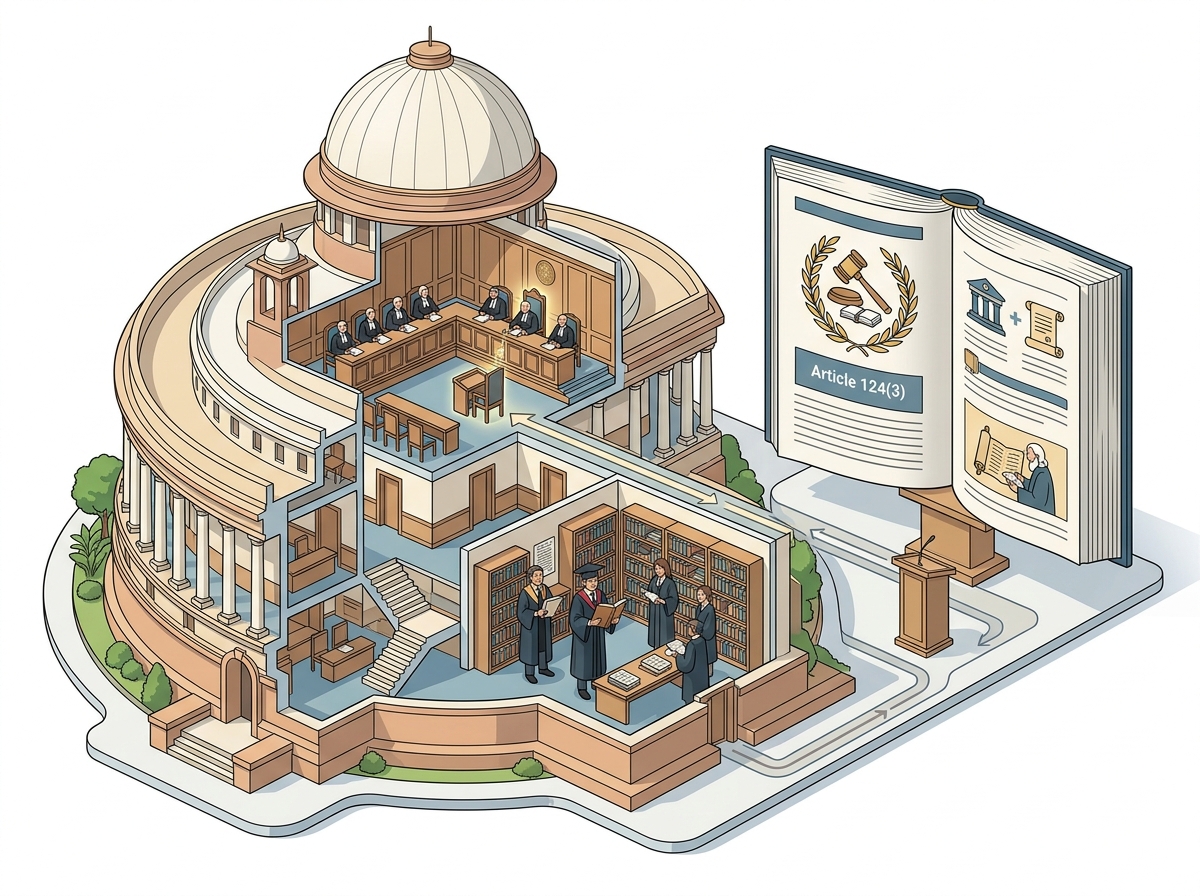
✎ Article 124(3) of the Constitution permits the President to appoint a ‘distinguished jurist’ as a Supreme Court Judge, a provision intended to diversify judicial expertise but remains unutilised due to ambiguity in criteria and…
Subject Relevance — Where This Topic Fits
- GS Paper II — Polity and Governance (Constitutional Provisions, Judiciary) | GS Paper IV — Ethics in Governance (Appointment Processes and Transparency)
- Prelims: Article 124(3), Supreme Court of India, High Court Judge, Advocate of High Court, distinguished jurist, judicial appointment criteria, Constituent Assembly debates, Felix Frankfurter, judicial restraint
- Essay: Judicial Appointments: Balancing Expertise and Representation, The Role of Constitutional Provisions in Shaping Democratic Institutions
Quick Revision: Article 124(3) of the Constitution permits the President to appoint a ‘distinguished jurist’ as a Supreme Court Judge, a provision intended to diversify judicial expertise but remains unutilised due to ambiguity in criteria and lack of procedural clarity.
Why is this in the news?
The Supreme Court Judge Justice Ujjal Bhuyan recently highlighted the underutilisation of Article 124(3) of the Constitution, which permits the appointment of a ‘distinguished jurist’ as a Supreme Court Judge. This observation underscores a long-standing constitutional provision that has remained largely dormant since India’s independence, raising questions about its intent, feasibility, and potential to diversify judicial expertise on the apex court.
Background
- The framers of the Constitution drew inspiration from international practices, notably citing the appointment of Felix Frankfurter—a Harvard Law School professor—to the U.S. Supreme Court in 1939 as a precedent for appointing eminent legal scholars to higher judiciary.
- The provision’s ambiguity regarding the definition of a ‘distinguished jurist’ and the absence of prescribed minimum qualifications or experience have contributed to its limited utilisation.
- Recent judicial observations, such as those by Justice Ujjal Bhuyan, have reignited discussions on the potential of this provision to enhance the Supreme Court’s intellectual diversity and expertise.
What is the ‘Distinguished Jurist’ Provision in Article 124(3)?
- Article 124(3) of the Constitution of India stipulates three mutually exclusive routes for appointment as a Judge of the Supreme Court: (i) service as a High Court Judge for at least five years, (ii) practice as an advocate in a High Court for at least ten years, or (iii) being, in the President’s opinion, a ‘distinguished jurist’.
- The ‘distinguished jurist’ category was introduced to ensure that persons with exceptional legal scholarship, irrespective of their background in judicial service or legal practice, could be considered for elevation to the Supreme Court.
- The provision does not define ‘distinguished jurist’, leaving its interpretation to the President in consultation with the judiciary, which has historically relied on subjective assessments of eminence in legal theory, jurisprudence, or public law.
- The framers envisaged this route as a mechanism to infuse the Supreme Court with expertise in constitutional law, legal philosophy, and comparative jurisprudence, thereby enriching judicial deliberations.
- The Constituent Assembly debates reveal that the inclusion of this provision was motivated by a desire to avoid a narrow, insular approach to judicial appointments, thereby promoting diversity in professional backgrounds among Supreme Court Judges.
- Historical precedents, such as the appointment of Felix Frankfurter to the U.S. Supreme Court, were cited to justify the inclusion of this provision, demonstrating a global recognition of the value of academic jurists in judicial institutions.
- The provision’s underutilisation over seven decades suggests systemic or procedural challenges, including the absence of clear eligibility criteria, lack of institutional mechanisms for identifying potential candidates, and potential reluctance to deviate from conventional career trajectories.
- The Supreme Court, as the final interpreter of the Constitution, plays a pivotal role in shaping the contours of this provision through its judgments and collegium practices, though no case law directly interprets the ‘distinguished jurist’ clause.
UPSC Value Addition
Keywords for Mains Answer-Writing
Supreme Court Judge appointment · Article 124(3) Constitution of India · distinguished jurist · judicial appointments · Constituent Assembly debates · H.V. Kamath · Felix Frankfurter precedent · judicial diversity · judicial philosophy · judicial restraint
Prelims Practice Questions
Q1. Consider the following statements regarding the appointment of Supreme Court Judges in India:
1. A person must have served as a High Court Judge for at least five years to be eligible for appointment as a Supreme Court Judge.
2. A person who has practised as an advocate of a High Court for at least 10 years is eligible for appointment as a Supreme Court Judge.
3. The Constitution explicitly defines the term ‘distinguished jurist’ for judicial appointments.
4. The provision allowing appointment of a ‘distinguished jurist’ was included to diversify professional backgrounds among Supreme Court Judges.
How many of the above statements are correct?
- Only one
- Only two
- Only three
- All four
Answer: Only three — Statements 1, 2, and 4 are correct. Statement 3 is incorrect because the Constitution does not define the term ‘distinguished jurist’; it is left to the President’s opinion.
Q2. Assertion (A): The Constituent Assembly debates reflect that the inclusion of the ‘distinguished jurist’ category in Article 124(3) was intended to bring diversity in professional backgrounds among Supreme Court Judges.
Reason (R): The framers of the Constitution believed that persons with outstanding legal and juristic learning were not necessarily confined to judges or advocates.
Codes:
A. Both A and R are true, and R is the correct explanation of A.
B. Both A and R are true, but R is not the correct explanation of A.
C. A is true, but R is false.
D. A is false, but R is true.
- A
- B
- C
- D
Answer: A — Both Assertion (A) and Reason (R) are true, and R correctly explains A as per the Constituent Assembly debates on Article 124(3).
Q3. Match the following provisions with their corresponding constitutional articles:
Column I | Column II
— | —
A. Appointment of Governor | 1. Article 124(3)
B. Appointment of Supreme Court Judge | 2. Article 155
C. Appointment of High Court Judge | 3. Article 156
D. Term of office of Governor | 4. Article 123
Select the correct match:
- A-2, B-1, C-4, D-3
- A-2, B-1, C-3, D-4
- A-1, B-2, C-3, D-4
- A-4, B-1, C-2, D-3
Answer: A-2, B-1, C-3, D-4 — A-2 (Governor appointed under Article 155), B-1 (Supreme Court Judge under Article 124(3)), C-3 (High Court Judge appointment), D-4 (Term of Governor under Article 156).
Mains Practice Question
✍ Article 124(3) of the Constitution of India provides for the appointment of a ‘distinguished jurist’ as a Supreme Court Judge. In this context, critically examine the constitutional provision, its historical intent, and the reasons for its limited utilisation. Also, analyse the potential benefits of appointing legal academics to the Supreme Court Bench. (15 Marks)
Approach: MODEL-ANSWER SKELETON:
1. **Constitutional Provision (2 marks)**:
– Article 124(3) of the Constitution outlines three routes for Supreme Court Judge appointments: (i) High Court Judge for 5+ years, (ii) Advocate in High Court for 10+ years, (iii) ‘Distinguished jurist’ as per President’s opinion.
– The provision does not define ‘distinguished jurist’ or prescribe minimum experience.
2. **Historical Intent (3 marks)**:
– Constituent Assembly debates (May 24, 1949): H.V. Kamath argued for wider professional diversity, citing Felix Frankfurter’s appointment to the U.S. Supreme Court (1939) as a precedent.
– M. Ananthasayanam Ayyangar referenced Frankfurter’s contributions to judicial philosophy, including judicial restraint.
– Intent was to include eminent legal scholars who may not fit conventional pathways.
3. **Reasons for Limited Utilisation (5 marks)**:
– **Ambiguity in Definition**: Lack of clarity on ‘distinguished jurist’ creates uncertainty and potential misuse.
– **Preference for Conventional Pathways**: Collegium system and judicial hierarchy favour traditional routes (judges/advocates).
– **Perceived Lack of Judicial Experience**: Legal academics may lack trial court or High Court experience, raising concerns about judicial temperament.
– **Collegium’s Discretion**: The Supreme Court Collegium has historically favoured candidates with judicial or advocacy backgrounds.
– **Institutional Resistance**: Judges may prefer peers with shared professional socialisation.
4. **Potential Benefits of Appointing Legal Academics (5 marks)**:
– **Diversity of Perspective**: Legal scholars bring theoretical and doctrinal depth, enhancing judicial reasoning.
– **Academic Rigour**: Expertise in constitutional law, international law, or jurisprudence can enrich judgments.
– **Judicial Restraint and Activism Balance**: Scholars may contribute to nuanced interpretations of constitutional provisions (e.g., Frankfurter’s judicial restraint).
– **Representation of Underrepresented Fields**: Inclusion of tax law, environmental law, or human rights scholars.
– **Global Precedents**: Countries like the U.S. (Felix Frankfurter) and South Africa (Albie Sachs) have appointed legal academics to apex courts.
5. **Way Forward (Optional, 1 mark)**:
– Clarify ‘distinguished jurist’ through judicial interpretation or constitutional amendment.
– Encourage nominations from legal academia in collegium consultations.
– Pilot appointments to assess impact on judicial output.
Source: The Hindu
Generated by AanyaAi for educational purpose.
Related guides on our sites
- Best PSIR optional coaching for upsc
- Best PSIR optional teacher for upsc
- Best teacher of PSIR optional for upsc
- Best PSIR optional coaching in delhi for UPSC

- उत्तराखंड राज्यपाल की पीएम मोदी से महत्वपूर्ण बैठक: जानिए मुख्य बिंदु - October 23, 2026
- How India’s Rs 20,000 Cr CCUS Budget Can Drive Net-Zero Goals - October 23, 2026
- पंजाब-हरियाणा में पराली जलाने पर सीएक्यूएम की सख्त समीक्षा, तुरंत उठाये गये कदमों पर जोर - October 23, 2026

No Comments