


11 Aug Centre tables Bill to bar state taxes on minerals, Oppn demands review
✎ The Mines and Minerals (Development and Regulation) Amendment Bill, 2026, seeks to prohibit state governments from imposing taxes, cesses, or levies on mineral rights and mineral-bearing lands, thereby centralising regulatory…
Subject Relevance — Where This Topic Fits
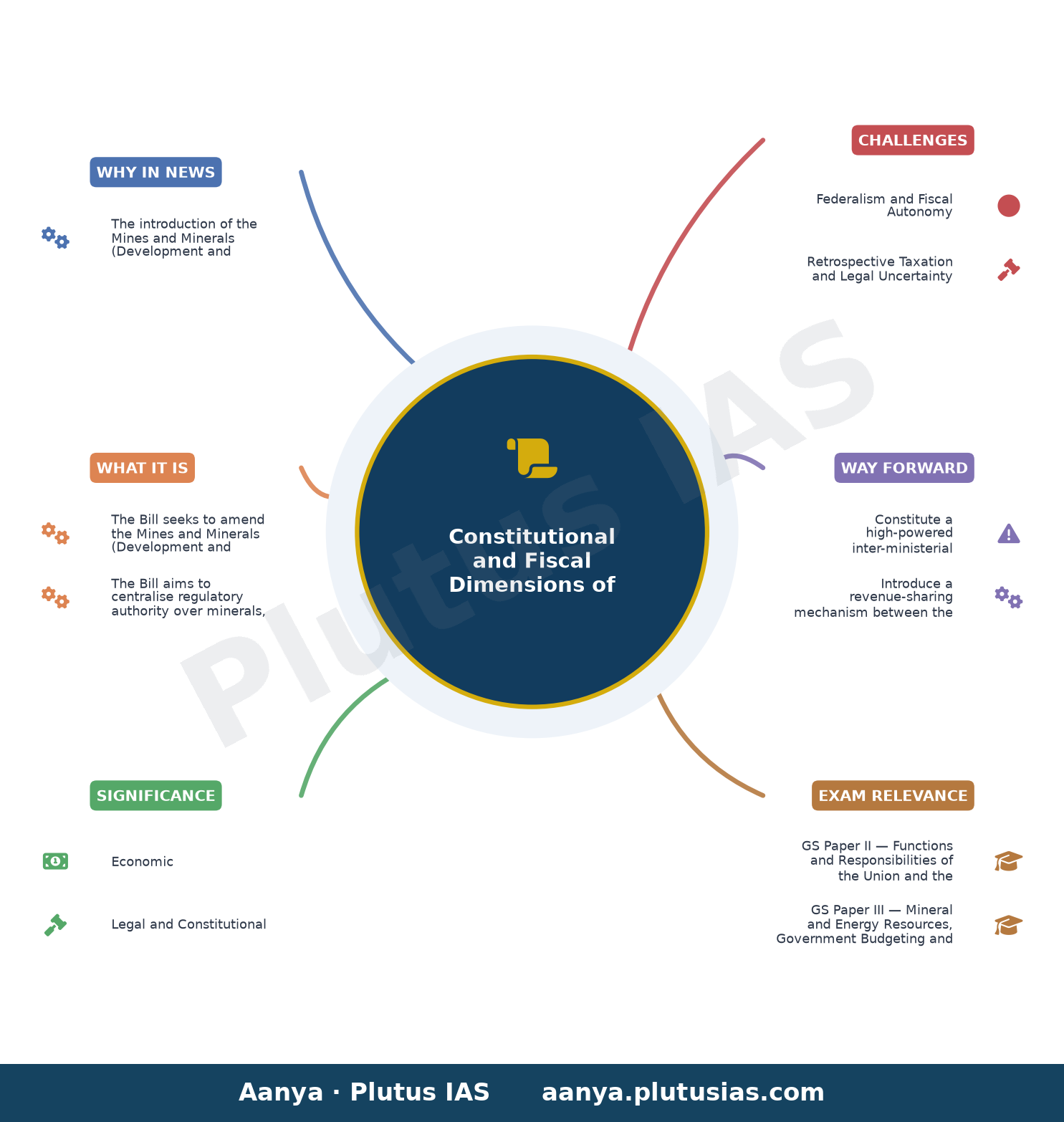
- GS Paper II — Functions and Responsibilities of the Union and the States, Federal Structure | GS Paper III — Mineral and Energy Resources, Government Budgeting and Fiscal Policy
- Prelims: Mines and Minerals (Development and Regulation) Act, 1957, Article 246 of the Constitution, Article 268A, Concurrent List (Entry 23), State List (Entry 23), Royalty vs Tax, Fiscal Federalism, Retrospective Legislation, Supreme Court Judgment in Mineral Taxation Cases
- Essay: Federalism in India: Balancing Centre-State Fiscal Autonomy and Economic Development, The Role of Judiciary in Resolving Centre-State Fiscal Disputes: Implications for Policy Stability
Quick Revision: The Mines and Minerals (Development and Regulation) Amendment Bill, 2026, seeks to prohibit state governments from imposing taxes, cesses, or levies on mineral rights and mineral-bearing lands, thereby centralising regulatory control over minerals and addressing conflicts arising from the Supreme Court’s 2024 judgment upholding state fiscal powers.
Why is this in the news?
The introduction of the Mines and Minerals (Development and Regulation) Amendment Bill, 2026, in the Lok Sabha on August 10, 2026, marks a significant development in the governance of India’s mineral sector. The Bill seeks to prohibit state governments from imposing taxes, cesses, or levies on mineral rights and mineral-bearing lands, thereby centralising regulatory control over minerals. This legislative move follows a July 2024 Supreme Court judgment that upheld the constitutional authority of states to levy such taxes, creating a conflict between judicial precedent and the Centre’s policy objective of ensuring uniform and sustainable mineral development. The Bill’s introduction has reignited debates on fiscal federalism, the balance of powers between the Union and the States, and the commercial viability of the mining sector.
Background
- The Mines and Minerals (Development and Regulation) Act, 1957 (MMDR Act) provides the statutory framework for the regulation of mines and minerals in India, vesting primary regulatory authority with the Union Government.
- Under the MMDR Act, royalty is the only form of fiscal levy prescribed by the Centre, while states have historically imposed additional taxes, cesses, or levies on mineral rights and mineral-bearing lands under their residual legislative powers.
- A July 2024 Supreme Court judgment and related cases upheld the constitutional validity of state taxes on mineral rights, affirming that such levies are distinct from royalty and fall within the ambit of state legislative competence under the State List (Entry 23).
- The Supreme Court ruled that the MMDR Act does not curtail the legislative power of states to tax mineral rights, thereby enabling mineral-rich states like Jharkhand, Odisha, Chhattisgarh, and Rajasthan to impose retrospective taxes on mining activities dating back to April 1, 2005.
- The Centre and private mining entities have contested the retrospective application of these levies, citing potential financial burdens exceeding ₹1.5–2 lakh crore, with public sector undertakings alone facing an estimated liability of ₹70,000 crore.
What is the Mines and Minerals (Development and Regulation) Amendment Bill, 2026?
- The Bill seeks to amend the Mines and Minerals (Development and Regulation) Act, 1957, by inserting a new provision to bar state governments from imposing any taxes, cesses, or levies on mineral rights and mineral-bearing lands.
- The Bill aims to centralise regulatory authority over minerals, expanding the Centre’s command over mineral-bearing lands to ensure ‘sustainable and uniform development of minerals’ in the national interest.
- The proposed amendment is designed to address concerns of excessive and unpredictable state taxation, which the Centre argues could render the mining sector commercially unviable and deter investment.
- The Bill reflects a policy shift towards uniformity in mineral governance, potentially reducing regulatory arbitrage and improving ease of doing business in the sector.
- The Bill has been introduced amid ongoing disputes between the Centre and mineral-rich states over fiscal autonomy and the interpretation of the MMDR Act, following the Supreme Court’s 2024 judgment.
- The Bill also seeks to align India’s mineral governance framework with global best practices, where royalty is typically the sole fiscal instrument for mineral extraction, and additional state levies are discouraged.
- The Bill does not propose any changes to the existing royalty regime under the MMDR Act but focuses exclusively on state-imposed taxes, cesses, or levies on mineral rights.
Key Features
| Feature | Significance |
|---|---|
| Prohibition of state taxes on mineral rights and mineral-bearing lands | Ensures uniform fiscal regime across states, reducing commercial unpredictability for mining investors and preventing retrospective taxation disputes. |
| Centralisation of regulatory command over mines and mineral-bearing lands | Enhances uniformity in mineral governance, aligning with the principle of sustainable and equitable resource utilisation under the MMDR Act. |
| Supreme Court’s July 2024 ruling upholding state taxing power | Establishes judicial precedent on the constitutional division of fiscal powers between Centre and states in mineral taxation, influencing legislative amendments. |
| Retrospective recovery of past dues permitted by Supreme Court (from April 1, 2005) | Provides states with a limited window to recover revenue, though penalties and interest are barred, reducing financial strain on mining entities. |
| Exclusion of royalty from state tax purview | Clarifies that royalty under the MMDR Act is distinct from state-imposed taxes, preventing double taxation and clarifying fiscal obligations. |
Why it Matters
Economic
- Facilitates a stable and predictable fiscal environment for the mining sector, critical for attracting domestic and foreign investment in mineral exploration and extraction.
- Prevents competitive fiscal distortions among states, ensuring a level playing field for mineral-rich regions like Odisha, Jharkhand, and Chhattisgarh.
- Reduces the financial burden on public sector undertakings (PSUs) and private entities by capping retrospective liabilities, thereby improving sectoral liquidity.
- Supports long-term capital formation in mining infrastructure, which is essential for India’s industrialisation and energy security goals.
Legal and Constitutional
- Reinforces the constitutional division of powers between the Union and the States under the Seventh Schedule, particularly Entry 54 (Union List: regulation of mines and minerals) and Entry 49 (State List: taxes on lands and buildings).
- Clarifies the distinction between royalty (a statutory levy under the MMDR Act) and state taxes on mineral rights, reducing ambiguity in fiscal jurisprudence.
- Aligns with the doctrine of federalism by balancing centralised regulatory oversight with state fiscal autonomy, subject to judicial interpretation.
Industrial and Sectoral
- Enhances the commercial viability of the mining sector by removing unpredictable tax burdens, which have historically deterred investment in exploration and beneficiation.
- Promotes sustainable mining practices by reducing fiscal pressures that may otherwise incentivise short-term, exploitative extraction methods.
- Supports the development of downstream industries (e.g., steel, aluminium, and cement) by ensuring stable input costs for mineral-based manufacturing.
Policy and Governance
- Demonstrates the role of judicial rulings in shaping legislative amendments, highlighting the dynamic interplay between the judiciary and Parliament in economic governance.
- Illustrates the Centre’s use of regulatory amendments to address sectoral challenges, balancing economic efficiency with constitutional principles.
Challenges
1. Federalism and Fiscal Autonomy
- The amendment risks encroaching on the fiscal powers of states, particularly those dependent on mineral revenue for development expenditures.
- States like Odisha and Jharkhand may face revenue shortfalls, necessitating alternative fiscal mechanisms to compensate for lost tax bases.
- The Centre’s assertion of regulatory command may be perceived as undermining cooperative federalism, especially if states are not adequately consulted.
UPSC Link: GS-II: Federalism
2. Retrospective Taxation and Legal Uncertainty
- The Supreme Court’s allowance for retrospective recovery (from 2005) creates a precedent for future disputes over past fiscal policies.
- Mining companies may continue to contest the legality of retrospective levies, leading to prolonged litigation and regulatory uncertainty.
- The exclusion of penalties and interest provides partial relief but does not resolve the core issue of liability for past dues.
UPSC Link: GS-II: Judiciary
3. Sectoral Viability and Investment Climate
- Despite the amendment, the sector’s long-term viability depends on other factors such as environmental clearances, land acquisition laws, and global commodity prices.
- High operational costs (e.g., logistics, energy, and compliance) may offset the benefits of tax uniformity, deterring investment.
- Competition from other resource-rich nations (e.g., Australia, Canada) could limit India’s attractiveness as a mining investment destination.
UPSC Link: GS-III: Investment
4. Environmental and Sustainability Concerns
- Centralised regulatory command must not dilute environmental safeguards or encourage unsustainable mining practices in the pursuit of economic efficiency.
- The amendment does not address the need for stricter enforcement of the Sustainable Development Framework (SDF) under the MMDR Act, raising concerns about ecological degradation.
- Balancing economic growth with environmental protection remains a critical challenge for mineral governance.
UPSC Link: GS-III: Environment
5. Implementation and Compliance
- The amendment’s effectiveness hinges on robust implementation mechanisms, including clear guidelines for the Centre’s regulatory role over mineral-bearing lands.
- States may resist compliance if they perceive the amendment as an overreach, leading to administrative friction and delays in mineral development.
- Monitoring and auditing frameworks will be essential to ensure transparency and prevent misuse of regulatory powers.
UPSC Link: GS-II: Governance
Challenges — UPSC Perspective
| Issue | Concern |
|---|---|
| State revenue loss | Mineral-rich states may face significant fiscal gaps, necessitating compensatory measures or alternative revenue streams. |
| Legal disputes over retrospective taxation | Mining companies may continue to challenge past levies, leading to prolonged litigation and regulatory uncertainty. |
| Investment hesitancy despite tax uniformity | Other sectoral challenges (e.g., land acquisition, environmental norms) may deter investment, limiting the amendment’s economic impact. |
| Environmental degradation risks | Centralised regulation must not dilute environmental safeguards, risking long-term ecological damage. |
| Centre-State coordination failures | Lack of consultation with states may lead to implementation gaps, undermining the amendment’s objectives. |
Way Forward
- Constitute a high-powered inter-ministerial committee comprising representatives from the Centre, state governments, and industry stakeholders to draft detailed guidelines for implementing the amendment, ensuring clarity on regulatory roles and fiscal adjustments.
- Introduce a revenue-sharing mechanism between the Centre and mineral-rich states to compensate for lost tax revenue, aligning with the principle of cooperative federalism.
- Strengthen the Sustainable Development Framework (SDF) under the MMDR Act with stricter environmental compliance norms and third-party audits to prevent ecological degradation.
- Establish a dedicated dispute resolution mechanism within the Ministry of Mines to expedite litigation related to retrospective taxation and regulatory disputes.
- Enhance transparency in mineral auctions and allocation processes by mandating real-time public disclosure of auction outcomes, beneficiary details, and environmental impact assessments.
- Promote research and development in mineral beneficiation and recycling to reduce dependence on raw mineral exports and enhance value addition.
- Conduct periodic reviews of the amendment’s implementation, with a focus on assessing its impact on investment flows, state revenues, and environmental outcomes.
- Incorporate provisions for capacity-building in state mineral departments to ensure effective implementation of the amended MMDR Act.
UPSC Value Addition
Keywords for Mains Answer-Writing
Mines and Minerals (Development and Regulation) Amendment Bill, 2026 · federalism and fiscal autonomy of states · Supreme Court judgment on mineral taxation (July 2024) · royalty vs. tax on mineral rights · MMDR Act, 1957 · retrospective taxation in mining sector · Centre-state relations in natural resource governance · mineral-bearing lands and regulatory command · public interest vs. state fiscal powers · mineral-rich states (Jharkhand, Odisha, Chhattisgarh, Rajasthan)
Constitutional & Policy Linkages
- Article 246: Division of legislative powers between Union and States (Seventh Schedule).
- Article 263: Inter-State Council for Centre-State coordination.
- Article 300A: Right to property, limiting arbitrary state action in mineral-bearing lands.
Concept Flow
Supreme Court’s July 2024 ruling upholds state taxing power on mineral rights → Legislative ambiguity over Centre-State fiscal jurisdiction → Introduction of MMDR Amendment Bill, 2026 to prohibit state taxes → Opposition citing federalism concerns → Need for Centre-State revenue-sharing mechanisms → Implementation challenges and environmental safeguards → Long-term impact on investment and sustainable mining.
Prelims Practice Questions
Q1. Consider the following statements regarding the Mines and Minerals (Development and Regulation) Act, 1957:
1. The Act empowers the Central Government to exclusively levy taxes on mineral rights.
2. Royalty under the Act is treated as a tax by the Supreme Court.
3. The Act does not limit the legislative power of states to tax mineral-bearing lands.
How many of the above statements are correct?
- Only one
- Only two
- All three
- None
Answer: All three — Statement 1 is incorrect: the Act does not grant exclusive taxing power to the Centre; states can levy taxes under the Constitution. Statement 2 is incorrect: the Supreme Court held royalty is not a tax. Statement 3 is correct: the Act does not restrict state taxation powers.
Q2. Assertion (A): The Supreme Court in its July 2024 judgment upheld the power of states to levy taxes on mineral rights separate from royalty.
Reason (R): The MMDR Act, 1957, explicitly bars states from imposing any levies on mineral-bearing lands.
Options:
A. Both A and R are true, and R is the correct explanation of A.
B. Both A and R are true, but R is not the correct explanation of A.
C. A is true, but R is false.
D. A is false, but R is true.
Answer: ? — Assertion (A) is true: the Supreme Court upheld state taxing power. Reason (R) is false: the MMDR Act does not bar state levies; in fact, it leaves room for state taxation under the Constitution.
Q3. Match the following mineral-rich states with the primary mineral they are known for:
Column I (State) | Column II (Primary Mineral)
1. Jharkhand | a. Bauxite
2. Odisha | b. Coal
3. Chhattisgarh | c. Iron ore
4. Rajasthan | d. Copper
Options:
A. 1-b, 2-c, 3-a, 4-d
B. 1-d, 2-c, 3-b, 4-a
C. 1-b, 2-a, 3-c, 4-d
D. 1-d, 2-a, 3-b, 4-c
- A
- B
- C
- D
Answer: B — Jharkhand is primarily known for coal (1-b). Odisha is a major producer of iron ore (2-c). Chhattisgarh is a key bauxite producer (3-a). Rajasthan is a significant copper producer (4-d).
Mains Practice Question
✍ Critically examine the constitutional and economic implications of the Mines and Minerals (Development and Regulation) Amendment Bill, 2026, which seeks to bar state taxes on mineral rights and mineral-bearing lands. Also discuss the balance between Centre-state fiscal autonomy and the need for uniform mineral development in India. (15 Marks)
Approach: MODEL-ANSWER SKELETON:
1. Constitutional Framework:
– Article 246 and the Seventh Schedule (Union List Entry 54: regulation and development of minerals; State List Entry 23: taxes on mineral rights).
– Federalism under the Constitution: cooperative vs. competitive federalism.
– Judicial interpretation: Supreme Court’s July 2024 judgment upholding state taxing power (distinction between royalty under MMDR Act and state taxes).
2. Economic and Sectoral Implications:
– Impact on mineral-rich states (Jharkhand, Odisha, Chhattisgarh, Rajasthan): revenue loss, fiscal autonomy, and developmental planning.
– Commercial viability of mining: retrospective taxation concerns (₹1.5–2 lakh crore estimated impact; ₹70,000 crore burden on PSUs).
– Uniform development vs. state-specific policies: Centre’s argument for sustainable and uniform mineral governance.
3. Centre-State Relations:
– Tension between regulatory command (Centre) and fiscal powers (states).
– Historical context: MMDR Act, 1957, and its amendments; evolution of Centre-state roles in mineral governance.
– Committee recommendations (if any) or parliamentary debates on fiscal federalism.
4. Balancing Public Interest and State Autonomy:
– Arguments for Centre’s regulatory command: avoiding competitive federalism, ensuring sustainable mining, and preventing tax arbitrage.
– Arguments for state autonomy: fiscal federalism, local resource utilisation, and developmental priorities.
– Possible middle ground: shared revenue models, GST-like compensation, or constitutional amendments.
5. Conclusion:
– Need for a consultative process involving states, industry, and experts.
– Emphasise the importance of balancing economic efficiency with constitutional federalism.
Source: Hindustan Times
Generated by AanyaAi for educational purpose.

- KWML’s Feasibility Reports for Water Metro in 18 Cities: UPSC & PCS Insights - October 3, 2026
- ओडिशा में वन्यजीव अनुसंधान अनुदान कार्यक्रम शुरू, सिमिलिपाल में 300 कैमरे और बढ़ेंगे - October 3, 2026
- India Summons Pakistan High Commission Official Over Violation - October 3, 2026

No Comments