


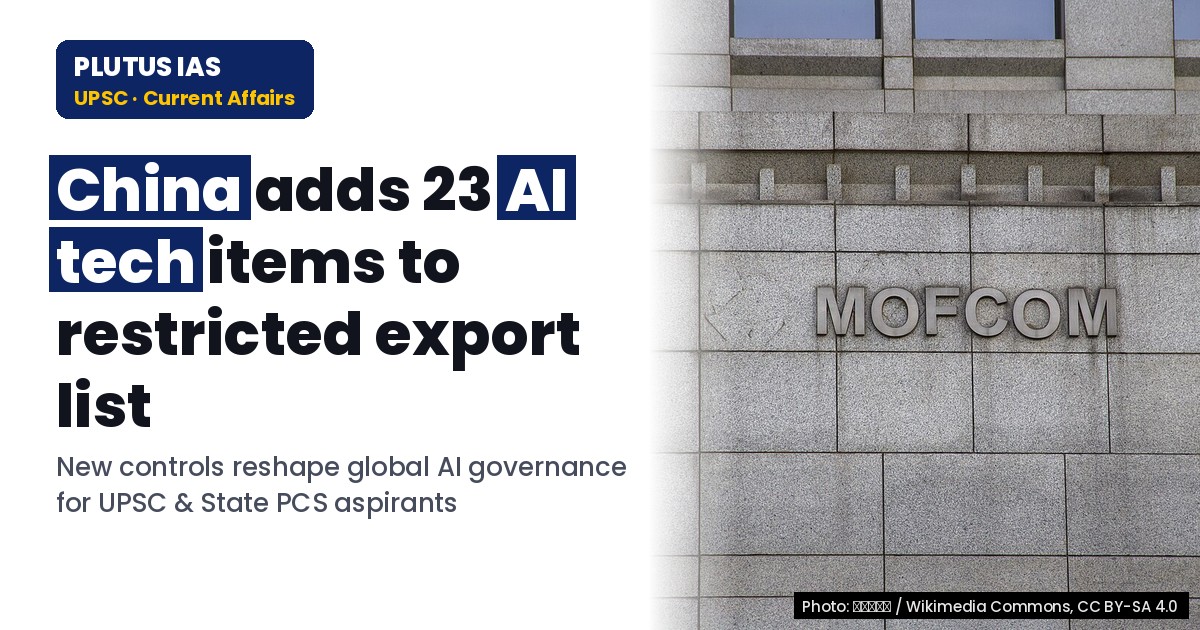
20 Oct China’s AI Export Controls: A Strategic Shift for UPSC & State PCS
✎ China’s AI export controls introduce a **pre-transfer registration and conditional licensing regime** for advanced AI technologies, including foundation models and agentic systems, while distinguishing between technology…
Subject Relevance — Where This Topic Fits
- GS Paper II — International Relations: Technology Transfers, Export Controls, and Strategic Trade | GS Paper III — Science and Technology: Artificial Intelligence, Semiconductor Industry, and Export Regulations
- Prelims: Export Control Order, MOFCOM, AI Foundation Models, FLOPs, Parameters, Data Security Law, Open-Weight Models, API Access, Semiconductor Supply Chain, Strategic Technology Transfer
- Essay: The Geopolitics of Technology: Export Controls and National Security in the 21st Century, Artificial Intelligence and the Sovereignty of Data: Balancing Innovation with Regulation
Quick Revision: China’s AI export controls introduce a **pre-transfer registration and conditional licensing regime** for advanced AI technologies, including foundation models and agentic systems, while distinguishing between technology transfers and service access.
Why is this in the news?
On 16 October 2026, China’s Ministry of Commerce (MOFCOM) issued a draft revision to its Catalogue of Technologies Prohibited or Restricted from Export, adding 23 advanced artificial intelligence (AI) technologies to the restricted list. This move introduces a dual mechanism—mandatory pre-transfer registration and conditional export licensing—for AI technologies, including foundation models, agentic systems, and associated hardware optimisations. The order, while not immediately restrictive, establishes a framework for Beijing to monitor, slow, or halt the export of cutting-edge AI capabilities, reflecting a calibrated shift in its export-control regime rather than an outright prohibition.
Background
- China has progressively expanded its export-control regime to include advanced technologies, aligning with its broader strategic objectives in technology sovereignty and national security.
- The 2021 revision of China’s Export Control Law empowered MOFCOM to regulate the transfer of sensitive technologies, including dual-use items, across borders.
- The inclusion of AI technologies follows global trends, with the United States, European Union, and Japan implementing similar controls on semiconductor and AI exports to address national security concerns.
- China’s Data Security Law (2021) and its 2025 amendments classify certain datasets as ‘important’ or ‘core,’ influencing the scope of AI export restrictions based on training data provenance.
- The draft order mirrors the United States’ CHIPS and Science Act (2022) and the EU’s AI Act (2024), which seek to regulate the global flow of advanced technologies while maintaining domestic innovation ecosystems.
- Open-weight AI models, which allow public access to model architectures and weights, are granted ‘automatic licensing’ under the draft order, indicating a preference for controlled openness over outright restriction.
What are China’s Export Controls on Advanced AI Technologies?
- The draft revision by MOFCOM introduces a **dual mechanism** for regulating AI technology transfers: (1) a **temporary registration requirement** for pre-transfer disclosure of covered technologies, and (2) a **conditional export licensing system** for restricted technologies.
- The **restricted list** includes **23 AI technologies**, such as foundation models, agentic systems, and hardware optimisations, with triggers based on computational thresholds (e.g., 10^26 training FLOPs, 2 trillion+ parameters) or global performance rankings.
- The order applies to **transfers of technology** (e.g., model weights, code, architecture) rather than the sale of AI services (e.g., API access), distinguishing between **control over capabilities** and **control over access**.
- Open-weight models, widely adopted globally, are subject to ‘automatic licensing,’ implying a streamlined approval process while retaining legal oversight.
- The **Data Security Law** plays a critical role, as restrictions may apply to models trained on ‘important’ or ‘core’ datasets, expanding the ambit of control beyond technical specifications.
- The order reflects a **calibrated approach**—not a blanket ban—allowing China to **monitor, slow, or halt** AI technology transfers based on strategic or security considerations.
- The inclusion of **agentic capabilities** (autonomous AI systems) underscores China’s focus on regulating not just foundational models but also their deployment in real-world applications.
- The move aligns with China’s broader **export-control strategy**, which includes restrictions on semiconductors, quantum computing, and biotechnology, to maintain a competitive edge in strategic sectors.
Key Features
| Feature | Significance |
|---|---|
| Draft revision of the Catalogue of Technologies Prohibited or Restricted from Export | Expands the scope of export controls to include advanced AI technologies, signalling a strategic shift in China’s technology governance. |
| Temporary registration requirement for technology transfers | Mandates pre-transfer disclosure of AI model weights, code, architecture, and hardware optimisations, enabling real-time monitoring of outbound technology flows. |
| Threshold-based restrictions (e.g., 10^26 training FLOPs, 2 trillion+ parameters) | Targets high-capability AI models, ensuring that only the most advanced systems fall under export restrictions, aligning with global AI development trends. |
| Automatic licensing for open-weight models | Facilitates controlled diffusion of open-weight AI models while maintaining regulatory oversight, balancing innovation with security concerns. |
| Exclusion of API access restrictions | Preserves China’s leverage by allowing foreign users to access AI capabilities as a service, ensuring dependency on Chinese providers without transferring model weights. |
Why it Matters
Economic and Strategic
- China’s move to regulate AI exports reflects a broader trend of weaponising technology controls in geopolitical competition, mirroring strategies employed by the United States and other major powers.
- The inclusion of AI in export-control lists underscores the strategic value of artificial intelligence in national security, economic competitiveness, and technological sovereignty.
- By creating a ‘switch’ rather than a ‘wall’, China retains flexibility to adjust export controls based on geopolitical or domestic priorities, ensuring adaptability in its policy toolkit.
Technological and Industrial
- The restrictions target foundational AI models and related core technologies, which are critical for the development of next-generation AI systems across sectors such as healthcare, finance, and defence.
- The focus on high-capability models (e.g., those with 2 trillion+ parameters) aligns with global AI advancement trends, where computational power and model complexity are key differentiators.
- The distinction between open-weight models and proprietary systems highlights China’s intent to balance innovation with control, ensuring that open models remain accessible while proprietary technologies are regulated.
Regulatory and Governance
- The temporary registration requirement introduces a proactive monitoring mechanism, enabling authorities to track technology transfers and intervene if necessary, thereby enhancing regulatory oversight.
- The broad and discretionary nature of the restrictions suggests a shift from risk-based regulation to capability-based controls, which may have implications for global AI governance standards.
- The order’s design reflects a nuanced approach to technology export controls, combining transparency (through disclosure requirements) with flexibility (through adjustable licensing mechanisms).
Challenges
1. Regulatory Arbitrage and Compliance Burden
- The discretionary nature of the restrictions may create uncertainty for exporters, who must navigate evolving criteria for compliance while ensuring their operations align with China’s policy objectives.
- The requirement for pre-transfer disclosure of AI technologies could impose administrative burdens on companies, particularly those engaged in cross-border collaborations or joint ventures.
UPSC Link: GS Paper 3: Science and Technology
2. Global AI Governance Fragmentation
- China’s AI export controls add to the existing fragmentation in global AI governance, where different jurisdictions adopt varying approaches to regulating artificial intelligence.
- The lack of harmonised international standards for AI export controls may lead to trade disputes or hinder collaboration on AI research and development.
UPSC Link: GS Paper 2: International Relations
3. Technological Dependence and Supply Chain Risks
- By restricting the transfer of AI model weights while allowing API access, China may inadvertently create a dependency among foreign users on Chinese AI providers, raising concerns about supply chain vulnerabilities.
- The reliance on Chinese AI technologies could expose other countries to geopolitical leverage, particularly in sectors where AI plays a critical role, such as defence and critical infrastructure.
UPSC Link: GS Paper 3: Science and Technology
4. Balancing Innovation with Security Concerns
- The broad scope of the restrictions may stifle innovation by discouraging the development of high-capability AI models, particularly in open research communities where transparency is valued.
- Governments must strike a delicate balance between addressing security concerns and fostering an environment that encourages technological advancement and collaboration.
UPSC Link: GS Paper 3: Science and Technology
Challenges — UPSC Perspective
| Issue | Concern |
|---|---|
| Discretionary nature of restrictions | Creates uncertainty for exporters and may lead to inconsistent compliance across industries. |
| Administrative burden of pre-transfer disclosures | Increases operational costs and delays for companies engaged in cross-border AI technology transfers. |
| Fragmentation in global AI governance | Undermines international collaboration and may lead to trade disputes or regulatory conflicts. |
| Technological dependence on Chinese AI providers | Raises concerns about supply chain vulnerabilities and geopolitical leverage. |
| Potential stifling of innovation in open research | May discourage transparency and collaborative development in the AI ecosystem. |
Way Forward
- Governments and industry stakeholders should engage in multilateral dialogues to establish harmonised international standards for AI export controls, ensuring consistency and reducing fragmentation.
- Countries should diversify their AI technology supply chains by investing in domestic AI research and development, as well as fostering partnerships with non-Chinese providers.
- Regulatory frameworks for AI export controls should incorporate clear, objective criteria to minimise discretion and enhance predictability for exporters.
- Policymakers should prioritise the development of open and transparent AI ecosystems, balancing security concerns with the need for innovation and collaboration.
- Collaborative initiatives between governments, academia, and industry can help address the challenges posed by AI export controls while promoting responsible AI development.
- Countries should assess the geopolitical implications of AI technology dependence and develop contingency plans to mitigate supply chain risks.
- Efforts should be made to align AI export controls with existing international regimes, such as the Wassenaar Arrangement, to ensure coherence and effectiveness.
UPSC Value Addition
Keywords for Mains Answer-Writing
Artificial Intelligence · export controls · technology transfer · foundation models · AI governance · AI safety · cyber sovereignty · export licensing regime · AI chip designs · AI agentic capabilities · Data Security Law · AI model weights · AI code architecture · AI hardware optimisations · AI ecosystem resilience · geopolitics of AI · AI export restrictions · AI licensing mechanisms · AI global rankings · AI training FLOPs
Concept Flow
China’s Ministry of Commerce (MOFCOM) issues a draft revision of the Catalogue of Technologies Prohibited or Restricted from Export, adding advanced AI technologies to the list. → The revision introduces a temporary registration requirement for technology transfers, mandating pre-transfer disclosure of AI model weights, code, and related technologies. → The restrictions target high-capability AI models based on thresholds such as training FLOPs, parameters, and global rankings, ensuring that only advanced systems fall under export controls. → The order distinguishes between open-weight models (subject to automatic licensing) and proprietary systems, balancing innovation with regulatory oversight. → By allowing API access while restricting model weight transfers, China retains leverage over foreign users, ensuring dependency on Chinese AI providers. → The move reflects a broader trend of weaponising technology controls in geopolitical competition, mirroring strategies employed by other major powers. → The policy has implications for global AI governance, supply chain dynamics, and technological sovereignty, necessitating coordinated responses from governments and industry stakeholders.
Prelims Practice Questions
Q1. Consider the following statements regarding China’s recent AI export control measures:
1. The draft revision of the Catalogue of Technologies Prohibited or Restricted from Export includes 23 AI items within a wider list of 40 technologies.
2. The restrictions apply to the sale of AI services but not to the transfer of AI technology.
3. Open-weight AI models adopted globally receive ‘automatic licensing’ under the new regime.
How many of the above statements are correct?
- Only one
- Only two
- All
- None
Answer: All — Statements 1 and 3 are correct. Statement 2 is incorrect because the restrictions apply to transfers of AI technology, not to the sale of AI services.
Q2. Assertion (A): China’s AI export control order is primarily motivated by cyber safety concerns.
Reason (R): The order mandates temporary registration for exporters to disclose transfers of covered AI technology before they occur.
- Both A and R are true, and R is the correct explanation of A.
- Both A and R are true, but R is not the correct explanation of A.
- A is true, but R is false.
- A is false, but R is true.
Answer: A is true, but R is false. — The order claims to address cyber safety concerns, but its broader coverage and design suggest it is also an instrument of control and leverage. R is true but does not fully explain A.
Q3. Match the following AI-related technologies with their corresponding regulatory treatment under China’s recent export control order:
Column I (Technology)
A. Foundation models with 10^26 training FLOPs
B. Open-weight models adopted globally
C. Advanced agentic capabilities
D. AI hardware optimisations
Column II (Regulatory Treatment)
1. Requires export licence with quick procedural approval
2. Requires export licence with potential veto
3. Automatic licensing (licence required but approval quick)
4. Prohibited from export
- {‘A’: 2, ‘B’: 3, ‘C’: 2, ‘D’: 2}
- {‘A’: 4, ‘B’: 3, ‘C’: 2, ‘D’: 1}
- {‘A’: 2, ‘B’: 1, ‘C’: 4, ‘D’: 3}
- {‘A’: 4, ‘B’: 3, ‘C’: 2, ‘D’: 4}
Answer: {‘A’: 4, ‘B’: 3, ‘C’: 2, ‘D’: 1} — A and C require export licences with potential veto due to high capability thresholds. B receives automatic licensing despite requiring a licence. D is included in the restricted list requiring a licence.
Mains Practice Question
✍ China’s recent AI export control order introduces a dual mechanism of licensing and registration for advanced AI technologies. Critically analyse the implications of such a regime for global AI governance, with particular reference to its potential impact on the resilience of open AI ecosystems. (15 Marks)
Approach: MODEL-ANSWER SKELETON:
1. **Introduction**: Define AI export controls and their purpose (technology transfer regulation, national security, cyber sovereignty). Briefly outline China’s dual mechanism (licensing + registration) and its stated motivation (cyber safety).
2. **Mechanism of the Regime**:
– Licensing for restricted technologies (foundation models, agentic capabilities, high FLOP models).
– Registration for covered transfers (model weights, code, architecture, hardware optimisations).
– Triggers for restriction: global top-10 rankings, training on ‘important’ data, 2 trillion+ parameters, or 10^26 FLOPs.
– Automatic licensing for open-weight models despite legal requirement.
3. **Implications for Global AI Governance**:
– **Control and Leverage**: The regime functions as a ‘switch’ rather than a ‘wall’, enabling China to monitor, slow, or stop AI technology flows. This mirrors US leverage in AI chip designs and models.
– **Dependency Risks**: Restrictions on model weights (but not API access) create dependency on Chinese providers, preserving control while allowing foreign use of capabilities.
– **Fragmentation of Ecosystems**: Potential Balkanisation of AI development, with separate ecosystems emerging in China, US, EU, and other regions.
– **Open Ecosystem Resilience**: Open-weight models face ‘automatic licensing’, but the requirement itself may deter adoption. The order risks undermining the collaborative, open nature of AI research.
4. **Impact on Open AI Ecosystems**:
– **Adoption Barriers**: Legal and procedural hurdles for open-weight models may reduce their global adoption.
– **Innovation Constraints**: Restrictions on high-capability models could limit cross-border collaboration and innovation.
– **Alternative Pathways**: The need for a resilient open ecosystem may drive the formation of consortia (e.g., India, EU, Gulf) to develop alternative AI models and frameworks.
5. **Balancing Views**:
– **Proponents of Control**: Argue that such regimes are necessary for national security and cyber sovereignty, preventing misuse of advanced AI.
– **Critics**: Warn of overreach, potential stifling of innovation, and the creation of a fragmented AI landscape that harms global progress.
6. **Conclusion**: The order reflects a broader trend of strategic technology control. While it may enhance China’s leverage, it also risks undermining the collaborative and open nature of AI development. The resilience of open ecosystems will depend on the ability of other regions to develop competitive, open alternatives.
Source: The Indian Express
Generated by AanyaAi for educational purpose.
Related guides on our sites
- Current affairs for upsc 2026
- Best PSIR optional coaching for upsc
- Best PSIR optional teacher for upsc
- Best teacher of PSIR optional for upsc

- सितंबर 2026 का कोर इंडस्ट्री इंडेक्स: जानिए अगस्त 2026 का अंतिम आँकड़ा - October 21, 2026
- Treasury Bills Auction: RBI Releases Full Results for UPSC Exam - October 21, 2026
- यूपीएससी के लिए महत्वपूर्ण: 91, 182 और 364 दिन के टी-बिल नीलामी परिणाम - October 21, 2026

No Comments