


03 Sep Clean Data & Sustainable AI: Key for Reliable AI Systems in UPSC Exams
✎ Clean, diverse, and representative data is the cornerstone of reliable AI systems, while synthetic data must be used judiciously to avoid introducing biases or errors; sustainable AI requires balancing technological advancement…
Subject Relevance — Where This Topic Fits
- GS Paper III — Science and Technology — Developments and their Applications and Effects in Everyday Life | GS Paper III — Environment and Sustainable Development — Climate Change and Sustainable Technologies
- Prelims: Data quality, synthetic data, machine learning, quantum computing, data centres, Terahertz technology, large language models (LLMs)
- Essay: Ethical Dimensions of Artificial Intelligence: Balancing Innovation with Responsibility, Sustainable Technology for a Resilient Future: The Convergence of AI and Green Energy
Quick Revision: Clean, diverse, and representative data is the cornerstone of reliable AI systems, while synthetic data must be used judiciously to avoid introducing biases or errors; sustainable AI requires balancing technological advancement with environmental and ethical considerations.
Why is this in the news?
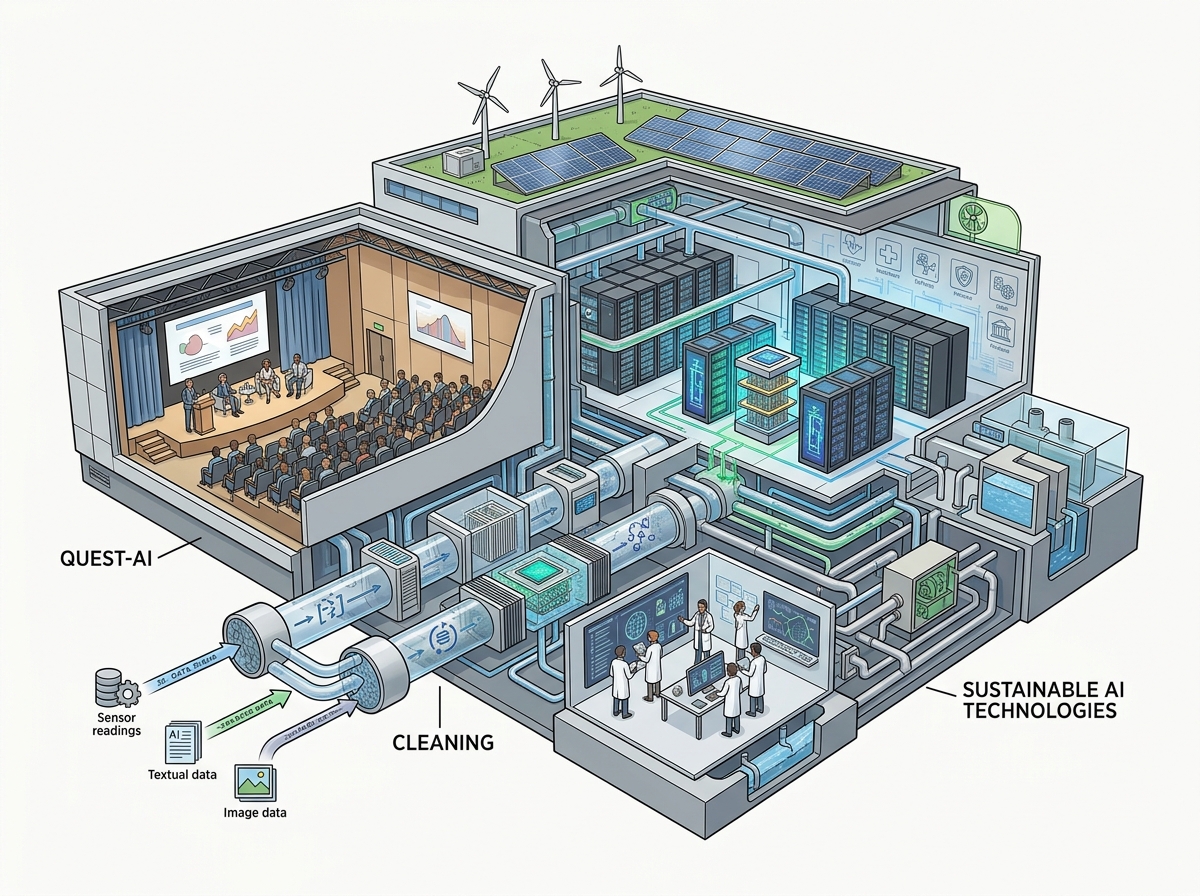
The international conference on Quantum Enhanced Sustainable Technologies for AI Systems (QUEST-AI), held in Visakhapatnam, highlighted the critical role of clean and diverse data in ensuring the reliability of AI systems, while also underscoring the need for sustainable AI technologies and the judicious use of synthetic data. The event brought together experts to deliberate on the intersection of quantum computing, AI, and sustainable energy solutions, reflecting the growing recognition of these domains as pivotal for India’s technological and environmental future.
Background
- Artificial Intelligence (AI) systems rely on vast datasets to train models, and the quality of these datasets directly influences the accuracy and fairness of AI outcomes.
- The proliferation of AI applications across sectors—healthcare, defence, finance, and governance—has amplified the need for robust data governance frameworks to prevent biases, errors, and unintended consequences.
- Synthetic data, generated artificially to mimic real-world data, is increasingly used to address data scarcity but poses risks of propagating inaccuracies or reinforcing biases if not carefully controlled.
- Quantum computing is emerging as a transformative technology with the potential to enhance AI capabilities, particularly in optimisation and cryptography, while also introducing new challenges in data security and energy consumption.
- Data centres, which underpin AI infrastructure, are energy-intensive, prompting discussions on sustainable alternatives such as nuclear power and green energy to mitigate their environmental footprint.
- Terahertz technology, operating in the frequency range of 0.1–10 THz, is being explored for applications in defence, healthcare, and communications, offering high-resolution imaging and non-invasive sensing capabilities.
Clean Data and Sustainable AI: Core Concepts and Challenges
- Clean Data: Refers to datasets that are accurate, unbiased, representative, and free from errors, inconsistencies, or missing values. Clean data is essential for training reliable AI models, as flawed datasets can lead to erroneous predictions, discriminatory outcomes, and systemic biases.
- Diverse Data: Ensures that AI systems are trained on datasets that reflect the full spectrum of real-world scenarios, including demographic, geographic, and socioeconomic diversity. This mitigates the risk of models performing poorly on underrepresented groups or edge cases.
- Small Data: In contexts where large datasets are unavailable, small data approaches—leveraging targeted, high-quality datasets—can still yield meaningful insights. Techniques such as transfer learning and federated learning enable effective model training with limited data.
- Synthetic Data: Artificially generated data designed to replicate real-world datasets. While useful for augmenting scarce data or testing AI models, synthetic data must be used within strict limits to avoid introducing artefacts, biases, or inaccuracies that could degrade model performance.
- Large Language Models (LLMs): Advanced AI models trained on vast textual datasets to generate human-like responses. The reliability of LLMs depends heavily on the quality and diversity of their training data, as well as the ethical frameworks governing their deployment.
- Quantum Computing: A paradigm that leverages quantum mechanics to perform computations exponentially faster than classical computers for specific tasks. Quantum-enhanced AI systems could revolutionise fields such as optimisation, cryptography, and drug discovery, but require significant energy inputs and pose new challenges in data integrity.
- Sustainable AI: An approach to AI development that prioritises environmental, social, and economic sustainability. This includes reducing the carbon footprint of AI infrastructure (e.g., data centres), adopting green energy solutions, and ensuring equitable access to AI technologies.
- Data Centre Energy Efficiency: Data centres consume vast amounts of electricity, contributing to carbon emissions. Sustainable alternatives, such as nuclear power, renewable energy integration, and advanced cooling technologies, are being explored to mitigate their environmental impact.
Key Features
| Feature | Significance |
|---|---|
| Clean and diverse data | Ensures reliability and fairness in AI systems by reducing biases and errors in machine-learning models. |
| Synthetic data | Augments scarce real-world data but must be used within defined limits to prevent degradation of model accuracy. |
| Small data approaches | Addresses data scarcity in niche domains, enabling AI applications where large datasets are unavailable. |
| Quantum-enhanced AI systems | Leverages quantum computing to improve data processing efficiency and computational power for AI tasks. |
| Terahertz technology | Enables high-speed data transmission and imaging, with applications in defence, healthcare, and communications. |
Why it Matters
Technological and Scientific
- AI systems depend on the quality of input data; flawed data leads to unreliable outputs, necessitating rigorous data curation.
- Quantum computing and AI integration can revolutionise data processing, enabling solutions to problems previously intractable.
- Terahertz technology bridges gaps in high-speed data transfer, critical for next-generation wireless networks and medical diagnostics.
Economic
- Investment in clean data infrastructure reduces long-term costs by minimising errors and rework in AI deployments.
- Sustainable AI technologies can lower energy consumption in data centres, aligning with global decarbonisation goals.
- Quantum-enhanced AI data centres may emerge as high-value economic assets, driving innovation and employment.
Ethical and Societal
- Diverse and representative datasets are essential to prevent algorithmic biases that could exacerbate social inequalities.
- Transparent use of synthetic data ensures accountability in AI decision-making processes.
- Ethical AI frameworks must balance innovation with safeguards against misuse in surveillance or misinformation.
Environmental
- Energy-efficient AI systems, including quantum-enhanced data centres, reduce the carbon footprint of digital infrastructure.
- Optimised data processing minimises electronic waste and resource consumption in hardware manufacturing.
Challenges
1. Data Quality and Bias
- Poor-quality or unrepresentative data leads to erroneous AI outputs, undermining trust in automated systems.
- Bias in datasets can perpetuate historical injustices, particularly in critical sectors like healthcare and criminal justice.
- Addressing bias requires interdisciplinary collaboration among technologists, ethicists, and domain experts.
UPSC Link: GS3: Science & Tech
2. Energy Consumption of AI Infrastructure
- Data centres consume vast amounts of electricity, contributing to greenhouse gas emissions.
- Quantum computing, while promising, may initially increase energy demands due to cooling and operational requirements.
- Transitioning to renewable energy sources for data centres is essential but logistically complex.
UPSC Link: GS3: Environment & Biodiversity
3. Limits of Synthetic Data
- Over-reliance on synthetic data can degrade model performance, especially in complex real-world scenarios.
- Distinguishing synthetic from real data is challenging, raising concerns about authenticity and traceability.
- Regulatory frameworks are needed to define permissible use cases and quality standards for synthetic data.
UPSC Link: GS3: Science & Tech
4. Quantum-AI Integration Challenges
- Quantum computing is still in its nascent stages, with limited practical applications in AI systems.
- High costs and technical expertise required for quantum infrastructure pose barriers to widespread adoption.
- Standardisation and interoperability between classical and quantum systems remain unresolved.
UPSC Link: GS3: Science & Tech
5. Ethical and Regulatory Gaps
- Lack of global consensus on AI governance creates inconsistencies in ethical standards and compliance.
- Intellectual property concerns arise from proprietary AI models trained on proprietary or sensitive data.
- Public scepticism about AI transparency and accountability hinders adoption in sensitive domains.
UPSC Link: GS4: Ethics & Integrity
Challenges — UPSC Perspective
| Issue | Concern |
|---|---|
| Data scarcity | Limited availability of real-world data in niche domains hinders AI model training. |
| Algorithmic opacity | Black-box nature of AI models obscures decision-making processes, complicating audits. |
| Energy inefficiency | High computational demands of AI systems contribute to environmental degradation. |
| Regulatory fragmentation | Divergent national policies on AI ethics and data governance create compliance challenges. |
| Skill gaps | Shortage of professionals trained in quantum computing, AI ethics, and data science impedes progress. |
| Cost barriers | High infrastructure and operational costs limit access to advanced AI technologies for developing nations. |
Way Forward
- Establish national and international standards for data quality, transparency, and bias mitigation in AI systems.
- Invest in research and development of energy-efficient AI hardware, including quantum-enhanced data centres.
- Promote public-private partnerships to accelerate the deployment of sustainable AI technologies.
- Develop ethical guidelines and regulatory frameworks for the responsible use of synthetic data.
- Enhance interdisciplinary education and training programmes to address skill gaps in AI and quantum technologies.
- Encourage open-access repositories of clean, diverse datasets to democratise AI development.
- Strengthen international collaboration to harmonise AI governance and ethical standards.
- Prioritise the integration of Terahertz technology in critical sectors like healthcare and defence to enhance data transmission capabilities.
UPSC Value Addition
Keywords for Mains Answer-Writing
Artificial Intelligence governance · Clean data principles for AI · Sustainable AI technologies · Quantum-enhanced AI systems · Data quality in machine learning · Synthetic data limitations · Energy-efficient data centres · Nuclear power for data infrastructure · Ethical AI development · Data governance frameworks · Small data vs big data · AI policy and regulation
Concept Flow
AI system reliability → Depends on data quality → Clean and diverse datasets reduce biases and errors. → Data scarcity → Addressed via synthetic data → Excessive use introduces new errors and ethical concerns. → Energy-intensive AI infrastructure → Drives demand for sustainable solutions → Quantum-enhanced data centres as a viable option. → Quantum computing advancements → Enable high-speed data processing → Facilitates real-time AI applications. → Terahertz technology deployment → Enhances data transmission speeds → Supports defence and healthcare innovations. → Ethical and regulatory frameworks → Ensure responsible AI deployment → Balance innovation with accountability. → Global collaboration → Harmonises standards and practices → Accelerates sustainable AI adoption.
Prelims Practice Questions
Q1. Consider the following statements regarding the role of data in Artificial Intelligence (AI) systems:
1. Machine-learning algorithms depend entirely on the volume of data rather than its quality.
2. Clean and diverse data are essential for producing reliable AI systems.
3. Synthetic data can be used without limits to augment real-world datasets in AI training.
4. Small data approaches are particularly relevant when real-world data availability is limited.
How many of the above statements are correct?
- Only one
- Only two
- Only three
- All four
Answer: Only three — Statements 2 and 4 are correct. Statement 1 is incorrect because AI systems depend on both volume and quality of data; poor-quality data produces flawed results. Statement 3 is incorrect because synthetic data should be used within clearly defined limits to avoid increasing errors in large language models.
Q2. Assertion (A): Quantum technology and AI are likely to work together in future applications.
Reason (R): Quantum-enhanced AI data centres are expected to address the major electricity requirements of conventional data centres.
In the context of the above statements, which of the following is correct?
- Both A and R are true, and R is the correct explanation of A.
- Both A and R are true, but R is not the correct explanation of A.
- A is true, but R is false.
- A is false, but R is true.
Answer: A is true, but R is false. — Assertion (A) is true as quantum technology and AI are expected to synergise in future. Reason (R) is true but does not directly explain the assertion; quantum-enhanced data centres are a consequence, not the reason for their collaboration.
Q3. Which of the following best describes the concept of ‘small data’ in the context of AI systems?
- A dataset containing only a few hundred records used for training AI models.
- Data collected from small-scale experiments or limited real-world sources to train AI models.
- A subset of big data used exclusively for testing AI models.
- Data generated synthetically to replace real-world datasets entirely.
Answer: Data collected from small-scale experiments or limited real-world sources to train AI models. — ‘Small data’ refers to datasets derived from limited real-world sources where data availability is constrained, making it particularly relevant for training AI models in such contexts.
Mains Practice Question
✍ Artificial Intelligence (AI) systems are only as reliable as the data they are trained on. Critically examine the challenges and policy imperatives associated with ensuring clean, diverse, and sustainable data ecosystems for AI development in India. (15 Marks)
Approach: MODEL-ANSWER SKELETON:
1. **Introduction (2 marks)**: Define AI reliability and its dependence on data quality. Briefly introduce the concept of ‘clean data’ and its significance in AI governance.
2. **Challenges in Data Quality (5 marks)**:
– **Volume vs Quality**: Critique the ‘big data’ obsession; highlight that poor-quality data leads to flawed AI outputs (cite the statement by Nilanjan Dey).
– **Diversity and Bias**: Discuss the risks of non-diverse datasets (e.g., underrepresentation of certain demographics) and resultant algorithmic bias.
– **Small Data Limitations**: Explain the constraints of small data in AI training and the need for innovative approaches (e.g., transfer learning, federated learning).
– **Synthetic Data Risks**: Analyse the limitations of synthetic data (e.g., increased errors in LLMs, lack of real-world context) and the need for regulated use.
3. **Policy and Governance Imperatives (5 marks)**:
– **Regulatory Frameworks**: Discuss the role of the Digital Personal Data Protection Act, 2023, and other data governance policies in ensuring data quality and privacy.
– **Institutional Mechanisms**: Highlight the need for a dedicated AI data governance body (e.g., akin to the proposed AI regulatory authority) to standardise data collection, cleaning, and annotation.
– **Public-Private Partnerships**: Emphasise collaboration between academia, industry, and government to develop clean data repositories and tools.
– **Ethical Guidelines**: Reference global frameworks (e.g., UNESCO Recommendation on the Ethics of AI) and their applicability in India.
4. **Sustainability and Energy Efficiency (3 marks)**:
– Discuss the energy demands of AI data centres and the proposal for nuclear-powered or quantum-enhanced data centres (cite Praveen Kumar’s statement).
– Highlight the need for energy-efficient AI models and the role of green computing in sustainable AI development.
5. **Conclusion (2 marks)**: Summarise the criticality of clean, diverse, and sustainable data ecosystems for India’s AI ambitions. Emphasise the need for a balanced approach that integrates technological innovation with robust governance.
Source: The Hindu
Generated by AanyaAi for educational purpose.
Related guides on our sites
- Current affairs for upsc 2026
- How to prepare for GS paper 1 for UPSC CSE mains exam
- Best UPSC coaching for IFOS exam
- Best mentorship programme for upsc

- आरबीआई द्वारा 91, 182 और 364 दिनीय ट्रेजरी बिलों की नीलामी: प्रमुख तथ्य - October 24, 2026
- Inflation’s Second-Round Effects: RBI Policy & Economic Impact Analysis - October 24, 2026
- ISRO का NVS-03 उपग्रह: NavIC को पुनः सक्रिय करेगा, जानिए कैसे? - October 24, 2026

No Comments