


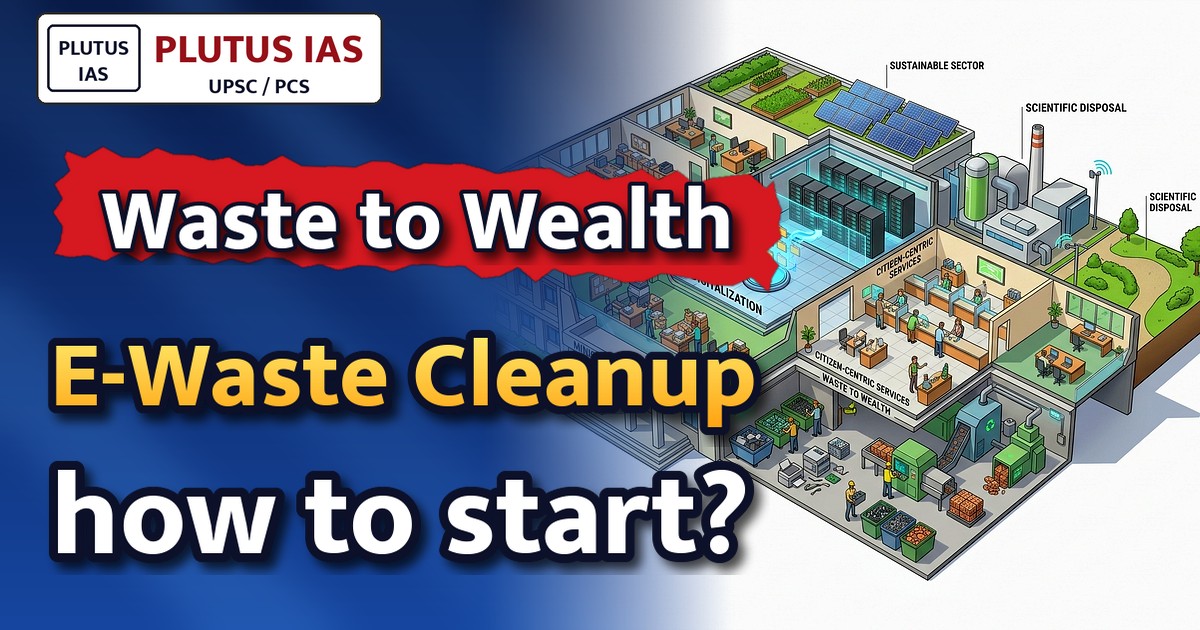
29 Sep Coal Ministry Launches Special Campaign-6 for Waste to Wealth Drive
✎ Special Campaign-6, launched by the Ministry of Coal from 2–31 October 2026, is a governance reform initiative under the ‘Waste to Wealth’ mission, focusing on e-waste disposal, scrap clearance, office optimization, and…
Subject Relevance — Where This Topic Fits
- GS Paper II — Governance, Transparency and Accountability | GS Paper III — Environment and Sustainable Development
- Prelims: Swachh Bharat Mission 2.0, E-waste Management Rules 2022, Digital India, Public Sector Undertakings (PSUs), Administrative Reforms
- Essay: Sustainable Development and Circular Economy: Balancing Growth and Environmental Stewardship, Institutional Mechanisms for Good Governance: Role of Public Sector Enterprises
Quick Revision: Special Campaign-6, launched by the Ministry of Coal from 2–31 October 2026, is a governance reform initiative under the ‘Waste to Wealth’ mission, focusing on e-waste disposal, scrap clearance, office optimization, and digitalization to enhance administrative efficiency and sustainability.
Why is this in the news?
The Ministry of Coal is set to launch Special Campaign-6 from 2 to 31 October 2026 across its administrative offices and public sector undertakings (PSUs) as part of the national ‘Waste to Wealth’ initiative. This month-long campaign aims to enhance governance efficiency, promote scientific disposal of e-waste, optimize office spaces, and accelerate digitalization, thereby fostering citizen-centric and sustainable administrative practices in the coal sector.
Background
- The Government of India has consistently emphasized the integration of environmental sustainability with governance reforms, as reflected in initiatives like Swachh Bharat Mission 2.0 and the National Clean Air Programme.
- Public Sector Undertakings (PSUs) in the coal sector, such as Coal India Limited (CIL), NLC India Limited (NLCIL), and others, are significant contributors to national coal production and are expected to lead by example in adopting sustainable administrative practices.
- The Ministry of Coal has previously conducted Special Campaigns to improve office cleanliness, digitization, and asset management, with measurable outcomes in administrative efficiency.
- The campaign is being coordinated through a structured review mechanism involving senior officials and nodal officers across the ministry and its PSUs to ensure systematic implementation.
- The initiative also incorporates youth engagement and awareness programs to foster a culture of sustainability and innovation among future stakeholders.
What is Special Campaign-6 under the ‘Waste to Wealth’ initiative?
- Special Campaign-6 is a month-long governance reform initiative launched by the Ministry of Coal, commencing on 2 October 2026 and concluding on 31 October 2026, as part of the broader ‘Waste to Wealth’ national mission.
- The campaign targets all administrative offices and PSUs under the Ministry of Coal, including Coal India Limited (CIL), NLC India Limited (NLCIL), Coal Controller’s Organisation (CCO), and Coal Mines Provident Fund Organisation (CMPFO).
- Core objectives include the scientific disposal of e-waste, systematic clearance of scrap and unused materials, optimization of office spaces, and acceleration of digitalization to enhance administrative efficiency.
- The initiative is designed to promote sustainable practices by reducing waste generation, improving resource utilization, and creating cleaner, more organized work environments.
- A structured review mechanism has been established, involving senior officials and nodal officers, to monitor progress, set targets, and ensure accountability during the campaign.
- Youth engagement is a key component, with workshops and competitions aimed at fostering innovation, creativity, and environmental awareness among employees’ children and young stakeholders.
- The campaign also includes awareness drives, such as debates and discussions, to sensitize officials about the importance of cleanliness, sustainability, and citizen-centric governance.
- The outcomes of Special Campaign-6 are expected to contribute to the broader goals of the ‘Waste to Wealth’ mission, aligning with India’s commitments under the Sustainable Development Goals (SDGs), particularly SDG 12 (Responsible Consumption and Production) and SDG 11 (Sustainable Cities and Communities).
Key Features
| Feature | Significance |
|---|---|
| E-waste scientific disposal | Ensures compliance with the E-Waste (Management) Rules, 2022, reducing environmental pollution and promoting circular economy principles within PSUs. |
| Scrap clearance and asset optimization | Enhances operational efficiency by identifying and liquidating non-utilised assets, aligning with the ‘Waste to Wealth’ national mission. |
| Office site optimization | Improves administrative efficiency through systematic space utilisation and ergonomic redesign of workstations. |
| Digitalisation of workplace | Facilitates transition to paperless governance, reducing resource consumption and improving service delivery timelines. |
| Citizen-centric governance promotion | Demonstrates commitment to Swachh Bharat Mission 2.0 and Sustainable Development Goals (SDG 12: Responsible Consumption and Production). |
Why it Matters
Administrative Efficiency
- Streamlines asset management in PSUs by identifying redundant physical and electronic waste, reducing storage costs and improving resource allocation.
- Promotes digital governance, reducing bureaucratic delays and enhancing transparency in public service delivery.
- Encourages inter-departmental coordination through structured review mechanisms and cross-functional participation.
Environmental Sustainability
- Supports national waste management frameworks by ensuring scientific disposal of e-waste, reducing landfill burden and toxic emissions.
- Aligns with India’s Nationally Determined Contributions (NDCs) under the Paris Agreement by reducing carbon footprint of administrative operations.
- Promotes circular economy principles by converting waste into reusable assets or revenue streams.
Institutional Capacity Building
- Strengthens institutional mechanisms through structured review processes and performance audits, fostering a culture of accountability.
- Enhances employee awareness and participation in sustainability initiatives, embedding long-term behavioural change.
- Demonstrates leadership in public sector governance, setting benchmarks for other ministries to emulate.
Youth Engagement and Innovation
- Fosters intergenerational collaboration by involving employees’ children in waste-to-wealth workshops, promoting STEM education and creativity.
- Encourages grassroots innovation in resource utilisation, aligning with the Atal Innovation Mission’s objectives.
- Enhances public perception of PSUs as progressive and environmentally conscious entities.
Challenges
1. Logistical and Operational Constraints
- Ensuring seamless coordination across multiple PSUs (CIL, NLCIL, CCO, CMPFO) with diverse operational priorities and resource constraints.
- Managing the disposal of hazardous e-waste in compliance with the E-Waste (Management) Rules, 2022, without causing operational disruptions.
- Addressing the lack of standardised protocols for asset liquidation and scrap clearance in legacy systems.
UPSC Link: GS3: Environmental Pollution
2. Behavioural and Cultural Resistance
- Overcoming institutional inertia and resistance to change among employees accustomed to traditional work practices.
- Ensuring sustained participation from all levels of staff, including senior officials, in waste segregation and digitalisation initiatives.
- Addressing scepticism regarding the tangible benefits of digitalisation and waste management in bureaucratic settings.
UPSC Link: GS4: Ethics in Governance
3. Technological and Infrastructure Gaps
- Limited access to advanced e-waste processing facilities in remote coalfield regions, necessitating outsourcing or public-private partnerships.
- Inadequate digital infrastructure in some PSU offices, particularly in rural or semi-urban areas, hindering seamless digitalisation.
- Ensuring cybersecurity and data privacy in the transition to paperless governance.
UPSC Link: GS3: Science & Technology
4. Monitoring and Evaluation Challenges
- Developing robust metrics to measure the success of asset optimisation, waste reduction, and digitalisation initiatives across diverse PSUs.
- Ensuring real-time tracking of progress and addressing bottlenecks without bureaucratic delays.
- Balancing short-term campaign goals with long-term institutionalisation of sustainable practices.
UPSC Link: GS4: Governance
5. Legal and Compliance Risks
- Ensuring full compliance with the E-Waste (Management) Rules, 2022, and other environmental regulations to avoid legal penalties.
- Addressing liability issues arising from improper disposal of hazardous waste or data breaches in digital systems.
- Navigating conflicts between waste management policies and existing procurement or asset utilisation policies.
UPSC Link: GS3: Environmental Laws
Challenges — UPSC Perspective
| Issue | Concern |
|---|---|
| Coordinated implementation across PSUs | Diverse operational priorities and resource constraints may hinder uniform execution of the campaign. |
| E-waste disposal compliance | Risk of non-adherence to the E-Waste (Management) Rules, 2022, leading to environmental and legal consequences. |
| Employee participation | Institutional inertia and resistance to change may limit active involvement from all staff levels. |
| Digital infrastructure gaps | Inadequate IT systems in some offices may impede the digitalisation agenda. |
| Asset liquidation protocols | Lack of standardised procedures for identifying and liquidating non-utilised assets may reduce efficiency gains. |
| Monitoring and evaluation | Difficulty in quantifying outcomes across multiple PSUs with varying scales of operations. |
Way Forward
- Constitute cross-functional task forces within each PSU to oversee campaign execution, with clear timelines and accountability matrices.
- Develop standardised SOPs for e-waste disposal, scrap clearance, and asset liquidation, in consultation with the Central Pollution Control Board (CPCB).
- Leverage public-private partnerships to set up regional e-waste processing hubs, particularly in coalfield regions with limited infrastructure.
- Conduct capacity-building workshops for employees on digital governance tools, waste segregation, and sustainability practices.
- Establish a real-time digital dashboard to track progress across all PSUs, enabling data-driven decision-making and corrective actions.
- Integrate the campaign’s outcomes with the Swachh Bharat Mission 2.0 and SDG 12 reporting frameworks for national benchmarking.
- Incentivise innovation by recognising and replicating successful waste-to-wealth initiatives across PSUs.
- Ensure periodic third-party audits to validate compliance with environmental regulations and assess the long-term impact of the campaign.
UPSC Value Addition
Keywords for Mains Answer-Writing
Waste to Wealth · E-waste management · Administrative reforms in India · Digitalisation of governance · Sustainable development · Public Sector Undertakings (PSUs) · Administrative efficiency · Circular economy · Swachh Bharat Mission · Institutional mechanisms for waste management · Government of India initiatives · Ministry of Coal · Scientific disposal of waste · Citizen-centric governance · Office automation · Resource optimisation
Concept Flow
Initiation of campaign → Identification of waste streams (physical, e-waste) → Segregation and scientific disposal → Asset optimisation and liquidation → Digitalisation of workplace → Enhanced administrative efficiency → Environmental sustainability → Institutional capacity building → Long-term behavioural change → Alignment with national missions (Swachh Bharat, SDGs)
Prelims Practice Questions
Q1. Consider the following statements regarding the ‘Waste to Wealth’ initiative of the Government of India:
1. The initiative aims to promote the scientific disposal of e-waste and scrap materials.
2. It is aligned with the Swachh Bharat Mission’s objectives.
3. The initiative is exclusively implemented by the Ministry of Environment, Forest and Climate Change.
4. It includes the digitalisation of office spaces as one of its components.
How many of the above statements are correct?
- Only one
- Only two
- Only three
- All
Answer: Only three — Statements 1, 2, and 4 are correct as they align with the initiative’s objectives of scientific disposal of e-waste, alignment with Swachh Bharat Mission, and digitalisation of offices. Statement 3 is incorrect because the initiative is implemented by the Ministry of Coal and its PSUs, not exclusively by the Ministry of Environment.
Q2. Assertion (A): The ‘Special Campaign 6’ of the Ministry of Coal focuses on the scientific disposal of e-waste and the digitalisation of office spaces.
Reason (R): The campaign is part of a broader national strategy to promote a circular economy and sustainable governance practices.
- Both A and R are true, and R is the correct explanation of A
- Both A and R are true, but R is NOT the correct explanation of A
- A is true but R is false
- A is false but R is true
Answer: Both A and R are true, and R is the correct explanation of A — Both A and R are true. The campaign indeed focuses on e-waste disposal and digitalisation (A), and these measures are part of a national strategy for a circular economy and sustainable governance (R). R correctly explains A.
Q3. Match the following initiatives with their respective ministries/PSUs:
Initiative Ministry/PSU
1. Special Campaign 6 A. Ministry of Environment, Forest and Climate Change
2. Swachh Bharat Mission B. Ministry of Coal
3. Digital India C. Ministry of Housing and Urban Affairs
4. National Clean Air Programme D. Ministry of Electronics and Information Technology
Select the correct match:
- 1-B, 2-C, 3-D, 4-A; 1-A, 2-B, 3-C, 4-D; 1-D, 2-A, 3-B, 4-C; 1-C, 2-D, 3-A, 4-B
- answer_explain_pairing_1_B_2_C_3_D_4_A
Answer: 1-B, 2-C, 3-D, 4-A; 1-A, 2-B, 3-C, 4-D; 1-D, 2-A, 3-B, 4-C; 1-C, 2-D, 3-A, 4-B — 1-B: Special Campaign 6 is implemented by the Ministry of Coal. 2-C: Swachh Bharat Mission is under the Ministry of Housing and Urban Affairs. 3-D: Digital India is under the Ministry of Electronics and Information Technology. 4-A: National Clean Air Programme is under the Ministry of Environment, Forest and Climate Change.
Mains Practice Question
✍ The ‘Waste to Wealth’ initiative, as operationalised through the Ministry of Coal’s ‘Special Campaign 6’, represents a paradigm shift in India’s approach to resource management and governance. Critically examine the significance of this initiative in the context of India’s sustainable development goals and administrative reforms. (15 Marks)
Approach: MODEL-ANSWER SKELETON:
1. **Introduction (2 Marks)**
– Define the ‘Waste to Wealth’ initiative and its alignment with the national ‘Waste to Wealth Mission’ under the NITI Aayog.
– Briefly outline the objectives of ‘Special Campaign 6’: scientific disposal of e-waste, scrap clearance, office optimisation, and digitalisation.
2. **Sustainable Development Goals (SDGs) and Circular Economy (4 Marks)**
– Link the initiative to SDG 12 (Responsible Consumption and Production) and SDG 11 (Sustainable Cities and Communities).
– Explain the concept of a circular economy and how the initiative promotes resource efficiency and waste reduction.
– Cite India’s commitments under international frameworks (e.g., Paris Agreement, Basel Convention) and domestic policies (e.g., E-Waste Management Rules, 2022).
3. **Administrative Reforms and Governance (5 Marks)**
– Discuss the role of administrative reforms in enhancing governance efficiency (e.g., Less Government More Governance, Mission Karmayogi).
– Highlight the significance of digitalisation in public administration (e.g., Digital India initiative, e-office systems).
– Explain how ‘Special Campaign 6’ aligns with the ‘Swachh Bharat Mission’ and promotes citizen-centric governance.
4. **Challenges and Way Forward (4 Marks)**
– Identify potential challenges: institutional inertia, lack of awareness, inadequate infrastructure for e-waste disposal, and resistance to digitalisation.
– Suggest measures: capacity building, public-private partnerships, awareness campaigns, and leveraging technology for monitoring and compliance.
– Conclude with the long-term benefits of such initiatives for environmental sustainability and governance excellence.
Source: PIB (Press Information Bureau)
Generated by AanyaAi for educational purpose.
Related guides on our sites
- Anthropology VS PSIR
- Best PSIR optional coaching
- Best PSIR optional coaching online
- Best PSIR optional teacher

- झारखंड में मिला तांबे का विशाल भंडार: गिरिडीह में खनन की तैयारी शुरू - September 30, 2026
- भारत खनन सप्ताह 2026: 19 देशों के राजनयिकों का बड़ा जमावड़ा - September 30, 2026
- India-South Korea Defence Logistics: 10th Joint Committee Meeting Outcomes - September 30, 2026

No Comments