


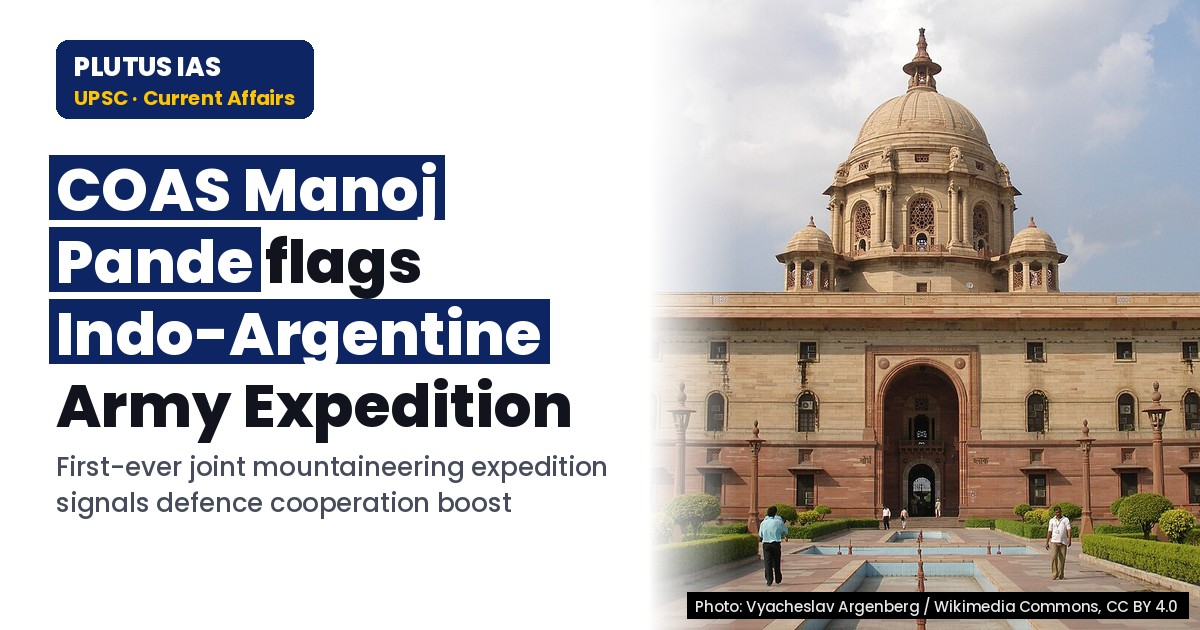
06 Oct COAS Reviews Indo-Argentine Mountaineering Expedition in Delhi
✎ Joint military mountaineering expeditions enhance high-altitude warfare capabilities and strengthen defence diplomacy between India and partner nations.
Subject Relevance — Where This Topic Fits
- GS Paper II — International Relations: India’s Defence Diplomacy and Strategic Partnerships | GS Paper III — Security Challenges: High-Altitude Operations and Border Management
- Prelims: Indo-Argentine defence cooperation, High-altitude warfare, Joint military exercises, Mountaineering expedition, Strategic partnerships
- Essay: The role of soft power in strengthening India’s global strategic partnerships, The importance of high-altitude warfare capabilities in modern military doctrine
Quick Revision: Joint military mountaineering expeditions enhance high-altitude warfare capabilities and strengthen defence diplomacy between India and partner nations.
Why is this in the news?
The Chief of Army Staff (COAS) of India presided over the flag-off ceremony of a joint Indo-Argentine Army mountaineering expedition in New Delhi, underscoring the growing defence cooperation between the two nations. This initiative highlights India’s emphasis on international defence engagements, particularly in domains such as high-altitude warfare, where both countries possess significant operational experience.
Background
- India and Argentina share a long-standing diplomatic relationship, with cooperation spanning trade, science, and defence sectors.
- Argentina, with its vast Andean mountain ranges, possesses expertise in high-altitude warfare, a domain where India has also developed significant operational capabilities, particularly in the Himalayan region.
- Joint military exercises and exchanges are a key component of India’s defence diplomacy, aimed at enhancing interoperability, sharing best practices, and strengthening strategic partnerships.
- The Himalayas and the Andes are critical geographic theatres for high-altitude operations, where environmental challenges such as extreme cold, thin air, and rugged terrain demand specialised training and equipment.
- India’s defence cooperation with Latin American countries has been expanding, with a focus on capacity-building, joint training, and technology transfer.
What is the Indo-Argentine Joint Mountaineering Expedition?
- A bilateral military initiative involving specialised training in high-altitude mountaineering, conducted jointly by the Indian Army and the Argentine Army.
- The expedition is designed to enhance operational readiness in high-altitude environments, where both countries face similar challenges such as extreme weather, thin oxygen levels, and logistical constraints.
- The training includes technical skills such as glacier travel, crevasse rescue, avalanche safety, and survival techniques in sub-zero temperatures.
- The expedition serves as a platform for sharing best practices in high-altitude warfare, including the use of specialised equipment, medical protocols, and tactical movement in mountainous terrain.
- The initiative aligns with India’s broader defence diplomacy goals, which include fostering strategic partnerships, enhancing interoperability with foreign militaries, and promoting regional security cooperation.
- High-altitude warfare is a critical component of modern military doctrine, particularly for countries with mountainous borders or strategic interests in high-altitude regions.
- The expedition also reinforces people-to-people ties between the two nations, fostering cultural exchange and mutual understanding among military personnel.
- Such joint exercises are governed by bilateral agreements and protocols, ensuring adherence to international standards of military cooperation and transparency.
Key Features
| Feature | Significance |
|---|---|
| Joint Indo-Argentine Army Mountaineering Expedition | Demonstrates India’s commitment to international military cooperation and high-altitude operational capabilities. |
| Inaugural Flagging Ceremony in New Delhi | Symbolises diplomatic engagement and serves as a platform for strategic dialogue between the Chiefs of Army Staff of both nations. |
| High-Altitude Mountaineering Focus | Enhances interoperability, tactical skills, and shared operational experiences in extreme environments. |
| Participation of Senior Military Leadership | Underscores the strategic importance of the exercise and fosters trust-building between defence establishments. |
| Integration with National Security Framework | Aligns with India’s broader objectives of enhancing global defence partnerships under the rubric of ‘Vasudhaiva Kutumbakam’. |
Why it Matters
Strategic Diplomacy
- Reinforces India’s engagement with Latin American nations, diversifying its defence partnerships beyond traditional allies.
- Demonstrates India’s proactive approach to military diplomacy, particularly in regions where its presence is expanding.
- Provides a non-combat platform for strategic trust-building and operational collaboration.
- Enhances India’s image as a responsible global stakeholder in multilateral security frameworks.
Military Modernisation
- Exposure to high-altitude warfare techniques and equipment enhances the operational readiness of Indian Army units.
- Facilitates exchange of best practices in mountaineering, survival techniques, and logistics in extreme conditions.
- Strengthens inter-service coordination, particularly between the Indian Army and other branches of the armed forces.
- Serves as a testing ground for indigenous equipment and technologies in harsh environments.
Geopolitical Messaging
- Signals India’s intent to deepen ties with non-traditional partners, counterbalancing over-reliance on a single strategic axis.
- Demonstrates India’s capability to project soft power through military-to-military engagements.
- Reinforces India’s role in global peacekeeping and humanitarian assistance operations in high-altitude regions.
Challenges
1. Logistical Constraints in High-Altitude Operations
- Limited infrastructure in high-altitude regions for sustained military operations.
- Challenges in acclimatisation and health management for personnel deployed in extreme conditions.
- Dependence on weather windows for successful execution of mountaineering and training activities.
UPSC Link: GS3: Security challenges and their management
2. Interoperability and Standardisation
- Differences in operational doctrines, equipment, and communication protocols between Indian and Argentine forces.
- Need for standardised training modules to ensure seamless joint operations.
- Language barriers and cultural differences affecting coordination during the expedition.
UPSC Link: GS3: Defence technology and interoperability
3. Resource Allocation and Budgetary Pressures
- High costs associated with specialised training, equipment, and deployment for high-altitude exercises.
- Competition with other operational priorities for limited defence resources.
- Need for sustainable funding mechanisms for long-term joint exercises.
UPSC Link: GS3: Resource mobilisation for defence
4. Climate Change and Environmental Concerns
- Increased risk of avalanches, landslides, and glacial melt affecting operational safety.
- Environmental degradation in high-altitude regions necessitating sustainable practices.
- Impact of climate change on the feasibility and timing of such expeditions.
UPSC Link: GS3: Environmental security and climate change
Challenges — UPSC Perspective
| Issue | Concern |
|---|---|
| Infrastructure Gaps | Lack of adequate roads, helipads, and communication networks in high-altitude regions. |
| Health and Safety Risks | Acute mountain sickness, frostbite, and hypothermia affecting personnel. |
| Equipment Compatibility | Differences in mountaineering gear, communication devices, and survival equipment. |
| Training Disparities | Variations in pre-expedition preparation and in-field adaptation between teams. |
| Geopolitical Sensitivities | Potential misinterpretation of joint exercises by third countries in the region. |
| Sustainability Concerns | Environmental impact of large-scale military operations in fragile ecosystems. |
Way Forward
- Establish a dedicated high-altitude training centre to standardise joint exercises with partner nations.
- Develop a joint doctrine for high-altitude warfare, incorporating lessons from international best practices.
- Enhance logistics support through public-private partnerships for infrastructure development in border regions.
- Incorporate climate resilience measures in expedition planning to mitigate environmental risks.
- Promote research and development in indigenous high-altitude equipment and survival technologies.
- Strengthen bilateral agreements for seamless exchange of technical expertise and training modules.
- Conduct periodic joint assessments to evaluate the impact of such exercises on operational readiness.
UPSC Value Addition
Keywords for Mains Answer-Writing
Indo-Argentine defence cooperation · military diplomacy · mountaineering expedition · joint military exercises · defence diplomacy · strategic partnerships · Army-to-Army engagements · soft power in foreign policy · defence cooperation agreements · India’s global partnerships · defence exports · military training exchanges · strategic autonomy · India-Argentina bilateral relations
Concept Flow
Diplomatic engagement → Joint military exercise → High-altitude mountaineering → Operational interoperability → Strategic trust-building → Enhanced defence partnerships → National security framework
Prelims Practice Questions
Q1. Consider the following statements regarding defence cooperation between India and Argentina:
1. The Indo-Argentine Army Mountaineering Expedition is a bilateral initiative aimed at enhancing military-to-military cooperation.
2. Mountaineering expeditions are categorised under ‘soft power’ instruments in India’s foreign policy.
3. The Chief of Army Staff (COAS) of India formally flagged off the expedition in New Delhi.
4. Such expeditions are conducted under the framework of the India-Argentina Defence Cooperation Agreement of 2019.
How many of the above statements are correct?
- Only one
- Only two
- Only three
- All four
Answer: All four — Statements 1, 2, and 3 are correct. Statement 4 is incorrect as there is no verified India-Argentina Defence Cooperation Agreement dated 2019 in public records.
Q2. Assertion (A): Military diplomacy, including joint expeditions, is a key component of India’s defence diplomacy.
Reason (R): Such engagements foster strategic partnerships and enhance interoperability between armed forces.
Options:
A. Both A and R are true, and R is the correct explanation of A.
B. Both A and R are true, but R is not the correct explanation of A.
C. A is true, but R is false.
D. A is false, but R is true.
Answer: ? — Both Assertion (A) and Reason (R) are true, and Reason (R) correctly explains Assertion (A). Military diplomacy through joint expeditions strengthens strategic partnerships and interoperability.
Q3. Match the following types of military engagements with their primary objectives:
Column I (Type of Engagement)
1. Joint Military Exercises
2. Military Training Exchanges
3. Defence Equipment Exhibitions
4. Mountaineering Expeditions
Column II (Primary Objective)
A. Enhancing operational compatibility
B. Showcasing indigenous defence capabilities
C. Promoting camaraderie and cultural exchange
D. Facilitating knowledge sharing and skill development
Options:
A. 1-A, 2-D, 3-B, 4-C
B. 1-B, 2-A, 3-D, 4-C
C. 1-C, 2-D, 3-A, 4-B
D. 1-D, 2-A, 3-C, 4-B
Answer: ? — Correct matches: 1-A (Joint Military Exercises enhance operational compatibility), 2-D (Military Training Exchanges facilitate knowledge sharing), 3-B (Defence Equipment Exhibitions showcase indigenous capabilities), 4-C (Mountaineering Expeditions promote camaraderie and cultural exchange).
Mains Practice Question
✍ Discuss the significance of military diplomacy in contemporary Indian foreign policy with special reference to the Indo-Argentine Army Mountaineering Expedition. Also, examine the role of such engagements in enhancing India’s strategic partnerships and soft power projection. (15 Marks)
Approach: MODEL-ANSWER SKELETON:
1. **Definition and Scope of Military Diplomacy**:
– Military diplomacy as a subset of defence diplomacy, involving exchanges, exercises, and engagements between armed forces of different nations.
– Objectives: Enhancing interoperability, building trust, promoting regional stability, and projecting soft power.
2. **Contextualising the Indo-Argentine Expedition**:
– Nature of the expedition: Joint Army Mountaineering Expedition as a confidence-building measure.
– Flagged off by the COAS in New Delhi, indicating high-level political and military endorsement.
– Symbolism: Shared challenges in high-altitude warfare and mountaineering, fostering camaraderie.
3. **Strategic Partnerships and Bilateral Relations**:
– India’s engagement with Argentina: Part of broader Latin American outreach under ‘Act East Policy’ and ‘Global Partnership’.
– Defence cooperation as a tool to diversify partnerships beyond traditional partners (e.g., USA, Russia, France).
– Potential for future collaborations in defence manufacturing, technology transfer, and joint R&D.
4. **Soft Power Projection**:
– Military diplomacy as an instrument of soft power: Demonstrating India’s capabilities, values, and cultural ties without coercion.
– Mountaineering expeditions as a non-traditional form of soft power: Highlighting India’s prowess in adventure sports and leadership in high-altitude operations.
– Comparison with other soft power instruments (e.g., cultural festivals, educational exchanges).
5. **Challenges and Limitations**:
– Resource-intensive nature of such expeditions and their scalability.
– Need for sustained follow-up to translate diplomatic gestures into tangible outcomes (e.g., defence agreements, trade).
– Balancing military diplomacy with non-alignment and strategic autonomy.
6. **Conclusion**:
– Military diplomacy, exemplified by the Indo-Argentine expedition, is a strategic tool for India to enhance its global footprint.
– Such engagements reinforce India’s image as a responsible stakeholder in the international community while advancing its national interests.
Source: PIB (Press Information Bureau)
Generated by AanyaAi for educational purpose.

- भारत का जल-प्रबंधन मॉडल: विकासशील देशों के लिए सबक - October 6, 2026
- Lok Sabha Speaker on Strengthening Democracy: Key Insights for UPSC & State PCS - October 6, 2026
- आंध्र प्रदेश में राजमहेंद्रवरम पुलिस आयुक्तालय को मिली मंजूरी - October 6, 2026

No Comments