


07 Oct Contempt of Court: Balancing Judicial Authority and Constitutional Freedoms
This article covers “Daily Current Affairs” and Topic details “Contempt of Court: Balancing Judicial Authority and Constitutional Freedoms”
SYLLABUS MAPPING
GS–2 – Polity – Separation of Powers, Institutions, and Accountability
FOR PRELIMS
What are the constitutional and legal provisions governing contempt of court in India, and what are its types?
FOR MAINS
Examine the relevance of contempt of court powers in maintaining judicial authority and public confidence. Discuss the challenges in balancing these powers with freedom of speech and suggest measures to improve the framework.
Why in the News?
In October 2025, a dramatic incident unfolded inside the Supreme Court of India when Advocate Rakesh Kishore threw a shoe at Chief Justice B.R. Gavai during court proceedings. The incident stemmed from earlier comments made by the CJI in a case involving a Vishnu idol, which some people saw as mocking religious feelings. Despite the provocation, the CJI stayed calm, and no contempt charges were brought against the advocate. The action faced widespread criticism across political and legal circles, with the Prime Minister calling it “utterly condemnable.”

Concept and Meaning of Contempt of Court
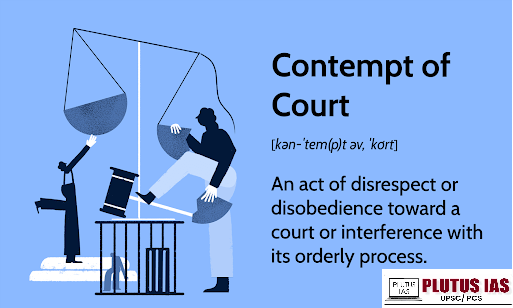
Definition: Contempt of Court refers to any act that disrespects the authority, dignity, or functioning of a court, thereby hindering the administration of justice.
Key Idea: It ensures that courts keep their respect and authority so that justice is not compromised by interference, criticism, or disobedience.
Scope: Applies to judges, proceedings, lawyers, media, and citizens.
Example: Publishing false information about court proceedings can be considered contempt.
Constitutional Provisions
| Article / Provision | Content / Relevance |
|---|---|
| Article 129 | Supreme Court is a court of record with the power to punish for contempt of itself. |
| Article 215 | High Courts are courts of record and have the power to punish for contempt. |
| Article 141 | Supreme Court judgments are binding; disobedience constitutes contempt. |
| Article 19(1)(a) vs 19(2) | Freedom of speech is subject to reasonable restrictions, including contempt, to maintain judicial authority. |
Why Do We Need Contempt Powers?
– Preserve the authority of courts: This protects the dignity and legitimacy of the judiciary. Example: Baradakanta Mishra v. Registrar of Orissa High Court (1973), which upheld contempt as essential for the rule of law.
– Ensure compliance with judicial orders: Courts do not have executive power, so contempt discourages disobedience. Civil contempt is invoked when government agencies fail to implement judicial directives.
– Maintain public confidence: This prevents harmful attacks that weaken trust in the judiciary. For instance, Prashant Bhushan’s tweets were seen as undermining the Supreme Court’s authority.
– Protect judicial proceedings: This prevents interruptions and biased commentary during ongoing cases. Media trials in high-profile cases can shape public opinion and impact justice.
Objectives of the Contempt of Courts Act (COCA), 1971
1. Preserve Dignity of Courts: The Act aims to protect the authority, respect, and credibility of the judiciary. By punishing acts that insult or scandalize the courts, it helps maintain the essential prestige of judicial institutions. This is crucial for upholding the rule of law and ensuring public compliance with judicial decisions.
2. Ensure Uninterrupted Administration of Justice: Contempt powers stop disruptions in court proceedings, whether caused by individuals, lawyers, or media commentary. This allows the courts to operate smoothly and efficiently without interference, delays, or obstruction, preserving the integrity of the judicial process.
3. Maintain Public Confidence: Public trust in the judiciary is essential for a democratic society. The Act protects this trust by penalizing statements or actions that could mislead, misinform, or generate unwarranted doubts about the fairness and impartiality of judicial proceedings.
4. Protect Judges from Intimidation: Judicial independence is fundamental to democracy. COCA protects judges from threats or intimidation that could influence their decisions. This enables judges to carry out their responsibilities without fear or bias, ensuring fair adjudication.
5. Regulate Media and Public Commentary: While freedom of speech is guaranteed under Article 19(1)(a), the Act strikes a balance. It prevents reporting or commentary on ongoing cases that could bias outcomes or sway public opinion, especially in sub judice matters.
6. Prevent Disobedience: The Act mandates compliance with court orders, ensuring that judgments, directions, and commitments are followed. This is especially vital when executive or administrative authorities might otherwise delay or neglect judicial directives. Contempt serves as a deterrent against such disobedience.
7. Provide a Legal Framework: COCA clearly specifies what counts as civil and criminal contempt, establishes procedures for starting proceedings, and outlines the punishments that can be imposed. This framework brings clarity, reduces unpredictability, and ensures that contempt powers are used in a fair and structured way.
Types of Contempt under COCA, 1971
| Type | Definition / Scope | Examples |
|---|---|---|
| Civil Contempt | Wilful disobedience of court orders or breach of undertakings. | Refusing to pay maintenance as ordered by the court. |
| Criminal Contempt | Acts that scandalize the court, interfere with proceedings, or obstruct justice. | Publishing articles questioning a judge’s impartiality during an ongoing case. |
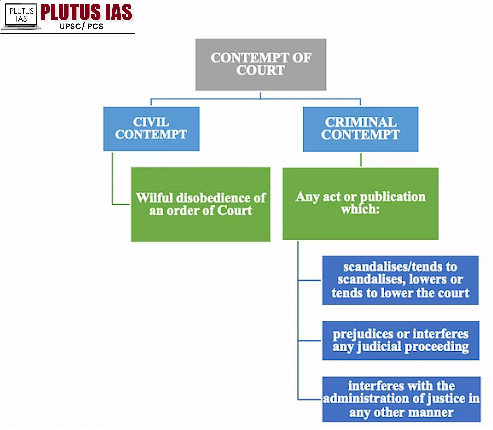
Subtypes of Criminal Contempt:
Scandalizing the Court – Lowering the dignity of the judiciary.
Interference with Judicial Process – Obstructing or influencing proceedings.
Disobedience of Court Orders – Sometimes overlaps with civil contempt.
Example: Media reports revealing details of an ongoing high-profile trial to influence public opinion.
Issues and Challenges with COCA
– Ambiguity in “Scandalizing Court,” subjective interpretation risks misuse.
– Freedom of Speech vs Contempt, there is tension between Article 19(1)(a) and contempt jurisdiction.
– Delayed or Selective Action, inconsistent enforcement means high-profile figures sometimes escape.
– Overlap Between Civil and Criminal Contempt causes procedural confusion.
– Misuse Against Media & Activists, legitimate criticism is sometimes treated as contempt.
– Lack of Clarity in Punishment, wide discretion under COCA leads to inconsistent sentencing.
– Limited Public Awareness is especially problematic in the social media era.
Landmark Case Laws
| Case | Principle / Significance |
|---|---|
| In Re Arundhati Roy (2002) | The Supreme Court fined Roy for scandalizing the court through media criticism. |
| Re: K.K. Verma (1982) | Clarified distinction between civil and criminal contempt. |
| Re: Rajeev Shukla (2019) | Social media posts against judges highlighted the need for digital-age guidelines. |
| S. Mulgaokar vs State of Maharashtra (1979) | Contempt must involve intent to interfere with justice, not mere criticism. |
| Subramanian Swamy vs Union of India (2016) | Reiterated the balance between free speech and judicial dignity. |
Ways to Manage and Protect the Dignity of Courts
– Public Awareness and Legal Literacy, Promote responsible criticism.
– Media Guidelines, Encourage self-regulation in reporting ongoing trials.
– Judicial Transparency, Reasoned judgments reduce misinformation.
– Legislative Review, Amend COCA to clarify vague provisions like “scandalizing the court.”
– Training for Lawyers and Officials, Avoid inadvertent contempt.
– ADR for Minor Contempt, Decriminalize minor breaches.
– Balancing Article 19 and COCA, Judicial restraint in exercising contempt powers.
Conclusion
The Contempt of Court law is essential for maintaining the authority and operation of the judiciary, which is a key part of Indian democracy. However, its broad and subjective application, especially related to “scandalizing the court,” creates challenges for free speech, media freedom, and democratic accountability. The shoe-throwing incident in the Supreme Court highlights the need for strong measures to protect judicial dignity and clearer legal guidelines to prevent misuse. Moving forward, India needs to find a balance between protecting courts from disruption and allowing room for legitimate criticism. The contempt law should reflect democratic values and modern realities.
Prelims Question
Q. Which of the following is/are the objectives of the Contempt of Courts Act, 1971?
1. Preserve dignity of courts
2. Protect judges from intimidation
3. Regulate media and public commentary
4. Limit the powers of Parliament to make laws on contempt
Select the correct answer using the code given below:
(a) 1, 2, and 3 only
(b) 1 and 4 only
(c) 2 and 4 only
(d) 1, 2, 3 and 4
ANSWER: A
Mains Question
Q. “Contempt of court powers are essential for the preservation of judicial authority and the rule of law.” Examine this statement with reference to the Contempt of Courts Act, 1971. (250 words)

- Elderly in India: Population, Challenges, and Government Initiatives - October 29, 2025
- Jal Jeevan Mission (JJM): Ensuring Tap Water to Every Rural Household - October 27, 2025
- National Blockchain Framework: Strengthening Governance through Blockchain Technology - October 25, 2025

No Comments