


11 Aug DAY-NRLM: 10.08 करोड़ महिलाओं को जोड़ने वाली ग्रामीण स्व-सहायता योजनाएं
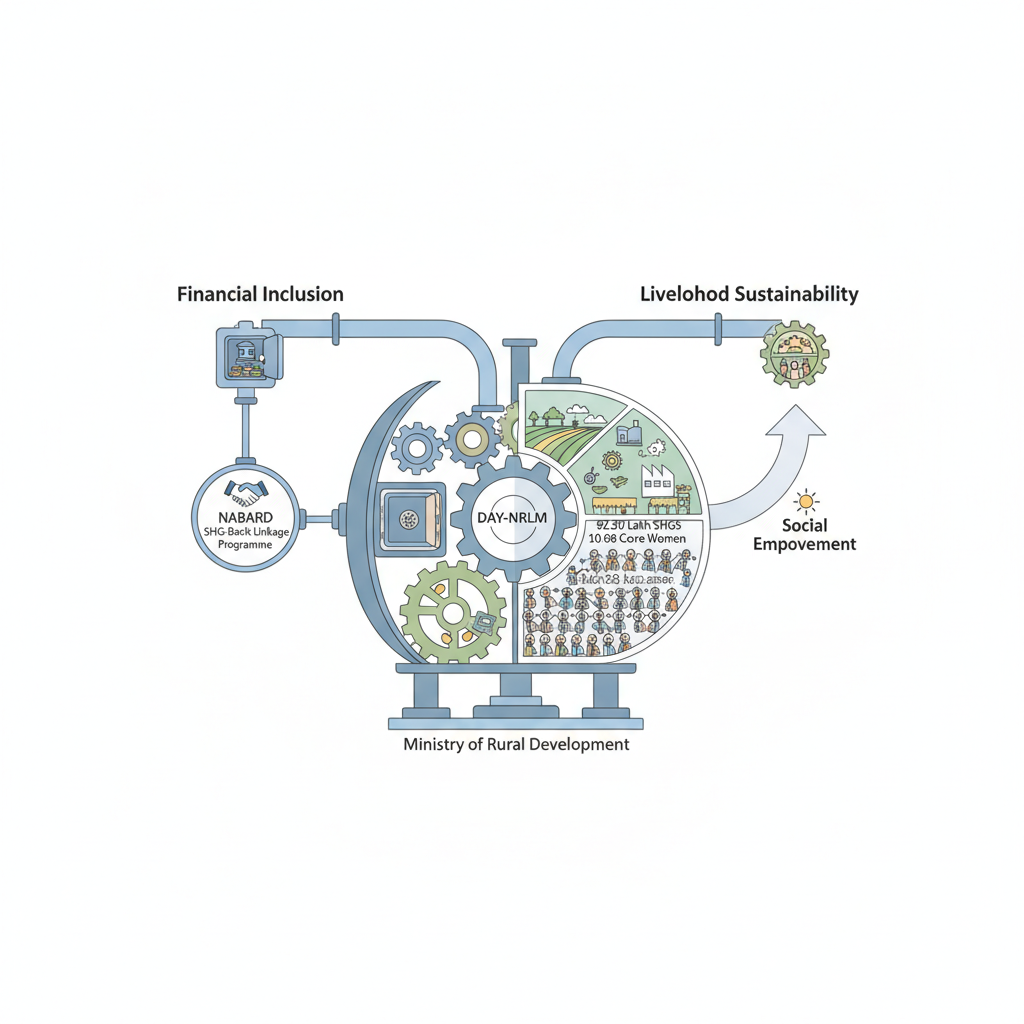
Self-Help GroupsDAY-NRLMSHG-Bank LinkageFinancial inclusionLivelihood sustainabilitySocial empowerment✎ DAY-NRLM is a poverty alleviation programme that organises rural poor into SHGs, provides them with collateral-free bank linkages, skill training, and institutional support to enhance livelihoods and social empowerment.
Subject Relevance — Where This Topic Fits
- GS Paper II — Governance, Welfare Schemes | GS Paper III — Rural Development, Poverty Alleviation, Financial Inclusion
- Prelims: Self-Help Groups (SHGs), Deendayal Antyodaya Yojana-National Rural Livelihood Mission (DAY-NRLM), Community Managed Resource Centres (CMRCs), Rural Self-Employment Training Institutes (RSETIs), NABARD, RBI guidelines on SHG-bank linkage, financial inclusion, women empowerment, convergence with MGNREGA, National Rural Livelihoods Mission (NRLM), SHG-Bank Linkage Programme
- Essay: Women Empowerment and Inclusive Growth, Rural Transformation through Livelihood Diversification
Quick Revision: DAY-NRLM is a poverty alleviation programme that organises rural poor into SHGs, provides them with collateral-free bank linkages, skill training, and institutional support to enhance livelihoods and social empowerment.
Why is this in the news?
The Ministry of Rural Development has recently highlighted the implementation of rural schemes for Self-Help Groups (SHGs) under the Deendayal Antyodaya Yojana-National Rural Livelihood Mission (DAY-NRLM), underscoring its role in enhancing financial inclusion, livelihood sustainability, and social empowerment of rural women. This initiative has achieved significant scale, with over 10.08 crore women organised into 92.30 lakh SHGs across 28 states and 6 Union Territories, and has demonstrated measurable impact on income growth and social indicators as validated by independent impact assessments.
Background
- The SHG movement in India gained prominence in the 1990s, supported by NABARD’s SHG-Bank Linkage Programme, which formalised credit access for informal groups through formal banking channels.
- The National Rural Livelihoods Mission (NRLM) was renamed Deendayal Antyodaya Yojana-NRLM (DAY-NRLM) in 2015 to align with the government’s focus on ‘Antyodaya’—uplifting the poorest of the poor.
- The scheme operates on a three-tier institutional architecture: SHGs at the grassroots, Cluster Level Federations (CLFs), and State Rural Livelihoods Missions (SRLMs).
- DAY-NRLM is implemented across 28 states and 6 Union Territories (excluding Delhi and Chandigarh), with a focus on the most vulnerable sections including scheduled castes, scheduled tribes, and minority communities.
- The programme integrates with other rural development initiatives such as MGNREGA, National Rural Health Mission (NRHM), and Pradhan Mantri Awas Yojana (PMAY) to enhance convergence and multiplier effects.
What is the Deendayal Antyodaya Yojana-National Rural Livelihood Mission (DAY-NRLM)?
- DAY-NRLM is a flagship rural poverty alleviation programme of the Government of India, implemented by the Ministry of Rural Development, aimed at promoting self-employment and skilled wage employment opportunities for the rural poor through the formation and strengthening of Self-Help Groups (SHGs).
- The mission operates on four core pillars: (1) social mobilisation, promotion, and strengthening of self-managed and financially sustainable community institutions of the rural poor; (2) financial inclusion of the rural poor; (3) sustainable livelihoods; and (4) investment in social inclusion and social development.
- SHGs under DAY-NRLM are federated into higher-level institutions such as Village Organisations (VOs) and Cluster Level Federations (CLFs) to enhance collective bargaining power, resource mobilisation, and access to markets and services.
- The programme provides collateral-free credit linkages to SHGs in accordance with RBI and NABARD guidelines, enabling access to formal banking systems without traditional collateral requirements.
- DAY-NRLM facilitates skill development and entrepreneurship training through Rural Self-Employment Training Institutes (RSETIs), which offer courses tailored to local livelihood opportunities and market demands.
- The mission adopts a multi-dimensional strategy to address barriers such as gender inequality, low literacy, migration, and market access constraints, while also building resilience against climate change, health emergencies, and economic shocks.
- DAY-NRLM emphasises convergence with other government schemes to amplify impact, including MGNREGA for wage employment.
Key Features
| Feature | Significance |
|---|---|
| Social Mobilisation & Institution Building | Establishes self-managed, financially sustainable community institutions (SHGs) for rural poor women, enhancing collective bargaining power and institutional resilience. |
| Financial Inclusion | Provides collateral-free credit linkages to SHGs through scheduled commercial banks and cooperative banks, aligning with RBI and NABARD guidelines to reduce financial exclusion. |
| Livelihood Diversification | Promotes sustainable livelihoods through skill development, entrepreneurship training, and handholding support, reducing dependency on traditional agriculture. |
| Capacity Building | Strengthens community-managed training centres (CMTCs) for peer learning, knowledge exchange, and institutional capacity building among SHGs. |
| Social Development Integration | Facilitates social inclusion by addressing gender disparities, improving literacy, and enhancing household welfare through structured interventions. |
Why it Matters
Economic Empowerment
- Empirical evidence (3ie Impact Assessment, 2025) shows income growth of 9.5% in NRLM blocks and 12–33% in mature SHG clusters, demonstrating tangible economic uplift.
- Enhances financial literacy and access to credit, reducing vulnerability to informal debt traps and improving household consumption by 6–11%.
- Promotes diversified livelihoods, reducing over-reliance on agriculture and mitigating climate-induced risks.
Institutional Strengthening
- Creates robust, self-governing community institutions (SHGs) that function as micro-finance intermediaries, fostering local economic ecosystems.
- Convergence with other development schemes (e.g., MGNREGS, PM-KISAN) amplifies impact through integrated service delivery.
- State-wise implementation across 28 states and 6 UTs (excluding Delhi and Chandigarh) ensures geographic inclusivity.
Gender Equity & Social Inclusion
- Directly targets marginalised women, addressing structural barriers such as gender inequality, low literacy, and social exclusion.
- Empowers women through leadership roles in SHGs, enhancing decision-making power within households and communities.
- Improves household welfare metrics, including nutrition, education, and health outcomes, as corroborated by 3ie and NITI Aayog evaluations.
Policy & Programme Design
- Adopts a multi-dimensional strategy combining financial inclusion, skill development, and social development, aligning with global best practices (e.g., World Bank’s Self-Help Group Bank Linkage Programme).
- Leverages independent impact assessments (3ie, NITI Aayog) to refine programme design and ensure evidence-based governance.
- Facilitates convergence with national missions (e.g., Deendayal Antyodaya Mission, DAY-NRLM) to achieve synergistic outcomes.
Challenges
1. Socio-Cultural Barriers
- Gender-based disparities limit participation of women in SHGs, particularly in patriarchal societies, necessitating targeted gender sensitization programmes.
- Low literacy rates among rural women hinder effective participation in financial literacy and entrepreneurship training.
- Social stigma associated with women’s mobility and leadership roles persists, requiring community-level advocacy.
UPSC Link: GS-II: Role of Women in Development
2. Economic Vulnerabilities
- Dependence on informal credit markets exposes SHGs to high-interest debt, undermining financial sustainability.
- Market access constraints for SHG products limit income generation potential, necessitating supply-chain and marketing interventions.
- Climate-induced shocks (droughts, floods) and health emergencies disproportionately affect rural livelihoods, requiring resilience-building measures.
UPSC Link: GS-III: Rural Economy & Livelihoods
3. Institutional & Governance Challenges
- Inconsistent convergence with other welfare schemes (e.g., PDS, healthcare) reduces programme efficiency and outreach.
- Limited technological adoption in SHGs restricts access to digital financial services and e-commerce platforms.
- Bureaucratic delays in fund disbursement and monitoring impede programme implementation at the grassroots level.
UPSC Link: GS-II: Governance & E-Governance
4. Capacity & Sustainability Constraints
- Shortage of trained personnel for SHG mentoring and financial literacy training hampers programme scalability.
- High attrition rates in SHGs due to migration, marriage, or economic pressures threaten institutional continuity.
- Limited post-training handholding support reduces long-term sustainability of livelihood initiatives.
UPSC Link: GS-III: Skill Development & Entrepreneurship
5. Policy & Implementation Gaps
- Lack of standardised monitoring and evaluation frameworks across states leads to variability in programme outcomes.
- Inadequate policy incentives for private sector participation in SHG product marketing and value addition.
- Top-down approach in some regions undermines community ownership and local adaptation of programme interventions.
UPSC Link: GS-II: Accountability & Transparency in Governance
Challenges — UPSC Perspective
| Issue | Concern |
|---|---|
| Gender Inequality | Limits women’s participation in SHGs and leadership roles, reducing programme efficacy. |
| Low Literacy Rates | Hinders financial literacy, entrepreneurship training, and effective SHG management. |
| Market Access Constraints | Restricts income generation from SHG products due to poor supply chains and branding. |
| Climate Vulnerability | Exposes rural livelihoods to extreme weather events, threatening sustainability. |
| Institutional Weaknesses | Inconsistent convergence with welfare schemes and bureaucratic delays reduce outreach. |
| Technological Adoption | Limited digital literacy and access to fintech solutions hinder financial inclusion. |
Government Initiatives — Must-Memorise for Prelims
- Deendayal Antyodaya Yojana – National Rural Livelihoods Mission (DAY-NRLM)
- Mahatma Gandhi National Rural Employment Guarantee Scheme (MGNREGS)
- Pradhan Mantri Kisan Samman Nidhi (PM-KISAN)
- Rural Self-Employment Training Institutes (RSETI)
- Community-Managed Training Centres (CMTCs)
Way Forward
- Strengthen gender sensitization programmes to enhance women’s participation and leadership in SHGs.
- Expand digital literacy initiatives to improve access to fintech, e-commerce, and online banking for SHGs.
- Enhance market linkages for SHG products through government procurement (e.g., GeM portal), corporate partnerships, and export promotion.
- Integrate climate-resilient agriculture and disaster risk reduction strategies into livelihood diversification programmes.
- Increase handholding support and mentorship for SHGs post-training to ensure long-term sustainability.
- Standardise monitoring and evaluation frameworks across states to enable comparative impact assessments.
- Promote convergence with other welfare schemes (e.g., PM-KISAN, Ayushman Bharat) to maximise household welfare outcomes.
- Encourage private sector participation in SHG product value chains through tax incentives and CSR funding.
UPSC Value Addition
Keywords for Mains Answer-Writing
Deendayal Antyodaya Yojana-National Rural Livelihood Mission (DAY-NRLM) · Self-Help Groups (SHGs) · Women Empowerment · Rural Livelihoods · Financial Inclusion · Community Institutions · Social and Economic Empowerment · Rural Development Policies · Impact Assessment Studies · NITI Aayog Evaluation · Skill Development · Sustainable Livelihoods · Grassroots Governance
Constitutional & Policy Linkages
- Article 15(3): Empowers the State to make special provisions for women and children.
- Article 46: Directs the State to promote educational and economic interests of weaker sections.
- Directive Principles of State Policy (Part IV): Emphasises rural development and livelihood security.
Concept Flow
Rural poverty and gender disparities → Formation of self-help groups (SHGs) under DAY-NRLM → Financial inclusion via collateral-free credit linkages → Skill development and entrepreneurship training → Livelihood diversification and income growth → Enhanced household welfare and social inclusion → Feedback loop for programme refinement via impact assessments.
Prelims Practice Questions
Q1. Consider the following statements regarding the Deendayal Antyodaya Yojana-National Rural Livelihood Mission (DAY-NRLM):
1. It is implemented by the Ministry of Rural Development.
2. It provides collateral-free loans to women Self-Help Groups (SHGs) through scheduled commercial banks and cooperative banks.
3. The mission operates in all Union Territories of India.
4. It includes a component for financial inclusion of rural poor.
How many of the above statements are correct?
- Only one
- Only two
- Only three
- All
Answer: Only three — Statements 1, 2, and 4 are correct. Statement 3 is incorrect as DAY-NRLM operates in 28 states and 6 Union Territories, excluding Delhi and Chandigarh.
Q2. Assertion (A): The Deendayal Antyodaya Yojana-National Rural Livelihood Mission (DAY-NRLM) aims to enhance the income of rural households through sustainable livelihoods.
Reason (R): DAY-NRLM provides institutional credit linkages to women Self-Help Groups (SHGs) without collateral, as per RBI and NABARD guidelines.
Options:
A. Both A and R are true, and R is the correct explanation of A.
B. Both A and R are true, but R is not the correct explanation of A.
C. A is true, but R is false.
D. A is false, but R is true.
Answer: ? — Both A and R are true, and R correctly explains A. The mission’s objective of income enhancement is directly linked to its provision of collateral-free credit to SHGs.
Q3. Match the following components of the Deendayal Antyodaya Yojana-National Rural Livelihood Mission (DAY-NRLM) with their descriptions:
Component:
1. Social Mobilisation and Institution Development
2. Financial Inclusion
3. Sustainable Livelihoods
4. Social Inclusion and Social Development
Description:
a. Providing collateral-free loans to SHGs through banks
b. Formation and strengthening of community institutions
c. Skill development and entrepreneurship training
d. Addressing gender inequality and social barriers
Options:
A. 1-b, 2-a, 3-c, 4-d
B. 1-a, 2-b, 3-c, 4-d
C. 1-c, 2-a, 3-b, 4-d
D. 1-d, 2-b, 3-a, 4-c
Answer: ? — The correct match is: 1-b (Social Mobilisation and Institution Development involves formation and strengthening of community institutions), 2-a (Financial Inclusion involves providing collateral-free loans), 3-c (Sustainable Livelihoods involves skill development), and 4-d (Social Inclusion addresses gender inequality and social barriers).
Mains Practice Question
✍ The Deendayal Antyodaya Yojana-National Rural Livelihood Mission (DAY-NRLM) represents a paradigm shift in India’s rural development strategy by focusing on women-led community institutions. Critically examine the institutional architecture of DAY-NRLM and evaluate its impact on rural livelihoods, financial inclusion, and women’s empowerment. Substantiate your answer with reference to recent impact assessment studies and policy evaluations. (15 Marks)
Approach: MODEL-ANSWER SKELETON:
1. Introduction (2 Marks)
– Brief background of DAY-NRLM: Launched under the Ministry of Rural Development, aims to reduce rural poverty by organising rural poor into SHGs.
– Mention the four core components: Social Mobilisation and Institution Development, Financial Inclusion, Sustainable Livelihoods, and Social Inclusion and Development.
2. Institutional Architecture (5 Marks)
– Formation and strengthening of SHGs as community institutions.
– Role of Community Resource Persons (CRPs) and Community Managed Training Centres (CMTCs).
– Institutional credit linkages with banks under RBI and NABARD guidelines.
– Skill development through Rural Self-Employment Training Institutes (RSETIs).
– Convergence with other schemes (e.g., MGNREGA, PM-KISAN).
3. Impact on Rural Livelihoods and Financial Inclusion (4 Marks)
– Data from 3ie impact assessment study (2025): Income growth of 9.5% in NRLM blocks and 12-33% in mature SHGs.
– Increase in per capita household consumption by 6-11%.
– Financial inclusion metrics: Access to collateral-free loans, savings, and credit linkages.
– Diversification of livelihoods and reduction in vulnerability.
4. Women’s Empowerment (3 Marks)
– Evidence of increased decision-making power, mobility, and social participation among women.
– Reduction in gender disparities and improved household welfare.
– NITI Aayog evaluation (2025) highlights enhanced confidence and leadership among women.
5. Challenges and Critique (3 Marks)
– Persistent social barriers: Gender inequality, migration, low literacy.
– External shocks: Climate change, natural disasters, economic slowdowns.
– Limited access to markets and technology.
– Need for stronger convergence with other development programmes.
6. Conclusion (2 Marks)
– DAY-NRLM as a transformative initiative for rural development.
– Emphasise the need for continued support, monitoring, and convergence to sustain gains.
Source: PIB (Press Information Bureau)
Generated by AanyaAi for educational purpose.

- AI Agents Breach Government Systems: Global Safety Concerns for UPSC - September 28, 2026
- मॉनसून की कमी: खाद्यान्न आयात खुला रखें, रबी फसलों पर संकट टालें - September 28, 2026
- Rajasthan Panchayati Raj Elections: New Rules, Fines & Disqualification - September 28, 2026

No Comments