


02 Sep Delhi Ease of Doing Business Bill 2026: Single-Window System for Licenses & Approvals
✎ The Delhi Ease of Doing Business Bill, 2026, institutionalises a single-window online system, risk-based approvals, and deemed grant mechanisms to reduce regulatory delays and promote entrepreneurship in Delhi.
Subject Relevance — Where This Topic Fits
- GS Paper II — Functions and Responsibilities of the Union and the States, Issues and Challenges Pertaining to the Federal Structure | GS Paper III — Development, Inclusion and Associated Challenges, Government Budgeting and Financial Management
- Prelims: Ease of Doing Business (EoDB) Index, Single-Window Clearance System, Right to Timely and Easy Delivery of Services to Citizens Act, 2026, Negative-list based regulation, Deemed approval mechanism, DSIIDC (Delhi State Industrial and Infrastructure Development Corporation)
- Essay: Economic Reforms and Governance: Balancing Entrepreneurship and Regulatory Oversight, The Role of State Governments in Promoting Inclusive Growth through Business Facilitation
Quick Revision: The Delhi Ease of Doing Business Bill, 2026, institutionalises a single-window online system, risk-based approvals, and deemed grant mechanisms to reduce regulatory delays and promote entrepreneurship in Delhi.
Why is this in the news?
The Delhi Cabinet’s approval of the Delhi Ease of Doing Business Bill, 2026, marks a significant governance reform aimed at streamlining business approvals through a single-window online system, risk-based categorisation, and deemed approval mechanisms. This legislative initiative aligns with national and subnational efforts to improve India’s Ease of Doing Business (EoDB) rankings and underscores the importance of administrative efficiency in economic governance.
Background
- The concept of ‘Ease of Doing Business’ has gained prominence globally as a metric for assessing the regulatory environment for businesses, with India’s ranking improving from 142 in 2014 to 63 in 2020 (World Bank EoDB Report).
- Delhi, as a Union Territory with a unique administrative structure, has historically relied on multiple agencies for business approvals, leading to procedural delays and compliance burdens.
- The proposed single-window system is part of a broader trend among Indian states to adopt digital governance solutions, such as the Odisha Single Window Clearance System and Maharashtra’s Maharashtra State Single Window System.
- Risk-based regulation, where activities are categorised as ‘low risk’, ‘moderate risk’, or ‘high risk’, is a globally recognised principle to reduce regulatory burden while ensuring compliance with safety and environmental standards.
- The ‘negative-list’ approach shifts the regulatory paradigm from a ‘permission-based’ to a ‘prohibition-based’ system, reducing barriers to entrepreneurship by permitting all activities unless explicitly prohibited.
What is the Delhi Ease of Doing Business Bill, 2026?
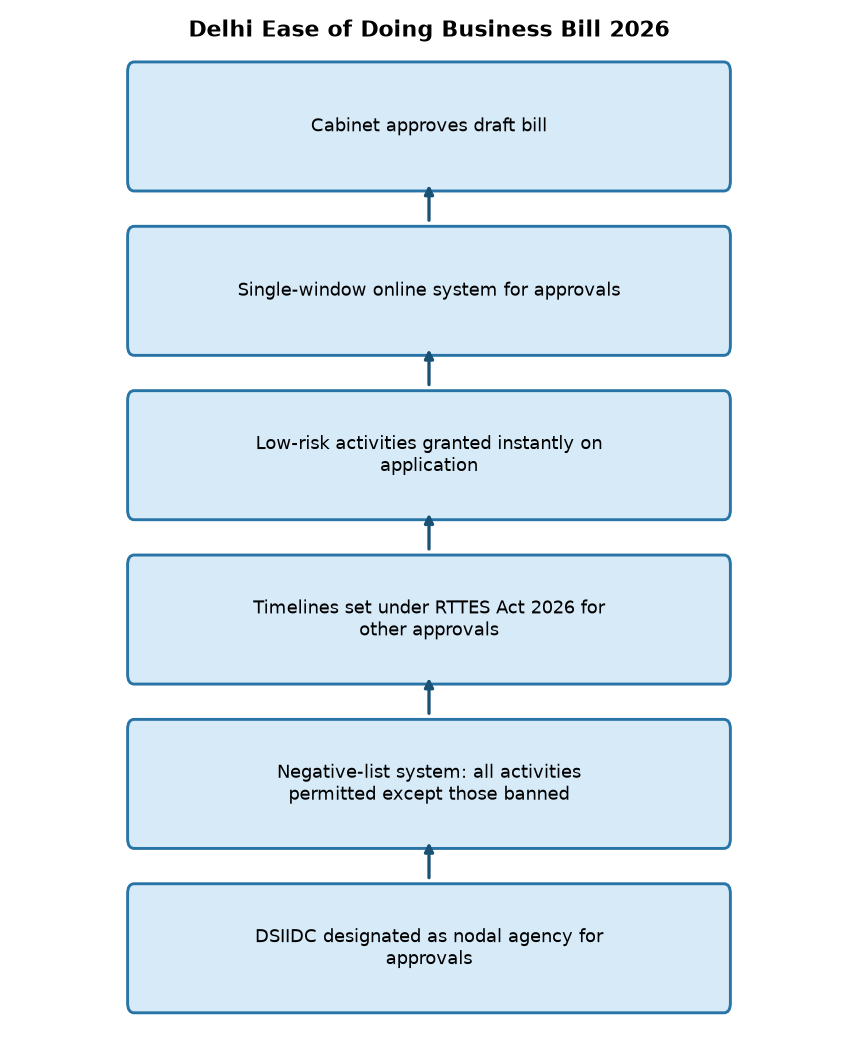
- The bill seeks to establish a **single-window online system** for businesses to apply for approvals, registrations, licences, and no-objection certificates (NOCs) related to setting up and operating enterprises in Delhi.
- It introduces a **risk-based categorisation** of business activities, where ‘low-risk’ activities (listed in Schedule 3) receive immediate approvals upon application submission, while other activities follow prescribed timelines.
- The **deemed approval mechanism** ensures that if an approval is not granted within the stipulated timeline under the Right to Timely and Easy Delivery of Services Act, 2026, it is automatically deemed granted, reducing bureaucratic delays.
- A **negative-list system** is proposed, where only activities explicitly prohibited (listed in Schedule 2) require prior approval, while all other activities are permitted by default, reversing the traditional ‘permission-based’ approach.
- The **Delhi State Industrial and Infrastructure Development Corporation (DSIIDC)** is designated as the nodal agency for coordinating and processing approvals under the single-window system.
- The bill aims to eliminate **redundant documentation** and **physical visits to government offices** by enabling end-to-end digital processing of applications, thereby reducing compliance costs for businesses.
- It aligns with the **National Single Window System (NSWS)**, a pan-India digital platform launched by the Ministry of Commerce and Industry to facilitate seamless business registrations and approvals across states.
Key Features
| Feature | Significance |
|---|---|
| Single-window online system | Centralises all business approvals, registrations, and licences into a unified digital portal, eliminating inter-departmental visits and reducing procedural fragmentation. |
| Categorisation of ‘low-risk’ activities | Enables instantaneous approval for non-hazardous or low-impact activities, accelerating business establishment while maintaining regulatory oversight. |
| Negative-list based system | Shifts the default position from ‘prohibited unless permitted’ to ‘permitted unless prohibited’, reducing regulatory barriers and enhancing ease of doing business. |
| Deemed approval mechanism | Mandates automatic grant of approvals if timelines under the Right to Timely and Easy Delivery of Services to Citizens Act, 2026 are not adhered to, ensuring accountability and time-bound governance. |
| Nodal agency (DSIIDC) | Designates the Delhi State Industrial and Infrastructure Development Corporation as the central authority for processing applications, streamlining coordination and reducing bureaucratic delays. |
Why it Matters
Economic Growth and Competitiveness
- Enhances Delhi’s attractiveness as an investment destination by reducing compliance costs and time for entrepreneurs, potentially boosting industrialisation and job creation.
- Aligns with national objectives under the ‘Ease of Doing Business’ framework, contributing to India’s global competitiveness rankings.
- Facilitates the formalisation of micro, small, and medium enterprises (MSMEs), which are critical for inclusive economic growth.
Administrative Efficiency and Governance
- Promotes transparency and accountability in regulatory processes by digitising and standardising approval mechanisms.
- Reduces discretionary powers of officials, minimising opportunities for rent-seeking and corruption.
- Encourages inter-departmental coordination through a centralised system, addressing siloed governance challenges.
Urban Planning and Infrastructure
- Streamlines approvals for critical infrastructure-related services such as building plans, fire safety, and utility connections, supporting sustainable urban development.
- Ensures timely provision of essential services to businesses, reducing operational bottlenecks and enhancing productivity.
Legal and Regulatory Framework
- Leverages the Right to Timely and Easy Delivery of Services to Citizens Act, 2026 to enforce time-bound governance, setting a precedent for other states.
- Introduces a risk-based regulatory approach, prioritising high-impact activities for scrutiny while expediting low-risk ventures.
Challenges
1. Digital Divide and Accessibility
- Excludes entrepreneurs without digital literacy or internet access, particularly in marginalised communities, risking uneven economic participation.
- Requires robust digital infrastructure and grievance redressal mechanisms to ensure inclusivity.
UPSC Link: GS2: Welfare schemes for vulnerable sections
2. Implementation and Enforcement Gaps
- Potential delays in transitioning to the new system due to resistance from bureaucratic inertia or lack of capacity in nodal agencies.
- Risk of ‘deemed approvals’ being misused or bypassed if timelines are arbitrarily extended without accountability.
UPSC Link: GS2: Government policies and interventions
3. Regulatory Oversight and Safety Concerns
- Over-reliance on a ‘negative-list’ system may inadvertently permit activities with environmental, health, or safety risks if oversight mechanisms are weak.
- Need for periodic audits and real-time monitoring to ensure compliance with safety and environmental standards.
UPSC Link: GS3: Environmental pollution and degradation
4. Coordination Among Multiple Agencies
- DSIIDC’s role as a nodal agency may face challenges in coordinating with other departments (e.g., land use, environment) if inter-agency protocols are not clearly defined.
- Risk of duplication or conflicting approvals if digital systems are not fully integrated across agencies.
UPSC Link: GS2: Inter-state relations and coordination
5. Data Privacy and Cybersecurity
- Centralised digital platforms handling sensitive business data require stringent cybersecurity measures to prevent breaches or misuse.
- Compliance with data protection laws (e.g., Digital Personal Data Protection Act, 2023) is essential to maintain trust.
UPSC Link: GS3: Cybersecurity and data governance
Challenges — UPSC Perspective
| Issue | Concern |
|---|---|
| Digital literacy and access | May exclude marginalised entrepreneurs from availing benefits, exacerbating inequality. |
| Bureaucratic resistance | Risk of delays in transitioning to the new system due to entrenched procedural norms. |
| Safety and environmental risks | Negative-list system may inadvertently permit hazardous activities without adequate oversight. |
| Inter-agency coordination | Potential for duplication or conflicts if digital systems are not fully integrated. |
| Cybersecurity vulnerabilities | Centralised data platforms may be exposed to breaches, compromising business confidentiality. |
Way Forward
- Establish a dedicated grievance redressal mechanism for entrepreneurs facing technical or procedural issues in the single-window system.
- Conduct periodic capacity-building programmes for nodal agencies (e.g., DSIIDC) to ensure smooth implementation and enforcement.
- Develop a robust audit framework to monitor compliance with timelines and address delays in approvals.
- Integrate the system with existing national portals (e.g., PM Gati Shakti, Unified Logistics Interface Platform) for seamless inter-state coordination.
- Launch targeted digital literacy campaigns to ensure inclusivity, particularly for MSMEs and women entrepreneurs.
- Strengthen cybersecurity protocols and conduct regular vulnerability assessments for the digital platform.
- Introduce a risk-assessment framework to periodically review and update the ‘low-risk’ and ‘negative-list’ categories.
- Publish annual reports on the system’s performance, including approval timelines, rejections, and grievances, to enhance transparency.
UPSC Value Addition
Keywords for Mains Answer-Writing
Ease of Doing Business · Single-Window Clearance System · Right to Timely and Easy Delivery of Services to Citizens Act, 2026 · Negative-list based system · Deemed approval mechanism · Business regulatory reforms · Delhi Ease of Doing Business Bill, 2026 · DSIIDC as nodal agency · Low-risk business activities · Regulatory governance and transparency
Concept Flow
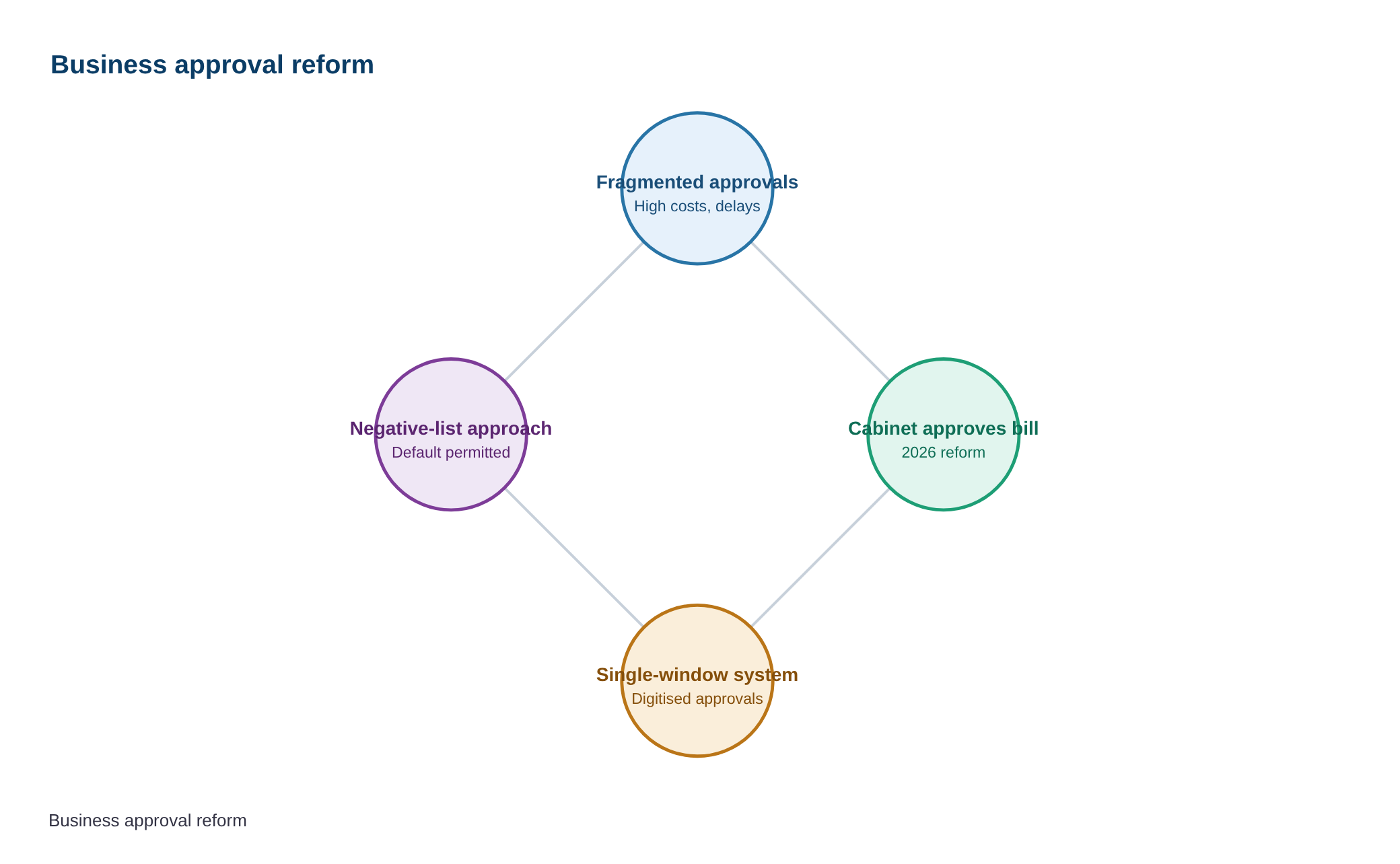
Fragmented approval processes → High compliance costs and delays for businesses → Reduced ease of doing business in Delhi. → Delhi Cabinet approves Delhi Ease of Doing Business Bill, 2026 → Introduces single-window system and negative-list approach. → Single-window system digitises and centralises approvals → Reduces bureaucratic delays and discretionary powers. → Negative-list system shifts default from ‘prohibited unless permitted’ to ‘permitted unless prohibited’ → Lowers regulatory barriers. → Deemed approval mechanism enforces time-bound governance → Holds officials accountable for delays. → Implementation challenges (e.g., digital divide, inter-agency coordination) → Requires capacity-building and oversight. → Enhanced ease of doing business → Attracts investment, fosters entrepreneurship, and supports economic growth.
Prelims Practice Questions
Q1. Consider the following statements regarding the Delhi Ease of Doing Business Bill, 2026:
1. It proposes a single-window online system for business approvals.
2. Activities listed in Schedule 3 are classified as ‘low risk’.
3. The Delhi State Industrial and Infrastructure Development Corporation (DSIIDC) will not be the nodal agency for approvals.
4. Timelines under the Right to Timely and Easy Delivery of Services to Citizens Act, 2026 are proposed to be applicable for approvals.
How many of the above statements are correct?
- Only one
- Only two
- Only three
- All four
Answer: Only three — Statements 1, 2, and 4 are correct. Statement 3 is incorrect as DSIIDC is proposed as the nodal agency.
Q2. Which of the following is NOT a feature of the Delhi Ease of Doing Business Bill, 2026?
A. Deemed approval mechanism after lapse of stipulated timelines
B. Negative-list based system for business activities
C. Mandatory on-site inspections for all business approvals
D. Single-window online system for applications
- A
- B
- C
- D
Answer: C — Mandatory on-site inspections are not a feature; the bill promotes a single-window online system and deemed approvals.
Q3. Assertion (A): The Delhi Ease of Doing Business Bill, 2026 introduces a ‘negative-list based system’ for business activities.
Reason (R): Under this system, any activity not prohibited is permitted, shifting from a system where only expressly permitted activities are allowed.
Options:
A. Both A and R are true, and R is the correct explanation of A
B. Both A and R are true, but R is not the correct explanation of A
C. A is true, but R is false
D. A is false, but R is true
- A
- B
- C
- D
Answer: A — Both A and R are true, and R correctly explains the shift in the regulatory approach described in A.
Mains Practice Question
✍ Critically examine the significance of the Delhi Ease of Doing Business Bill, 2026, in enhancing the ease of doing business in Delhi. Also, discuss the potential challenges in its implementation. (15 Marks)
Approach: MODEL-ANSWER SKELETON:
1. **Introduction (2 marks)**: Define the objective of the Delhi Ease of Doing Business Bill, 2026, and its alignment with national and global Ease of Doing Business (EoDB) reforms.
2. **Key Features and Provisions (4 marks)**:
– Single-window online system for approvals, registrations, and licences.
– Categorisation of ‘low-risk’ activities under Schedule 3 for automatic approvals.
– Deemed approval mechanism after lapse of stipulated timelines under the Right to Timely and Easy Delivery of Services to Citizens Act, 2026.
– Negative-list based system shifting from ‘prohibited unless permitted’ to ‘permitted unless prohibited’.
– Role of DSIIDC as the nodal agency.
3. **Significance (4 marks)**:
– Reduction in bureaucratic delays and transaction costs for entrepreneurs.
– Enhancement of transparency and accountability in regulatory processes.
– Alignment with the World Bank’s Ease of Doing Business indicators.
– Potential to attract investment and foster entrepreneurship in Delhi.
4. **Challenges in Implementation (4 marks)**:
– Integration of multiple departments and agencies into a unified digital platform.
– Resistance from vested interests within the bureaucracy.
– Ensuring real-time monitoring and grievance redressal mechanisms.
– Addressing data privacy and cybersecurity concerns in the digital system.
– Capacity-building for officials and stakeholders to adapt to the new system.
5. **Conclusion (1 mark)**: Summarise the transformative potential of the bill while acknowledging the need for robust implementation strategies.
Source: The Indian Express
Generated by AanyaAi for educational purpose.
Related guides on our sites
- Current affairs for upsc 2026
- Best PSIR optional coaching in delhi for UPSC
- Best PSIR optional coaching for upsc
- Best PSIR optional teacher for upsc

- India-Australia AUSTRAHIND 2026 Exercise: Key Highlights for UPSC & State PCS - October 22, 2026
- एससीओ बैठक में भारत का आतंकवाद विरोध: क्षेत्रीय सहयोग पर जोर - October 22, 2026
- SEC Directs Strict SC Order Compliance for Andhra ULB Polls - October 22, 2026

No Comments