


09 Sep Delhi HC directs govt on rabies elimination plan by 2030: Key UPSC insights
✎ The Animal Birth Control (ABC) Programme, mandated by the ABC Rules, 2023, is the cornerstone of India’s strategy to eliminate rabies by 2030, requiring every district to establish functional ABC centres for humane stray dog…
Subject Relevance — Where This Topic Fits
- GS Paper II — Governance, Constitution, Polity, Social Justice and International Relations (Animal Welfare and Environmental Governance) | GS Paper III — Environment and Ecology (Wildlife Conservation and Public Health)
- Prelims: Rabies elimination by 2030, Animal Birth Control (ABC) Rules, 2023, Stray dog management, Public Interest Litigation (PIL), Animal Welfare Board of India (AWBI), Municipal Corporation of Delhi (MCD), Suo motu cognisance, One Health Approach
- Essay: The role of judiciary in ensuring public health and welfare: Balancing rights and duties, Sustainable urban governance: Integrating public health, animal welfare, and ecological balance
Quick Revision: The Animal Birth Control (ABC) Programme, mandated by the ABC Rules, 2023, is the cornerstone of India’s strategy to eliminate rabies by 2030, requiring every district to establish functional ABC centres for humane stray dog population control.
Why is this in the news?
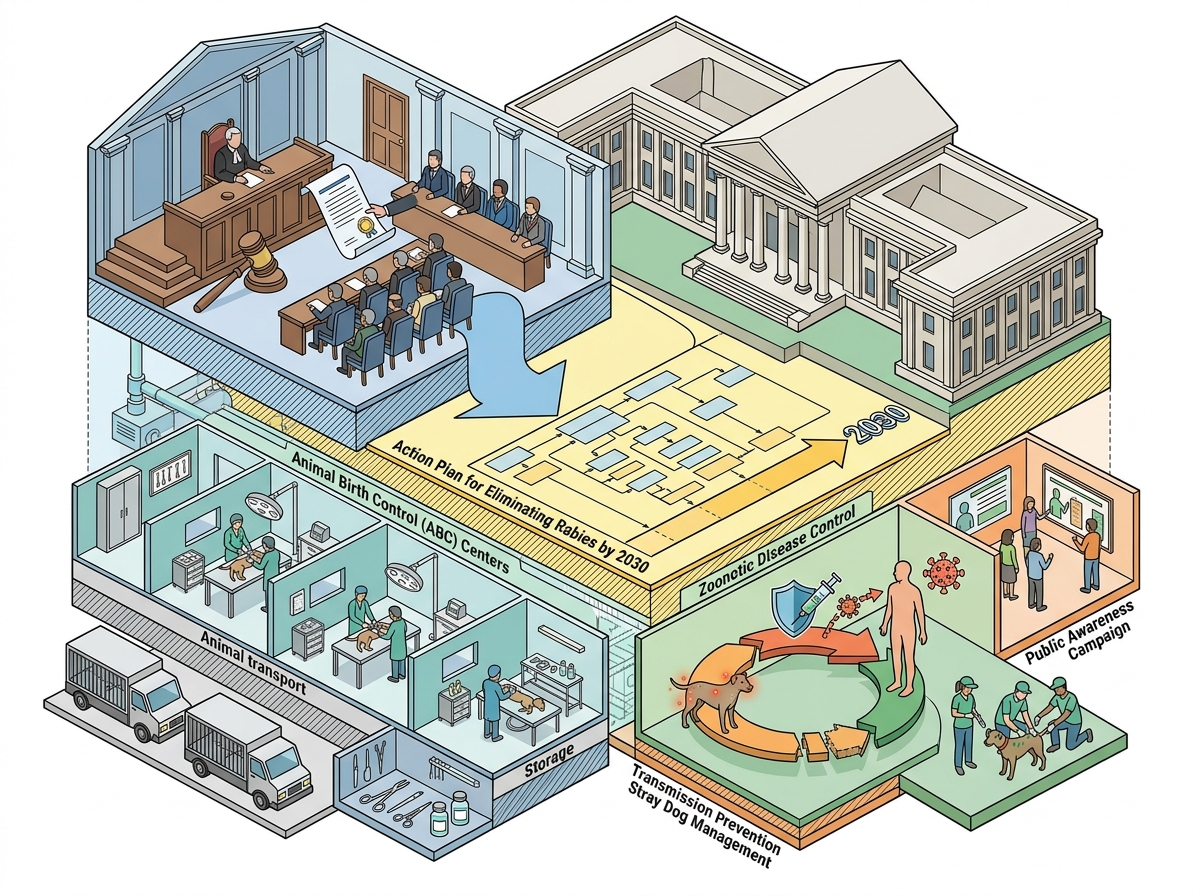
The Delhi High Court has directed the Delhi government to submit a detailed action plan for eliminating rabies by 2030, following the Supreme Court’s directives to all states and Union Territories to establish functional Animal Birth Control (ABC) centres in every district. This development underscores the judicial intervention in public health governance, particularly in the management of stray dog populations and zoonotic disease control. The case highlights the intersection of constitutional obligations, municipal governance, and animal welfare in India’s urban centres.
Background
- Rabies is a 100% fatal zoonotic disease transmitted primarily through the bites of infected animals, with dogs accounting for 99% of human rabies cases globally (WHO, 2023). India accounts for nearly 36% of the global rabies burden, with an estimated 20,000 deaths annually.
- The Animal Birth Control (ABC) Rules, 2023, framed under the Prevention of Cruelty to Animals Act, 1960, mandate the establishment of ABC centres in every district to control stray dog populations through sterilisation and immunisation, thereby reducing the risk of rabies transmission.
- The Supreme Court of India, in its judgment dated May 2026, directed all High Courts to register suo motu PILs to monitor the implementation of ABC programmes and stray dog management across the country, emphasising the constitutional duty of the state to protect public health and animal welfare.
- The Delhi High Court, acting on a suo motu PIL, has been overseeing compliance with these directives, including pilot projects for sterilisation and vaccination in specific wards of the Municipal Corporation of Delhi (MCD) and the North Delhi Municipal Corporation (NDMC).
- Urban centres, particularly metropolitan cities like Delhi, face unique challenges in stray dog management due to high population densities, limited municipal resources, and competing urban development priorities.
What is the Stray Dog Management Framework in India?
- The Animal Birth Control (ABC) Programme is a scientifically validated method to control stray dog populations and mitigate rabies transmission. It involves the capture, sterilisation, vaccination, and release (CSVR) of stray dogs, ensuring humane and sustainable population control.
- The ABC Rules, 2023, provide a legal framework for the implementation of ABC programmes, including the establishment of ABC centres, funding mechanisms, and monitoring protocols. These rules are aligned with the World Organisation for Animal Health (WOAH) and WHO guidelines for rabies elimination.
- The Prevention of Cruelty to Animals Act, 1960, is the primary legislation governing animal welfare in India. Section 11 of the Act prohibits the killing of stray dogs, except in extreme cases, and mandates their humane management through sterilisation and immunisation.
- The One Health Approach integrates human, animal, and environmental health to address zoonotic diseases like rabies. This approach recognises that controlling rabies requires coordinated action across sectors, including public health, veterinary services, and municipal governance.
- Municipal corporations play a critical role in implementing ABC programmes, as they are responsible for urban sanitation, public health, and animal welfare within their jurisdictions. The Municipal Corporation of Delhi (MCD) and North Delhi Municipal Corporation (NDMC) are key stakeholders in the current judicial oversight.
- Judicial oversight through suo motu PILs ensures accountability in the implementation of public health and animal welfare policies. The Supreme Court’s directives and the Delhi High Court’s monitoring underscore the judiciary’s role in enforcing constitutional and statutory obligations.
- Public participation and awareness are essential for the success of ABC programmes. Community engagement, education on responsible pet ownership, and reporting of stray dog incidents are critical components of the framework.
- The integration of technology, such as GIS mapping and digital tracking of stray dogs, can enhance the efficiency and transparency of ABC programmes. Such innovations are increasingly being adopted by municipal authorities to improve programme outcomes.
Key Features
| Feature | Significance |
|---|---|
| Suo Motu PIL by Delhi HC | Demonstrates judicial activism in monitoring compliance with Supreme Court directives on stray dog management and rabies elimination. |
| Animal Birth Control (ABC) Centres | Mandated in every district to control stray dog population through sterilisation and vaccination, a key strategy for rabies elimination. |
| Pilot Projects in Municipal Wards | Identification of specific wards for sterilisation and vaccination camps to test implementation before scaling up. |
| Amicus Curiae Role | Animal welfare activist appointed to advise the court on technical and policy aspects of stray dog management and rabies control. |
| Judicial Timeline for Compliance | Court-imposed deadlines (e.g., four-week response period, next hearing on October 5) to ensure timely government action. |
Why it Matters
Public Health Implications
- Rabies is a fatal zoonotic disease with nearly 100% mortality post-symptom onset, making elimination critical for public health security.
- Stray dog bites account for ~99% of human rabies cases in India, necessitating integrated stray management and vaccination strategies.
- The 2030 elimination target aligns with the WHO’s global strategy for dog-mediated rabies elimination.
Animal Welfare and Governance
- The directive reflects a shift from ad-hoc measures to structured, evidence-based animal birth control and vaccination programmes.
- Judicial intervention ensures accountability in implementation, addressing gaps in municipal and state-level enforcement.
- Pilot projects allow for data-driven scaling of interventions, reducing trial-and-error in policy execution.
Judicial-Executive Synergy
- The suo motu PIL mechanism empowers high courts to monitor executive compliance with apex court directives, enhancing governance oversight.
- Amicus curiae appointments bridge the gap between judicial requirements and ground-level operational feasibility.
- Judicially imposed timelines prevent delays in policy implementation, a common challenge in public health programmes.
Challenges
1. Infrastructure and Capacity Gaps
- Establishing ABC centres in every district requires significant investment in veterinary infrastructure, trained personnel, and logistical support.
- Municipal corporations may lack the financial and human resources to sustain long-term sterilisation and vaccination campaigns.
- Urban areas with high stray dog densities pose logistical challenges for effective implementation of ABC programmes.
UPSC Link: GS Paper 2: Governance, GS Paper 3: Animal Husbandry
2. Community Participation and Awareness
- Public resistance to sterilisation drives, driven by misconceptions about animal welfare or religious sentiments, can hinder programme success.
- Lack of awareness about rabies transmission and prevention measures among vulnerable populations increases exposure risk.
- Effective community engagement is essential to ensure cooperation in vaccination and sterilisation efforts.
UPSC Link: GS Paper 2: Social Justice, GS Paper 4: Ethics
3. Data Gaps and Monitoring Mechanisms
- Inadequate baseline data on stray dog populations complicates the design and evaluation of ABC programmes.
- Weak monitoring systems may fail to capture the impact of interventions, leading to delayed course corrections.
- Integration of digital tools (e.g., GIS mapping, mobile apps) is needed for real-time tracking of sterilisation and vaccination coverage.
UPSC Link: GS Paper 3: Science & Tech, GS Paper 2: Governance
4. Inter-Agency Coordination
- Rabies elimination requires coordination between municipal corporations, state health departments, veterinary services, and animal welfare organisations.
- Fragmented governance structures may lead to duplication of efforts or gaps in implementation.
- Clear delineation of roles and responsibilities is essential to avoid jurisdictional conflicts.
UPSC Link: GS Paper 2: Federalism, GS Paper 3: Disaster Management
5. Sustainability of Funding
- Long-term funding for ABC programmes and rabies surveillance is often uncertain, relying on ad-hoc allocations or external grants.
- Economic constraints may prioritise competing public health priorities, risking underfunding of rabies control measures.
- Innovative financing models (e.g., public-private partnerships, CSR funds) need exploration to ensure sustained resources.
UPSC Link: GS Paper 3: Economics of Development
Challenges — UPSC Perspective
| Issue | Concern |
|---|---|
| Veterinary Infrastructure | Insufficient number of trained veterinarians and facilities for large-scale sterilisation and vaccination. |
| Public Perception | Misconceptions about animal birth control leading to resistance from communities or municipal authorities. |
| Data Deficits | Lack of reliable baseline data on stray dog populations and rabies incidence for targeted interventions. |
| Funding Gaps | Uncertain or inadequate budgetary allocations for sustained implementation of ABC programmes. |
| Inter-Agency Coordination | Overlapping or conflicting roles between municipal corporations, state agencies, and NGOs. |
| Legal Enforcement | Challenges in enforcing municipal bye-laws on stray dog management due to weak penalties or enforcement mechanisms. |
Government Initiatives — Must-Memorise for Prelims
- Animal Birth Control (ABC) Programme for Street Dogs (under the Animal Welfare Board of India)
- National Rabies Control Programme (NRCP) (Ministry of Health and Family Welfare)
Way Forward
- Strengthen veterinary infrastructure by establishing ABC centres in every district with adequate funding and trained personnel.
- Launch targeted awareness campaigns to educate communities on rabies transmission, prevention, and the benefits of sterilisation.
- Develop a national-level digital dashboard for real-time monitoring of sterilisation, vaccination, and rabies surveillance data.
- Enhance inter-agency coordination through structured frameworks (e.g., state-level rabies control committees) to align municipal, health, and veterinary efforts.
- Pilot innovative financing models, such as CSR partnerships or user fees for pet vaccination, to ensure sustainable funding for programmes.
- Conduct periodic impact assessments of ABC programmes to identify bottlenecks and refine strategies for scaling up.
- Integrate rabies surveillance into existing public health surveillance systems (e.g., Integrated Disease Surveillance Programme) for early detection of outbreaks.
UPSC Value Addition
Keywords for Mains Answer-Writing
Rabies elimination by 2030 · Animal Birth Control (ABC) Centres · Stray dog management · Public Health (Prevention and Control of Rabies) Rules, 2023 · One Health Approach · Animal Welfare Board of India (AWBI) · Municipal Corporations and rabies control · Suo Motu PILs and judicial oversight · Zoonotic diseases and governance · Constitutional provisions for animal welfare (Art. 48A, 51A(g)) · Sterilisation and vaccination of stray dogs · One Health Mission · National Rabies Control Programme · Judicial activism in public health governance
Constitutional & Policy Linkages
- Article 21 (Right to Life and Personal Liberty) – Ensuring protection from zoonotic diseases like rabies.
- Article 48A (Directive Principles of State Policy) – Protection and improvement of environment and wildlife.
- Article 51A(g) (Fundamental Duties) – Duty to protect and improve the natural environment.
Concept Flow
Stray dog population growth and unvaccinated dogs → Increased risk of dog bites and rabies transmission → Public health crisis (human rabies cases) → Supreme Court directs high courts to monitor stray dog management and rabies elimination → Delhi HC registers suo motu PIL to ensure compliance → Amicus curiae appointed to advise on technical aspects → Court directs establishment of ABC centres in every district and pilot projects in municipal wards → Government (Delhi) files response with action plan → Municipal corporations (MCD, NDMC) organise sterilisation and vaccination camps in pilot wards → Judicial monitoring ensures accountability and timelines → Data-driven evaluation of pilot projects informs scaling up of interventions → Sustained implementation of ABC programmes and vaccination drives → Gradual reduction in stray dog population and rabies cases → Progress towards 2030 elimination target
Prelims Practice Questions
Q1. Consider the following statements regarding the Public Health (Prevention and Control of Rabies) Rules, 2023:
1. The rules mandate the establishment of at least one fully functional Animal Birth Control (ABC) centre in every district.
2. The rules require all states and Union Territories to expand ABC infrastructure based on population density and local requirements.
3. The rules are silent on the role of municipal corporations in implementing rabies control measures.
How many of the above statements are correct?
- Only one
- Only two
- All three
- None
Answer: Only two — Statement 1 and 2 are correct as per the rules framed under the Prevention and Control of Rabies Act. Statement 3 is incorrect because the rules explicitly assign responsibilities to municipal corporations for implementing rabies control measures.
Q2. Assertion (A): The Animal Welfare Board of India (AWBI) is a statutory body under the Ministry of Environment, Forest and Climate Change.
Reason (R): The AWBI is mandated to promote animal welfare and advise the central government on matters relating to animal welfare, including the implementation of the Animal Birth Control (ABC) programme.
Options:
A. Both A and R are true and R is the correct explanation of A.
B. Both A and R are true but R is not the correct explanation of A.
C. A is true but R is false.
D. A is false but R is true.
Answer: ? — Both the assertion and reason are true. The AWBI is indeed a statutory body under the Ministry of Environment, Forest and Climate Change, and it is tasked with advising the government on animal welfare, including the ABC programme.
Q3. Match the following columns related to rabies control measures in India:
Column I (Institution/Scheme)
A. Animal Welfare Board of India (AWBI)
B. Municipal Corporations
C. National Rabies Control Programme
D. One Health Mission
Column II (Role/Function)
1. Implementation of sterilisation and vaccination of stray dogs through pilot projects
2. Statutory body advising the government on animal welfare and ABC programme
3. Central scheme for mass dog vaccination and public awareness
4. Inter-sectoral coordination for zoonotic disease control
Select the correct match:
- A-2, B-1, C-3, D-4
- A-1, B-2, C-4, D-3
- A-3, B-4, C-1, D-2
- A-4, B-3, C-2, D-1
Answer: A-2, B-1, C-3, D-4 — The correct match is: A-2 (AWBI is a statutory body advising on animal welfare), B-1 (Municipal Corporations implement ABC programmes), C-3 (National Rabies Control Programme focuses on mass vaccination), D-4 (One Health Mission coordinates zoonotic disease control).
Mains Practice Question
✍ The Delhi High Court has recently directed the Delhi government to file a response on its action plan for eliminating rabies by 2030, with a focus on establishing functional Animal Birth Control (ABC) centres and pilot projects for sterilisation and vaccination of stray dogs. In this context, critically examine the constitutional and statutory framework governing animal welfare and public health measures in India. Also, assess the role of judicial oversight in ensuring compliance with such measures. (15 Marks)
Approach: MODEL-ANSWER SKELETON:
1. **Constitutional Framework** (4 Marks):
– Article 48A (Directive Principles of State Policy) and Article 51A(g) (Fundamental Duties) mandate the state to protect and improve the environment, including animal welfare.
– Article 21 (Right to Life) has been interpreted by the Supreme Court to include the right to a clean and healthy environment, which encompasses animal welfare.
– Reference to the 42nd Amendment Act, 1976, which inserted Article 48A and the Fundamental Duty under Article 51A(g).
2. **Statutory Framework** (5 Marks):
– **Prevention of Cruelty to Animals Act, 1960**: Prohibits cruelty to animals and establishes the Animal Welfare Board of India (AWBI) for oversight.
– **Public Health (Prevention and Control of Rabies) Rules, 2023**: Mandates the establishment of ABC centres in every district and assigns roles to municipal corporations.
– **National Rabies Control Programme (NRCP)**: A central scheme under the Ministry of Health and Family Welfare for mass dog vaccination and public awareness.
– **Animal Birth Control (Dog) Rules, 2001**: Framework for ABC programmes, including sterilisation and vaccination of stray dogs.
– **One Health Mission**: Inter-sectoral coordination between health, animal husbandry, and environment ministries to address zoonotic diseases.
3. **Judicial Oversight and suo motu PILs** (4 Marks):
– Role of the Supreme Court and High Courts in directing states to implement welfare measures (e.g., Animal Welfare Board of India vs. A. Nagaraja, 2014).
– Suo motu PILs as a tool for judicial activism in public health governance, ensuring compliance with statutory and constitutional obligations.
– Case law: Delhi High Court’s recent directives on ABC centres and pilot projects for stray dog management.
4. **Challenges and Way Forward** (2 Marks):
– Lack of uniform implementation across states due to varying infrastructure and resource constraints.
– Need for inter-sectoral coordination (One Health Approach) and community participation.
– Suggestions: Strengthening AWBI’s enforcement powers, increasing budgetary allocations, and leveraging technology for monitoring ABC programmes.
Source: The Indian Express
Delhi PCS (DSSSB) — State PCS Practice
Prelims: Which constitutional body or authority is responsible for implementing the ‘Rabies Elimination Action Plan’ in Delhi to achieve the target of zero human rabies deaths by 2030?
- A. Delhi Urban Shelter Improvement Board (DUSIB)
- B. Municipal Corporation of Delhi (MCD)
- C. Delhi Pollution Control Committee (DPCC)
- D. Delhi State Legal Services Authority (DSLSA)
Answer: B. Municipal Corporation of Delhi (MCD) — The Municipal Corporation of Delhi (MCD) is the primary civic body responsible for animal control and public health measures, including rabies elimination programs.
Mains: Critically analyze the role of the Delhi High Court’s intervention in directing the government to submit an action plan for eliminating rabies by 2030. Discuss the challenges in implementing such a plan and suggest measures to ensure its effective execution in Delhi.
Generated by AanyaAi for educational purpose.
Related guides on our sites
- Current affairs for upsc 2026
- Best PSIR optional coaching in delhi for UPSC
- Best PSIR optional coaching for upsc
- Best PSIR optional teacher for upsc

- Andhra Pradesh Prepares for Very Severe Cyclone: Key Facts for UPSC & State PCS - October 25, 2026
- टीजी-आईपास पोर्टल दो दिन में बहाल: साइबर हमले के बाद सुरक्षा बढ़ाई गई - October 25, 2026
- नीति आयोग ने बताया: सशक्त शहरी सरकारें ही देश को बना सकती हैं विकसित - October 25, 2026

No Comments